Publicis_URD_UK 2025
-
UNIVERSAL REGISTRATION DOCUMENT 2025
This Universal Registration Document is a translation into English of the official French version of the Universal Registration Document established in ESEF (European Single Electronic Format) format, filed on April 30, 2026 with the French Financial Markets Authority (Autorité des Marchés Financiers) as the competent authority under Regulation (EU) 2017/1129, without prior approval in accordance with Article 9 of said Regulation.
The Universal Registration Document may be used for the purposes of an offer to the public of financial securities or the admission of financial securities to trading on a regulated market if it is supplemented by a securities note (or note relating to financial securities) and, where applicable, a summary and any amendments made to the Universal Registration Document. The resulting package is approved by the AMF in accordance with Regulation (EU) 2017/1129.
-
MESSAGE FROM THE CHAIRMAN AND CEO
Publicis Groupe is reaping the rewards of Maurice Lévy’s vision and the work our teams have done to implement it. Thanks to our AI-driven growth model, we are entering our second century stronger than ever.
Publicis has gone through a radical transformation over the past decade, moving from being a communications partner to our clients to being their preferred partner in their transformation. We have established a true “Category of One,” for ourselves thanks in large part to our unrivaled position in proprietary data, our connected media ecosystem, our intelligent creativity capabilities, and our 25,000 engineers and IT consultants, all united through the Power of One. Since the rise of generative AI three years ago, our growth model has shown that, far from being a tailwind, artificial intelligence is a strategic driver of growth and margin improvement for Publicis. During this period, we have increased our net revenue and operating income by nearly 20% on an organic basis, widening the gap with our peers.
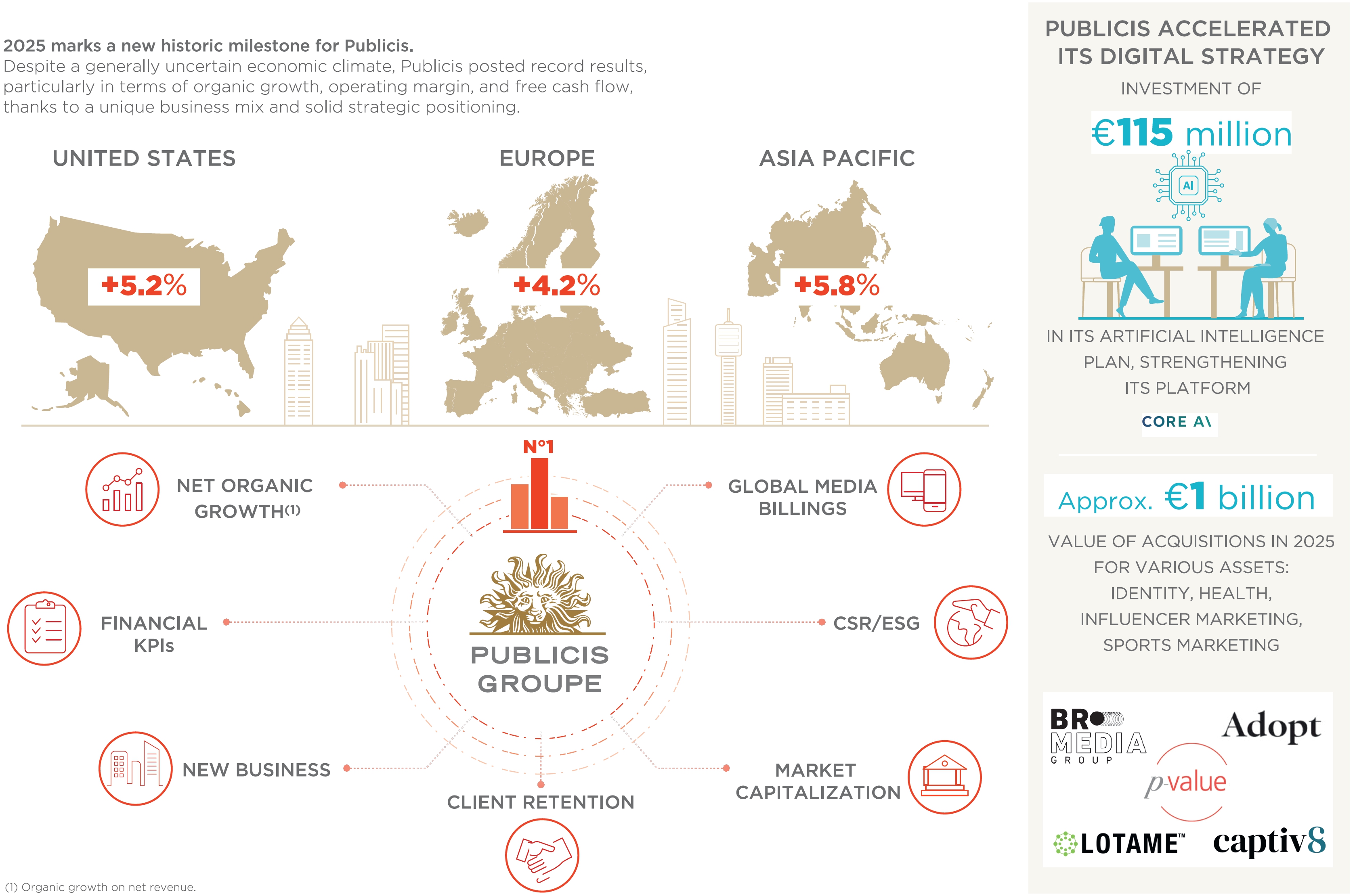
In an environment that remained challenging, we delivered net revenue organic growth of +5.6% in 2025, 700 basis points ahead of our holding company peers, and an acceleration compared with the average net revenue growth since 2020. This outperformance was made possible in large part by our data-driven Connected Media activities, and to our continued ability to win market share. Our creative agencies regrouped within Intelligent Creativity have shown resilience in the face of budget cuts across the traditional advertising sector. Publicis Sapient continued to face a wait-and-see attitude from some clients regarding their digital transformation projects, a situation affecting all major players in the IT consulting space in general.
A DEFINING FEATURE OF 2025 WAS OUR INCREASED INVESTMENT IN ARTIFICIAL INTELLIGENCE AND TALENT, WHILE FURTHER IMPROVING OUR MARGIN AND FREE CASH FLOW TO RECORD LEVELS.
A defining feature of 2025 was our Increased investment in artificial intelligence and talent, while we further improved our margin to 18.2% and boosted our free cash flow to over 2 billion euros—financial metrics that were already the highest in the industry. We also confirmed our commercial momentum, ranking once again at the top of the new business rankings.
These very solid results will allow us to propose to our shareholders at the General Shareholders’ Meeting of May 27, 2026, an all-cash dividend of euro 3.75 per share—an increase of 4.2%—and a payout ratio of 50.1%, the highest in our industry.
Now, as we look to 2026 and beyond, mention of course needs to be made of the global situation as it stands at the start of this year. In an environment that is more volatile than ever with ongoing conflict in Eastern Europe and the Middle East, rising energy prices, and the prospect of further tariffs we will remain closer than ever, at our clients’ side, to support them through these uncertain times.
In this context, we have a simple ambition: to be the industry’s MVP—Most Valuable Partner. The MVP for our customers, by designing agentic solutions that generate tangible business results, at a time when 95% of artificial intelligence projects fail to deliver real value. The MVP for our employees, by continuing to see them as a key differentiator and providing them with the tools and training they need to thrive in this AI world. And, the MVP for our shareholders, by focusing on delivering transformative growth versus the consolidation of traditional assets.
OUR AMBITION: TO ESTABLISH OURSELVES AS THE INDUSTRY’S MOST VALUABLE PARTNER, FOR OUR CLIENTS, EMPLOYEES AND SHAREHOLDERS.
All of this gives us confidence in our ability to outperform the sector in terms of organic growth for the seventh consecutive year in 2026, while improving our margins, earnings per share and free cash flow.
I would like to thank the Board for its unwavering support and especially Élisabeth Badinter, Vice-Chair of the Board, and Maurice Lévy, Emeritus Chairman, whose pioneering visions and investments have enabled the Groupe to advantageously position itself to confront a future dominated by artificial intelligence, as it enters its second century. Throughout 2025 more than ever, his experience and knowledge of the sector were valuable assets.
-
GLOSSARY
Advanced TV: Advertising medium in which ads are shown in programs and films broadcast via over-the-top (OTT) services on connected TVs (with a built-in Internet connection) or streaming devices.
Digital Business Transformation (DBT): Consulting services in the transformation of our clients’ business models and their adaptation to the digital world.
Direct-to-consumer brands: Brands selling directly to consumers over the Internet without going through physical distributors.
Dynamic creativity: Personalized creative content adapted to the consumer according to their characteristics (location, interests, stage in their consumer journey, etc.).
Epsilon CORE ID: The market-leading privacy-safe person-based identifier, designed to help brands accurately recognize and reach consumers across the open web.
Epsilon PeopleCloud: Platform powered by Epsilon’s CORE ID to enable personalized consumer journeys at scale. The platform allows brands to manage and grow their client data, engage with consumers across channels and measure marketing spend to optimize best outcomes.
Global Delivery Centers: Hubs bringing together Publicis Groupe employees available to support the country model, particularly in media, production, data and digital transformation expertise.
Groupe Client Leaders (GCL): The Groupe Client Leader is responsible for all services and skills made available to the client, regardless of the discipline. GCLs have a geographical scope that can be global, regional or country-based.
Industry verticals: Organization of certain Groupe activities according to the clients’ business sector.
JANUS: the body of rules of conduct and ethics that applies to all Groupe employees and establishes the rules of business conduct: “The Publicis way to behave and operate”.
Platform: Service acting as an intermediary to access information, content, services or goods, most often published or provided by third parties. It organizes and prioritizes content and generally responds to its own ecosystem approach.
Publicis Communications: Until the end of 2019, Publicis Communications brought together the Groupe’s global creative offering, including Publicis Worldwide, Leo Burnett, Saatchi & Saatchi, BBH, as well as Prodigious, a world leader in production, Marcel, Fallon and MSL, a specialist in strategic communication. As of early 2020, this structure no longer exists at the global level as the Groupe has moved to a country organization. It continues to exist in the United States, reflecting the organization’s adaptation to the size of the country. Publicis Communications US has also included Razorfish, a digital marketing activity, since 2020.
Publicis Media: Until the end of 2019, Publicis Media brought together all of the Groupe’s media expertise, specifically the investment, strategy, analysis, data, technology, marketing performance and content of Starcom, Zenith, Spark Foundry, Blue 449, Performics and Digitas. As of early 2020, this structure no longer exists at the global level as the Groupe has moved to a country organization. It continues to exist in the United States, reflecting the organization’s adaptation to the size of the country.
Publicis Sapient: Publicis Sapient partners with clients in the field of digital business transformation, based on technology, data, digital and consumer experience.
Re:Sources: Re:Sources includes the Shared Service Centers, which cover most of the required administrative functions for the Groupe’s agencies.
Retail media: Purchase and sale of advertising on retailers’ websites and apps, most commonly in sponsored product ad format and based on retailer transactional data.
The Power of One: A unique offering made available to clients by simply, flexibly and efficiently providing all of Publicis Groupe’s expertise (creative, media, digital, tech, data and health).
Viva Technology: Event co-organized by the Groupe, Les Echos and Publicis Groupe. This is the first international meeting dedicated to innovation, the growth of start-ups and collaboration between large groups and start-ups in France.
Walled garden: Expression generally used to designate the advertising ecosystems of a few digital giants in which advertisers have only limited access to data and information.
CapEx: Net acquisitions of tangible and intangible assets, excluding financial investments and other financial assets.
CCPA: The California Consumer Privacy Act (CCPA) is a law of the State of California (USA) relating to the protection and processing of personal data of California residents. The CCPA came into force on January 1, 2020.
EPS (Earnings per share): Net income attributable to the Groupe divided by average number of shares, not diluted.
Free cash flow: Net cash flow from operating activities after financial income received, financial interest disbursed and repayment of lease commitments and related interest.
Free cash flow before changes in WCR: Net cash flow from operating activities after financial income received and financial interest disbursed, before repayment of lease commitments and related interest, and before change in working capital related to operating activities.
GDPR: The General Data Protection Regulation (GDPR) refers to Regulation (EU) 2016/679 of the European Parliament and of the Council of April 27, 2016 on the protection of natural persons with regard to the processing of personal data and on the free movement of such data.
GSM, OGM, CGSM: General Shareholders’ Meeting, Ordinary General Shareholders’ Meeting, Combined General Shareholders’ Meeting.
Headline EPS, diluted (Headline earnings per share, diluted): Headline Groupe net income, divided by average number of shares, diluted.
Headline net income, Groupe share: Net income attributable to the Groupe, after elimination of impairment charges/real estate transformation expenses, amortization of intangibles arising on acquisitions, the main capital gains (or losses) on disposals, change in the fair value of financial assets and the revaluation of earn-outs.
Net debt (or net financial debt): Sum of long- and short-term financial debt and associated hedging derivatives, less cash and cash equivalents.
Net revenue: Revenue less pass-through costs. Those costs are mainly production & media costs and out-of-pocket expenses. As these items that can be passed on to clients are not included in the scope of analysis of transactions, the net revenue indicator is the most appropriate for measuring the Groupe’s operational performance.
Operating margin: Revenue after personnel costs, other operating expenses (excl. non-current income and expenses) and depreciation (excl. amortization of intangibles arising on acquisitions).
Organic growth: Change in net revenue excluding the impact of acquisitions, disposals and currencies.
-
1.1 GROUPE HISTORY
In 1926, Marcel Bleustein-Blanchet created an advertising agency called Publicis: “Publi,” for “Publicité,” which means “advertising” in French, and “six” for 1926. The founder’s ambition was to transform advertising into a true profession with social value, applying rigorous methodology and ethics, and to make Publicis a “pioneer of modern advertising.” The Company quickly won widespread recognition. In the early 1930s, Marcel Bleustein-Blanchet was the first to recognize the power of radio broadcasting, a new form of media at the time, to establish brands. Publicis became the exclusive representative for the sale of advertising time on the government-owned public broadcasting system in France. But in 1934, the French government abolished advertising on State radio; Marcel Bleustein-Blanchet then decided to launch his own station, “Radio Cité”, the first private French radio station. In 1935, he joined forces with Havas to form a company named “Cinéma et Publicité,” which was the first French company specialized in the sale of advertising time in movie theaters. Three years later, he launched “Régie Presse,” an independent subsidiary dedicated to the sale of advertising space in newspapers and magazines.
After suspending operations during the Second World War, Marcel Bleustein-Blanchet reopened Publicis in early 1946, and not only renewed his relationships with pre-war clients but went on to win major new accounts: Colgate-Palmolive, Shell and Sopad-Nestlé. Recognizing the value of qualitative research, in 1948, he made Publicis the first French advertising agency to conclude an agreement with the survey specialist IFOP. Later, he created an in-house market research unit. At the end of 1957, Publicis relocated its offices to the former Hôtel Astoria at the top of the Champs-Élysées. In 1958, Publicis opened the first drugstore, which has since become a Paris landmark.
From 1960 to 1975, Publicis grew rapidly, benefiting in particular from the beginnings of advertising on French television in 1968. The Boursin campaign inaugurated this new media: this was the first television-based market launch in France, and the slogan soon became familiar to everyone in the country: “Du pain, du vin, du Boursin” (“Bread, wine and Boursin”). Several months later, Publicis innovated again by siding with one of its clients in a new kind of battle: the defense of Saint-Gobain, for which BSN had launched the first-ever hostile takeover bid in France.
On September 27, 1972, Publicis’ head offices were entirely destroyed by fire. A new building was built on the same site and the Publicis set about pursuing a strategy of expansion through acquisitions in Europe, taking over the Intermarco network in the Netherlands, followed by the Farner network in Switzerland; this resulted in the creation of the Intermarco-Farner network to support the expansion of major French advertisers in other parts of Europe.
In 1977, Maurice Lévy was appointed Chief Executive Officer of Publicis Conseil, the Groupe’s main French business, after joining Publicis in 1971.
In 1978, Publicis set up operations in the United Kingdom after acquiring the McCormick advertising agency. In 1984, Publicis had operations in 23 countries across Europe. In 1981, Publicis opened a very small agency in New York.
In 1987, Marcel Bleustein-Blanchet decided to reorganize Publicis as a company with Supervisory and Management Boards. He became Chairman of the Supervisory Board, and Maurice Lévy was appointed Chairman of the Management Board.
In 1988, Publicis concluded a global alliance with the American firm Foote, Cone & Belding Communications (FCB) and the two European networks of the two partners merged. Publicis thus expanded its global presence with the help of its ally’s network.
Growth accelerated in the 1990s. France’s number four communications network, FCA!, was acquired by Publicis in 1993, followed by the merger of FCA! with BMZ to form a second European network under the name FCA!/BMZ. In 1995, Publicis terminated its alliance with FCB.
On April 11, 1996, Publicis’ founder died. His daughter, Élisabeth Badinter, replaced him as Chairman of the Supervisory Board. Maurice Lévy stepped up the Company’s drive to build an international network and offer clients a presence in markets around the world. The drive to acquire intensified and became global: first Latin America and Canada, then Asia and the Pacific, India, the Middle East and Africa. The United States was the scene of large-scale projects from 1998 onwards, as Publicis looked to significantly expand its presence in the world’s largest market. Publicis acquired Hal Riney, then Evans Group, Frankel & Co. (relationship marketing), Fallon McElligott (advertising and new media), DeWitt Media (media buying).
In 2000, Publicis acquired Saatchi & Saatchi, a business with a global reputation for talent and creativity. This acquisition was a milestone in the development of the Groupe in Europe and the United States.
In 2001, Publicis Groupe formed ZenithOptimedia, a major international player in media buying and planning, by merging its Optimedia subsidiary with Zenith Media, which had previously been owned 50/50 by Saatchi & Saatchi and the Cordiant Group.
In 2002, Publicis announced its acquisition of the US group Bcom3, which controlled the Leo Burnett, D’Arcy Masius Benton & Bowles agencies and Starcom MediaVest Group, and held a 49% interest in Bartle Bogle Hegarty. At the same time, the Groupe established a strategic partnership with Dentsu, the undisputed leading communications group in Japan and a founding shareholder of Bcom3. The acquisition established Publicis in the top tier of the advertising and communications industry, making it the fourth largest advertising group worldwide, with operations in more than 100 countries and five continents.
From 2002 to 2006, Publicis Groupe successfully integrated Bcom3, following Saatchi & Saatchi, and brought together a large number of entities. At the same time, it made a number of complementary acquisitions to create a coherent range of services, particularly offering different types of marketing services and access to the principal emerging markets.
The period between 2006-2013 marked the transformation of Publicis for the digital world. This was reflected by a profound change in its structure and operating methods to better adapt to the new demands of this new era. The Groupe added digital services to its well-known holistic offer while strengthening its position in fast-growing economies, both of which would be major strategic bets in the years to come. Amid fast growth in the digital arena, the most visible sign of the Groupe’s transformation was undoubtedly the launch of VivaKi, a new initiative aimed at optimizing the performance of advertiser investments. In 2007, Publicis completed the acquisition of Digitas, the US leader and the world’s largest interactive and digital communications agency. The acquisition of Razorfish – the number two interactive agency in the world after Digitas – from Microsoft in 2009, brought new strengths to the Groupe’s digital activities, notably in e-commerce, interactive marketing, search engines, strategy and planning, social network marketing and the resolution of technological architecture and integration issues.
In 2009, Publicis Groupe became the world’s third-largest communications firm, overtaking Interpublic Group.
During 2012 and 2013, the Groupe made a number of targeted acquisitions worldwide, particularly in the digital sector, in France, Germany, the United Kingdom, Sweden, the United States, Russia, Brazil, China, Singapore, India, Israel and, for the first time, in Palestine.
On July 27, 2013, Publicis Groupe and Omnicom Group signed an agreement for a merger of equals. In May 2014, Publicis Groupe chose not to pursue the proposed merger.
The most important transaction of 2014 was the acquisition of Sapient. In a world of growing convergence, the combination of Sapient with the Groupe’s know-how created an unparalleled expertise in marketing and commerce across all distribution channels and consulting services based on outstanding technological prowess.
Publicis Sapient became part of the new Group organizational structure announced in 2015, whose implementation was completed at the end of the first half of 2016. This structure abandoned the holding company model in order to develop an operational architecture based on the Connecting Company concept. This model is a one-of-a-kind platform that offers clients plug-and-play access to top-tier services:
- ▪ a client-first approach – clients are at the heart of the Groupe’s operations;
- ▪ a fluid model – just one person – the Group Client Leader – acts as the sole point of contact and account manager, able to draw on the Groupe’s entire talent pool, breaking down silos;
- ▪ a harmonized working method – income statements are consolidated and all operational barriers are removed;
- ▪ modular organization – the ability to adapt to individual client requirements and situations, with an open architecture that offers plug-and-play access to global partners where required;
- ▪ a comprehensive offering – by bringing together creative, intelligence and technological expertise, the Groupe provides its clients with transformation ideas that are unprecedented in the sector.
Thus, Publicis connects all its expertise in an integrated way thanks to the “Power of One” to provide winning solutions to its clients.
In 2016, on its 90th anniversary, the Groupe launched a project named Publicis90. This idea was to provide 90 projects or start-ups with financial aid and the support of the Groupe’s digital experts. These projects were selected from 3,500 applications submitted from 130 countries.
At the beginning of 2017, the Publicis Groupe Supervisory Board appointed Arthur Sadoun as Maurice Lévy’s successor as Chairman of the Management Board. Maurice Lévy became Chairman of the Supervisory Board.
After breaking the silos and organizing itself into Solutions, the Groupe went a step further in 2017 by implementing a country-based organizational structure, aiming to provide clients with a fully integrated offer, from advertising to marketing, consulting, and media, with data at its core. The deployment of this organization began in France, the United Kingdom, China and Italy.
Publicis looked to equip itself with a system that would serve its talent. The Marcel artificial intelligence platform, developed in partnership with Microsoft, and named in tribute to the Groupe’s founder, was launched in 2018. The aim of Marcel is to facilitate the transformation from a holding company to a platform so that all Groupe employees worldwide can discuss and collaborate without barriers or borders.
With the acquisition of Epsilon, 2019 was a pivotal year. Epsilon has the technology and platforms to structure client first-party data, round it out with an incomparably diverse range of data sources and put together personalized campaigns at scale. The Groupe’s activities were resolutely positioned to the future, with more than 30% of net revenue generated by data and digital business transformation.
At the same time, the Power of One strategy was now fully in place, and the Groupe had thus completed its transformation in terms of assets and structure. The Groupe was in a unique position to serve clients across the entire value chain. It is the only one to have large-scale assets in creativity, media, data and technology.
2020 will remain marked by the global Covid-19 pandemic, which resulted in one of the largest economic crises in recent history. In such a context, the Groupe succeeded in delivering solid results thanks to the transformation undertaken several years earlier. Its Marcel platform brought teams together and proved to be a valuable tool during such a period. It helped the Groupe to adapt to meet the requirements of new working methods and enable better sharing, even remotely.
In 2021, global advertising spending rebounded strongly, boosted by overall economic growth and multiple stimuli from central banks and governments. It was also marked by the continuation of structural changes in the industry, in first-party data management, new digital media, the evolution of commerce and digital business transformation. In this environment, the Groupe achieved record results with all indicators exceeding their 2019 levels. Furthermore, the Groupe acquired CitrusAd, a technology platform that optimizes the marketing performance of brands directly on e-commerce sites.
The Groupe emerged from the pandemic both stronger and even more committed to ESG, as evidenced by its progress in ESG performance, reflected in its top ranking in the sector in the ratings of 8 out of the 10 leading rating agencies.
In 2022, the Groupe’s revenue exceeded euro 14 billion for the first time and net revenue euro 12 billion, driven in particular by double-digit organic growth for the second consecutive year. The Groupe made several acquisitions in the fields of data (Retargetly), commerce (Profitero) and digital transformation (Tremend). In addition, the Groupe announced the creation of Unlimitail, a joint venture with Carrefour, to respond to the booming retail media market in Continental Europe and Latin America.
On the ESG front, the Groupe laid the foundations for a major initiative, #WorkingWithCancer, aimed at eradicating the stigma of cancer in the workplace by supporting affected employees or those whose relatives are affected by the disease. Many companies have joined the project since the beginning of 2023.
With revenue of nearly euro 15 billion in 2023, Publicis reinforced its position as the second-largest player in the industry, ahead of Omnicom, and the largest in terms of market capitalization. During the year, the Groupe made several acquisitions: Yieldify in the field of technological marketing; Practia, a leader in digital transformation in Latin America; and Corra, a leader in e-commerce recognized by Adobe as the one of the best e-commerce companies in North America.
2024 will remain a historic year for Publicis Groupe. With net revenue of nearly euro 14 billion, the Groupe became the world’s leading advertising group, ahead of WPP. This performance is the result of efforts made over many years, generating market share gains, the contribution of numerous investments in data and technology, and the benefit of its platform organization, putting clients at the heart of its operations. In 2024, the Groupe implemented a new organization based on three pillars: Connected Media, bringing together data, media, CRM, social and commerce activities; Intelligent Creativity, including creative, production and public relations; and Technology with Publicis Sapient. In addition, Publicis Groupe completed two significant acquisitions: Influential in influencing marketing and Mars United in commerce.
2024 was an exceptional year in the field of artificial intelligence, marked by technological advances and a proliferation of large language models (LLMs). While supporting its clients in their transformation towards AI, Publicis is also accelerating the deployment of this technology within its own organization by bringing together all of its own data under a single entity: CoreAI. This platform, developed in-house by Publicis Sapient, unifies all the Groupe’s activities, enabling its talent to take full advantage of AI and drive growth for clients.
2024 was also the year in which the Groupe’s governance structure changed, with the transition from a Supervisory Board and Management Board to a Board of Directors, and the appointment of Arthur Sadoun as Chairman and Chief Executive Officer
Thanks to its AI-led growth model, Publicis maintained its leading position in all its key indicators in 2025: organic growth in net revenue, operating margin, free cash flow, new business, client retention, global media billings, ESG and market capitalization. Notably, 2025 marked the sixth consecutive year that the Groupe has outperformed the sector in terms of organic growth. Throughout the year, Publicis continued to target acquisitions to strengthen its capabilities in areas such as identity resolution (Lotame), influencer marketing (Captiv8, BR Media and HEPMIL), healthcare (p-Value) and sports marketing (Adopt). Publicis is thus entering its second century stronger than ever.
-
1.3 ACTIVITIES AND STRATEGY
1.3.1 Introduction
Publicis is a world leader in marketing, communications and digital business transformation, established in 1926 when Marcel Bleustein-Blanchet created what was essentially a start-up.
The passion that Marcel felt for communications and the creation of strong relations between brand names and consumers transformed this new business into a prosperous and respected profession. The Groupe has never stood still, continuing to grow, innovate and transform for nearly 100 years. The core values dear to its founder’s heart have continued to define everything we do: respect, honest products, client satisfaction, quality and creativity, together with a pioneering spirit, unwavering conviction and the ethical values inherited from his legendary fighting spirit.
-
1.4 INVESTMENTS
Our investments focus on digital expertise, data and technology to strengthen our teams, boost innovation and offer new services. By reinforcing our agencies, and developing strategic partnerships or initiatives with major Internet players, Publicis Groupe can anticipate changes and developments in the communications industry as it shifts towards digital technologies. Our aim is to offer the most innovative solutions to clients, in line with rapidly changing consumer behavior and technology.
1.4.1 Main investments and divestments during the past three years
In 2023, Publicis announced the acquisition of Practia, one of the leaders in digital transformation services in Latin America, based in Argentina. With its 1,200 experienced professionals, Practica will help position Publicis Sapient to penetrate the Latin American market while establishing a foundation for a nearshore delivery platform to better service clients based in North America. Also, in digital transformation, the Groupe acquired Corra, based in New York, a leader in e-commerce that will augment Publicis Sapient’s existing expertise in commerce solutions, including Adobe Commerce, while extending Publicis Sapient’s offerings in digital and omnichannel commerce.
In order to address the booming demand for retail media in Continental Europe, Brazil and Argentina, Publicis and Carrefour announced the launch of their joint venture Unlimitail, based on the most advanced technologies from “CitrusAd powered by Epsilon” and the deepest retail expertise in the mass market retail sector from Carrefour.
Finally, with Publicis Sapient AI Labs and PS Hummingbird, the Groupe has invested in specialized AI joint ventures to strengthen this expertise at Publicis Sapient.
With Influential, Publicis Groupe invested in the world’s preeminent influencer marketing company and platform. Influential’s proprietary AI-powered technology platform with over 100 billion data points, coupled with its network of over 3.5 million creators, including access to and data on 90% of global influencers with more than 1 million followers, currently serves more than 300 brands around the world. By combining these capabilities with the unique data and identity assets of Epsilon, Publicis Groupe is putting the leadership of ID-driven influencer marketing in the hands of all of its clients through a premium creator network, revolutionized influencer planning and maximized cross-channel outcomes.
The Groupe significantly strengthened its commerce offer through the acquisition of Mars United Commerce, the largest independent commerce marketing company in the world. With over 1,000 employees based in 14 hubs worldwide, Mars leverages its proprietary suite of commerce solutions to drive growth for more than 100 of the world’s top brands. The combined forces of Publicis Groupe and Mars has created the industry-leading connected commerce solution, allowing clients to influence the complete commerce journey for billions of global shoppers through an offering that begins with the industry’s deepest and richest database of consumer behavior and ends at the digital and physical shelves of the world’s leading online and offline retailers.
The Groupe also acquired AKA Asia, one of Singapore’s leading integrated communications agencies. The acquisition expands and diversifies Publicis Groupe’s capabilities in the market while bolstering the Groupe’s strategic communications, PR and influence offering. AKA joins the Groupe’s regional Influence division.
In France, Publicis Groupe acquired Downtown Paris, a creative and production house specializing in the world of luxury goods and beauty, intended to strengthen the production activity of Publicis France and to work with the Groupe’s various luxury goods entities.
With the acquisition of Spinnaker SCA, the Groupe strengthened Publicis Sapient’s supply chain capabilities and skills, while the acquisition of Wibilong, a SaaS platform for creating customer communities, completes the Epsilon France offer.
In 2025, the Groupe acquired Lotame, an independent leader in data and identification solutions. The combined data and identity assets of Lotame and Publicis Groupe’s 2.3 billion global profiles enable clients to reach 91% of adult internet users securely and transparently.
The acquisition of Moov AI, a Canadian leader in AI and data solutions, allows the Groupe to strengthen its AI offering for the Groupe’s customers in the North American market.
The Groupe also strengthened its global influence offering with the acquisitions of Captiv8, the world’s largest platform dedicated to influencer marketing (with a network of 15 million content creators worldwide, bringing together 95% of influencers with more than 5,000 followers), BR Media Group, the leader in influencer marketing and content in Latin America, and HEPMIL Media Group, the leading influencer agency in Southeast Asia.
In sports, the Groupe completed the acquisition of Adopt, a global agency specializing in sports and culture, to strengthen its ability to use athletes to create authentic cultural connections with brands.
Publicis Health acquired p-Value Group, a leading player in medical communication, providing a complete range of services to life sciences companies.
-
1.5 MAJOR CONTRACTS
-
1.6 RESEARCH AND DEVELOPMENT
The Groupe does not believe that it is dependent on any specific patent or license to operate its businesses.
R&D within Publicis Groupe has always taken an applied form, as it is directly linked to the search for concrete technological solutions designed to help our clients, to developing and improving the performance of our products, technological platforms or internal tools, and to taking advantage of the latest technological advances to offer new options to our clients. Several PhD students work within the Groupe, most of them at Publicis Sapient and Epsilon.
Epsilon’s R&D efforts are underpinned by a culture and investments that promote continuous innovation, grounded in academic discipline, in order to accelerate the deployment of solutions for clients. Its 3,000 engineers are active in designing new solutions, testing them, improving them and deploying them for more than 700 clients. Data scientists work to optimize and refine the performance of algorithms, with the goal of achieving the highest possible accuracy and efficiency.
Every year, Epsilon organizes an internal hackathon and tech conference designed to rally all of its engineers over a short period to work on prototypes of new AI features that will be integrated into the PeopleCloud platform. Finally, looking to the future and knowledge sharing, a specific program hosts 15 PhD students for one year, who are monitored and mentored by the Decision Science teams.
Publicis Sapient has developed three major AI products: Slingshot, Bodhi, and Sustain, which are constantly being improved and are helping clients achieve exceptional results. The seven “Labs” in North America, Europe, India and Latin America are centers of technical expertise to respond in real time to clients’ technological issues. Publicis Sapient also organizes several Hackathons throughout the year to promote innovation – some tailored to specific clients, some focused on improving the delivery of client solutions, and others aimed at enhancing internal work processes. These key moments also help build internal capacity and a collaborative culture, while helping junior practitioners develop new skills.
To stay ahead of technological developments, several strategic partnerships have been established with key technology providers, enabling us to certify numerous teams and collaborate on a number of pilot projects.
Lastly, the Groupe’s Media activities invest significant resources in mathematical and statistical processing in order to best advise their clients in their media choices (particularly in terms of modelling the marketing mix or calculating the effectiveness of media actions), and many doctoral students are also part of these teams.
-
2.1 MAIN RISK FACTORS
The risk factors described below, together with the other information concerning Publicis Groupe and its consolidated financial statements included in this Universal Registration Document should be carefully considered before making an investment in the shares or other securities of Publicis Groupe. This section covers the main risks to which Publicis Groupe feels exposed to, as of the date of this Universal Registration Document. Each one of the risk factors may have a negative impact on the Groupe’s earnings and financial position as well as on its share price or financial instruments. Other risks and uncertainties of which Publicis is unaware of or which are not currently considered to be significant could also have a negative impact on the Groupe.
Description of the main risk factors
In accordance with the provisions of article 16 of Regulation (EU) 2017/1129, in each of the risk categories mentioned below, major risks are presented in descending order of significance according to the Groupe’s assessment at the date of this document. The risk factors considered the most significant are presented first, following an assessment of their potential impact and likelihood after taking into account the mitigating measures implemented. The significance of the risks, as assessed by Publicis Groupe, may be amended at any time in light of changes in the Groupe’s activities and circumstances.
At the filing date of this Universal Registration Document, the geopolitical environment is marked by multiple conflicts in the Middle East and between Russia and Ukraine. However, the Groupe’s direct exposure to these conflict countries remains moderate.
The multiplication of conflicts, geopolitical tensions and economic retaliatory measures is contributing to an uncertain macroeconomic environment, which may affect some of our clients and, indirectly, the investments they allocate to communications and the transformation of their activities.
As of the filing date of this Universal Registration Document, the Groupe, like all economic operators, is not in a position to assess the impact of these geopolitical and economic developments on its activities.
Furthermore, the rapid development of artificial intelligence is generating increasing questions from investors regarding its effects on the advertising and communication services sector.
-
2.2 INTERNAL CONTROL AND RISK MANAGEMENT PROCEDURES
2.2.1 Objectives and organization(1)
The internal control and risk management framework is fully integrated into the Groupe’s operational, financial and non-financial management. Its remit extends across all the Groupe’s activities and structures. The internal control and risk management policy defined by the Executive Management, is regularly monitored by the Audit and Financial Risks Committee together with the Strategic, Environmental and Social Committee, and relayed to all levels of the Groupe. This policy aims to provide reasonable assurance on the achievement of the Groupe’s objectives in terms of:
- ▪ reliability of financial and non-financial information;
- ▪ compliance with applicable laws and regulations;
- ▪ management of strategic, operational, financial and non-financial risks;
- ▪ effectiveness and efficiency of operations, consistent with management directives established by Executive Management;
The objectives of this framework, as approved by the Executive Management and presented to both the Audit and Financial Risks Committee and the Strategic, Environmental and Social Committee, are to enable:
- ▪ continuous monitoring aimed at identifying risks and opportunities having a potential impact on the achievement of the Groupe’s strategic, operational, financial and non-financial objectives;
- ▪ appropriate communication about risks contributing to the decision-making process;
- ▪ regular monitoring of the internal control and risk management framework effectiveness.
The Groupe has a Secretary General function, which allows organized and centralized monitoring of several of the activities that constitute the internal control framework. The Secretary General is a member of the Groupe’s Management Committee. This function includes the Legal Department (managed by the Groupe General Counsel), the Compliance Department (managed by the Groupe Chief Compliance Officer), the Internal Audit, Internal Control and Risk Management Department (managed by the Groupe Internal Audit, Investigation & Risk Management Officer), the Human Resources Department (compensation and employee benefits, human resources information system management, employee-related matters and mobility) and the Insurance Department. The Chairman and Chief Executive Officer and the Secretary General participate in all meetings of the Strategic, Environmental and Social Committee. The Secretary General and the Groupe Internal Audit, Investigation and Risk Management Officer attend all Audit and Financial Risks Committee meetings and have easy access to its Chair and each of its members. Similarly, the Audit and Financial Risks Committee has direct access to the Internal Audit, Internal Control and Risk Management Department.
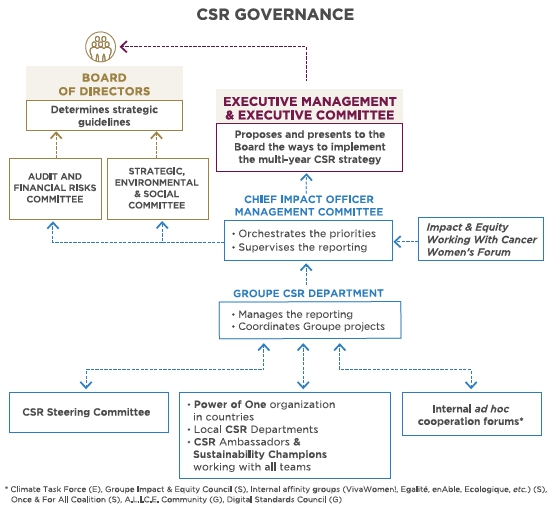
Since May 2024, the Chief Impact Officer has been overseeing Corporate Social Responsibility (CSR), including the CSR strategy, sustainability reporting, and key initiatives of the Groupe. The CSR Department is responsible for non-financial reporting and collaborates closely with other departments within the Groupe, particularly through the CSR Steering Committee. Additionally, the Chief Impact Officer regularly updates the Audit and Financial Risks Committee and the Strategic, Environmental, and Social Committee on regulatory changes in sustainability reporting, the status of ongoing projects, and the work being conducted with external sustainability auditors.
The expertise of the Secretary General and the CSR Department offers a comprehensive understanding of risks, which enhances the organization’s goal of improved risk management through the implementation of an internal control system across the organization.
Furthermore, the Board of Directors, via the Audit and Financial Risks Committee, reviews the effectiveness of the Groupe’s internal control and risk management framework and oversees the preparation of both financial and non-financial information.
The Groupe’s internal control and risk management system bases its structure on the 2013 COSO (Committee of Sponsoring Organizations of the Treadway Commission) guidelines, as well as the reference framework established by the AMF.
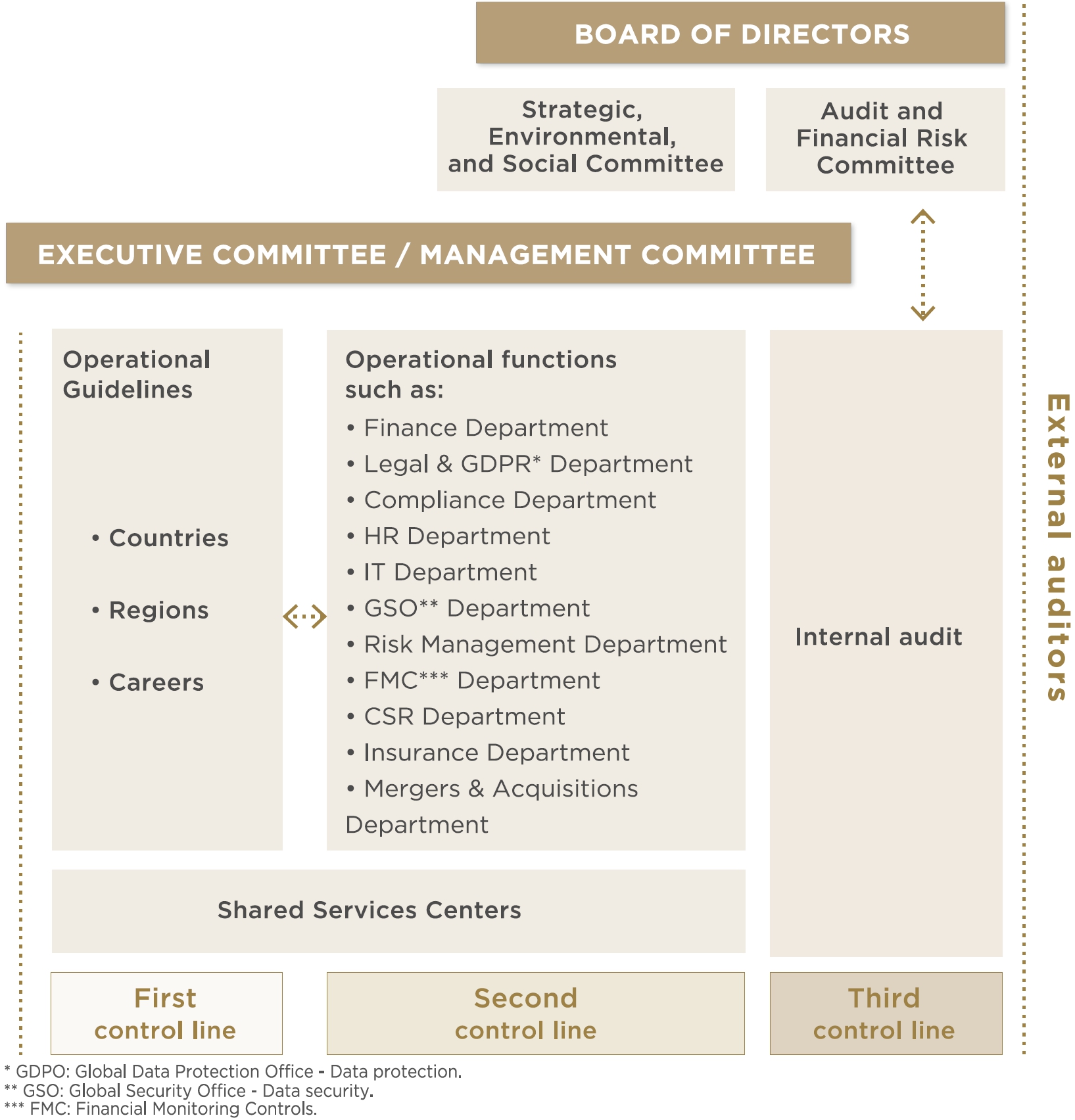
- ▪ first line: the first line consists of operational managers within the entities, business units, shared services, and various countries and regions. These managers are responsible for managing risks as part of their daily operations. They act in accordance with relevant laws and regulations, ensuring adherence to the rules and guidelines established in Janus;
- ▪ second line: the second line functions are performed by the head office departments, which establish the policies, standards and procedures. These functions define and deploy the risk management framework and ensure compliance with laws and regulations, design controls to ensure compliance with Janus, monitor the adequacy and effectiveness of the internal control system, and facilitate the prompt remediation of any identified weaknesses;
- ▪ third line: the third line is provided by the internal audit function, which provides independent assurance on the effectiveness of governance, risk management and internal control.
-
2.3 INSURANCE AND RISK COVERAGE
The insurance policy’s purpose, centrally managed within the Insurance Department, is to provide the appropriate coverage for the Groupe’s people and assets by achieving the right balance between local and corporate insurance coverage.
By implementing two-tier insurance coverage (local and centralized), the Groupe seeks to ensure complementarity of guarantees and thus better risk management across all the countries in which Publicis is present.
On a local level, mainly through the Re:Sources shared service centers, entities must purchase general liability, property damage and business interruption, automobile and employer’s liability insurance policies, as well as health and life insurance coverage for local employees. This insurance is taken out in compliance with the local regulations.
The only exception is the European zone: using the free provision of services framework in Europe, the Groupe has taken out a property damage and business interruption insurance policy and a general liability insurance policy which is available to all European subsidiaries.
At Groupe level, insurance programs have been implemented with leading insurance companies with the aim of automatically covering all subsidiaries against the financial consequences of risks such as, but not limited to:
- ▪ professional liability and cyber risks;
- ▪ director and officer liability;
- ▪ civil liability related to employment practices;
- ▪ general liability when terms and conditions or limits differ from the local insurance policies;
- ▪ property damage and business interruption when terms and conditions or limits differ from the local insurance policies;
- ▪ assistance and repatriation of employees during business travel.
In addition, the Groupe negotiates and sets up specific coverage that subsidiaries may subscribe to depending on their business needs, such as credit insurance, health and life insurance for expatriates and specific insurances for film and TV shoots.
The insurance policies are regularly reviewed to customize the coverage to any changes in our activity and, in particular, new digital services: the Groupe focuses particularly on this risk and its cyber-risk insurance coverage.
The amount of coverage is considered to be consistent with identified risk levels and with market practices.
In light of the Groupe’s significant mergers and acquisitions activity, the Insurance Department also oversees the integration of acquired entities within the Groupe’s program.
In June 2022, the Groupe set up Publicis Ré SA, a captive reinsurance company within the meaning of article L. 310-1-1 of the French Insurance Code. Publicis Ré is a wholly-owned French subsidiary dedicated to the reinsurance of the Groupe’s risks. It was approved on October 10, 2022, by the French Prudential Supervision and Resolution Authority (ACPR) to operate as a non-life reinsurer.
-
3. CORPORATE GOVERNANCE
The information contained in the following developments is that mentioned in articles L. 225-37-4 and L. 22-10-8 to L. 22-10-10 of the French Commercial Code. Other information in the report, notably that mentioned in article L. 22-10-11 of the French Commercial Code, is listed in Section 3.1.7 as well as Section 10.9 of the Universal Registration Document “Cross-reference table for the corporate governance report.”
This report also includes information required for the preparation of the sustainability report according to the European Sustainability Reporting Standards. It will be identified using footnotes and presented in the cross-reference table available in Section 4.8.
Publicis Groupe SA refers to the corporate governance code for listed companies established by the AFEP and Medef (hereinafter the “Afep-Medef Code”) as updated in December 2022. This Code can be consulted online on the AFEP website www.afep.com, the Medef website www.medef.com, and the French High Committee on Corporate Governance (Haut comité de gouvernement d’entreprise - HCGE) website www.hcge.fr.
-
3.1 GOVERNANCE OF PUBLICIS GROUPE(1)
Publicis Groupe SA is a French limited liability company (société anonyme) with a Board of Directors.
This mode of governance was broadly approved by the General Shareholders’ Meeting of May 29, 2024, replacing a structure with a Supervisory Board and Management Board.
This change is the result of a long and rigorous process initiated by Mr. Maurice Lévy, then Chairman of the Supervisory Board, in the interest of the company, all stakeholders, and in particular shareholders.
This change makes it possible to reconcile three major requirements: first, a controlled transition; then, continuity; and finally, effective and balanced governance.
In this context, Mr. Arthur Sadoun, former Chairman of the Management Board, was appointed as Chairman and Chief Executive Officer and Mr. Maurice Lévy, former Chairman of the Supervisory Board, was appointed as Emeritus Chairman, thus preserving the tandem formed by Mr. Arthur Sadoun and Mr. Maurice Lévy since 2017, key ingredients of the Groupe’s success.
This change was accompanied by appropriate measures to ensure balanced governance. This is ensured by the continuity of the position of Vice-Chair of Mrs. Élisabeth Badinter, by the strengthened organization of the Board Committees to enable them to monitor the Company’s risks and strategy more closely, and by the creation of a position of Lead Director, held by Mr. André Kudelski.
3.1.1 Governance structure(2)
Pursuant to French regulations and the Afep-Medef Code, the Board of Directors has the authority to choose between the two methods of exercising Executive Management, namely the separation or combination of the roles of Chairman of the Board of Directors and Chief Executive Officer of the Company.
On the recommendation of the Nominating Committee, the Board of Directors decided on May 29, 2024 to combine the roles of Chairman of the Board of Directors and Chief Executive Officer, and to appoint Mr. Arthur Sadoun as Chairman and Chief Executive Officer for the entire duration of his term of office as Director, i.e. until the end of the 2028 General Shareholders’ Meeting called to approve the financial statements for the financial year ended December 31, 2027.
Combining the functions of Chairman and Chief Executive Officer is the most appropriate organizational method for Publicis Groupe’s current situation, its agility, its business sector, its geographical locations and the challenges it faces. The Board considered that unifying the roles of Chairman and Chief Executive Officer would make it possible to further improve the effectiveness of the management team, thanks to a responsive and agile governance system in its decision-making under the impetus and control of the Board of Directors, while ensuring continuity in the governance of the Groupe, which has been at the heart of Publicis’ success since its creation.
This is all the more important as, in the Groupe’s sector more than in any other, talent is at the heart of success. A strong feature of this industry is that only a leader from the core business has the legitimacy and capability to assume the leadership position and succeed in it. In addition, the success of any company is based on a long-term strategy served by long-term management teams.
Publicis has only had three executives in its nearly 100 years of existence: the founder, Mr. Marcel Bleustein-Blanchet for 60 years, Mr. Maurice Lévy for 30 years and Mr. Arthur Sadoun since 2017. This continuity of leadership is a major asset that must be preserved so as not to destabilize the balance of teams and customer relations.
In accordance with the internal rules and regulations of the Board of Directors, the Nominating Committee may reassess the relevance of the choice of governance method, in particular when renewing the term of office of the Chairman and Chief Executive Officer. The Nominating Committee endeavors to formulate its proposals with a view to building a solid, sustainable and fluid governance for the Groupe, taking into consideration all measures to ensure the balance of powers within the Board of Directors.
Since May 29, 2024, Mr. Arthur Sadoun has been Chairman and Chief Executive Officer of Publicis Groupe SA (for more information on the profile of Mr. Arthur Sadoun, see Section 3.1.2.3).
Given the choice to unify the functions of Chairman of the Board of Directors and Chief Executive Officer, the Chairman and Chief Executive Officer performs the duties assigned to the Chairman of the Board and assumes the Executive Management of the Company. In this respect, the provisions of the Articles of Incorporation applicable to the Chairman of the Board are also applicable to the Chief Executive Officer.
The Chairman and Chief Executive Officer has all the powers conferred by the law, the Company’s Articles of Incorporation and the internal rules and regulations of the Board of Directors.
Extract from article 11 of the Articles of Incorporation:
The Chairman shall perform the duties and exercise the powers vested in him/her by law and by the Articles of Incorporation.
He/She chairs the meetings of the Board of Directors and organizes and directs its work and meetings, on which the Chairman reports to the General Shareholders’ Meeting. The Chairman shall ensure the smooth functioning of the Company’s governing bodies and, in particular, the ability of the Directors to perform their duties. The Chairman chairs the General Shareholders’ Meetings and prepares the reports required by law.
[…]
The age limit for holding the office of Chairman of the Board of Directors is seventy-five years.
In addition, as Director, the Chairman and Chief Executive Officer is fully subject to the rules intended to prevent the occurrence of conflicts of interest pursuant to the law as well as by the internal rules and regulations (the rules pursuant to the latter are described at Section 3.1.1.6).
Extract from article 16 of the Articles of Incorporation:
[…]
The age limit for appointment as Chief Executive Officer is seventy years.
[…]
The Chief Executive Officer is vested with the broadest powers to act on behalf of the Company in all circumstances. He/She shall exercise his/her powers within the scope of the Company’s corporate purpose and subject to the powers expressly conferred by law to the General Shareholders’ Meeting and the Board of Directors. He/She represents the Company in its relations with third parties. The Chief Executive Officer may grant, with or without the option of substitution, any delegations to any corporate officers that he/ she designates, subject to the limitations pursuant to the law.
[…]
When the Chairman of the Board of Directors assumes responsibility for the executive management of the Company, the provisions of the Articles of Incorporation and the law shall apply with respect to the Chief Executive Officer. He/She shall assume the title of Chairman and Chief Executive Officer and may remain in office until the Ordinary General Shareholders’ Meeting convened to approve the financial statements for the previous year and held in the year in which the Chief Executive Officer reaches the age of seventy.
In accordance with the Board’s decisions made at its meetings of May 27, 2025 and its internal rules, the Chairman and Chief Executive Officer must obtain the prior authorization of the Board of Directors to carry out the following transactions:
- ▪ any investment and divestment operation envisaged by the Groupe, in particular the acquisition and disposal of assets (including the acquisition and disposal of all or part of equity interests), the subscription to any securities issues, the conclusion of partnerships or the pooling of resources with a unit value in excess of euro 300 million (including earnout);
- ▪ any real estate acquisition or disposal transaction contemplated by the Company;
- ▪ any financing operation envisaged by the Groupe, regardless of the terms and conditions, involving a unit amount in excess of 5% of the Company’s shareholders’ equity;
- ▪ all mergers, demergers and asset contributions envisaged by the Groupe for net asset contribution values individually exceeding 5% of the Company’s shareholders’ equity, excluding any internal restructuring;
- ▪ all transactions and compromises relating to litigation involving unit amounts in excess of 5% of the Company’s shareholders’ equity;
- ▪ any significant transaction planned by the Groupe that falls outside the scope of the strategy announced by the Company or is likely to have a material impact on it.
In addition, the Chairman and Chief Executive Officer must obtain annual authorization from the Board of Directors, up to the limit set by the Board, to issue sureties, endorsements or guarantees given on behalf of the Company.
Since May 29, 2024, the Vice-Chair of the Board of Directors has been Mrs. Élisabeth Badinter, a long-standing and significant shareholder of Publicis Groupe SA (for more information on the profile of Mrs. Élisabeth Badinter, see Section 3.1.2.3).
In the absence of the Chairman of the Board of Directors, the Vice-Chair convenes the Board and chairs its discussions.
Mrs. Élisabeth Badinter helps ensure balanced governance within the Groupe. Through her long experience and her essential contribution to all the work of the Board, Mrs. Élisabeth Badinter always ensures that the Groupe’s fundamental values are respected in the interest of its leading stakeholders, including the employees and shareholders.
In connection with the appointment of Mr. Arthur Sadoun as Chairman and Chief Executive Officer, the Board of Directors created the position of Lead Director, a key role in balanced governance.
The Board of Directors of May 29, 2024, on the recommendation of the Nominating Committee, appointed Mr. André Kudelski as Lead Director. His personality and experience will enable him to effectively carry out this role. This appointment is subject to maintaining the status of Independent Director for the duration of his term of office, it being specified that the Nominating Committee may reassess his situation as necessary.
Mr. André Kudelski, previously member of the Supervisory Board, was appointed by the General Shareholders’ Meeting of May 29, 2024 as Director for a term of four years. As of December 31, 2025, he is member of the Audit and Financial Risks Committee, the Nominating Committee and the Compensation Committee (for more information on the profile of Mr. André Kudelski, see Section 3.1.2.3).
The Lead Director’s main missions are to contribute to the balance of governance, to improve the organization of dialogue with and within the Board of Directors (in particular through the organization of executive sessions) and to deal with potential conflicts of interest.
The Lead Director does not take part in deliberations or votes of the Board and its Committees that concern him.
- ▪ have access to all the documents and information he deems necessary to fulfil his missions;
- ▪ carry out or commission any external studies;
- ▪ meet the main operational managers of the Publicis Groupe;
- ▪ add items to the agenda of Board of Directors meetings;
- ▪ request the assistance of the Board Secretary.
The Lead Director meets regularly with the Chairman and Chief Executive Officer, the Vice-Chair of the Board of Directors and, if necessary, with the Emeritus Chairman.
Extract from article 3 II of the internal rules and regulations of the Board of Directors:
The main role of the Lead Director is to assist the Chairman in ensuring the proper functioning of the Company’s corporate governance bodies.
In this capacity, he/she may be consulted by the Chairman on proposed changes to the composition of the Company’s governance bodies, and on the selection process for independent Directors.
He/she is informed by the Chairman of questions raised by shareholders on social, environmental and governance issues, and ensures that they are answered.
He/she coordinates the work of the Independent Directors and acts as a liaison between them and Executive Management.
The Lead Director examines situations of conflict of interest and brings to the attention of the Board of Directors any conflicts of interest concerning Directors or the Chairman of the Board of Directors. The Lead Director may chair Executive Sessions.
The performance and compensation of the Chairman and the Executive Management are reviewed once a year at a Board of Directors’ meeting. The Lead Director chairs the discussions relating to the review of the performance and compensation of the Chairman and Executive Management at this meeting.
The Lead Director may supervise the Board of Directors’ evaluation process, as described in article 6 of these internal rules and regulations.
The Lead Director reports to the Board of Directors once a year on the performance of his/her duties.
Main work completed in 2025 Relations with Executive Management The Lead Director regularly discussed the organization of governance with Executive Management.
He organized and led a meeting with the heads of the various Corporate functions to discuss the current key topics.
Preparation of Board meetings The Lead Director was consulted in advance on the agendas of each Board of Directors’ meeting.
He attended all meetings of the Board and the Committees of which he is a member.
Assessment of the Board and Committees He supervised the assessment process of the Board and its Committees for financial year 2025. In this context, he reviewed the draft questionnaire to be submitted to the Directors. He conducted individual interviews with Directors who so wished. He reported on these items to the Board of Directors in early 2026 Prevention of conflicts of interest In 2025, the Lead Director did not have to deal with any conflicts of interest within the Board of Directors. Executive sessions He organized and led two meetings between Independent Directors. The main conclusions of these meeting were brought to the attention of the Board of Directors at its meeting of November 26, 2025. Governance The Lead Director was involved in the thinking and development of the succession plan for the Chairman and Chief Executive Officer and key executives. He actively contributes to this work in his role on the Nominating Committee. This involvement is also strengthened by exchanges held outside formal governance bodies, particularly during executive sessions. Discussions with shareholders He was informed of the conclusions of the meetings organized with certain institutional investors and contributed to the shareholder dialogue on governance-related topics. Pursuant to the option provided for by the Company’s Articles of Incorporation and its internal rules and regulations, the Board of Directors may appoint an Emeritus Chairman who is a natural person and former Chairman of the Board of Directors or of the Supervisory Board.
On May 29, 2024, the Board of Directors, on the advice of the Nominating Committee, decided to appoint Mr. Maurice Lévy, former Chairman of the Supervisory Board, as Emeritus Chairman for an indefinite period, enabling the Company to continue to benefit from his talent, energy and experience.
Mr. Maurice Lévy joined Publicis Groupe in 1971 as IT Director. In 1975, he was appointed Executive Vice-President of Publicis Conseil, the Groupe’s flagship, working his way up to his appointment as Chairman of the Management Board in 1987. He held this role for 30 years, until the General Shareholders’ Meeting of May 2017, when he was appointed as Chairman of the Supervisory Board of Publicis Groupe SA. He steered the accelerated globalization of the Groupe starting in 1996. In 2001, Publicis Groupe’s globalization picked up more steam with the acquisition of Saatchi & Saatchi, then Bcom3 (Leo Burnett, Starcom, MediaVest, etc.) in 2002. The move into the digital world began with the acquisition of Digitas (2006), followed by Razorfish (2009), and Rosetta (2011). The acquisition of Sapient in early 2015 opened new avenues for Publicis beyond its core business into marketing, omnichannel commerce and consulting.
Mr. Maurice Lévy co-founded the Institut français du cerveau et de la mœlle épinière (ICM) in 2005 and today chairs the Board of Directors of numerous organizations, including the Peres Center for Peace and Innovation, and, since October 2015, the Institut Pasteur-Weizmann. He has also received numerous distinctions for his work and his fight for tolerance. He is Grand Officier de la légion d’honneur and Grand officier de l’ordre national du mérite.
Pursuant to the internal rules and regulations of the Board of Directors, the Emeritus Chairman may attend the meetings of the Board of Directors in an advisory capacity only.
Mr. Maurice Lévy shares with the Board his experience, his expertise, his intimate knowledge of the Groupe and his privileged relationships with the Groupe’s key contacts in France and around the world.
In addition to his duties as Emeritus Chairman, Mr. Maurice Lévy chairs an innovation and prospective working group. This group, which is separate from the Board Committees, is composed of three Independent Directors, three members of the Executive Committee and the Secretary General of Publicis Groupe. This is an internal think tank on topics related to innovation and strategic options for the future. The Chairman and Chief Executive Officer is informed of its work, which continued in 2025. This specific mission, entrusted to Mr. Maurice Lévy, is part of the service agreement entered into with the Company, approved by the Board of Directors.
The Emeritus Chairman is not a corporate officer. However, he is subject to the same rules of confidentiality and ethics as those applicable to Directors, including the rules relating to the prevention of market abuse. As such, he is subject to compliance, with the obligations to abstain from trading in Publicis Groupe SA shares during “blackout periods.”
Similarly, in the event of a conflict of interest, even a potential one, in which the Emeritus Chairman may be directly or indirectly involved, the latter must also refrain from attending or participating in the discussions concerning the corresponding deliberation, or requesting any document or information in any form whatsoever relating to the subject in question.
The Groupe has a set of rules governing its behavior and ethics under the name “Janus”. It is applicable to all of the Groupe’s hierarchical levels and sets out the rules of conduct for operations: “The Publicis way to behave and to operate”. It is regularly updated, distributed across all internal networks and is available in seven languages.
Janus includes the rules and principles related to ethics, Corporate Social Responsibility, compliance with regulatory and legal frameworks, governance, communication, conducting business and client relations, human resources management, protecting the Groupe’s brand names, other intellectual property rights and financial and accounting management, as well as rules governing mergers and acquisitions, investments, restructuring and purchasing policies.
The guidelines include a Code of Conduct and Ethics applying to all Groupe employees with specific rules for the main executives. The values embodied by Publicis are clearly outlined there, starting with our commitment to our clients and respect for individuals and their diversity.
The aim of these rules of conduct is to provide the Groupe with strict rules and procedures for running our business worldwide in all fields: human resources management, ethics, financial management, individual responsibility. They are meant to prevent any illegal activity, in particular by ensuring that Groupe employees comply with laws and regulations which govern business conduct. The Groupe’s rules of conduct are also meant to prevent favoritism, misappropriation of funds, breach of trust, corruption, conflicts of interest or other misconduct and subject the Groupe and its employees to the highest standards in terms of integrity, ethics and compliance. They are designed to protect the Groupe’s data and know-how by establishing strict guidelines regarding confidentiality and good faith. They establish procedures for control and reporting by management of the Groupe and of the various networks of any breach of these policy rules. Certain policies have been made public.
Janus is regularly reviewed. In parallel with the work to update this code, a new presentation of the Groupe’s Code of Ethics and Conduct was circulated in December 2025. This document, intended to be shared internally and externally, brings together the principles and values that guide the Groupe, as set out in the Janus Code. This Code reaffirms Publicis’ commitment to its clients, partners and talents. Training courses are organized for all employees to encourage the adoption of these principles and to ensure the uniform application of the Groupe’s rules of ethics and conduct.
The Janus Code public policies are available on the Groupe’s website (www.publicisgroupe.com) in the “Corporate Social Responsibility” section, under “Library” then “Code of Conduct and Ethics”.
Janus provides detailed rules on stock market ethics in a specific chapter. The Groupe’s objective is to ensure compliance with the laws and regulations in force, as well as the recommendations issued by the AMF, in the area of risk management related to the holding, disclosure or possible use of insider information.
- ▪ define insider information and the related general rules of its use;
- ▪ determine the specific rules applicable to persons holding insider information;
- ▪ specify the administrative and/or criminal penalties applicable to a breach of the obligations related to holding insider information; and
- ▪ detail the preventive measures.
These rules apply to any employee, corporate officer or executive corporate officer of the Company who has insider information, as well as to persons closely related to them within the meaning of the MAR regulation, until the information is publicly disclosed.
In addition, the Groupe has drawn up a list of employees, corporate officers and executive corporate officers with access to sensitive and confidential information that, while not constituting inside information within the meaning of MAR regulation, could become so due to its particularly sensitive nature. The Company has set blackout periods during which these persons are prohibited from, on their own behalf or on behalf of the account of a third party, to execute, directly or indirectly, any transaction involving the Company’s securities, derivatives or other related financial instruments (unless authorized by the Company, pursuant to the regulations in force).
This specific chapter is regularly reviewed to adapt to legislative and regulatory changes and to take into account the recommendations of the AMF.
Extract from article 1 of the internal rules and regulations of the Board of Directors:
All Directors must comply with the laws and regulations that govern the position of Director of a société anonyme and, in particular, the rules with respect to:
- ▪ the definition of the powers of the Board of Directors;
- ▪ holding multiple offices;
- ▪ agreements entered into, directly or through an intermediary, between the Company and the Director or a company of which he/she is a director, a supervisory board member, a person with management responsibilities or a shareholder with unlimited liability;
- ▪ holding and using privileged information;
- ▪ reporting transactions involving the Company’s shares or financial instruments relating to the Company’s shares;
- ▪ the obligation to hold the Company’s shares in registered form and to deposit them with a custodian;
- ▪ the periods during which they must refrain from trading in the Company’s shares.
The Board of Directors, in its internal rules and regulations, has set out strict rules on conflicts of interest: each Director must be able to perform his or her duties in complete independence from the other members of the Board.
Extract from article 1-1 of the internal rules and regulations of the Board of Directors:
Directors must perform their duties independently from each other and independently from any interests other than the Company’s corporate interests.
Accordingly, Directors undertake to maintain their capacity to analyze, judge, decide and act independently and to resist all pressure, whether direct or indirect or internal or external to the Company, that may be exercised against them and, more broadly, not to seek or accept from the Company or its direct and/or indirect subsidiaries, or from any third party, any benefits that may be considered as compromising their independence.
In addition, each Director undertakes to inform the Board of any actual or potential conflict of interest as soon as they become aware of it. In the event of an occurrence of such conflict of interest, the Director concerned shall commit to:
- ▪ abstain from attending the discussion and from voting on the decision in relation to the subject concerned;
- ▪ not solicit or communicate any document or information in any form whatsoever relating to the subject in question;
- ▪ where applicable, in the event of a permanent conflict of interest that cannot be resolved, to resign from office.
To the Company’s knowledge, there are no potential conflicts between the interests of the directors of the Company and their duties towards the Company.
To the best of the Company’s knowledge, the only family ties between the Company’s corporate officers are those between Mrs. Élisabeth Badinter (daughter of Mr. Marcel Bleustein-Blanchet, founder of Publicis Groupe), her son, Mr. Simon Badinter, and her niece, Mrs. Sophie Dulac.
There is no undertaking or agreement by the Company or its subsidiaries with the Company’s Directors providing for benefits to be paid upon termination of their roles, nor any other agreement between the Company, its subsidiaries and these persons, other than those described in Sections 3.2 and 3.3.
Except as may be described otherwise in Section 3.3, no appointment as Director has been made pursuant to an undertaking made to a major shareholder, client or a supplier of the Company.
- ▪ no Director of the Company’s Board has been convicted of fraud;
- ▪ no Director of the Board has been involved in a bankruptcy or been subject to receivership or liquidation;
- ▪ no indictment and/or official public sanction has been pronounced against these people by statutory or regulatory authorities or professional organizations;
- ▪ no Director of the Company’s Board has been banned by a court of law from being a member of a corporate body, management or supervisory Board of an issuer, nor from taking part in the management or business operations of an issuer.
-
3.2 COMPENSATION OF CORPORATE OFFICERS
Pursuant to applicable legal and regulatory provisions, this section sets out the compensation policy for corporate officers for the 2026 financial year as well as the items of compensation for corporate officers for the 2025 financial year.
The Board of Directors places particular emphasis on maintaining a high-quality dialogue with shareholders. As such, the Groupe holds regular discussions, before and after the General Shareholders’ Meeting, with its main shareholders and proxy advisory firms on matters relating to the compensation of corporate officers.
These discussions focus in particular on the structure of compensation, the balance between fixed and variable components, the performance criteria used – including non-financial criteria – comparisons with the compensation of its international competitors, as well as the alignment of the compensation policy with the Groupe’s long-term strategy and shareholders’ interests.
The feedback expressed in this context is carefully analyzed by the Compensation Committee and taken into account by the Board of Directors, where applicable, when revising the compensation policy to be submitted for approval by the General Shareholders’ Meeting. This dialogue contributes to greater transparency, understanding and shareholder support for the principles and procedures of the Groupe’s compensation policy.
3.2.1 Principles applicable to all corporate officers
The compensation policy for corporate officers is determined by the Board of Directors on the basis of proposals from the Compensation Committee. Pursuant to the law, the General Shareholders’ Meeting will be asked to vote on this policy at least once a year, as well as whenever there is a major change to the compensation policy.
The Compensation Committee plays a key role in determining the compensation policy and the individual decisions. In this regard, the Compensation Committee meets at least once a year to review the compensation policy for corporate officers, confirm the performance results for the financial and non-financial objectives from the previous year and determine the new performance criteria and objectives for the current year. To this end, the Compensation Committee relies in particular on the elements prepared and presented by the Secretary General and also on the analyses carried out by independent compensation experts. It specifically looks at past practices in terms of the compensation of corporate officers and looks at external benchmarks, as well as the terms and conditions of compensation and employment of employees and other executives within the Groupe. In addition, the Compensation Committee takes various measures to avoid or manage conflicts of interest. Chaired by an independent member and composed of 100% independent members in 2025 (see Section 3.1.4.3 “Compensation Committee”), it ensures the application of the Board of Directors’ internal rules and regulations, notably by asking its members to report any conflicts of interest and, if such a conflict arises, by verifying that the persons concerned abstain from participating in debate or the vote on the matter, that they do not request or communicate any information relating thereto, or that they resign from their position (see Section 3.1.1.6 “Ethics of corporate officers”). The resulting policy is then submitted to the Board of Directors before being voted on by the General Shareholders’ Meeting. During this meeting, when the functions of Chief Executive Officer and Chairman of the Board of Directors were combined, the Lead Director exceptionally chairs the discussions relating to the review of the performance and compensation of the Chairman and Chief Executive Officer.
The principles of the compensation policy applicable to corporate officers, subject to approval by the General Shareholders’ Meeting on May 27, 2026, are also intended to apply to newly appointed corporate officers or those who are reappointed at the General Shareholders’ Meeting. For the latter, the Board of Directors is nevertheless authorized to temporarily decide certain adjustments in order to take into account, in particular, their profile and their experience. Where an executive corporate officer has been hired from outside the Groupe, the Board of Directors may decide to compensate, in whole or in part, the benefits forgone on leaving the previous employment. The Board of Directors will decide, on the advice of the Compensation Committee, to the extent strictly required by the situation and only with respect to those points of the current compensation policy that are clearly inappropriate to the situation of the newly appointed executive/corporate officer.
The compensation policies for the Directors and the Chairman and Chief Executive Officer are set out respectively in Sections 3.2.2.1 and 3.2.3.1 hereinafter.
In exceptional circumstances and under conditions pursuant to the law, the Board of Directors may derogate from the compensation policy where this is temporary, in the best interests of the Company and necessary to ensure the Company’s long-term future and viability.
This derogation may only be decided by the Board of Directors after a reasoned opinion from the Compensation Committee and may only relate to variable or exceptional items of the compensation policy.
In accordance with the decisions of the Board of Directors, the following modification will be proposed to the General Shareholders’ Meeting of May 27, 2026 compared to the compensation policy previously approved by the shareholders at the last General Shareholders’ Meeting of May 27, 2025:
- ▪ it is proposed to apply a pro rata to the annual fixed compensation of any new Director from 2026, calculated according to the duration of his/her term of office during the year in question.
- ▪ the annual fixed compensation of the Chairman and Chief Executive Officer would be increased by 20%, from euro 1,170,000 to euro 1,404,000.
-
3.4 STATUTORY AUDITORS’ REPORT ON REGULATED AGREEMENTS
In our capacity as statutory auditors of your company, we hereby report to you on regulated agreements.
We are required to inform you, on the basis of information provided to us, the principal terms and conditions of those agreements brought to our attention or which we may have discovered during the course of our audit, without expressing an opinion on their usefulness and appropriateness or identifying such other agreements, if any. It is your responsibility, pursuant to Article R. 225-31 of the French Commercial Code (Code de commerce), to assess the interest involved in respect of the conclusion of these agreements for the purpose of approving them.
Our role is also to provide you with the information stipulated in Article R. 225-31 of the French Commercial Code (Code de commerce) relating to the implementation during the last fiscal year of agreements previously approved by the annual general meeting, if any.
We conducted the procedures we deemed necessary in accordance with the professional guidelines of the French National Institute of Statutory Auditors (Compagnie nationale des commissaires aux comptes) relating to this engagement.
We hereby inform you that we have not been notified of any agreements authorized during the year to be submitted to the annual general meeting for approval in accordance with Article L. 225-38 of the French Commercial Code (Code de commerce).
We hereby inform you that we have not been notified of any agreements previously approved by the annual general meeting, whose implementation continued during the year ended December 31, 2025.
-
4. SUSTAINABILITY
Sustainability statements meet French (Decree no. 2023-1142 of December 6, 2023) and European (2022/2464/EU of December 14, 2022) legal obligations related to the entry into force in 2024 of the European CSRD (Corporate Sustainability Reporting Directive) and ESRS (European Sustainability Reporting Standards). The sustainability report corresponds to Sections 4.1 to 4.4.
This chapter brings together all of Publicis Groupe’s key CSR information and metrics. It includes the metrics of the ESRS and other sustainability metrics that are not included in the ESRS which are specific to Publicis Groupe. Examples of the actions and initiatives implemented in the agencies are given in four key countries: the United States, India, the United Kingdom and France. For information, examples of initiatives can be found on the Groupe’s website www.publicisgroupe.com, in the CSR section. A dynamic table of environmental, social and governance (ESG) indicators, cross-referencing with other standards, is also available on the website (CSR Section) under the heading “CSR Smart data.”
This sustainability report covers the period from January 1 to December 31, 2025. It is aligned with the scope of the financial statements and covers the entire Groupe and turnover generated in 2025. It covers the Company’s operations, including the upstream value chain (suppliers, partners, etc.), and the intellectual services to companies offered to downstream clients. This report follows the CSRD requirements, taking into account impacts, risks and opportunities (IRO) and describing the Groupe’s policies, as well as the action plans and objectives defined locally. Quantitative and qualitative data are collected at the level of the subsidiaries and then consolidated at the Groupe level.
The sustainability report is primarily based on this Chapter, with references to other Chapters or Sections of this Universal Registration Document (URD) and marked as follows:
- ▪ background information on segment trends or the general outlook, as well as on the business model and value-creation components, are presented in the introduction with key financial figures and non-financial indicators presented in the URD Introduction;
- ▪ the Groupe’s strategy and activities are presented in more detail in Chapter 1, which also contains information on the competitive environment and research and development activities;
- ▪ the risk factors are presented in order of priority in Chapter 2. Non-financial risks are also addressed in the form of CSR issues in this chapter. Human rights and environmental risks are presented in Section 4.6, to comply with Duty of Care requirements. As part of the Groupe’s Climate strategy, the work carried out on these risks is presented in Section 4.2.1.3;
- ▪ the governance of the Groupe and the functioning of its governance bodies are presented in Chapter 3;
- ▪ the consolidated financial statements are in Chapter 6;
- ▪ the simplified cross-reference table specific to ESRS can be found in Section 4.1.11.
The methodology and processes in place for CSR and sustainability reporting are explained in Section 4.1.2.
-
4.1 GENERAL INFORMATION
The European Directive, the CSRD (Corporate Sustainability Reporting Directive) and ESRS (European Sustainability Reporting Standards), are primarily intended to bring non-financial reporting to the same level of requirements as financial reporting, to give a more complete understanding of the Company’s activities and its impacts. This Directive also aims to harmonize and to improve the quality of sustainability information published by European companies. Pursuant to the “Quick Fix” delegated act no. 2025/1416 adopted by the European Commission on July 11, 2025, Publicis Groupe has applied the transitional measures planned for the 2025 financial year.
The Groupe continued to improve its non-financial reporting to comply with the regulatory requirements set by ESRS, as applicable on the date the sustainability report was prepared, based on the data and information available. The use of scope limitations is mentioned on a case-by-case basis for certain data, as specified in the contextual elements.
2025 is the second year of implementation, in a context where the European regulator has already announced future simplification; the Groupe seeks to improve its sustainability reporting in line with additional recommendations, positions, or interpretations as soon as they become available. The regulator provides for the possibility of changing the scope over the first years of implementation; this option is used for a limited number of indicators. In December 2025, the European Trialogue bodies (European Commission, Council of Europe, European Parliament) agreed to simplify the CSRD and CSDDD (Corporate Sustainability Due Diligence Directive); once confirmed, this change will have to be translated into national law.
The sustainability report covers all Publicis Groupe subsidiaries worldwide, aligned with the consolidated scope of financial reporting, from January 1 to December 31, 2025, including companies accounted for using the equity method. [ESRS 2 BP-1-5 (b) i] Any exclusions are indicated in the scope for the indicators concerned (see Section 4.1.2). Companies acquired within the last six months as of December 31, 2025 are included in all social indicators, but not in the environmental indicators.
The CSR Steering Committee, in place since 2009, is the internal forum for working on the implementation of regulatory changes. Joint work is carried out between departments throughout the year. The double materiality analysis (DMA) has been revised to incorporate the EFRAG methodology published in 2024, calling for a more detailed analysis of each impact-risk-opportunity (IROs). A regular progress report was presented to the Groupe’s Secretary General and Chief Impact Officer. This work confirmed the four ESRS standards considered as non-material:
- ▪ ESRS E2 - Pollution: with regard to the double materiality analysis and the type of intellectual services offered to the Groupe’s clients, pollution issues do not appear to be applicable. This does not exempt the Company from measuring its waste and type of waste or improving its waste sorting. Since 2009, the Company has been measuring the volume of its waste and e-waste every year in order to reduce it and promote efficient recycling. The Groupe questions its suppliers on this matter as part of their CSR assessments. In addition, the Groupe annually monitors the commitments of its major clients in terms of the environment, in particular their climate trajectory and the reduction of their impacts. [ESRS 2 IRO- 2-58]
- ▪ ESRS E3 - Water and marine resources: the double materiality analysis does not identify this topic as material, which is consistent with the Company’s intellectual services activities. However, the quantities of water consumed in offices around the world have been traced since 2009, and the objective remains to limit the use of this resource. The Groupe also asks its suppliers about their impacts on their management of water resources, in particular high-consuming activities such as data centers and the cloud. [ESRS 2 IRO-2-58]
- ▪ ESRS E4 - Biodiversity and ecosystems: given that it provides intellectual services activities to companies, the Groupe’s double materiality analysis does not identify this as a major topic. However, aware that these are natural dimensions that need to be better understood, the Groupe carried out an initial biodiversity footprint analysis in 2023. This work did not reveal any significant impacts. [ESRS 2 IRO-2-58]
- ▪ ESRS S3 - Affected communities: the Groupe has historically been very committed to local communities in the countries and cities where the teams work. However, the double materiality analysis did not identify this topic as material. The Groupe will continue to analyze the actions it carries out in favor of communities, in particular its societal commitments and actions promoting public interest causes. [ESRS 2 IRO-2-58]
The Groupe CSR Department manages an internal CSR Steering Committee, bringing together the Groupe’s main corporate functions (Legal and Compliance, Finance, HR Operations, Financial Monitoring Controls, Procurement, Risk Management, etc.), which covers all key areas included in the sustainability report.
The CSR Department is also supported by external firms such as EcoAct and Carbone 4 on environmental issues and Bureau Veritas on issues of measurement and methodology related to greenhouse gas emissions.
For social issues, the Groupe carried out a major social audit in 2023 with the help of WTW, and works occasionally with other firms. The CSR Department works in project mode with various local teams responsible for client projects worldwide. It uses a dual approach: “push” to help implement internal initiatives and progress certain issues, and “pull” by fully driving the sustainability report.
The framework for sustainability reporting in the CSRD and ESRS format is described in an ad hoc document, the CSR Reporting Comprehensive Guide, updated regularly throughout the year and shared with all contributors. It includes:
- ▪ the definition of all material quantitative and qualitative metrics collected at entity level, it also has the ESRS heading and an explanation allowing everyone in their local context to understand it. Calculation rules and focal points are indicated; it is the same for the organization of data checks, with the roles and responsibilities of each person from the relevant position in the entity to the Groupe CSR Department for the final check before consolidation;
- ▪ a description of the tools and systems used for data collection, and the link to existing sources and documents. Whether it concerns their governance, user rights or documents available for new contributors, all this structuring information is available directly with updates;
- ▪ referral of metrics to Janus Groupe policies, the Code of Conduct and Ethics, and more local policies where applicable;
- ▪ referral to the various internal communication channels dedicated to sustainability reporting, active throughout the year to inform and mobilize, and to train and prepare ahead of each reporting cycle.
The 2025 CSR Reporting Comprehensive Guide was developed by the Groupe CSR Department with the support of a cross-functional project group of around 100 people. It was shared with +1,000 contributors, with several online sessions, particularly in the second half of the year, to prepare for the hard close of the third quarter, then for the preparation of the fourth quarter. This community met every week, answering various internal questions as they arose.
The CSR Reporting Comprehensive Guide includes seven sections in order to cover all the areas expected by the regulator and meet the expectations of contributors, with a view to continuous improvement.
CSR/ESG reporting is based on social, societal and environmental metrics collected in 900 Groupe entities since 2009, with a coverage rate of 99% of the Groupe’s own workforce.
The scope of the sustainability report is aligned with that of the consolidated financial statements, including all subsidiaries controlled by the Groupe, those more than 50% owned by the Groupe, entities over which the Groupe has operational control, and companies accounted for using the equity method. The latter have communication and technology activities that are in every way similar to those of Publicis. [ESRS 2 BP-1-5 (b) i & ii]
The exercise is based on data collected at the level of each subsidiary/entity. However, two indicators are subject to lower coverage rates, and exclusions are due to the lack of data on these topics from our subsidiaries:
-
▪
- ▪ absenteeism: coverage rate of 98% of own workforce;
- ▪ paper: coverage rate of 88% of own workforce.
These exclusions are monitored locally and at Groupe level in order to improve coverage rates in subsequent years.
Data collection for sustainability reporting is done at the level of each Groupe entity, according to a procedure aligned with the financial reporting. The tools used are:
- ▪ quantitative social, societal and environmental data is collected in accordance with financial reporting control rules and processes via a dedicated module (HFM CSRGRI) incorporated into the financial information system (HFM) and specific verification, control and validation processes. The collection process is organized in three stages: the entry of local data, by the contributors in the agency and/or by Re:sources, then validation at agency or country, Brand or region level, and finally verification and consolidation by the Groupe CSR Department. This data is under the responsibility of the agency and country Financial Directors;
- ▪ quantitative social information related to the Company’s own workers and demographics is collected via Career Settings, the Human Resources reporting system (HRIS - Human Resource Information System). The data included in this system is under the responsibility of the Chief Talent Officers (CTOs or Human Resources Directors/ Managers) of the agencies and countries, responsible for data verification. Three levels are in place. The controls are carried out locally by the CTOs in the agencies, then the data is assembled by a dedicated team, under the responsibility of the Groupe HR Operations Department, working closely with the Groupe CSR Department for reconciliation with other qualitative social data collecting tools.
Backed by Career Settings, Career Conversation makes it possible to carry out and monitor employee assessments, as well as Moments That Matters to collect employee satisfaction data. Both are accessible on the internal platform Marcel.ai.
Marcel.ai and Marcel Classes are also backed by Career Settings to consolidate data related to employee training:
- ▪ qualitative social, societal and environmental information is collected via a dedicated internal platform, PARIS (Publicis Groupe Platform for Agencies Reporting on Impacts & Sustainability), accessible to all agencies. Qualitative information is placed under the responsibility of Chief Talent Officers or HR Directors/Managers and the agencies and countries, who validate the selected content.
HFM CSRGRI and PARIS are interfaced for qualitative consistency checks at the level of each subsidiary;
- ▪ an additional social questionnaire collects social data relating to labor law and employee social protection law (coverage level) at country level;
- ▪ for the rest of the value chain: [ESRS 2 BP-1-5 (c)]
- ▪ for the Groupe’s corporate clients and its subsidiaries, the SBTi platform is used to monitor their climate commitments,
- ▪ some of the Tier 1 suppliers are integrated, thanks to data collected in cooperation with the Groupe Procurement Department. Publicis uses the EcoVadis external CSR assessment platform, as well as its internal P.A.S.S. (Publicis Groupe Providers’ Platform for a self-Assessment for a Sustainable Supply chain) platform, so that suppliers can self-assess on CSR issues. Other external tools are used as part of the supplier Due Diligence (see Section 4.4.4.3).
Sustainability reporting is done throughout the year with the help of CSR Managers and CSR or Sustainability Champions in the agencies, and with the support of teams from the shared service centers (Re:Sources) involved upstream of the reporting.
The nature of the data collected, particularly for environmental metrics, is based on actual data recorded. However, for certain data (such as water or electricity) available in several countries well after the reporting deadlines, entities that did not have the actual data in time are authorized to use the previous year and the per capita ratio to calculate the year 2025. To calculate the GHG emissions assessment, the methodological note specifies the type of data used, direct or indirect, and their sources, as well as the degree of uncertainty. (see Section 4.2.4). [ESRS 2 BP-1-10 (a) & (b); [ESRS 2 BP-2-11 (b) i & ii]
In the course of its data checking and verification process (of each metric per agency), the Groupe CSR Department was in direct contact with all the local teams during the final consolidation phase. All of the quantitative data and qualitative information is checked and analyzed by the Groupe CSR Department, which is responsible for the Groupe’s published consolidated reporting.
The teams responsible for controlling financial statements, FMC (Financial Monitoring Control), and Internal Audit verify, as part of their work, compliance with the financial and extra-financial reporting processes within the entities.
The report of the Statutory Auditors in charge of verifying the sustainability information, KPMG & PricewaterhouseCoopers Audit, can be found in Section 4.5, in accordance with the CSRD regulatory requirements, with a limited level of assurance.
System/tool (or source) Use Department responsible HFM CSRGRI - Hyperion (Oracle) Entry and consolidation of quantitative environmental, social and societal data (entity level) Finance departments of subsidiaries and countries and heads of shared services (Re:Sources) Career Settings & Career Conversations (SAP) Collection of quantitative social data (entity level) Talent & HR Departments of subsidiaries and countries PARIS - Qualitative database (Sharepoint) Collection of quantitative social data in the form of examples and illustrations Talent & HR Departments of subsidiaries and countries Internal Social Questionnaire (Airtable) Collection of qualitative social data (country level) Talent & HR Departments of subsidiaries and countries A.L.I.C.E. (Advertising Limiting Impacts & Carbon Emissions) Measurement of the carbon footprint of clients’ projects Groupe CSR Department & local CSR Teams EcoVadis Collection of CSR data from suppliers shared on this third-party platform Global Procurement and Groupe CSR Departments P.A.S.S. (Publicis Groupe Providers Platform for a self-Assessment for a Sustainable Supply-chain) Collection of CSR data based on data declared by suppliers Global Procurement and Groupe CSR Departments SBTi (Science Based Targets initiative) Monitoring of companies’ climate commitments Groupe CSR Department At Board level, CSR/sustainability governance is shared between the Audit and Financial Risks Committee, which monitors the application of the CSRD system, and the Strategic, Environmental and Social Committee, which monitors major actions.
- ▪ the composition of the Board of Directors and Committees, including employee representation, the Board’s diversity policy, the independence of the Directors, their experience and skills; [ESRS 2 GOV-1-21 (a) to (e)] [ESRS 2 GOV-1-23 (a)&(b)]
- ▪ the duties and activities of the Board and its committees during the financial year; [ESRS 2 GOV-1-22 (a), (c) ii]
- ▪ the respective roles and responsibilities of the governance and executive management bodies; [ESRS 2 GOV-1-22 (c)]
- ▪ their particular involvement in the analysis of impacts-risks-opportunities; [ESRS 2 GOV-1-22 (b)]
- ▪ the processes and procedures as well as the links between the various bodies, and the control procedures in place. [ESRS 2 GOV- 1-22 (c) i, ii, iii & (d)]
- ▪ in 2024, the missions of the Audit and Financial Risks Committee of the Board (see Section 3.1.4.1 of this document) changed to integrate its new responsibilities on sustainability reporting, particularly its monitoring of impacts, risks and opportunities concerning sustainability. The Committee also ensures the integrity of the sustainability reporting process and the effectiveness of the internal control and risk management systems in terms of sustainability reporting. The update of the climate risk mapping was presented. It did not highlight any new risks for the company. The results of the revised double materiality analysis were shared in order to explain the more granular approach, which helped to validate the revision of the impacts, risks and opportunities (IROs). Regulatory changes in sustainability reporting are presented, along with a parallel analysis of short- and medium-term actions. The committee was regularly informed of the progress made by the Chief Impact Officer, as well as the work carried out to prepare the sustainability report; [ESRS 2 GOV-1-22 (a) to (c)]; ESRS 2 GOV-2-26 (a) to (c); ESRS 2 IRO-1-53 (e)&(f)]
- ▪ in 2025, the Board’s Strategic, Environmental and Social Committee (see Section 3.1.4.4 of this document) was informed of the revised climate risk mapping and the updated double materiality analysis. The deployment of the N.I.B.I. (No Impact for Big Impact) program on responsible marketing and technology was presented. The annual monitoring of the implementation of the Duty of Care Plan makes it possible to see changes in actions and indicators; [ESRS 2 GOV-1-22 (a) to (c) i ; ESRS 2 GOV-2-26 (a) to (c)]
- ▪ within the Executive Committee, chaired by Mr. Arthur Sadoun, Chair and Chief Executive Officer, CSR issues are supervised by Mrs. Agathe Bousquet, Chair of Publicis Groupe in France, who deals with cross-functional issues across the three pillars of the Company (Intelligent Creativity, Connected Media, Technology), including CSR; [ESRS 2 GOV-1-22 (c) i, ii, iii]
- ▪ within the Management Committee, the Chief Impact Officer, Nannette Lafond Dufour, oversees the CSR strategy and sustainability reporting, as well as the Groupe’s flagship initiatives, such as the Women’s Forum, Working With Cancer advocacy and social equity issues; [ESRS 2-MDR-P-65 (c)] [ESRS 2 GOV-1-22 (c) i,ii,iii]
- ▪ the Groupe CSR Department reports to the Chief Impact Officer. This team is in charge of developing and deploying the ESG strategy, projects and changes to the policies involved in the Groupe’s CSR strategy, and monitoring action plans and targets. This department is in charge of sustainability reporting. This department is a source of proposals to Executive Management for changes to be implemented in order to achieve the targets approved by the Groupe’s governance bodies. The Janus Code of Conduct and Ethics incorporates these elements into ESG policies. The CSR Department relies on the CSR Steering Committee, in place since 2015, which brings together the corporate departments: Legal and Compliance, Finance and Information Systems, HR Operations, Groupe Procurement, Risks, Internal Financial Control, Internal Audit, Shared Services/Re:Sources (IT, Real Estate, etc.). The managers of the countries or activities are involved in the work in order to take into account the CSR challenges of clients. The 2025 work mainly focused on the review of the double materiality analysis;
- ▪ the CSR Department leads several internal bodies that have been set up for sharing experience and cooperation, such as the Groupe Impact & Social Equity Council, which brings together the managers responsible for inclusion and Impact & Social Equity programs every two months, or the Climate Crew, which brings together the teams in charge of reducing climate impacts every two months. It is also working with various business lines to identify metrics specific to the challenges of responsible marketing. In 2025, it led the international extension of the N.I.B.I. (No Impact For Big Impact) internal program. [ESRS 2 GOV-1-22 (c) i,ii,iii]
- ▪ the Audit and Internal Financial Control (Financial Monitoring Controls) Department have included certain topics related to the sustainability report preparation, such as those relating to talent, personal data compliance issues, and IT system security;
- ▪ the Risk Management team collaborated on the update of the climate risk mapping, as well as the revision of the double materiality analysis, alongside the Finance Department;
- ▪ the Finance Department is involved in the various risk mapping work (climate risks, ESG risks, double materiality analysis). Working with this Department, the European Taxonomy and its qualification criteria are monitored. It is also in close cooperation that structuring projects are prepared and deployed (internal carbon price, emissions reduction-related investments, etc.);
- ▪ the Risk Management and FMC (Financial Monitoring Controls) teams (see Section 2.2) support the CSR Department in structuring an ESG control framework, which integrates the elements of the CSRD and ESRS;
- ▪ the Groupe HR Operations Department, responsible for Groupe HR policies, handle all social indicators at Groupe level, in partnership with the various teams responsible for the different tools. It has also participated in the double materiality revision work;
- ▪ in the agencies and countries, operational deployment of CSR actions is carried out under the responsibility of local management, and priority actions are implemented based on topic by their dedicated CSR teams (CSR Ambassadors or Sustainability Champions), the Talent, HR or Impact & Equity teams, and of course with the Operational Business teams. Not to mention the local Re:Sources teams for the support functions in the shared service centers, which collect environmental data. It is important to highlight the very large number of employees volunteering to start new CSR initiatives and innovate in their daily professional practices. [ESRS 2 GOV-1-22 (a)]
Since 2020, Publicis Groupe has included sustainability issues in the variable portion of the Chairman and Chief Executive Officer’s compensation, a compensation structure submitted each year to a shareholder vote. Variable compensation for long-term plans is described in Section 3.2.3. [ESRS 2 GOV-3-29 (a) to (e)] In 2025, two CSR criteria were included in the annual variable portion for the Chairman and Chief Executive Officer, each accounting for 10%:
- ▪ in social matters, women represented 46% in 2025 of the members of the Groupe’s main Executive Committees (Groupe Executive Committee, Management Committee, Executive Committee of the main countries excluding those based in the United States). The choice of this criterion was motivated by the need to advance gender equality, particularly at the highest levels of responsibility in the Groupe and its main subsidiaries. The 2025 target has been achieved and surpassed, with 46.5%;
- ▪ in terms of the environment, switch to 100% direct renewable energy by 2030, with an indicative checkpoint of 75% in 2025. The choice of this criterion was motivated by the digital nature of the activities and the need to use only renewable energy sources in all offices. The 2025 target has been achieved and surpassed, with 79.7%. [ESRS 2 GOV-3-29 (b) & (c)]
Historically, ESG risks have been included in the Groupe’s major risk map (Chapter 2 of this document), in particular risks relating to Talent and social issues, but also risks related to ethics, personal data and data security. These risks are also analyzed and monitored as part of the application of the French law on the Duty of Care (see Section 4.6). Topics are treated in-depth as part of the work of the Strategic, Environment and Social Committee. The same applies to the monitoring of the Company’s three main ESG priorities and related actions.
In the ESG mapping, five risks have been identified, some of which are aligned with the Groupe’s major risk mapping. No risk appeared to be very high and certain. [ESRS 2 GOV 5-36 (a) to (c)] These five CSR risks are:
- ▪ challenges in the management and protection of personal data in the context of artificial intelligence deployment (Chapter 2 and Section 4.3.11.7);
- ▪ data security breach in a context where cyber risks have increased (Chapter 2 and Section 4.3.11.8);
- ▪ deterioration in the well-being and working conditions of talent (Chapter 2 and Section 4.3.6.4);
- ▪ growing challenges on social equity issues (Chapter 2 and Section 4.3.4);
- ▪ climate change challenges for advertising activities (see Section 4.2.2).
The results of this work on ESG risk mapping were presented to the Supervisory Board’s Audit Committee and ESG Committee in September 2023.
In 2025, Climate risks were revised, based on the work carried out in 2022. An ad hoc study was carried out, with the help of an external firm, on Climate-related risks, carried out with the Risk Management and Finance teams. The objective of this review was to re-examine the changes in physical risks – depending on the situation of offices and data centers in urban areas, and transition risks. Based on the work of the IPCC, two scenarios were selected: RCP 2.6 (stabilization at 1.8°C), and RCP 8.5 (+4°C scenario).
This work was shared with the Strategic, Environmental and Social Committee and the Audit Committee in September 2025. These elements were also considered to carry out the work for the Duty of Care risk mapping in 2025, presented to the Strategic, Environment and Social Committee in September 2025. [ESRS 2 GOV-5-36 (d)]
The structure of the sustainability-related internal control is based on several elements described in this chapter, in the sustainability reporting methodology, as well as in other chapters of this document, namely: [ESRS 2 IRO-1-53 (d)]
- ▪ the Groupe’s internal control and risk management system and procedures presented in Chapter 2, Sections 2.2.1, 2.2.2 and 2.2.4 and the sustainability reporting requirements are the same as those applied for financial reporting. The internal sustainability control system was structured in 2023. Key indicators were included in 2025, as part of a pilot phase, in the reviews carried out by FMC (Financial Monitoring Controls). The sustainability reporting processes are reassessed at the end of each exercise by integrating feedback from the various contributing teams, with a view to continuous improvement. The Groupe’s internal control and risk management framework is based on the COSO 2013 guidelines. [ESRS 2 GOV-5-36 (a) & (b)]
- ▪ the elements specific to sustainability reporting are explained in Section 4.1.2 (reporting methodology and processes). The 2025 CSR Reporting Comprehensive Guide is developed by the Groupe CSR Department and is shared with the FMC (Financial Monitoring Controls) and Risk Management teams. The Groupe CSR Department relies on a set of rules established by indicator for its verification stages at entity and country level and for consolidation; [ESRS 2 GOV-5 36 (a) & (d)]
- ▪ the Internal Audit teams have access to the reports and recommendations of the Statutory Auditors verifying the sustainability information;
- ▪ the work carried out by the Board Committees in Section 3.1.4. [ESRS 2 GOV-5-36 (d) & (e)]
The Groupe’s strategy is described in detail in Chapter 1 of this document. For the ESRS, the description of inputs and products and results are presented in the Business Model and Value Creation pages in the Introduction section of this document; the strategy is presented in Chapter 1.
Publicis Groupe is a consulting company, i.e. the provision of intellectual services (intangible goods) for its corporate clients, with responsible marketing and communication at the heart of the offer and the three strategic pillars:
- ▪ creation and production under the heading Intelligent Creativity;
- ▪ media and data under the heading Connected Media;
- ▪ technological activities under the heading Technology.
Sustainability in the Company’s business strategy is based on three pillars that permeate all activities: the fight against climate change, social equity and equal opportunities for our employees, and responsible marketing and technology at the heart of what we achieve for our clients. [ESRS 2 SBM-1-38]
Our talents and all the teams in each business line are Publicis Groupe’s main asset; they are passionate and curious, well-trained and connected to all types of innovation, experts in countless fields and attentive to societal changes. They are at the forefront of strategic transformations.
The Power of One organization places the client at the center: it is the operational lever enabling highly effective client support and project implementation and monitoring.
Publicis Groupe made the shift towards technology and data very early on, investing more than euro 10 billion over the last ten years, integrating acquisitions in technology with Sapient and in data with Epsilon, as well as internal developments around Core AI. Artificial intelligence is a growth driver for Publicis. The Groupe continues to gain market share and assert itself as a “Category of One”, thanks to its unique model, powered by AI. This performance is the result of increased interest from our clients in the Groupe’s AI products and services, and is reflected in the sustained growth of the “Connected Media” business, which includes Epsilon. Its strong growth is based on its ability to connect the entire media ecosystem, commerce, and influence through AI, for the benefit of its clients.
Core AI unifies client proprietary data and allows each client to draw on thousands of useful data points. Core AI feeds into and enhances Publicis’ three strategic pillars and helps to support the modernization of clients’ business models in a world where everything is connected.
In terms of organization and operations, the experience of the pandemic in 2020 & 2021 validated the Groupe’s resilience in the face of a major physical impediment, with employees around the world having ensured good business continuity and client service, and demonstrated a real agility to adapt to exceptional circumstances. Major climatic hazards can physically impact offices (power cuts, temporary inaccessibility, etc.), just as employees and their living quarters can be affected (tornadoes, floods, fires, etc.), but the local teams are trained to be able to quickly implement solutions adapted to the needs of employees and clients. [ESRS 2 SBM-1-40, ESRS 2 SBM-1-42 (a) & (b), ESRS 2 SBM-3-48 (f)]
Upstream, the Company needs suppliers and partners to carry out the consulting service, then execute the action plan approved by the client. In addition to real estate lessors for offices, Publicis’ main suppliers include technology companies offering products and services such as hardware, cloud services and digital solutions as well as software essential for employees to work worldwide.
Under the contract between them and their clients, the agencies act in the name and/or on behalf of their clients, in particular for media purchases. When technological solutions are developed for clients, this is often done in cooperation with other technology companies.
Downstream, Publicis Groupe’s clients contact their own clients and end-users interested in their brands, products or services.
The Groupe’s client portfolio is fairly balanced between the various sectors and industries: automotive, finance, health, food and beverage, technology, consumer goods, retail, etc. (see Key figures in the Introduction to this document). [ESRS 2 SBM-1-42 (c)]
Publicis Groupe has many stakeholders in connection with the Company’s worldwide presence and its business model related to its intellectual services to companies. Three of them are considered as major stakeholders: clients, employees, as well as investors and shareholders.
Engagement with stakeholders takes place at Groupe level, as well as at country or business level, in a complementary manner. The modus operandi differs between the Groupe and the subsidiaries; the example of France is interesting due to its regular consultation mechanisms. Similarly, Publicis Media in the United States set up the Publicis Media Digital Standards Council several years ago, bringing together clients, platforms and media, representatives of professional organizations and innovative startups. At Groupe level, consultations regularly focus on impacts, risks and opportunities as described in Section 4.1.9 for the double materiality analysis. The results of this work are shared with the Executive Management and the governance bodies, upstream of the process and downstream, during the results. The list of stakeholders is exhaustive in the following table.
Three groups of stakeholders were asked to take part in qualitative interviews: employees (at various levels, managers and employees), clients (mainly international clients) and investors. The views expressed by consumers and users have been included on the basis of the results of surveys carried out by third parties or the Groupe’s agencies (see Section 4.3.11.6). The points of view of associations and NGOs were taken into account with regard to direct local discussions and/or their own publications (see Section 4.1.8). As for universities and schools, close local relationships within the framework of our recruitment programs make it possible to collect their views (see Section 4.1.8).
As part of the revision of the double materiality analysis in 2025, all the feedback collected in 2023 was reviewed through a process of engagement with internal experts. The latter, more than 30, were questioned several times: on the revision of the elements of analysis, then during the final scoring. [ESRS 2 SBM-2-45 (a), (b) & (d), ESRS 2 MDR-T-80 (h)]
Stakeholder expectations
(modes of dialogue)Our responses & key policy points Main actions implemented Talents
- Health and safety protection
- Increased inclusion in agencies and the Groupe
- Support changes
in society
(semi-annual Career Conversation satisfaction surveys, annual and ad hoc individual interviews, workshops, conferences, seminars)
- Protect the physical and mental health of employees
- Increase social impact and equity
- Viva La Différence: employees are invited to participate in internal round tables (the one in December helps to plan for the coming year)
- Offer a learning culture to grow and benefit from professional opportunities
- Sustainability of physical and mental health prevention solutions covering 100% of employees, launch of #WorkingWithCancer
- Programs enabling women to access key positions in the Groupe
- #WorkYourWorld program to work differently
- Marcel: platform serving employees for their professional and personal development
- The Groupe’s Climate commitments validated by the SBTi, with the switch to 100% renewable energy** by 2030
Clients
- Offer innovative, sustainable and energy-efficient services
- Transparency on data protection and use
- Environmental commitment
with suppliers
(ongoing satisfaction surveys, quarterly, semi-annual or annual business reviews, joint projects)
- Support the marketing and digital transformation of our clients with innovative solutions
- Make responsible marketing the standard
- Reduce our environmental impacts in line with the 2030/2040 objectives validated by SBTi
- Innovative Power of One offer
- Training of teams in the Groupe’s ethics rules (Janus Code of Conduct and Ethics)
- Reduction of GHG emissions through the Climate Transition Plan and targets for 2030 and 2040
- A.L.I.C.E. (Advertising Limiting Impacts & Carbon Emissions): carbon calculator for campaigns and projects promoting eco-design
- Events: Women’s Forum and VivaTechnology
Suppliers & partners
- Sustain business
relationships
(Calls for tenders, annual/quarterly reviews, P.A.S.S., joint projects)
- Reduce all negative impacts and increase positive impacts together
- Help SMEs access our calls for tenders and diversify our value chain
- Due diligence on suppliers to strengthen the strength of commercial relationships
- Specific action plan with the Supplier Diversity program
- CSR assessment of suppliers by a third party, strengthened through deployment of the ESG Enhanced Program
Shareholders and investors
- Create
sustainable value
(quarterly conferences, ad hoc meetings, roadshows, General Shareholders’ Meeting, written responses)
- Sustain the Company’s financial, economic, social and environmental performance
- Regular and transparent communication through the provision of information
- Regular meetings with investors, responses to ESG investor questionnaires
Consumers and end-users
- Promote
responsible products/services
(ad hoc studies and surveys, workshops, events)
- Listen carefully to expectations
- Encourage responsible consumption behaviors
- Training of employees in eco-design with the deployment of the program N.I.B.I. and the use of A.L.I.C.E.
Universities and schools
- Promote
social inclusion
(teaching, group work, visits, conferences)
- Welcome all differences
- Cooperate to innovate together
- Support educational and research programs
- Work in schools and universities to train (MCTP, Publicis Track, etc.) and co-construct the future of business lines
- Targeted local programs for disadvantaged young people who are far removed from our business lines
Associations & NGOs
- Participate
in the fight against inequalities and climate change
(Meetings, conferences, pro bono & volunteering campaigns, joint projects)
- Support public interest causes fighting against social inequalities and the climate emergency
- Permanent dialogue and support through our business lines at the service of NGOs
- Women’s Forum actions in conjunction with NGOs
- Creation of the Once And For All Coalition in favor of media aimed at minorities in the United States
Regulatory authorities
- Participation
in inter-professional work
(regular conferences and meetings, joint projects)
- Improve the standards of the profession and promote self-regulation
- Active participation in sector projects in countries where the Groupe operates, such as Ad Net Zero and many others
States and administrations
- Fulfill our obligations
(meetings, discussions)
- Meet local legal requirements and participate in local and global institutional dialogue
- Member of the United Nations Global Compact
- Participation in international institutional events such as the World Economic Forum in Davos
ESG rating agencies
- Enhance
the available information
(questionnaires, discussions)
- Discuss as part of the assessments and examine the improvements to be made
- Make all data available with CSR Smart data on the Groupe’s website
- * SBTi: Science-Based Targets initiative.
- ** RE: Renewable Energy.
The double materiality analysis is based on the premise of examining, on the one hand, financial materiality, with the impact of the deterioration of societal and environmental conditions on the Company’s activity and its financial impacts, and, on the other hand, the materiality of impact, with the measurement of the impact of the Company’s activities under these same conditions.
The work was carried out with the help of Salterbaxter(1) at Groupe level in several stages, with the involvement of the Finance and Risk Management teams (see ESG risk mapping, Section 4.1.5). The starting point was the key CSR issues for Publicis Groupe, the same issues that formed the basis of the ESG risk mapping. The work on ESG risks was also reconciled with the work carried out in 2025 on the risks related to the Duty of Care Plan (Section 4.6).
The scope taken into account is that of the Company’s own operations, as well as its commercial relations with,
- 1. its direct upstream suppliers;
- 2. its downstream clients, with whom the relationship is direct;
- 3. consumers and end-users, with whom the downstream relationship is indirect, as they are our clients’ customers;
- 4. other indirect relationships are established mainly with the media and communication platforms, with whom the relationship is indirect because it is carried out on behalf of clients; and with communities and civil society organizations. [ESRS 2 SBM-3-48 (b) to (g), ESRS 2 IRO-1-53 (b) i, ii, iii]
- ▪ contextual and sectoral, documentary and regulatory analysis. The literature review took into account:
- ▪ regulatory aspects and interpretation of legislation,
- ▪ the point of view of professional organizations,
- ▪ as well as the review of the criticisms leveled at the communications industry by associations and activists;
- ▪ integration of the 2025 update of the Climate risk mapping;
- ▪ integration of the 2025 update of the Groupe’s major risks mapping;
- ▪ cross-checking of work with that of ESG risk mapping;
- ▪ qualitative interviews with clients from different sectors in several countries including the United States, the United Kingdom and France;
- ▪ qualitative interviews with some ESG investors;
- ▪ qualitative internal interviews with employees, supplemented by webinars in four countries in 2023 (the United States, France, India and the United Kingdom), and repeated in 2024 in France and the United Kingdom to deepen the opportunity component. These interviews were supplemented by an internal survey beginning - and ending - in 2024 to which 350 employees familiar with CSR responded, using the internal Marcel Intelligence platform;
- ▪ in 2025, all of this work was resumed in order to align with the approach recommended by EFRAG(2), requiring a finer and more detailed level of granularity. This analysis took into account the various activities and regional locations This work did not reveal any significant findings in relation to 2024;
- ▪ a new Impacts, Risks, and Opportunities (IROs) rating exercise was carried out with internal Subject Matter Experts (SME), to finalize a new presentation. The latter, illustrated by an infographic, shows their positioning in the value chain: Upstream - Operations/Activities - Downstream;
- ▪ Publicis Groupe does not have a Social and Environmental Committee (CSE) at Groupe level, as the Groupe Works Council in France does not have the attributes of a CSE. [ESRS 2 IRO-1-53 (a) & (b) i to iv; ESRS 2 IRO-1-53 (e) to (h)]
- ▪ the four-level severity of impacts scale (1-low, 2-moderate, 3-high, 4-major) used to prioritize the Groupe’s risks (see Section 2.2.4);
- ▪ the four-level probability of occurrence scale (1-rare, 2-possible, 3-probable, 4-certain) used to prioritize the Groupe’s risks (see Section 2.2.4);
- ▪ the time frame used is presented in the table below based on the concepts of short term (one year), medium term (between one and three years) or long term (more than three years). [ESRS 2 BP-48 (d) & (e); ESRS 2 IRO-1-53 (c) i to iii]
- (1) Salterbaxter is a subsidiary of Publicis Groupe with offices in London, New York and Sydney. This entity is an expert in sustainability and communication support for companies’ sustainable development goals. It supports the Groupe in its engagement work with stakeholders and was involved in the single materiality exercises, and the double materiality exercise in 2023 and 2025. This mission is carried out under a standard contract with the Groupe’s CSR Department as a client.
- (2) EFRAG: European Financial Reporting Advisory Group.
On this basis, and in light of the 143 IROs analyzed, the decision was made to retain in the DMA material issues with a high level of severity and a certain probability (see diagram). These topics structure material sustainability issues for the company. The scales used for the double materiality analysis are based on those used in the Groupe’s risk mapping, in order to maintain overall consistency (see Chapter 2).
The double materiality analysis gives a prominent place to social issues; this is consistent for an intellectual services company like Publicis, whose major asset is its employees. Topics of business ethics and responsible marketing around the societal role that communications and technology can play in the coming ecological and social transitions are also among the topics considered important by clients and employees alike. While there are regional differences, they do not call into question the order of priorities.
This work did not highlight any obvious dependencies, whether in terms of impacts, risks or opportunities. [ESRS 2 SBM-3-48 (a) to (c)]
To date, this analysis had not revealed any major immediate impact on the Groupe’s strategy and business model, activities, client portfolio or geographical locations. It did not identify any significant elements resulting from the double materiality analysis to be reported in the financial statements. Action plans are integrated into the efficient running of the Company and do not require any operational expenditure or significant investment. The methodologies used to set targets and metrics are indicated in each topical ESRS.
The double materiality – impact and financial – is presented in a summary table. They are detailed at the beginning of each ESRS.
- ▪ Groupe: Janus, the Code of Ethics and Conduct, is the reference for all other policies (see Section 3.1.1.6). It is based on the Groupe’s core values and is backed by major international standards such as the United Nations Global Compact. It brings together all the standards with which all employees must comply without exception. It is made available to all employees on the Marcel platform and the Groupe’s internal website. These policies are covered in mandatory training during recruitment (complete module) and then each year with revisions and updates.
Janus is subject to an annual review. Some policies may be adjusted during the year, particularly in the event of regulatory change. Information is then sent to employees (e.g. anti-corruption policy);
- ▪ Countries: the policies establish the local implementation measures in compliance with local regulations and their specific characteristics. They are reviewed annually and adjusted regularly according to new or improved systems, particularly in the social field;
- ▪ Agency/entity or network: for historical reasons, some entities may maintain additional policies, as they are directly related to the activity and its operational characteristics. They are revised as needed.
The Groupe’s multi-year CSR/ESG strategy is based on the following three main priorities. Targets are set by Executive Management; Groupe policies set a consistent framework for all subsidiaries, supplemented by local policies adapted to the context. The entities are responsible for operational implementation, with related action plans and monitoring of metrics. This table summarizes a consolidated view at Groupe level.
[ESRS 2 MDR-P-65 (a) to (f), ESRS 2 MDR-A-68 (a) to (e), ESRS 2 MDR-M-75, 77 (a) & (b), ESRS 2 MDR-T-80 (a) to (j) and 81 (a) & (b)]
CSR/ESG issues Groupe policies
& Public ReferralsSome key actions in brief 2025 Metrics and progress Comments & Objectives
[ESRS 2 MDR-T-80 (a) to (g)]- 1. European climate Taxonomy
- URD 2025
- Eligible Groupe activities
- 10.6%
- Epsilon activities
Reduction of carbon emissions (GHG) - Net Zero Climate Policy
- CSR for Business Guidelines
- Eight-point Climate action plan, aimed at carbon emission reduction in line with the SBTi 2030/2040 trajectory (2019 reference year)
- Major suppliers in compliance with the Enhanced ESG program
- 11% reduction (absolute)
- 33% reduction per capita
- 72% compliant
- 84% have a climate trajectory
- SBTi reduction targets:
-50% by 2030
-90% by 2040 - Objective by 2030: 100% of suppliers
Renewable energy - Net Zero Climate Policy
- Eight-point Climate action plan including point no. 2 Energy: increase the share of RE(1)
- 79.7% directly sourced(3) RE(1)
- Objective for 2025 achieved
- Objective by 2030: 100% RE
- 2. Social: Impact & Equity
- HR General policy
- Impact & Equity policy & Country policies
- URD 2025
- Percentage of Women in Groupe leadership positions (United States excluded)
- Women’s Forum for the Economy & Society for women’s rights
- 46.5%(4)
- 1,800 participants in Paris
- Objective for 2025 achieved
- 12,000 participants online
Training & professional development - HR General policy
- URD 2025
- Press release
- Marcel Classes and other training
- Studio/Le Grand Studio programs
- #WorkYourWorld
- 94%
- 3,568 participants
- 3,721 employees
- Target 100% of employees
- Of which 57% are women
- Of which 64% are women
Employee well-being - Health & Safety policy
- Press release
- Global partnership with Thrive
- #WorkingWithCancer pledge
- Access to 100% of employees
- 5,000 corporate partners
- To help employees take into account their mental health
- Strong mobilization against cancer-related stigma
Compensation, value sharing - URD 2025
- Equal pay for men and women with the Syndio tool
- Adequate wage
- 2% of own workforce needs an increase of over 2%
- 87% of own workforce covered in 2025
Engagement with communities - Corporate Citizenship charter
- Create & Impact (pro bono campaigns, volunteering, sponsorship, etc.)
- Value €41.5 million
- Long-term commitments and concrete solidarity
- 3. Responsible marketing and Business ethics
- Responsible Marketing & Tech policy
- URD 2025 on the advances of N.I.B.I. and A.L.I.C.E.
- Clients with an SBTi climate objective
- Number of countries using A.L.I.C.E.
- Number of projects assessed in 2025
- International deployment of the N.I.B.I. program
- Once And For All Coalition
- 92% (Top 100)
- 90
- +1,600
- 45 Ambassadors
- $35 million since 2021
- Strong public commitments
- Objective 2025 achieved: use in large countries, with adaptations
- Objective by 2026: cover all large countries
- Investment in content via the Inclusion Investment Fund of Publicis Media
Business ethics - Janus Code of Conduct and Ethics
- Anti-Bribery And Anti-Corruption policy
- Data Protection policy
- Data Security policy
Employee training in Janus(2):
- Anti-corruption
- Data protection
- Data security
- 95%
- 88%
- 90%
- 89%
- Target: 100% of employees
- Ethics is at the heart of practices and standards in all business lines.
Responsible procurement - CSR for Business Guidelines
- Number of suppliers assessed by EcoVadis
- Number of suppliers self-assessed in P.A.S.S.
- 471
- 342
- Average EcoVadis score: 65/100
- Average P.A.S.S. score: 40/100
Ecosystem & Innovation
- Website
- VivaTechnology: Tech can permeate the economy and society
- 180,000 participants in Paris
- 14,000 start-ups
- 171 countries represented
- (1) RE: Renewable Energy.
- (2) Training on the Janus Code of Ethics takes various forms: online training in Marcel, awareness-raising sessions during programs for new employees, and more specific internal sessions for certain positions.
- (3) The share of renewable energy increased to 79.7% (objective achieved) by including offices where the transition to renewable energy sources is blocked and can only be achieved through the establishment of long-term High Impact RE contracts (see Section 4.2.4).
- (4) The proportion of women in the Groupe’s main Executive Committees reached 46.5% (objective achieved) after excluding the United States, following the decision of the Supreme Court of June 2023, which could make a quota policy uncertain or even illegal.
Key elements to consider Associated ESRS Section in the sustainability report - a) Integration of the due diligence process in
- governance
- strategy
- business model
ESRS 2 GOV-2
ESRS 2 GOV-3
ESRS 2 SBM-3
Detailed information on the integration of due diligence into the governance, strategy and business model is available in Sections 4.1.3 “CSR/ESG governance”, 4.1.4 “Integration of sustainability issues into compensation”, 4.1.7 “Strategy and business model”. - b) Stakeholder engagement in the due diligence process
ESRS 2 GOV-2
ESRS 2 SBM-2
ESRS 2 IRO-1
ESRS 2 MDR-P
Items concerning stakeholder engagement in the due diligence process are available in Sections 4.1.8 “Stakeholder consultation”, 4.1.9 “Double materiality analysis and financial impact”, as well as within the topical ESRS related to social issues (S1-1, S1-2), workers in the value chain (S2.2) and consumers and end-users (S4-2). - c) Identifying and assessing adverse impacts
ESRS 2 SBM-3 Information concerning the identification and assessment of negative impacts is available in sections 4.1.9 “Double materiality analysis and financial impact,” 4.2.1.1 “Impacts, risks, and opportunities related to environmental and climate issues,” 4.2.9.1 “Impacts, risks, and opportunities related to resource use and the circular economy,” 4.3.2.1 “Impacts related to social and human issues,” 4.3.10.1 “Impacts, risks, and opportunities related to procurement - in brief,” 4.3.11.1 “Impacts, risks, and opportunities related to consumers and end users.” - d) Actions undertaken to counter adverse impacts
ESRS 2 MDR-A The actions undertaken to counter negative impacts are described in Section 4.1.11 “Multi-year CSR strategy” as well as in the thematic ESRS related to climate in Section 4.2.1.1, the circular economy in Section 4.2.9.1, and social issues in Section 4.3.2, to workers in the value chain in Section 4.3.10.1, to consumers and end-users in Section 4.3.1.1. - e) Measure the effectiveness of actions and communicate
ESRS 2 MDR-M
ESRS 2 MDR-T
Items intended to measure the effectiveness of actions and communications are available in Section 4.1.11 “Multi-year CSR strategy”, on climate change in Section 4.2.3 “The climate transition plan”, on social matters in the monitoring of the objectives set out in Section 4.3.2 “Impacts, risks and opportunities”, in terms of consumers and end-users in the monitoring of the objectives set out in Section 4.3.11.1. / Simplified cross-reference table of the ESRS disclosure requirements with the chapters and sections of the URD [ESRS 2 IRO-2-56, ESRS 2 IRO-2-59] [ESRS 2 BP-2-16]
12 Standards & Topics (ESRS) Sections of Chapter 4 and other Chapters of the document ESRS 1 and ESRS 2 – General Requirements and Information BP-1, BP-2 : Preparation 4.1.1 General basis for preparation & 4.1.2 CSR Reporting methodology and process SBM-1: Strategy, business model
SBM-1-40 (a)
4.1.7 Strategy and business model - See also Introduction & Chapter 1
1.3.3 Main activities and Groupe organization
SBM-2: Interests and views of stakeholders 4.1.8 Stakeholder consultation SBM-3: Impacts, risks and opportunities in line with the company’s strategy
IRO-1: IRO identification process
IRO-2: ESRS covered in the sustainability report
4.1.5 ESG risk management and mapping
4.1.9 Double materiality analysis: matrix & table Present table & 4.1.1 List of non-material ESRS
GOV-1: The role of the administrative, management and supervisory bodies 4.1.3 CSR/ESG governance ESRS 2 GOV-1-20 (a) 3.1.2 Composition of the Board of Directors ESRS 2 GOV-1-20 (b) 3.1.3.3 Missions and activities of the Board of Directors ESRS 2 GOV-1-21 (a) 3.1.2.1 Composition as of December 31, 2025 ESRS 2 GOV-1-21 (b) 3.1.2.4 Employee representation on the Board of Directors ESRS 2 GOV-1-21 (c) 3.1.2.3 Presentation of the directors ESRS 2 GOV-1-21 (d) 3.1.2.1 Composition as of December 31, 2025 ESRS 2 GOV-1-21 (e) 3.1.2.1 Composition as of December 31, 2025
3.1.2.5 Diversity policy of the Board of Directors
ESRS 2 GOV-1-22 (a) 3.1.2.7 Independence of directors
3.1.4.1 Audit and Financial Risks Committee
ESRS 2 GOV-1-22 (b) 3.1.4.4 Strategic, Environmental and Social Committee
3.1.4.1 Audit and Financial Risks Committee
ESRS 2 GOV-1-22 (c) 3.1.4.4 Strategic, Environmental and Social Committee Audit Committee/Audit and Financial Risks Committee ESRS 2 GOV-1-23 (a) 3.1.2.5 Diversity policy of the Board of Directors
ESRS 2 GOV-1-23 (b) 3.1.2.5 Diversity policy of the Board of Directors
GOV-2: Information sent to the Company’s administrative, management 4.1.3 CSR/ESG governance and supervisory bodies and the sustainability issues handled by these bodies 3.1.4.1 Audit and Financial Risks Committee ESRS 2 GOV-2-26 (a) 3.1.4.4 Strategic, Environmental and Social Committee
3.1.4.1 Audit and Financial Risks Committee
ESRS 2 GOV-2-26 (b) GOV-3: Integration of sustainability-related performance in incentive schemes
4.1.4 Integration of sustainability issues into compensation ESRS 2 GOV-3-29 (a) to (f) 3.2.3.1 Compensation policy for Mr. Arthur Sadoun, Chair and Chief Executive Officer
3.2.5.4 Items of the compensation of the Groupe’s employees and senior executives
GOV-4: Statement on due diligence 4.1.12 Disclosure requirements - General disclosures GOV-5: Risk management and internal controls over sustainability reporting ESRS 2 GOV-5-36 (a) 2.2.1 Objectives and organization
2.2.2 Internal control system
2.2.3.4 Process for preparing non-financial information
2.2.4 Risk management framework
ESRS 2 GOV-5-36 (b) 2.2.1 Objectives and organization
2.2.4 Risk management framework
ESRS 2 GOV-5-36 (c) 2.2.1 Objectives and organization
2.2.4 Risk management framework
[ESRS 2 GOV-5-36 (d)] 2.2.3.4 Process for preparing non-financial information ESRS 2 GOV-5-36 (e) 3.1.4.1 Audit and Financial Risks Committee ESRS E1 - Climate
E1-1: Transition plan
E1-2: Policies related to climate change mitigation and adaptation
E1-3: Actions and resources related to the policies
E1-4: Targets
E1-5: Energy consumption and energy mix
E1-6: GHG emissions (Scopes 1 + 2 + 3)
E1-7: GHG removals and carbon credits
E1-8: Internal carbon pricing scheme
4.2.1.1 Impacts, risks and opportunities related to environmental and climate issues
4.2.2 Reducing impacts with the Net Zero Climate Policy
4.2.3 Accelerating the climate transition plan
4.2.2 Reducing impacts
4.2.4 Energy consumed and increase in RE
4.2.4 Reduction of greenhouse gas
4.2.5 Offsetting actions
4.2.2.2 See Internal Carbon Price (ICF)
ESRS E5 - Resource Use & Circular Economy
E5-1: Policies related to resource use and circular economy
E5-2: Actions
E5-3: Targets
E5-5: Waste
4.2.9.2 Groupe policies and main actions
4.2.9.1 Impacts, risks and opportunities
4.2.9.3 Waste management
ESRS S1 - Own workforce
S1-1: Own workforce policy
S1-2: Dialogue with employees and their representatives
S1-3: Impact repair and channels for raising concerns
S1-4: Material impacts, risks and opportunities
S1-5: Targets
S1-6: Employee characteristics
S1-7: Non-employee characteristics
S1-8: Coverage of collective bargaining and social dialogue
S1-9: Diversity
S1-10: Adequate wages
S1-11: Social protection
S1-12: Persons with disabilities
S1-13: Training
S1-14: Health & Safety
S1-15: Work-life balance
S1-16: Compensation
S1-17: Human rights cases and complaints
4.3.3 Key points of the social and human resources (HR) policy
4.3.7 Promoting social dialogue
4.3.4.2 See Whistleblowing system for employees
4.3.2 Impacts, risks and opportunities (IRO)
4.3.3 HR Policy & 4.3.3 Impact & Equity Policy
4.3.2.4 Employee characteristics – demographic metrics
4.3.2.4 See Non-employee characteristics
4.3.7.2 See Collective bargaining and social dialogue coverage tables
4.3.4 Impact & Equity Policy
4.3.8.1 Rewarding and sharing value
4.3.6.2 Health coverage
4.3.4.1 See point 8) Persons with disabilities
4.3.5 Developing skills
4.3.6.1 Health and Safety
4.3.6.5 Work-life balance
4.3.8.1 Rewarding and sharing value
4.3.7.4 See Table & 4.4.2.1 Centralized whistleblowing System See Table
ESRS S2 - Workers in the value chain
S2-1: Policies related to workers in the value chain
S2-2: Dialogue process with workers in the value chain
S2-3: Adverse impacts remediation process
S2-4: Actions concerning material impacts
S2-5: Targets for the management of material adverse impacts, management of material risks and opportunities
4.3.10.2 Procurement policy CSR for Business Guidelines
4.3.10.3 Actions taken in favor of supply chain employees
4.3.10.3 See whistleblowing system DR (& AR) for which current data are partial – It will be covered in 2025
4.3.10.2 Procurement Policy CSR for Business Guidelines & 4.4.4.2 Due diligence & 4.4.4.5 Enhanced ESG Program
ESRS S4 - Consumers and end-users
S4-1: Policies related to consumers & end-users
S4-2: Dialogue process
S4-3: Adverse impacts remediation process and channels to raise concerns
S4-4: Actions to manage material risks and opportunities
S4-5: Targets
3.1.1.6 Code of Conduct and Ethics & 4.4.2 Janus, ethical principles
4.3.11.6 Dialogue with consumers
4.3.11.6 Consumer and end-user dialogue policy & 4.3.11.9 See whistleblowing system
4.3.12.1 Applying ethical principles in all business lines
DR (& AR) not covered
ESRS G1 - Business conduct
G1-1: Policies related to business conduct
G1-2: Management of relationships with suppliers
G1-3: Prevention and detection of corruption and bribery
G1-4: Incidents of corruption or bribery
G1-5: Political influence and lobbying
G1-6: Payment practices
4.4.2 Janus: policies and ethical principles in business conduct
4.3.10.2 Procurement policy CSR for Business Guidelines
4.4.3 Anti-Corruption Program
4.4.2.1 Centralized whistleblowing System See Table
4.4.3.8 Lobbying practices
4.4.4.3 See Supplier Payment Rules
-
4.2 ENVIRONMENT: FIGHT AGAINST CLIMATE CHANGE
Publicis Groupe was the first communication group to support and promote the Ten Principles of the United Nations Global Compact in 2003. Then the Company confirmed its climate commitments by joining the United Nations “Caring for Climate” advocacy. The first climate targets were backed by the so-called “20-20-20” European Climate-Energy package (by 2020, 20% renewable energy, 20% emission reduction, and 20% increase in energy efficiency). Having achieved its targets in 2019, the Groupe is committed to SBTi, and is a signatory of the Business Ambition for 1.5° (United Nations Global Compact) in support of the efforts of the Intergovernmental Panel on Climate Change (IPCC or UN IPCC) asking companies to accelerate the transition to a decarbonized economy and world, and in favor of a fairer society.
The Groupe’s voluntary environmental commitments underpinning the Groupe’s policy, and reaffirmed annually, correspond to the following factors:
- ▪ 2003: signed the United Nations Global Compact, followed in 2007 by the United Nations Caring for Climate advocacy;
- ▪ 2009: alignment of the Groupe’s climate targets with the “20-20-20” Climate-Energy legislative package;
- ▪ 2009: first participation in the CDP (Carbon Disclosure Project) renewed annually since 2010;
- ▪ 2015: French Climate Business Pledge, signed in support of the Paris Agreement at the COP21, now the “Pacte Climat”;
- ▪ 2018: alignment with the rules of the TCFD (Task Force on Climate-related Financial Disclosure);
- ▪ 2020: joined the Business Ambition for 1.5°, then the mobilization campaign Race to Zero of the UNFCC (United Nations Framework Convention on Climate Change);
- ▪ 2021: validation of carbon emission reduction targets by SBTi (Science Based Targets initiative);
- ▪ 2022: following the change in SBTi methodology, further validation was obtained for the Near-Term & Long-Term Targets and Net Zero.
Publicis Groupe has voluntarily chosen to follow the recommendations of the TCFD (Task Force on Climate-related Financial Disclosure) now integrated into the ISSB (International Sustainability Standards Board); the environmental policy is based on the recommended principles – governance, strategy, risk management, key metrics and targets – in order to allow a clearer understanding of the targets and resources implemented. Additional information can be found on the Groupe’s website, in the CSR section, where public responses to external questionnaires such as the one issued by the CDP Climate Change can be found.
Publicis Groupe also participates in other trade initiatives as a member of economic organizations such as, in France, through the Medef and the “Pacte Climat”, in which several French subsidiaries of Publicis Groupe also participate. This advocacy reaffirms the determination of French companies to support the objectives of the Paris Agreement, the energy transition and the fight against global warming in a 1.5°C scenario. Under France’s Climate and Resilience Law, Publicis France publishes its commitments on the Ademe website, while Publicis UK publishes its impacts under the UK Climate Financial Disclosure, and Publicis Spain does so in accordance with Spanish Royal Decree 214/2025.
The industry professional organizations to which the Groupe and its agencies belong, particularly in Europe, have made strong commitments to reduce the impact of communication and advertising in all their forms. The Groupe is a voluntary player in this area in order to quickly take all the measures necessary for the essential collective effort. In France, the AACC (Association des agences conseils en communication) with the UDECAM (Union des entreprises de conseil et d’achat média), IAB France (Interactive Advertising Bureau) and ARPP (Autorité de régulation professionnelle de la publicité), alongside advertisers (Union des marques), are working on a trajectory to achieve carbon neutrality.
In the United Kingdom, spearheaded by the Advertising Association, which brings together the industry, from advertisers to agencies and media to platforms, Ad Net Zero has been created, a sectoral initiative with the objective to achieve Zero Waste – Zero Carbon in 2030.
Publicis Groupe has joined other United Nations initiatives such as Business Ambition for 1.5° and Race to Zero, which bring together committed companies.
4.2.1.1 Impacts, risks and opportunities related to environmental and climate issues [ESRS 2 SBM-3, E1 IRO-1, E1-2-24 & 25, E1-4-32 & 34]
IROs/Score/
Time frameDefinition of IRO Policies & ad hoc work Major actions Objective Risks
IRO 1
High
LT
- The introduction of regulatory carbon pricing mechanisms such as carbon taxes could increase the operational costs of high-carbon purchases and services such as energy and IT equipment. This is a transition issue. Some customers may also be subject to it.
- Net Zero Climate Policy
- 2025 revision of the Climate risk mapping
- Reducing carbon emissions at source remains the Groupe’s priority across its entire value chain, with major targets for 2030 and 2040. An internal carbon price (shadow fee) was set in 2023 at euro 50 per metric ton, to enable all subsidiaries to better measure the carbon impacts directly linked to the activities, as well as their potential costs, particularly for Scope 3 emissions.
- Managed by the Legal Department, international and national regulatory monitoring helps us anticipate changes affecting us and/or our clients, and change our own standards
Deployment in 2026 Negative impacts
IRO 2
High
ST/MT & LT
- Increase in energy consumption (Scopes 1 + 2) related to activities, including artificial intelligence, which will increase carbon emissions.
- Net Zero Climate Policy
- 2025 revision of the Climate risk mapping
- Energy consumption, both direct and indirect, will increase. Actions to improve energy efficiency at all levels remain ongoing. The Groupe’s objective of achieving 100% renewable energy from direct sources by 2030 remains unchanged, combining several options to achieve this, including the use of contracts allowing the use of “High impact RECs”.
- Switching data centers and servers to cloud providers largely reduces the direct impacts related to energy consumption because their energy efficiency is better (size effect).
100% RE from direct sources by 2030 Negative impacts
IRO 3
High
ST/MT & LT
- Increase in carbon emissions from the supplier chain (Scope 3), particularly those related to purchases of goods and services, and business travel.
- Net Zero Climate Policy CSR for Business Guidelines 2025 edition
- 2025 revision of the Climate risk mapping
- Purchases of goods and services, and air transportation are the main sources of GHG emissions. The Groupe Procurement Department expects its major suppliers to establish GHG emission reduction targets, measure their progress, and share their results. They are part of the “Enhanced ESG Program” and must undergo an external CSR assessment (such as EcoVadis or similar).
- Business travel by plane is subject to a stricter validation procedure
- Particular attention is paid to suppliers in the IT category, a strategic category for the Groupe’s activities where the impacts are analyzed on a supplier-by-supplier basis.
Scope 3 reduction by 50% by 2030 (base year 2019) Publicis Groupe is an intellectual services company serving its corporate clients, with over 114,079 employees in around a hundred countries. Teams work in “open space” offices, mainly located in capitals or major cities, and spread over one or more floors. After the Covid-19 pandemic, employees returned full-time to the office in some countries, while in other countries, flexibility around remote working three days a week in the office has been in place since January 2023. The double materiality analysis revealed two negative impacts:
- 1. The Company’s energy consumption (Scope 2) will grow, due to the digital nature of all activities and the use of artificial intelligence. Moving to the cloud allows you to benefit from the computing power of partners and their energy efficiency, which is better than that of a company operating in isolation.
- 2. Scope 3 and the associated GHG emissions are growing. The Company’s strong economic growth since 2019 automatically increases the environmental impacts. In this context, two major sources of impacts are proving difficult to limit: purchases of goods and services, and business air travel. [ESRS 2 SBM-3-48 (b), ESRS 2 SBM-3-48 (c) ii & iv]
In 2025, the Groupe revised its Climate risk mapping, based on the work carried out in 2022. With the help of an external firm, several scenarios were taken into consideration. This work on climate risks was aligned with the method used by the Groupe’s Risk Management (time horizon, frequency, financial impacts, mitigation measures), and was analyzed in accordance with the recommendations of the TCFD (Task Force for Climate-related Financial Disclosure). The main conclusion of this updating exercise is the need to integrate the speed of climate phenomena and their increasing intensity.
The Company may be faced with physical risks linked to climate change in various cities (flooding, high heat, etc.) that could potentially disrupt its operations and adversely affect the health of employees, as described in the risk analysis in Section 4.2.1.3 below. Mitigation measures have been established and taken, both in terms of business continuity and support for employees who may face difficulties.
- ▪ a low-carbon transition scenario compatible with global warming limited to 1.8°C by 2100 (RCP 2.6);
-
▪
a trend scenario leading to global warming of more than 4°C by 2100 (RCP 8.5).
[E1-ESRS 2 IRO-1-AR 11 (a), E1-ESRS 2 SBM-3-AR 18 & AR 19, E1-ESRS 2 SBM-3-48, E1-ESRS 2 IRO-1-20 (a), (b) & (c), E1-ESRS 2 IRO-1-21, ESRS E1-9-66 (a) to (d)]
The Climate Task Force, led by the Groupe’s CSR Department with the support of the Risk Management, Finance, IT and GSO (infrastructure and information systems security), Legal, Real Estate and Insurance Departments and corporate teams, took part in the work. A debriefing was accompanied by training to share the latest information on climate issues with these teams. This group works in the form of topical sub-groups in order to examine possible new risks and/or opportunities, to share best practices, and to propose actions that strengthen the Groupe’s resilience in the face of climate hazards and their consequences.
- 1. Physical risks: the physical risk analysis follows the recommendations of the TCFD(1). It takes into account the geographical location of offices, employees and data centers. It analyzes the possible alteration of service continuity for customers and possible disruptions in the normal operation of the Company. It includes the study of the following climatic phenomena: high temperatures, rising sea levels, extreme rainfall with flooding, major fires, tornadoes.
- By 2025, the 100 locations of the Groupe’s main
offices across five continents had been mapped. None of the buildings where the Groupe and its subsidiaries are located has been
identified as presenting a major climate risk.
[E1-ESRS 2 IRO-1-20 (b), E1-9-66 (b) and E1-9 67] - 2. The transition risks: they come from changes in the market, regulations or technology to limit global warming to 1.5°C and have been grouped into six other scenarios. Particular attention was paid to possible regulatory changes, such as the end of certain product categories for the Groupe’s clients, the ban on communicating on certain products, stricter constraints for certain products, or the possible occurrence of additional taxes. The issues surrounding carbon taxes in different forms were analyzed in detail.
92% of the Groupe’s Top 100 Clients have defined their climate trajectory with public information, verified by third parties.
The ecological transition has already been a reality for several years: clients ask their agencies not only to measure the impact of their marketing and communication actions, but also to identify solutions to reduce their carbon footprint. The Groupe supports its clients in their own ecological transformation, establishing partnerships with specialized third parties and startups, or with expert organizations that can help implement operational changes.
Climate issues are also an opportunity for innovation in terms of new services to be offered to customers. The Groupe relies on the following levers:
- ▪ a specific request in terms of support for clients and their marketing related to their transformation towards more sustainable products, less impactful and adapted to changes in consumer behavior (environmental trade-off criteria, use of the circular economy, privileged proximity, etc.). Consumer expectations are heightened in terms of traceability, transparency and truthfulness;
- ▪ the Company’s ability to innovate and help clients reduce their own emissions, particularly those related to their marketing and communication, through adapted solutions, working with partners and suppliers committed and aligned behind these same carbon emissions reduction imperatives to achieve Net Zero. The Publicis approach is collaborative, resulting in various tools or services built with the help of partners and third-party experts.
In 2019, Publicis Groupe achieved its initial Climate targets for 2020 and 2030. In 2020, Publicis Groupe launched a new cycle of actions by increasing its ambitions and voluntarily committing to an approach verified by the SBTi (Science Based Targets initiative) for 2030 and 2040. The trajectory adopted is that of the Paris Agreement and a 1.5°C scenario.
- 1. climate change mitigation;
- 2. climate change adaptation;
- 3. energy efficiency;
- 4. deployment of renewable energy;
- 5. other areas.
This environmental policy relies on an EMS (Environmental Management System) which has been in place for the past several years to organize projects. It is based on the voluntary ISO 14001 standard, with precise targets, annual reporting with quantitative and qualitative data (via HFM CSRGRI, P.A.R.I.S., etc.) and proprietary tools (A.L.I.C.E., P.A.S.S., etc.) designed to constantly improve the measures in place and innovate both in terms of business lines and suppliers. This EMS applies to all subsidiaries; it is managed by the Groupe’s CSR Department under the supervision of the Chief Impact Officer, who is a member of the Management Committee, and is reviewed annually to seek continuous improvements.
27 subsidiaries representing 16.6% of employees are IS0 14001 certified; these are the entities for which this certification is essential to work with certain clients.
An intermediate stage is planned with carbon neutrality for the entire Groupe before 2030 (neutrality meaning GHG emissions are offset by voluntary carbon credits). To offset irreducible impacts, VCCs (Voluntary Carbon Credits) are used only as a last resort. This annual operation is managed centrally by the Groupe and only covers Scopes 1 and 2 emissions, as well as air transportation (Business travel) in Scope 3. [ESRS 2 MDR-T-80 (a) to (j)]
The policy incorporates the elements of the Transition plan and is structured around the following eight levers: [ESRS 2 MDR-T 78 & 79, E1-2-24, E1-2-25, E1-4-34]
- 1. reduction of transportation, particularly by air, and its impacts, thanks to the reduction in air business travel and the use of teleconferencing tools.
- 2. reduction in energy consumption and switch to 100% direct-source renewable energy. Improving the energy efficiency of offices and buildings, seeking to limit the impacts of electricity, heating and air conditioning, remains key.
- 3. reduction in consumption of natural resources and raw materials (mainly paper, water, plastics). The global plan launched at the beginning of 2020 to eliminate single-use plastics (Zero Single-Use Plastic) from all agencies in order to rapidly comply with the ambitious objectives of the plan voted by the European Parliament remains in place;
- 4. reduction in waste volume: the systematic use of recycling channels, particularly for electronics and IT products (Waste from Electrical and Electronic Equipment or WEEE), and the organized management of non-hazardous waste remain the priorities;
- 5. reduction of the impacts of campaigns and projects completed for clients: the Groupe has created an internal impact assessment platform called A.L.I.C.E. (Advertising Limiting Impacts & Carbon Emissions), which makes it possible to measure and find less impactful options (Section 4.3.12.2);
- 6. product and service innovation at agency and country level, with new solutions offered to clients to support their energy and environmental transition. (Section 4.2.1.4);
- 7. reduction of the impacts related to purchased goods and services. The CSR for Business Guidelines are an integral part of the contracts signed with suppliers. Strategic suppliers are required to be assessed by an independent third party in terms of CSR (EcoVadis or others). For other suppliers, a self-assessment platform for their CSR approach is available: P.A.S.S. (Publicis Groupe Providers’ Platform for a self-assessment for a Sustainable Supply chain) (Section 4.4.4.4). [E1-1-14, E1-1-16 (a) & (b), E1-3-28, E1-3-AR 19 (d)]
- 8. mobilization of teams: everyone must act both in their daily lives and in the services provided to clients, and through environmentally and socially responsible implementation of projects. Team training is central.
- (1) Definition of “Net Zero”: in this document, the expression “Net Zero” is used either to describe the 2040 target validated by SBTi, known as the “Long-Term Target” of reducing carbon emissions by 90%, or to refer to the title of Publicis Groupe’s environmental policy, “Net Zero Climate Policy.”
The Company’s strategy incorporates the absolute need to reduce the overall environmental impacts, whether in terms of the Company’s internal operations, the services offered to clients and the work carried out for them, or the products and services purchased. [ESRS 2 SBM-1, SBM-3 AR 6, E4-1-12, E4-1-13]
Publicis Groupe recognizes that climate change represents a major challenge for companies on a global scale. In order to guarantee the sustainability of our business model, we have undertaken a process of assessing our strategic and operational resilience to climate impacts, with an approach that allows us to structure our analysis of physical risks and transition risks in order to identify the levers of action to strengthen our adaptation. [ESRS 2 SBM-3-19 (b) & (c), AR 7b & 8b]
We identified the most important processes for the operation of our Groupe, considering the three scopes:
- ▪ direct scope: our offices, data centers, equipment and infrastructure;
- ▪ upstream and downstream value chains: our relationships with suppliers, partners and clients;
- ▪ stakeholders: external players indirectly linked to our business.
We analyzed the sensitivity of our key processes to various climatic hazards (extreme temperatures, intense rainfall, drought, etc.). For example, our data centers are particularly sensitive to heat waves.
The assessment of current capacity to deal with the identified hazards was carried out by considering different aspects:
- ▪ financial: availability of funds to implement adaptation measures;
- ▪ technical: technologies in place to protect our infrastructure;
- ▪ organizational: business continuity plans and crisis management protocols;
- ▪ human: training and awareness of our teams on climate risks.
In 2025, Climate risks were re-assessed on the basis of the same two scenarios as in 2022, adapted to the current situation:
- ▪ a low-carbon transition scenario compatible with global warming limited to 1.8°C by 2100 (RCP 2.6);
- ▪ a trend scenario leading to global warming of more than 4°C by 2100 (RCP 8.5).
The development of adaptation trajectories help to define concrete actions in the short, medium and long term to strengthen the resilience of our infrastructures (for example, by improving the energy efficiency of our data centers), diversifying our supply chains, and supporting our clients in their own ecological transition.
- ▪ promoting more sustainable working practices to reduce our emissions
- ▪ the use of renewable energy to power our offices, with an objective of 100% by 2030;
- ▪ training to raise our teams’ awareness of climate issues.
Our resilience plan is part of a continuous improvement process based on changes in the climate context and experiential feedback.
- ▪ the Talent and HR teams in the countries have extended the spectrum of systems enabling employees to be supported in terms of physical and mental health prevention throughout the year, with the possibility of strengthening these systems, as was the case with the pandemic. With the internal tool LionAlert, the Groupe can contact employees in case of extreme emergency and ensure they are safe. LionAlert is activated locally according to events (earthquake, cyclone, flood, major fire, but also acts of terrorism, political tensions, etc.) Employees regularly update their contact information;
- ▪ the IT Department implemented the necessary measures to ensure continuity of service from one region of the world to another; tests and backup plans are carried out regularly. The Re:Sources IT teams are able to equip all employees worldwide for an extended remote working configuration with the appropriate equipment for IT, connectivity and office automation (this was already the case for years in regions of the world subject to major climate hazards, and this has covered 100% of the Groupe since the pandemic);
- ▪ in terms of energy, the switch to 100% renewable energy, expected before 2030 in the Group, will reduce the impact of non-renewable energy for electricity needs;
- ▪ ISO 14001 certification provides a method that helps anticipation strategies, especially for entities that may be the most exposed.
Outlook on physical risks: these risks will increase inexorably over the coming years, but with a low impact on the operational functioning of the Company in view of the systems and modus operandi practiced.
Internal carbon price or ICF (Internal Carbon Fee). In 2023, the Management Board approved the principle of an internal carbon price of euro 50 per TeqCO2. [E1-8-63 (a) & (b)] This price was built by integrating three parameters:
- ▪ the price of voluntary carbon credits for REDD+ and sequestration-type projects;
- ▪ a contribution to the financing of internal actions to facilitate the ecological transition (R&D, new tools or systems);
- ▪ support for innovation in subsidiaries’ products and services to help the Groupe’s clients in their own transition. [E1-8-63 (c)]
This ICF is currently available for information purposes. It helps measure the change in impacts and their costs since the reference year used for the carbon trajectory calculations (in particular the targets validated by SBTi with 2019 as the reference year). This ICF covers Scopes 1 + 2 + 3 carbon emissions such as travel, including air transportation and direct purchases. Even though these initial estimates result in a fairly low ICF, it is expected from this exercise that subsidiaries will better assess the financial impacts of their own carbon emissions, which should help accelerate the implementation of all solutions to reduce these impacts. [E1-3-29 (c), E1-8-63 (b), E1-8-AR 65]
- ▪ from a business line point of view, Publicis Groupe participates in sectoral work like Ad Net Zero enabling our various activities to anticipate regulatory changes and be a source of proposals to improve professional practices. The implementation of a proprietary carbon calculator, A.L.I.C.E., illustrates the desire to innovate;
- ▪ from a regulatory point of view, under the supervision of the Legal Department, various teams monitor international and national regulations in order to anticipate changes concerning us or our clients, to develop our standards, and to call upon external experts where applicable;
- ▪ with regard to possible carbon taxes, the objective is to reduce all sources of carbon emissions without exception, and to work on long-term projects. [ESRS 2 SBM-3-48 (b)]
Outlook on transition risks: these changes are expected in the coming years, but with a low impact in the short term in view of the work undertaken within the Groupe.
Climate for Nature Fund. In 2023, Publicis Groupe’s Executive Management joined the Climate Fund for Nature Fund managed by Mirova/Natixis, through an investment of 20 million euros. It is a fund shared with other companies and investors whose objective is to support projects dedicated to the protection and restoration of nature with co-benefits for biodiversity and communities in several countries. A majority of them will take the form of carbon phase-out projects: afforestation, reforestation, restoration of key natural ecosystems, such as mangroves, or natural regeneration, as well as regenerative agriculture and agroforestry projects. The Fund is already supporting an ambitious project to protect primary forests in Peru in partnership with a local NGO and indigenous communities. Various other projects are at an advanced stage of study, including mangrove and land restoration in Latin America, Africa and Southeast Asia. This investment will enable the Groupe to receive carbon credits for around 15 years starting in 2028 to offset residual carbon emissions.
The Groupe monitors key performance indicators to assess the effectiveness of our adaptation measures and adjust our actions if necessary, with transparent communication on our climate resilience performance, following TCFD recommendations(1).
The Groupe demonstrated its resilience during the Covid-19 crisis; its approach allows it to continuously assess and strengthen its resilience to climate change which could alter business continuity. It helps to better understand the risks and opportunities related to its activities, and to adapt its business model to ensure its long-term sustainability. Publicis Groupe is committed to being a proactive player in the transition to a more sustainable economy. [E1 SBM-3-19 (a) & (b)]
In light of the material climate issues for Publicis Groupe, and in line with the SBTi targets aligned with the Paris Agreement and its 1.5°C scenario (the Company is part of the CAC 40 1.5° index [E1-1-16 (g)]). The GHG emission reduction targets and climate change mitigation actions implemented are presented below in a table.
- ▪ Near-Term Target 2030: 50% reduction in the impacts of Scopes 1+2+3;
- ▪ Long-Term Target 2040: 90% reduction in the impacts of Scopes 1+2+3 and Net Zero in 2040.
This projection includes another voluntary objective, which is the switch to 100% direct-source renewable energy throughout the Groupe by 2030 (see Section 4.4.4).
We have a single watchword: reducing all impacts. The reduction trajectory will not be linear, because the Groupe benefits from economic growth that automatically generates an increase in certain impacts, such as direct and indirect energy consumption, in the age of artificial intelligence and growth in purchases.
These targets (on gross greenhouse gas emissions) anticipate the fact that disruptive technological and operational innovations still unknown on the market will be implemented in the coming years. In 2025, Publicis did not deploy significant resources or identify any future investments (CapEx) that would be essential for the transition plan. [E1-1-16 (e)] In addition, the Groupe has not identified any significant locked-in emissions likely to jeopardize the transition plan. [E1-1-16 (d)]
Changes to the transition plan are monitored annually by the Audit and Financial Risks Committee and the Strategic, Environmental and Social Committee. The projections of the carbon emissions trajectory as well as the measures of the plan implemented are examined. [E1-1-16 (i)]
In view of Scope 3 GHG emissions which increased in 2025, largely due to the Groupe’s economic growth, Publicis will submit new objectives to SBTi in 2026, in order to design a new Climate trajectory taking into account the new size of the Company.
2019 2020 2021 2022 2023 2024 2025 Net Revenue m€ 9,800 9,712 10,487 12,572 13,099 13,965 14,547 Net Revenue Variation (n/n-1)% -1% 8% 20% 4% 7% 4% Headcount 83,235 79,051 88,531 98,022 103,295 104,328 114,079 Headcount Variation (n/n-1)% -5% 12% 11% 5% 1% 1% GHG Emissions TeqCO2 316,149 188,299 157,083 216,431 222,399 287,078 281,044 GHG Emissions Variation (n/n-1) % -40% -17% 38% 3% 29% -2% Variation from 2019 -40% -50% -32% -30% -9% -11% Emissions intensity (TeqCO2/M€) 32.26 19.39 14.98 17.22 16.98 20.56 19.32 Intensity Variation (n/n-1) % -40% -23% 15% -1% 21% -6% Description Reference year 2019 Target 2030 Target 2040 GHG emissions (TeqCO2) The strong growth in activities since 2019 automatically leads to an increase in GHG emissions in absolute value. The objective is to keep GHG emissions per capita contained 304,177 29,176 Scope 1 direct emissions Reinforcement of energy efficiency actions undertaken in the various offices (5,892) (9,760) Energy consumed Transition to 100% renewable energy from direct sources, now via the implementation of long-term “High impact REC” contracts (45,343) (65,103) Strengthening the energy efficiency of offices Switching to 100% renewable energy, with energy efficiency actions undertaken in the various offices (5,191) (10,442) Decarbonization of the supply chain (Tier 1 suppliers) - 1. Reducing emissions related to the purchase of goods and services by prioritizing suppliers who are committed to the climate transition and have public GHG emissions reduction targets validated by third parties
- 2. Launch of the ESG assessment program for suppliers, “Enhanced ESG Program,” in 2023
(50,579) (90,498) Reduce business travel by air - 1. Reduction of business air travel, with a strengthening of the internal policy and rules justifying this type of travel
- 2. Implementation of preference criteria for airlines committed to reducing their emissions
(42,870) (71,008) Limiting commuting-related impacts The use of public transport is facilitated by (total or partial) coverage of costs, just as employees can have access to soft mobility thanks to incentive mechanisms. (32,073) (53,124) The central lever for Scope 2 is the transition to 100% renewable energy (RE) from direct sources by 2030, and with energy efficiency actions that are underway in the various offices. This switch to 100% renewable energy contributes to the reduction of impacts, while controlling the investments to be made in terms of High impact RECs (renewable energy certificates), for countries where direct access to renewable energies is limited. The priority countries in 2025 were the United States and India; it is planned to increase the coverage rate and add more countries by 2030 to reach 100%.
Specific work began in 2025 on the energy consumption of own and external data centers and continued in 2025 (Section 4.2.7.4);
- 1. Purchases of goods and services: reducing emissions related to the purchase of goods and services by prioritizing suppliers who are committed to the climate transition and have public GHG emissions reduction targets validated by third parties. They are asked to do this as part of the Enhanced ESG Program launched in 2023 (Section 4.4.4.2). The Groupe is also attentive to the actions that our direct suppliers take with their own suppliers to reduce carbon emissions. The modeling of suppliers’ actual emissions shows a reduction in the emissions associated with their products or services, in particular for sectors where the monetary emission factors are not very precise. The challenge remains the level of maturity of the usable supplier data.
- 2. Business travel: air travel is subject to stricter travel necessity criteria, with different levels of internal validation. This Travel policy (in Janus, the Code of Ethics and Conduct) is applicable to all employees: it specifies the conditions for using air transportation and encourages train travel when local infrastructure allows it. In addition, there are preference criteria for airlines that are committed to reducing their emissions and have either invested in the latest generation of aircraft that consume much less fuel and are adapted to the types of journeys (domestic, short, medium and long haul), or in robust programs for the use of SAF (Sustainable Aviation Fuel).
- Various scenarios for the future development of business air travel have been studied to adjust our travel validation policy and processes. The Groupe’s international dimension and the need to regularly hold face-to-face discussions with clients imply a need to think differently about business travel to group meetings more effectively (Section 4.2.4). However, despite reductions, the Groupe’s growth and the regional dispersion of customers did not allow for as significant a reduction in flights as hoped. [E1-1-16 (h)]
- 3. Commuting: with the strengthened RTO (Return to Office) policy and the maintenance of the 2-day remote working rule, more employees are regularly returning to the office. The local implementation of financial incentives encourages the use of soft and shared mobility, as well as public transport (Section 4.2.4).
- ▪ in 2025, mandatory training for employees was implemented in order to standardize knowledge around sustainability and responsible marketing and technology. This “Powering Sustainability” training is also included in the mandatory modules for new hires, and is the subject of an annual refresher;
- ▪ since 2019, the #N.I.B.I. (No Impact for Big Impact) program has been a comprehensive approach that requires employee training, starting with the client briefing and ending with the final implementation of communication actions. Several tools are available to the Groupe’s teams, such as A.L.I.C.E. for measuring the carbon footprint, and other AI (artificial intelligence) tools such as Antigreenwashing AI. #N.I.B.I. invites each business line to rethink its processes, invent new, more efficient approaches and think outside the box. In 2025, the N.I.B.I. internal program was extended to some 15 countries, through the identification and training of around 50 CSR/N.I.B.I. Ambassadors from all business lines. At the end of the one-year training program, they will be equipped to onboard their colleagues and then train client teams. The key stage is the final workshop, which allows teams to develop concrete, useful solutions with a positive impact in the short and medium term. Other external programs such as the Climate Fresk with trained employee facilitators are also used. All employees can access these programs online on the Marcel platform; [E1-2 AR 18, S1-4-43]
- ▪ A.L.I.C.E. (Advertising Limiting Impacts & Carbon Emissions) is a proprietary carbon calculator created in 2017, used for more than 1,600 projects in 2025 in 55 countries to measure the carbon footprint of projects and reduce their environmental impacts. In the United States, the United Kingdom, Poland and Canada, Media teams have integrated A.L.I.C.E. measures into their tools such as Growth.OS, PMX, or Lighthouse. This approach makes it possible to provide clients with a tailor-made proposal, integrating performance and carbon footprint, even if all market players are not yet at the same maturity level. Work is in progress to include the measurement of the use of generative AI. The calculation methodology is provided by Bureau Veritas as an independent expert (Section 4.3.13.2);
- ▪ e-footprint, launched by Publicis Sapient, it is the first open source project (available at https://github.com/Boavizta/e-footprint-interface) that models the impact of manufacturing and energy consumption by complex digital systems. The special feature of this model is that it can be used upstream of projects, to prioritize eco-design actions according to the calculated orders of magnitude right from the design phase.
In 2025, the e-footprint web interface reached a sufficient level of maturity to be hosted within the Boavizta association. It is available at this link: https://e-footprint.boavizta.org. The modeling domain of e-footprint, initially only web, has been extended to edge equipment (IoT, sensors, etc.). The tool takes into account the impacts of using generative AI, for example chatbots; [2 SBM-3-48 (b)]
- ▪ in France, Razorfish (digital agency) launched a solution at the start of 2022 called Razoscan in partnership with Green IT and their EcoIndex algorithm to generate an eco-score of the key journeys of a website, with a score ranging from A to G. The aim is for the agency’s sites to obtain the best ratings, guaranteeing an optimized user experience that consumes less energy. The use of Razoscan has been incorporated into all technological design and manufacturing processes for customer digital experiences, and is used to continuously analyze the environmental footprint of client sites. The objective is to reduce this footprint, to remain at the best level (A or B) without compromising the user experience.
For the 16th edition, the greenhouse gas (GHG) emissions assessment used the GHG Protocol method, calculated with the assistance of Bureau Veritas Exploitation based on data collected by all Groupe entities, i.e. 99% of the Company’s own workforce (margin of uncertainty of 25%).
This data takes into account new emission factors updated from the Base Empreinte® database managed by the French Environment & Energy Management Agency (ADEME, accessible at https://base-empreinte.ademe.fr); these emission factors are required by the French Ministry for the Ecological and Inclusive Transition for the GHG emissions assessment. Additional databases are used, such as Dekra or Ecoinvent.
Methodological note: The carbon footprint is fully aligned with the requirements of the CSRD directive (Corporate Sustainability Reporting Directive) and strictly follows the GHG Protocol methodology, which is internationally recognized for the calculation and management of greenhouse gas (GHG) emissions. In accordance with the international standards of this methodology, we carried out an exhaustive analysis of our direct emissions (Scope 1) from our own fixed installations and vehicles, as well as our indirect emissions related to the consumption of electricity, heat or steam (Scope 2). In addition, we have extended our analysis to indirect emissions upstream and downstream of our value chain (Scope 3), including business travel, commuting, purchases of products and services, fixed assets, leased assets, but also waste. Direct emissions from processes excluding energy, transport of outgoing goods, use and end-of-life of products sold, and allowances (see detailed description of the three scopes hereafter) were excluded from our carbon assessment for the following reasons:
- 1. materiality: after a preliminary analysis, we determined that emissions related to the transport of goods represent less than 5% of the total carbon footprint. In accordance with the principles of the GHG Protocol and the CSRD guidelines, we have chosen to focus on the most significant emissions items;
- 2. nature of Publicis’ activity: our activity does not produce goods or commodities. These items are therefore much less significant;
- 3. limited operational control: the Company does not exercise direct control over transport logistics, which is, if applicable, entirely subcontracted to external service providers. Our ability to influence these emissions is therefore limited;
- 4. focus on priority areas for improvement: the resources are focused on the emissions areas where we have identified the greatest reduction potential, in accordance with the decarbonization strategy;
- 5. methodological consistency: this exclusion is applied consistently from one year to the next, allowing data to be compared over time.
Pursuant to the methodology, the greenhouse gases considered are those listed in the French Order of August 24, 2011 relating to greenhouse gases covered by greenhouse gas emissions assessments, namely: carbon (CO2), methane (CH4), nitrous oxide (N2O), hydrofluorocarbons (HFCs), perfluorocarbons (PFCs), and sulfur hexafluoride (SF6).
This comprehensive approach allows us to meet the transparency and comprehensiveness criteria required by the CSRD while respecting the principles of relevance, completeness, consistency, transparency and precision of the GHG Protocol. The data is verified by an independent third party, thus guaranteeing the reliability and comparability of our reports, fully in line with the objectives of the CSRD aimed at standardizing and improving the quality of non-financial reporting.
The total of Scopes 1 + 2 (Market Based) + 3 in 2025, for the entire Groupe and its subsidiaries, is estimated at 281,044 TeqCO2, i.e. a carbon intensity of 2.46 TeqCO2 per capita. These emissions are slightly down compared to 2024 [E1-6-46] The breakdown by category of the GHG Protocol follows the presentation submitted and validated by SBTi for the 2030 and 2040 objectives. [E1-4-32, 33, 34a & 34b]
Analysis of the 2025 trajectory: the reduction trajectory is not linear for two reasons: the beneficial effects of the actions implemented by the Company may have effects that are manifested in the medium term and not in the short term, and the economic growth of the Groupe automatically increases several types of impacts such as purchases and business travel. The slight reduction is due to several factors: the consolidation of office space, the better qualification of purchases in certain categories and the use for the first time of emission factors from several IT suppliers (see Scope 3 explanations - Upstream - 1st point), and lastly, the growing share of renewable energy from direct sources.
However, the data for 2025, i.e. at the halfway point, show GHG emissions in absolute value terms close to 2019, making the initial objective of reducing Scope 3 by 50% by 2030 difficult to achieve. This is why in 2026, taking into account the Company’s strong growth, the Groupe will submit new objectives to the SBTi. [E1-4-34 (c)]
For company vehicles or service cars, for the past 15 years, the Groupe has aligned its professional vehicles policy (Car Policy) on the European targets of 95g CO2 maximum, and supports the target of zero-emission road mobility by 2035 indicated in the European draft regulation Fit-for-55. Individual practices have evolved in favor of hybrid and electric vehicles;
- 2. energy consumed is estimated at 111,310 MWh for associated emissions of 11,312 TeqCO2 [E1-4-32, E1-4-34, E1-5-36]
Renewable energy (RE) from direct sources, via suppliers, accounts for 79.7% of total consumption (based on the certifications given by electricity suppliers). In some countries, the energy mix (renewables versus non-renewables) has made little progress or is even fluctuating. The 100% renewable energy plan for 2030 is reinforced by long-term contracts, to take into account unexpected volatility in renewable energy; it is based on several points:
- ▪ reducing energy consumption, regardless of the source, everywhere;
- ▪ the switch to 100% renewable energy supply contracts is continuing through discussions with the managers of the buildings where our offices are located, where feasible;
- ▪ the use of “High impact RECs” (Renewable Energy Certificates) to achieve the objective of 100% by 2030 in the various countries, in structurally blocked situations, where the Groupe cannot choose its energy supplier or energy mix, such as:
- ▪ when it is a government- or city- regulated market which does not allow choice of electricity supplier,
- ▪ when the building operator is blocked by its contract with a supplier that does not offer renewable energy,
- ▪ when we are faced with a refusal by the other tenants to switch to renewable energy because of a price difference.
Methodological clarification on “High impact RECs” and classic RECs: in both cases, these are contractual instruments certifying that renewable energy has been produced by an installation. The “High impact RECs” meet higher qualitative criteria such as:
- ▪ being backed by an electricity production project, which without this purchase of “High impact RECs” would not have been possible;
- ▪ the electricity produced by this project is indeed additional when it is injected into the electricity grid at a given time;
- ▪ Finally, in a majority of cases, these projects also have social co-benefits.
These criteria are recognized by the GHG Protocol, thus making it possible to reduce GHG emissions related to electricity consumption. In order to achieve its objectives by 2030, Publicis has set up, with the help of Schneider Electric, long-term contracts in the countries to be covered.
After purchases of “High impact RECs” and taking into account traditional RECs and GOs (Guarantees of Origin), this rate rose to 95.2% in 2025. The Groupe CSR Department, together with the Real Estate Department, reviews the progress of these contract changes with the local teams and contributes directly to the negotiations if necessary.
Efforts continue to improve energy efficiency and best practices (switch-off policy for computers and machines such as printers, as well as night and weekend lighting).
- 3. data centers: in addition to the ongoing work to optimize and rationalize servers, an analysis project was launched at the end of 2023 to gain a picture of energy issues in our own and shared data centers, as well as those of our partners, particularly in the cloud.
- a) energy audits: pursuant to European Directive 2012/27/EU, some agencies in Europe carried out energy audits, enabling progress plans to be drafted for the coming years (for example, improvements to systems or the strengthening of individual and collective eco-friendly practices);
- b) energy efficiency: during the winter of 2023-2024, in a context of global tension on energy, the watchword of reducing energy consumption continued, thanks to new best practices implemented and maintained since then.
With the entry into force of French Decree no. 2022-982 revising several articles of the French Environmental Code on the calculation Scope of Scope 3, and compliance with the European CSRD, which also requires companies to take into account a wider scope, Publicis Groupe worked on integrating new categories (e.g. social benefits and other services).
- 1. Products and services purchased, which represent the largest part of Scope 3, for an estimated total of 103,702 TeqCO2. The following categories are taken into account in the calculation (included in the targets validated by SBTi):
- a) information & Technology (IT): data centers & cloud services, software licenses, development and consulting,
- b) telecommunications and networks,
- c) research and development, studies,
- d) recruitment costs and external training costs,
- e) insurance, banking and legal fees.
In 2025, after observing the progress made by IT sector suppliers, the most critical position for Publicis, it was decided to use this data to calculate the 2025 Carbon Footprint. The methodological criteria used to take into account the emission factors of several strategic suppliers are as follows:
- a) the public nature of this information, mainly through mandatory annual publications,
- b) verification by an external third party, and a public auditor’s report confirming the review of this data,
- c) coverage of the supplier’s Scopes 1+2 (“market based”)+3 (partial) emissions.
Current limits to the emissions inventory linked to the total volume of purchases: the volume considered relates to the Groupe’s strategic purchases benefiting all subsidiaries. Local purchases are taken into account above euro 100,000. Below this amount, and due to remaining discrepancies in the nomenclatures, these purchases are not yet included. Indirect purchases, made on behalf of clients and in their name (such as purchases of media space, for example), are included directly in clients’ Scope 3. [E1-4-34 (b)]
- a) IT: for an estimated total of 5,883 TeqCO2. IT equipment (servers, workstations and laptops, screens, cellular phones, tablets, printers, etc.) are taken into account in the form of an exhaustive inventory of all office equipment and connectivity used by employees for their daily activities, in the workplace or at home. The Groupe seeks to use Green IT solutions wherever possible in order to be able to work on more energy-saving computers and use more virtuous software;
- b) paper: 214 metric tons were consumed, of which 70% were certified or standard-compliant paper (FSC, PEFC or other certifications), as were consumables (ink cartridges, office supplies, etc.), i.e. an impact of 211 TeqCO2. For several years now, the “zero paper” policy has been encouraged everywhere. The roll-out of applications such as “Follow Me” makes it possible to select printers based on the type of document to be printed and to use a pass to activate printing.
- 3. Activities with energy consumption excluding Scopes 1 + 2 for an estimated total of 5,232 TeqCO2.
The emissions measured in this category take into account upstream emissions and losses related to energy consumption, calculated from the Groupe’s energy consumption using the appropriate data sets.
- 4. Upstream transportation: not relevant to the intellectual services business.
- 5. Waste for a total of 250 TeqCO2:
- a) the volume of waste (non-hazardous — the Groupe does not handle hazardous or toxic waste) recycled is estimated at 1,691 metric tons. Most of this waste is paper and cardboard. It is recycled with traceability (some agencies have had traceability in place for 100% of these volumes for several years now). In early 2020, the Groupe launched a global plan for single-use plastic, with the aim of achieving its elimination in all entities. Although the pandemic has led to an increased use of single-use personal protective equipment, most plastic office equipment has been phased out;
- b) electronic waste is collected in local WEEE (Waste Electrical and Electronic Equipment) channels, or as part of IT equipment take-back contracts, also allowing a second life for this still usable equipment;
- c) the issue of food waste has been monitored for a number of years now. In all agencies, employees must reduce waste day-to-day and support sharing initiatives to tackle food insecurity. For example, in the late afternoon, employees can go to the cafeteria to collect untouched food left over from meetings.
- a) air business travel for a total of 61,444 TeqCO2. Since 2013, Publicis Groupe has been calculating the carbon emissions of flights according to the distance actually flown and the class of passengers. This calculation takes into account the impact of condensation trails. The terms and conditions of business travel are established in the Travel policy, updated annually in Janus, the Code of Ethics and Conduct. These terms and conditions favor the use of trains when local infrastructures allow it. This air travel is validated at several levels; the objective is for the employees concerned to rethink the organization of their trips by concentrating meetings over several days to avoid unnecessary round trips. Internal justification criteria have been strengthened and the teams have changed the organization of their travel to do less. We remain dependent on our clients and their desire to see each other regularly. If carried out for any other reason, travel must be approved by a member of the Executive Management. Business travel was up compared to 2024 due to the growth in activities. Given the impact of this travel, it is included in the Groupe’s current carbon offset program.
- b) other travel, by train and other modes of transportation, including car rental. For rental vehicles, only the most basic model is requested, with a preference for hybrid or electric engines where possible. In countries where this service exists, Groupe use of Green Cabs and taxis is encouraged.
The Groupe’s offices are located in major cities around the world. Employees are therefore encouraged with financial incentives to use public transportation (partial or total) or other forms of soft mobility (bicycle, electric bicycle, etc.), and to carpool. With the return to the office three days a week, the impacts of commuting automatically increase. The agencies have established local policies to address the challenges of the location of agencies and local public transportation. The objective is to encourage, wherever possible, the use of low-emission modes of transportation, such as public transportation, wherever possible, as well as other options, such as electric, hybrid or smaller company cars or alternative mobility solutions (electric bicycles).
These emissions come from the operation of assets leased by the Groupe during the reference year, and which are not already included in the Groupe’s Scope 1 or 2, calculated in carbon equivalent per square meter of office space.
Real estate and offices (Upstream leased assets), taken into account for the total surface area occupied, in all countries, for an estimated total of 28,021 TeqCO2.
Environmental issues are integrated by the Groupe’s Real Estate Department right from the early stages of a project, whether in the course of refurbishment work for the agencies or when looking for new premises. The objective is to favor functional spaces that meet energy and environmental performance criteria. With work in hybrid mode, the Groupe supports the transformation of workspaces while pursuing its objectives of optimizing floor space as part of the “All in One” program. Every year, examples of good practices are exchanged by real estate managers in different countries so as to anticipate requirements for the future premises:
- a) building certification (LEED, BREEAM, HQE, Energy Star, etc.), such as in Boston, New York, Chicago, Los Angeles, Gurugram, Bangalore, Shanghai, Paris and London, to cite a few examples. In accordance with the terms of the European Directive on Climate Taxonomy, new leases in environmentally certified buildings are taken into account in the aligned CapEx (Section 4.2.1);
- b) selection of energy supplier and energy mixes that include renewable energies. More and more agencies are already 100% using renewable energies;
- c) installations of “smart” energy-saving electrical meters and regulated management of heating and air conditioning;
- d) monitoring of the consumption of water and other fluids used (air conditioning);
- e) biosourced materials for interiors and decoration;
- f) effective (tracked and proven) waste sorting and recycling systems.
As an intellectual services company, downstream transportation and distribution are not considered relevant, as there is no physical movement of materials as is the case in a manufacturing process.
- 10. Treatment of products and services sold: not relevant to the intellectual services business.
- 11. Use of products and services sold: We work with our clients and partners to develop harmonized measurement methods. Thanks to the use of A.L.I.C.E., the internal carbon calculator that applies to all of the Groupe’s activities, teams can estimate the impacts of their projects for clients. These calculations are useful in particular for production or media activities that are part of clients’ Scope 3. The Groupe is active in industry work that will align all players behind a common and unilateral measurement method.
Clients survey the Groupe’s agencies in order to take into account in their own calculations of the greenhouse gas emissions related to the services they purchase from us. The preferred approach is “Service Level Emissions” in order to have homogeneous calculations. They are based on the amount of services purchased from Publicis compared to total revenue, multiplied by the Groupe’s total carbon emissions;
- a) amount of purchases made by clients from agencies (carbon intensity on revenue): the Groupe’s published data are taken as a reference (except for media purchases, for which emissions from the media themselves must be taken into account);
- b) amount of purchases made by clients from agencies by type of service sold (carbon intensity on revenue by activity): emissions related to the service purchased in the given country, including geographical variations in the local energy mix;
- c) number of employees working on their projects (carbon intensity per capita);
- d) estimate of impacts related to media purchasing campaigns or for the development of a digital solution: the A.L.I.C.E. carbon calculator estimates these impacts more accurately than monetary emissions factors.
- 12. End of life of products and services sold: not relevant with regard to intellectual services activities.
- 13. Downstream leased assets: Not relevant: the Groupe has no assets leased to other entities, as would be the case in this category.
- 14. Franchises: not relevant to the Company’s activity.
- 15. Investments: This category includes the Scopes 1 and 2 emissions of a few entities in which Publicis Groupe holds less than 50%. Other investments are already included in Scope 1+2 emissions.
- 16. The GHG emissions of Publicis Groupe do not show any significant differences when examined by major activities or by country; the analysis at Groupe level remains the most relevant. [E1-6-AR 41]
ESRS indicators 2025 - a) Total energy consumption from fossil sources (MWh)
19,422 - b) Total energy consumption from nuclear sources (MWh)
3,200 - c) Total renewable energy consumption (MWh)
88,687 - c-i) Fuel consumption for renewable sources, including biomass (including also industrial and municipal waste of biological origin), biofuels, biogas, hydrogen from renewable sources, etc.
– - c-ii) Consumption of electricity, heat, steam, and cooling purchased or acquired from renewable sources (MWh)
88,687 - c-iii) Consumption of self-generated renewable energy not from fuel
– Share of renewable sources in total energy consumption (%) 79.7% Total energy consumption (MWh) 111,310 2024 2025 GHG emissions reduction achieved 24,311 23,133 GHG emissions reduction expected 67,680 83,330 GHG intensity by net revenue 2024 2025 %N/N-1 Total GHG emissions (depending on location) by net revenue (TeqCO2)/currency unit) 19.47 18.52 -4.88% Total GHG emissions (market-based) by net revenue (TeqCO2)/currency unit) 17.84 16.15 -9.47% Quantitative reconciliation 2024 2025 Net revenue used to calculate GHG intensity 16,030 17,399 Net revenue (other) 16,030 17,399 Quantitative reconciliation 2024 2025 Total GHG emissions by location (TeqCO2) 312,228 322,231 Total market-based GHG emissions (TeqCO2) 285,980 281,044 Quantitative reconciliation 2024 2025 Biogenic CO2 emissions from the combustion or biodegradation of biomass not included in Scope 1 GHG emissions – – Percentage of contractual instruments, Scope 2 GHG emissions* 65.2% 79.7% Disclosure of types of contractual instruments, Scope 2 GHG emissions EAC EAC Percentage of Scope 2 GHG emissions based on the market and related to the purchase of electricity associated with instruments 100% 100% Percentage of contractual instruments used for the sale and purchase of energy with attributes relating to energy production in relation to Scope 2 GHG emissions –% –% Percentage of contractual instruments used for the sale and purchase of unbundled energy attributes in relation to Scope 2 GHG emissions –% –% Biogenic CO2 emissions from the combustion or biodegradation of biomass not included in Scope 2 GHG emissions –% –% Percentage of Scope 3 GHGs calculated using primary data 56% 63.6% Biogenic CO2 emissions from the combustion or biodegradation of biomass that occur in the value chain are not included in Scope 3 GHG emissions.
- * In 2025, the share of renewable energy reached 79.7% including the implementation of long-term High impact RECs (see Section 4.2.4).
Carbon emissions by scope Reference
year 20192024 2025 %N/N-1 2030 2040 Annual % Target/
base yearScope 1 GHG emissions Gross Scope 1 GHG emissions (TeqCO2) 9,895 6,164 5,338 -13% 4,948 989 4.50% Percentage of Scope 1 GHG emissions from regulated emission trading systems (%) – – – – Scope 2 GHG emissions Scope 2 gross location-based emissions (TeqCO2) 56,018 42,739 52,498 22.8% 28,009 5,601 4.50% Scope 2 market-based gross emissions (TeqCO2) 55,885 16,491 11,312 -31.4% 27,943 5,588 4.50% Significant Scope 3 GHG emissions Total gross indirect (Scope 3) GHG emissions (TeqCO2) 250,236 264,278 262,786 -0.6% 125,118 2,502 4.50% - 1. Purchases of goods and services
51,778 111,474 103,702 -7.0% 25,889 - 2. Capital goods
- Of which IT equipment
3,113 5,353 5,883 9.9% 1,557 - 3. Fuel and energy-related activities (not included in Scope 1 or 2)
13,478 5,597 5,232 -6.5% 6,739 - 4. Upstream transportation and distribution
N/R N/R N/R N/R N/R - 5. Waste generated by activities
200 113 250 121.2% 100 - 6. Business travel
- Of which air 2025: 61,444
- Of which other modes 2025: 5,166
94,562 64,547 66,610 3.2% 47,281 - 7. Commuting
52,863 46,162 53,087 15.0% 26,432 - 8. Upstream leased assets
34,242 30,532 28,021 -8.2% 17,121 - 9. Downstream transport
N/R N/R N/R N/R N/R - 10. Processing of products sold*
N/R N/R N/R N/R N/R - 11. Use of products sold
– – - 12. End-of-life treatment of products sold*
N/R N/R N/R N/R N/R - 13. Downstream leased assets
– – - 14. Franchises*
N/R N/R N/R N/R N/R - 15. Investments
– 500 – –% – - * N/R: not relevant with regard to Publicis Groupe’s intellectual services activities, services intended for companies (BtoB).
Investments enabling carbon emissions reduction and offsetting transactions are managed by the Groupe CSR Department in order to concentrate efforts on authenticated local projects, audited by third parties and with recognized certifications such as Gold Standards for the UN SDGs, VCS (Verified Carbon Standard) and CCBA (Climate, Community & Biodiversity Alliance). These transactions appear publicly in the VERRA registers [E1-7-61 (c)]. Publicis Groupe is supported in these projects by an external firm in order to validate the robustness of the projects selected and to monitor their evolution over time. [E1-7-59 (a) & (b)]
Carbon offsetting through the purchase of carbon credits remains the action taken as a last resort. Publicis Groupe has set itself the intermediate objective of achieving carbon neutrality for Scopes 1 and 2 by 2030, with the use of renewable energy from direct sources as its main lever. Carbon offsetting, as part of the committed plans, aims to offset irreducible Scopes 1 and 2 emissions. In recent years, the Groupe has included emissions related to business air travel (Scope 3 share) in its offsetting plan. [E1-7-56 (a) & (b), E1-7-58]
In 2025, the Groupe canceled the equivalent of 83,260 TeqCO2 through VCCs. These reduction and offsetting actions enabled Publicis Groupe to achieve carbon neutrality for Scopes 1+2 and business travel in 2025 (and since 2020), in accordance with the requirements of the Paris Agreement. [E1-7-56 (b), E1-7-AR 61]
Since 2022, Publicis Groupe has included Scope 3 emissions related to air transportation from business travel in its current offsetting plan. In 2023, a second five-year multi-year project was implemented to build on the first. This “VCC Plan 2” includes:
- ▪ 85% the continuation of the Gandhi/Pawan program (certified Verified Carbon Standard - “bundled renewable energy project”), which will mean ten years of support for this wind project in the same three regions of Gujarat, Karnataka and Maharashtra, with a strong social impact around the education of children and economic emancipation of women. This project is aligned with the United Nations Sustainable Development Goals (SDGs) 7, 8 and 13;
- ▪ 15% of VCCs come from forestry projects in the United States (certified American Carbon Registry - “IFM - Improved Forest Management)”, in the states of Maine and Michigan (Baraga), in the same vein of prioritizing countries where the Groupe has a strong presence. These projects are aligned with SDGs 6, 13 and 15.
In order to anticipate future needs in terms of carbon credits, to offset irreducible residual emissions, Publicis Groupe has joined the Climate Fund for Nature, managed by Mirova/ Natixis. This is a pooled fund in which the Groupe has invested 20 million euros in exchange for carbon credits for the next 15 years – see the description in Section 4.2.2.2.
/ Carbon offsetting: projects supported in Plans 1 & 2 since 2019 [ESRS 2 E1-4, AR 25 (a) & (b), E1-7-AR 56 (a) & 56 (b), 58, 59 (a)&(b)]
Project name Country Project
categoryType of project International
StandardCo-benefit
standardSDG alignment No. of credits
in 2025Allocation of
the offsetGandhi/Pawan (Plan 1 and Plan 2) India Reduction Renewable energy (wind turbines in 3 regions) VCS – Nos. 7, 8, 13 70,342 85% Forest of Maine and Forest of Michigan (Plan 2) United States Reduction Preservation of deciduous and coniferous forests ACR – Nos. 6, 13, 15 12,916 15% ESRS indicators - Removals - Comparative data N % N/N-1 ESRS indicators - Removals - Comparative data – Total GHG removals resulting from the Company’s own activities (in TeqCO2) – GHG removal activity no. 1 (e.g. forest restoration) – Total GHG removals in the upstream and downstream value chain (in TeqCO2) Reversals (in TeqCO2) [E1-7-58] GHG elimination activity 2024 2025 GHG elimination activity 1 – – GHG elimination activity 2 – – Greenhouse gas emissions related to removal activities Total GHG elimination in the upstream and downstream value chain (TeqCO2) – – Reversals (TeqCO2) – – [E1-7-59] Carbon credits canceled during the reporting year 2024 2025 Recognized quality standard 1 VCS VCS Recognized quality standard 2 VCS VCS Recognized quality standard 3 ACR ACR Share of projects in the EU –% –% Share of reduction projects 100% 100% Share of removal projects –% –% Share of carbon credits subject to corresponding adjustments –% –% Carbon credits canceled during the reporting year 2024 2025 Total amount of carbon credits outside the value chain expected to be canceled in the future [E1-7-AR 62] 2024 2025 Percentage of reduction projects 100% 100% Percentage of removal projects –% –% Percentage of recognized quality standards 100% 100% Percentage of projects completed in the European Union –% –% Percentage subject to corresponding adjustment –% –% [E1-7-AR 64] Carbon credits canceled during the reporting year Date Expected date for canceling carbon credits outside the value chain 2026 Multi-year data trends are available on the Groupe website, in the CSR section – under the heading “CSR Smart data.”
Indicators Unit 2023 2024 2025 SBTi
targets for
2030(1)Groupe Workforce Number 103,295 108,179 114,079 Scope 1 TeqCO2 6,164 5,211 5,338 - 50 % Scope 2 “Location-based” TeqCO2 33,462 42,739 52,498 Scope 2 “Market-based” TeqCO2 20,138 16,491 11,312 50 % Scope 2 related to steam consumption, heat TeqCO2 1,049 1,097 1,609 Scope 3 total TeqCO2 195,049 264,278 262,786 - 50 % Scope 3 by GHG Protocol categories(2) TeqCO2 Products and services purchased TeqCO2 74,883 111,474 103,702 Capitalized assets TeqCO2 4,743 5,353 5,883 Fuel and energy emissions (not included in scope 1 or scope 2) TeqCO2 6,331 5,597 5,232 Waste generated TeqCO2 256 113 250 Business travel TeqCO2 50,820 64,547 66,610 Commuting TeqCO2 35,452 46,162 53,087 Upstream leased assets TeqCO2 22,064 30,532 28,021 Investments TeqCO2 500 500 – Total* of Scopes 1+2 “Market-based” + 3 TeqCO2 222,399 287,077 281,044 Emissions offset by Voluntary Carbon Credits TeqCO2 68,602 86,249 83,260 % reduction of Scopes 1+2 emissions(3) % 58.4 59.2 56.6 % reduction of Scope 3 emissions(3) % (7.7) 5.6 (1.0) % reduction of Scopes 1+2+3 emissions(3) % 24.9 7.9 11.1 Carbon intensity per capita - Intensity per capita
TeqCO2 2.10 2.7 2.46 Carbon intensity to revenue TeqCO2 /€ - Intensity to revenue
m 16.9 17.8 19.2 Electricity consumption MWh 109,650 110,188 111,310 Energy intensity per capita - Intensity per capita
MWh 1.1 1.1 1.0 Renewable energy (excluding RECs) MWh 65,998 83,170 88,640 Renewables as a percentage of direct sources(4) % 60 65.2 79.7 100 % Renewables as a percentage of direct sources + RECs % 92.6 94.9 95.2 RECs Purchased (MWh) MWh 34,841 21,399 17,211 Water consumption m3 431,050 399,941 428,966 Of which water per capita m3 4.2 3.7 3.8 Total volume of non-recycled waste metric tons 3,028 2,680 2,875 Total volume of waste recycled metric tons 1,586 1,805 1,691 Recycled waste per capita metric tons 0.02 0.02 0.01 Paper consumption metric tons 159 140 214 Of which FSC-certified, PEFC-certified paper, eco-labels % 70 68.5 92.1 Of which paper per capita metric tons 0.002 0.001 0.001 Total kilometers traveled (business trips and commuting between home and work) thousand km 582,807 715,901 821,453 Travel per capita thousand km 5.6 6.6 7.2 Business trips thousand km 264,325 363,411 373,687 Daily commute thousand km 318,481 352,490 447,766 - (1) SBTi: following the methodological change of November 2021, the Groupe’s targets have been resubmitted: 50% reduction in Scopes 1+2+3 & Carbon Neutrality target for 2030. A Net Zero target has been set for 2040.
- (2) GHG Protocol for Green House Gas Protocol.
- (3) Compared to 2019 (316,149 TeqCO2).
- (4) In 2024, the share of renewable energy increased from 65.2% to 75% by including offices in the United States where the transition to renewable energy sources is blocked and can only be achieved through the establishment of long-term contracts (see Section 4.2.4).
- * Total calculated on the basis of gross data (excluding reduction and offsetting actions).
Water consumption is estimated at 428,966 m3 – i.e. 3.8 m3 per capita. Agencies rent premises in serviced buildings, which include local water supplies. This is standard sanitary quality water. The treatment of water after use is also similar to the procedures used for residents. The main improvements for the agencies are efficiency-based; for example, for sanitary facilities, the installation of sensors reducing the volumes of water dispersed, and rapid intervention as soon as the slightest water leak is detected. Water is supplied from municipal distribution systems or private operators under long-term contracts with the managers of the buildings. The objective remains to continue to reduce water consumption.
In 2023, the Groupe carried out an initial Biodiversity footprint analysis with the help of an external firm.
This work focused on an initial analysis of the Groupe’s biodiversity footprint (Scopes 1 + 2 + 3) based on the GBS (Global Biodiversity Score) model which uses the so-called MSA (Mean Species Abundance), offered in MSA.km2, MSAppb, or MSAppb* (ppb = parts per billion*, meaning aggregate). This method covers static and dynamic impacts linked to the past year’s activity. The model covers four of the five categories of the IPBES – Intergovernmental Science-Policy Platform on Biodiversity and Ecosystem Services (the IPCC of Biodiversity), for terrestrial and freshwater ecosystems: either a) change of use of soils, b) over-exploitation of natural resources, or c) climate change and d) pollution.
The impacts were analyzed by associating the NACE codes of all subsidiaries with the sectors of Exiobase, the international database which converts financial data (subsidiaries’ turnover) into physical data. The Globio model then assesses the impacts of the activities of the 163 industries considered on biodiversity. Two-thirds of Publicis Groupe’s activities are in the category “Other Business Activities,” i.e. advertising, media, consulting, design, events and other technical services, and one-third is part of the so-called “Computer and related activities,” i.e. digital activities, IT programming, IT consulting, and data processing & hosting.
These calculations were made using public data from 2022. The total sum of impacts on biodiversity amounted to 232 MSAppb*, more than two-thirds being attributed to terrestrial impacts (versus aquatic).
Publicis Groupe came out with an impact of 18 MSAppb* (ppb = parts per billion, and * meaning aggregated).
In view of these factual elements on the Groupe’s estimated footprint, and following the double materiality analysis revised in 2025, this ESRS is not material for Publicis Groupe. This analysis will be updated in 2026.
Locally, the Groupe’s entities are concerned about biodiversity, but to a limited extent in terms of what is accessible and easy to implement.
In France, the Groupe continued to develop the apiary installed on the roof of the Groupe’s headquarters on the Champs-Élysées. Employees are trained each year to support the care of the beehives. In addition to supporting the French beekeeping sector, a partnership has been established with the Apiflordev association, which fights against poverty in Africa. 100% of the sale of honey from the Parisian beehives is used to finance the installation of beehives in Cameroon, with the Baka people, to preserve the ancestral know-how of woven beehives.
In Costa Rica, Re:Sources is continuing its plan involving employees in a carbon offsetting program designed to promote local biodiversity by preserving tropical flora and fauna in protected forests.
Nature protection is the subject of pro bono campaigns or volunteer activities in favor of environmental associations and the defense of natural resources and biodiversity (plant and animal) in many countries.
The European regulation known as the Green Taxonomy (EU Regulation 2020/852) is part of the implementation of the action plan for sustainable finance, whose objective is to achieve carbon neutrality by 2050.
The Taxonomy Regulation introduces reporting obligations for non-financial and financial companies based on a classification to establish environmentally sustainable economic activities. This classification aims, in particular, to redirect flows towards so-called sustainable investments.
The European Taxonomy has set a framework around six objectives that are covered under a delegated regulation of the European Commission:
- 1. climate change mitigation;
- 2. climate change adaptation;
- 3. sustainable use and protection of water and marine resources;
- 4. transition to a circular economy, including waste recycling;
- 5. pollution prevention and reduction;
- 6. protection and restoration of biodiversity and healthy ecosystems.
Publicis Groupe conducted an analysis of its activities that may meet the six expected eligibility criteria defined in:
- ▪ Delegated Regulation (EU) 2026/73 amending Delegated Regulation (EU) 2021/2178 as regards simplifying the content and presentation of disclosures on environmentally sustainable activities; and
- ▪ Delegated Regulations (EU) 2021/2139 and (EU) 2023/2486 on the simplification of certain technical screening criteria for determining whether economic activities do not cause significant harm to any of the environmental objectives.
The Groupe is required to publish the following three required indicators on the designation of material eligible activities. It is exempt from the eligibility analysis and alignment of economic activities that are not material, i.e. those whose cumulative value is less than 10% of the denominator of the Key Performance Indicator (KPI). The analysis is conducted independently at the limits of each indicator: turnover, CapEx (capital expenditure) and OpEx (operational expenditure).
An activity is said to be “eligible” when it is included in the evolving list of activities appearing in the delegated acts of the Taxonomy Regulation insofar as it contributes to the six aforementioned environmental objectives.
The analysis of the Company’s activities was carried out on the basis of NACE codes and completed by a qualitative review of certain activities, with checks at local and central level, to more precisely identify eligible activities. The European taxonomy primarily covers the activities with the greatest impact on the climate. Under current regulations, several of the Groupe’s activities, such as advertising creation and communication, are not eligible.
The methodology used for Taxonomy reporting is explained in Section 4.1.2 “CSR Reporting Methodology” of this document.
In 2025, the Groupe’s turnover amounted to euro 17,399 million and corresponds to the amount shown in the Groupe’s consolidated income statement.
Eligible turnover amounts to euro 1,840 million (10.6% of the Groupe’s revenue) and corresponds to the Groupe’s activities classified in the “Data processing, hosting and related activities” category. Epsilon’s activities are the main ones concerned.
In 2025, the Groupe’s capital expenditure amounted to euro 276 million, of which euro 115 million in respect of intangible assets and euro 161 million in respect of property, plant and equipment (see tables of changes in property, plant and equipment and intangible assets in Note 13 and Note 14 of the 2025 consolidated financial statements). The share of capital expenditure related to eligible turnover amounts to euro 86 million and corresponds to the investments made as part of the development of the Epsilon platforms.
CapEx also includes increases in right-of-use assets related to real estate leases for euro 191 million (see Note 25 to the 2025 consolidated financial statements). These investments are 100% eligible.
As a result, the amount of eligible CapEx in 2025 amounted to euro 277 million, i.e. 59.3% of the Groupe’s CapEx, which totals euro 467 million.
In 2025, the metric relating to operating expenses as defined by the Taxonomy mainly concerns office upkeep and maintenance expenses. However, this metric is considered irrelevant for Publicis given its insignificant impact.
With regard to the criteria of the European Taxonomy, the eligible activities are not yet aligned. Work is underway on the qualification of eligible activities, see Section 4.2.7.4.
- ▪ Publicis Groupe is a member of the Global Compact of the United Nations, and its ten Key Principles are included in the Janus Code Conduct and of Ethics. It also refers to the OECD guidelines for multinationals, as well as the International Labour Organization (ILO) relating to the fundamental labor principles and rights, of the eight fundamental principles of the ILO and the International Bill of Human Rights. The Janus Code of Conduct and Ethics applies to the entire Groupe and its subsidiaries worldwide, and therefore to all employees. As part of the Duty of Care Plan, measures are intended to ensure respect for Human Rights and Fundamental Freedoms, Personal Health and Safety, as well as in terms of environmental impacts (see Section 4.6).
- ▪ Publicis Groupe defined a policy to prevent fraud risks and has a dedicated organization to prevent corruption risks, aligned with the rules of the so-called Sapin 2 Law (see Section 4.4.3).
- ▪ Publicis Groupe considers that the contribution made by taxation contributes to the economic and social development of the countries in which it operates, for the benefit of local communities.
- ▪ The Janus Code of Conduct and Ethics reaffirms the obligation to comply with local laws, including competition law. All employees are required to comply with these rules (see Section 4.4.2).
/ Share of 2025 turnover eligible for and aligned with the Taxonomy, by environmental objective [ESRS 2 E1-9]
Share of turnover/total turnover Aligned with Taxonomy
by objectiveEligible for Taxonomy
by objectiveClimate change mitigation (CCM) –% 10.6% Climate change adaptation (CCA) –% –% Water and marine resources (WTR) –% –% Circular economy (CE) –% –% Pollution (PPC) –% –% Biodiversity and ecosystems (BIO) –% –% / Share of capital expenditure (“CapEx”) eligible for and aligned with the Taxonomy, by environmental objective
Share of CapEx/total CapEx Aligned with Taxonomy
by objectiveEligible for Taxonomy
by objectiveClimate change mitigation (CCM) –% 59.3% Climate change adaptation (CCA) –% –% Water and marine resources (WTR) –% –% Circular economy (CE) –% –% Pollution (PPC) –% –% Biodiversity and ecosystems (BIO) –% –% / Share of operating expenses (“OpEx”) eligible for and aligned with the Taxonomy, by environmental objective
Share of OpEx/total OpEx Aligned with Taxonomy
by objectiveEligible for Taxonomy
by objectiveClimate change mitigation (CCM) –% –% Climate change adaptation (CCA) –% –% Water and marine resources (WTR) –% –% Circular economy (CE) –% –% Pollution (PPC) –% –% Biodiversity and ecosystems (BIO) –% –% Detailed tables showing the share of turnover, CapEx and OpEx resulting from activities that are economically eligible and/or aligned with the Taxonomy are presented in Section 4.2.8.
In 2023, Publicis Groupe began an in-depth review of its own, shared and third-party cloud data centers. The aim of this work is to identify and qualify the proportion of these infrastructures aligned with the European Code of Conduct for Energy Efficiency in Data Centers, meeting the criteria set out in the format published in September 2023 (Assessment Framework for Data Centers in the Context of Activity 8.1 in the Taxonomy Climate Delegated Act). The first stage consisted, with the help of an independent external firm, of training the teams concerned and establishing a work program. This work covers the data centers directly, those leased from third parties and the cloud with external partners, and new tools like virtual studios.
This approach is voluntary and is intended to provide a sufficiently precise analysis to help improve energy efficiency and reduce data center energy consumption. It must also encourage its partners, particularly those in the cloud, to adopt the most energy-efficient solutions. This work will continue in 2026 in order to obtain a better qualification of these activities. For 2025, as in 2024, these activities were considered, by default, as non-aligned.
In 2024, Publicis Groupe committed euro 20 million to the Mirova/Natixis Climate Fund for Nature, which will enable the Company to have carbon credits for the next 15 years at a stable price. (euro 6 million has already been invested between 2024 and 2025).
Proportion
ofProportion
ofBreakdown by environmental objectives of Taxonomy-aligned
activitiesProportion Proportion Not assessed Taxonomy
-aligned
activitiesProportion of
Taxonomy-
aligned activitiesKPI Total Taxonomy-
eligible
activitiesTaxonomy-
aligned
activitiesTaxonomy-
aligned
activitiesClimate
Change
MitigationClimate
Change
AdaptationWater Circular
EconomyPollution Biodiversity of
enabling
activitiesof
transitional
activitiesactivities
considered
non-materialin previous
financial
year (N-1)in previous
financial year
(N-1)(1) (2) (3) (4) (5) (6) (7) (8) (9) (10) (11) (12) (13) (14) (15) (16) Turnover 17,399 10.6% – –% –% –% –% –% –% –% –% –% –% 0 –% CapEx 467 59.3% – –% –% –% –% –% –% –% –% –% –% 0 –% OpEx 50 –% – –% –% –% –% –% –% –% –% –% –% 0 –% Columns (2) to (14) pertain to the financial year (N). (N-1) Indicates the previous financial year.
Column (2) contain the denominator of the respective KPI.
Column (3) contain the proportion of the denominator of the respective KPI that is associated with total Taxonomy-eligible economic activities regardless of whether those activities are taxonomy-aligned or not.
Column (5) contain the proportion of the denominator of the respective KPI that is associated with total Taxonomy-aligned economic activities.
Taxonomy-
eligible KPI
(Proportion ofTaxonomy-
aligned KPITaxonomy-
aligned KPI
(Proportion ofEnvironmental objective of Taxonomy-aligned activities Proportion of
Taxonomy-Economic Activities Code Taxonomy-
eligible
Turnover)(monetary
value of
Turnover)Taxonomy-
aligned
Turnover)Climate
Change
MitigationClimate
Change
AdaptationWater Circular
EconomyPollution Biodiversity Enabling
activityTransitional
activityaligned in
Taxonomy-
eligible(1) (2) (3) (4) (5) (6) (7) (8) (9) (10) (11) (12) (13) (14) Data processing, hosting and related activities CCM 8.1 10.6% 0 –% –% –% –% –% –% –% 0 0 –% Sum of alignment per objective –% –% –% –% –% –% Total KPI (Turnover) 17,399 0 –% –% –% –% –% –% –% 0 0 –% For activity rows, column (2): The Code constitutes the abbreviation of the relevant objective to which the economic activity is eligible to make a substantial contribution, as well as the Section number of the activity in the relevant Annex covering the objective;
- Climate Change Mitigation: CCM,
Taxonomy-
eligible KPI
(Proportion ofTaxonomy-
aligned KPITaxonomy-
aligned KPI
(Proportion ofEnvironmental objective of Taxonomy-aligned activities Proportion of
Taxonomy-Economic Activities Code Taxonomy-
eligible CapEx)(monetary
value of
CapEx)Taxonomy-
aligned CapEx)Climate
Change
MitigationClimate
Change
AdaptationWater Circular
EconomyPollution Biodiversity Enabling
activityTransitional
activityaligned in
Taxonomy-
eligible(1) (2) (3) (4) (5) (6) (7) (8) (9) (10) (11) (12) (13) (14) Data processing, hosting and related activities CCM 8.1 18.4% 0 –% –% –% –% –% –% –% 0 0 –% Acquisition and ownership of buildings CCM 7.7 40.9% 0 –% –% –% –% –% –% –% 0 0 –% Sum of alignment per objective –% –% –% –% –% –% Total KPI (CapEx) 467 0 –% –% –% –% –% –% –% 0 0 –% For activity rows, column (2): the Code constitutes the abbreviation of the relevant objective to which the economic activity is eligible to make a substantial contribution, as well as the section number of the activity in the relevant Annex covering the objective;
- Climate Change Mitigation: CCM.
The assessment carried out led to the conclusion that the operating expenses covered by the Taxonomy definition are not material in relation to the Groupe’s total consolidated operating expenses. Given its activity, the Groupe’s operating expenses consist mainly of personnel costs and other operating expenses. (see Notes 5 and 6 of the consolidated financial statements for the 2025 financial year presented in Chapter 6).
Publicis Groupe has chosen to use the materiality exemption option allowed by the text and has not conducted any additional analysis on the eligibility and alignment of its OpEx.
Publicis Groupe’s corporate services activities are based on the marketing of intangible assets. However, the Company’s digital activities require the use of materials, particularly IT, which are part of products that use natural resources in their manufacture. In addition, the storage of digital data requires ad hoc capacities, whether in the form of company servers or the cloud data centers of suppliers. Finally, certain short-lived business activities, such as events and production, can generate waste.
This topic is therefore material at the upstream end of the Company’s value chain and requires in-depth work with suppliers. These regulatory issues were anticipated but required a harmonized management and monitoring tool for suppliers allowing the collection of CSR data, which is the case with the ramp-up of the ARIBA platform. Initial analyses have been carried out and will be extended in 2025 and continued in 2026. This chapter therefore presents a partial overview.
IROs/Score/
Time frameDefinition of IRO Policies & ad hoc work Major actions Objective Negative impacts
IRO 4
High
ST/MT/LT
- For all its digital activities to run smoothly, the Groupe needs high-performance IT systems and the latest equipment for its employees.
- Digital activities generate electronic waste; without appropriate treatment channels, this waste could harm ecosystems and/or human health, particularly in developing countries
- Janus - Net Zero Climate Policy
- CSR for Business Guidelines
- Social and environmental issues are at the heart of the CSR reviews conducted with suppliers. External social audits were conducted in 2025 to deepen these topics with suppliers in the Facilities Management category. A series of external social audits was carried out with suppliers in the Facilities Management category.
- On environmental aspects, employees are made aware of waste reduction through local actions to raise awareness of waste sorting, the fight against waste, and careful management of natural resources and materials
- Suppliers are asked to offer products and options derived from the circular economy, to guarantee that materials are taken back for reuse or recycling in appropriate channels. E-waste is discussed with cloud suppliers
- Production and event activities have implemented operational standards to reduce all forms of waste as much as possible and to use solutions from the circular economy
Compliance with the CSR for Business Guidelines from strategic and important suppliers IROs: impacts - risks – opportunities
Score: Low, Medium, High, MajorTime frame: ST: short-term; MT: medium term; LT: long-term
Since its inception, the Groupe’s environmental policy, Net Zero Climate, and its Appendix, has incorporated the need to promote the circular economy to limit the use of natural resources, or raw materials that could be available in another form, thanks to the circular economy. [E5-1-12, E1-5-14, ESRS 2 MDR-P-65 (b)]
This principle applies to the Company’s operations as well as its business activities. For more than ten years, agencies have voluntarily committed to promoting media made from paper, plastics, fabrics and other recycled materials, whether for print editions or temporary events, working with suppliers to guarantee these raw materials from recycled materials. For example, production and event activities have included the use of the circular economy as a key principle to promote this type of sourcing in their various projects. CSR managers from these agencies are involved at a very early stage of projects in order to reduce waste as much as possible and find alternatives as needed. For temporary events, priority is given to materials from recycled products such as wood for decorations, or choosing carpets from recycled ones (see the example of Publicis Live through its Sustainability Guidelines, shared with suppliers involved in various events on the Groupe’s website). For production, priority is given to used decorative items and rented suits where possible. This encourages virtuous sectors and committed suppliers, and working with some of them on new solutions. [E5-1-16, E5-2-19, ESRS 2 MDR-A-68 (a),(b)&(c)]
The CSR for Business Guidelines policy applies to suppliers in the context of Groupe contracts as an appendix to the signed contract. It includes the objective of increasing the proportion of goods purchased that come from the circular economy, or that contain a growing proportion of materials from the circular economy. [E5-1-14] For example, in the category of laptops and monitors, which are essential for all employees, the proportion of materials from the circular economy is increasing—mainly computer cases, keyboards, and mice, as well as printers. [E5-2-20 (a), (b) & (d)]
This explains why the Groupe has not yet generalized targets to be achieved. The prospects for increasing the use of the circular economy are discussed on a case-by-case basis with each supplier, depending on their level of maturity and their projects in this area, and the product ranges that will be purchased by the Groupe in order to encourage this supply from the circular economy.
Since its inception, the Groupe’s environmental policy, Net Zero Climate, has included a drastic reduction in waste, whether in the context of the Company’s operations, its business activities, or its relations with suppliers.
- ▪ the volume of (non-hazardous) waste recycled is estimated at 1,691 metric tons. [E5-5-37 (b)] Most of this waste is paper and cardboard. It is recycled with traceability (some agencies have had traceability in place for 100% of these volumes for several years now). Given that the Groupe provides services, it does not manage any hazardous or toxic waste. In early 2020, the Groupe launched a global plan for single-use plastic, with the aim of achieving its elimination in all entities. This has been the case for years for office supplies, and alternatives have been found for utensils required for food uses;
- ▪ electronic waste is collected in local WEEE (Waste Electrical and Electronic Equipment) channels, or as part of IT equipment take-back contracts, also allowing a second life for this still usable equipment.
Method for calculating physical waste: the Re:Sources teams are responsible locally for this measurement, depending on the organization of the building where the agencies are located. Over the years, several situations have made it possible to collect more precise data: waste sorting is carried out by the building manager, who identifies the volumes concerning our activities on the basis of a weekly or monthly volume; some agencies (with Re:Sources) have involved a third party guaranteeing waste selection and management in a specialized sector (for example, at the Groupe’s head office in Paris). Waste categories have been part of the CSR reporting in place for 15 years, with information collected from subsidiaries.
The issue of food waste has been monitored for a number of years now. In all agencies, employees must reduce waste day-to-day and support sharing initiatives to tackle food insecurity. For example, in the late afternoon, employees can go to the cafeteria to collect untouched food left over from meetings. The Groupe defends responsible, fair and sustainable food that is sourced locally whenever possible, mindful of animal welfare, as evidenced by several projects carried out with various clients (see www.publicisgroupe.com, CSR section).
-
4.3 SOCIAL: FUNDAMENTAL HUMAN RIGHTS, IMPACT & EQUITY
Business growth was very strong in 2025. The Groupe’s employees drive the Company’s dynamism and have shown adaptability and effectively met their clients’ expectations. Social issues are central and material for Publicis Groupe, with teams and human capital being the Company’s main asset.
Since its creation in 1926 by Mr. Marcel Bleustein-Blanchet, the Groupe’s values have been based on humanistic and universal principles. The history of the century-old Company embodies clear choices in favor of freedom, fraternity, solidarity and equality. These principles were shared by the founder in numerous books illustrating his vision of the Company and its role in society at the time. With the international expansion led by Mr. Maurice Lévy, then Chairman of the Management Board, these values were written in order to be more widely shared with the employees joining the Groupe through multiple acquisitions. They are based on human dignity, respect for everyone’s individuality, and on the fight against all forms of discrimination or harassment. This document is public, and was the basis for the Groupe’s Janus Code of Conduct and Ethics, introduced in the early 2000s. These values are regularly reaffirmed and endorsed by the Chairman of the Groupe, Mr. Arthur Sadoun, as well as the members of the Executive Committee and Management Committee.
All employees are a core asset of the Company. Even though Publicis Groupe now has 114,079 employees (52.4% women) worldwide, human relations and interactions are at the heart of agency life. In addition to compliance with laws and regulations, which is imperative, the flexible and agile internal way of working allows everyone to grow professionally, to propose initiatives and to participate in the development of the Company. This humanistic vision goes beyond the Groupe’s own framework and applies to relationships with clients, partners and suppliers, and with society in general. [S1-SBM-3]
Trusting labor and human relationships are formally supported by a number of public commitments made by the Groupe:
- ▪ in 2003, Publicis Groupe signed the United Nations Global Compact, reaffirming its commitment to the ten key principles each year. These principles were then integrated into the Company’s human resources policy to affirm its commitment to human rights and fundamental freedoms; the fight against all forms of forced labor, modern slavery, human trafficking and child labor; and the protection of health and safety;
- ▪ in 2009, Publicis Groupe acquired the Women’s Forum for the Economy and Society, illustrating its determination to highlight the strong economic and social contribution of women in society (see Section 4.3.4.1);
- ▪ in 2011, the Groupe joined Catalyst in the United States, an NGO specializing in equal opportunity issues in the broadest sense, acting as an expert center that shares a great deal of corporate knowledge and experience;
- ▪ in 2015, the Groupe aligned itself with the 17 United Nations Sustainable Development Goals (SDGs);
- ▪ in 2018, Publicis Groupe signed the WEPs (Women Empowerment Principles of the United Nations) and joined the AIMM (Alliance for Inclusive Multicultural Marketing) in the United States, as well as the Free The Work initiative, promoting women in the professions of production, direction and photography; [S1-1-20 (a) to (c)]
- ▪ in 2022, Publicis joined OneInThreeWomen, an international initiative mobilizing companies around domestic violence against women: companies are required through this commitment to set up assistance systems or facilitate access to concrete assistance for victims (temporary accommodation, various resources, etc.). They are in place in agencies in the United States and Canada, India, France, Australia and New Zealand, for example. Publicis France is a member of #StOpE (Stop Ordinary Sexism in the Company), the first inter-company initiative to combat so-called “ordinary” sexism in the workplace;
- ▪ in 2025, Publicis joined the Engage & Care Corporate Coalition, initiated by L’Oréal, and bringing together several companies to share best practices to support employee well-being and progress a number of topics.
IROs/Score/
Time frameDefinition of IRO Policies Major actions Objective Risks
IRO 5
High
ST/MT- Personnel costs could increase due to talent volatility, linked to significant competition in the communications and technology sectors
- Janus – Values
- Janus – HR General Policies & Rules
- Janus – Groupe Key Executives
- Janus - Impact & Equity policy
- Local policies in agencies
- Ad hoc monitoring of P 1000 for several years, employees with a key role locally
- The Groupe Key Executives are identified in the Janus Code of Conduct and Ethics, with regard to specific criteria for their contribution to the Groupe’s success with which the Chair and Chief Executive Officer regularly interacts.
- Marcel.ai, the internal artificial intelligence platform, with Marcel Classes allows all employees to engage in continuous learning in their profession, and to explore other activities and/or progress their expertise.
- Internal mobility systems making it possible to change professions and/or countries or entities, to learn within different teams and to take on more responsibilities.
Contain turnover to around 20% Negative impacts
IRO 6
High
ST/MT/LT- With a demanding and resolutely “customer-centric” corporate culture in the communication and technology professions, work-life balance could be impacted, leading to a possible disengagement of employees.
- Janus – Values
- Janus – HR General Policies & Rules
- Janus – Groupe Key Executives
- Janus - Harassment and workplace-Violence
- Janus - Impact & Equity policy
- Local Impact & Equity policies in agencies
- Janus - Health, Safety and Security
- Local policies in agencies related to well-being and health/safety at work
- The Chair and CEO’s regular messages to employees always place employees at the heart of the Company’s concerns, and collective successes with customers are highly valued
- The Groupe’s HR policy and local policies place great importance on issues relating to quality and well-being at work. The actions implemented are multiple and in different forms, in order to enable everyone to find the support that suits them
- All employees have access to various systems to help them with their physical and mental health, such as the Thrive platform at Groupe level and with other local partners
Unquantified objective Positive impacts
IRO 7
High
MT/LT- Progressive employment practices are assets in terms of team retention and the attractiveness of future talent
- Janus – Values
- Janus – HR General Policies & Rules
- Janus – Groupe Key Executives
- Janus - Impact & Equity policy
- Working Remotely
- Internal tools such as Marcel.ai and Marcel Classes allow employees to manage part of their professional and personal development by themselves. Marcel Classes plays a central role in learning new professions, such as issues related to AI.
- In addition to the traditional rules of flexibility, the Work Your World program is offered to all employees, who can benefit from working for six weeks from the location of their choice, subject to the agreement of their manager
- Agencies are active locally through their local initiatives, for example targeting young people who are not interested in business careers (e.g. MCTP in the United States, Publicis Track in France, etc.).
Unquantified objective Positive impacts
IRO 8
High
ST/MT/LT- The implementation of impactful, innovative and proprietary social programs attracts and retains talent, improving engagement and performance.
- Janus – Values
- Janus – HR General Policies & Rules
- Janus – Groupe Key Executives
- Janus - Impact & Social Equity policy
- Working Remotely
- Actions are carried out at several levels, the local level being decisive because local family policies enable employees to better manage their work-life balance.
- The Working With Cancer (WWC) advocacy initiative provided an opportunity to implement a comprehensive protection system across the Groupe for employees affected by the disease or acting as caregivers.
100% of subsidiaries in compliance with the WWC plan Negative impacts
IRO 9
High
ST/MT/LT- A lack of social equity could hinder career progression and lead to employee disengagement, contrary to the purpose and name of “Viva la Différence”
- Janus – Values
- Janus – HR General Policies & Rules
- Janus – Groupe Key Executives
- Janus - Impact & Social Equity policy
- The Groupe has set itself quantified gender balance targets, with annual checkpoints, in order to guarantee its commitments to gender balance, particularly within the Groupe’s main Executive Committees
- For the Groupe’s training programs, gender balance is examined upstream, in order to allow actual equal opportunities and merit-based development
- Local recruitment programs such as the MCTP or Publicis Track can promote access to a greater number of candidates to the Groupe’s various professional opportunities
46% women in the main Executive Committees in 2025 Negative impacts
IRO 10
High
ST/MT/LT- In the event of discrimination, violence or harassment in any form, the commitment and well-being of employees could be impacted.
- Janus – Values
- Janus – HR General Policies & Rules
- Janus - Harassment and workplace- Violence
- Janus - Impact & Equity policy
- Local Impact & Equity policies in agencies
- As part of the Janus training, the code of conduct and ethics, mandatory for all employees, the Zero Tolerance principle is stated as fundamental.
- In several countries, mandatory training designed for different levels of managers helps to better decipher potential problematic situations and to prepare managers to deal with them appropriately
90% of employees trained on Janus each year Opportunities
IRO 11
Entity Specific High
ST/MT/LT- The growing development of solutions using artificial intelligence, in particular Generative AI, is a lever for improving productivity and performance
- Janus – Values
- Janus – HR General Policies & Rules
- AI has already been present for more than a decade in many business lines. With the arrival of Generative AI, the Groupe has set up training courses covering all positions and business lines from the beginning of 2024. In 2025, expert modules were made available to facilitate exploration of its tools’ potential to save time on various repetitive tasks
- Familiarization with Generative AI allows employees to master their abilities, and to free up time for higher value-added steps.
- Learning and using all these tools allows employees to increase their skills and employability
90% of employees trained in AI IROs: impacts - risks – opportunities
Score: Low, Medium, High, Major
Time frame: ST: short-term; MT: medium term; LT: long-term
With 114,079 employees worldwide, Publicis Groupe is a major employer. Employees are the Company’s core asset. This human capital is at the heart of the Top Management’s concerns, as it is very aware of the value of each individual and is keen to ensure that everyone feels good in their professional activities.
- 1. Work organization is totally focused around the client in order to offer them a service that meets their expectations. The internal culture is demanding of all teams, especially in the current period with rapid changes in business lines and skills requiring constant agility.
The employee turnover rate is structurally high in the communication and technology businesses. The objective of the Groupe’s HR and Talent teams is to limit voluntary departures and to propose internal changes towards new professions or other countries.
- 2. Social equity issues are important to ensure that employees have their skills recognized, in a Company that values difference. Equal opportunities must benefit everyone, based on the contribution to the Company’s performance and individual merit. Gender balance targets, in addition to legal requirements, demonstrate a tangible commitment.
- 3. Publicis has been implementing the principle of zero tolerance for all forms of discrimination, harassment or violence for decades. This principle acts as a watchdog to protect employees. In a global context in which certain regions have reversed rights that seemed to be taken for granted, the Groupe is attentive to ensuring that each employee can be respected in his or her uniqueness.
- 1. Progressive employment practices are assets in terms of team retention and the attractiveness of future talent. Among the tools and programs accessible to all are the Marcel platform and Marcel Classes, which allow each employee to take control of their professional and personal development. In addition to the traditional rules on flexibility, the international flexibility program #Work Your World is one of the unique initiatives specific to Publicis.
- 2. The implementation of impactful, innovative and proprietary social programs attracts and retains talent, improving engagement and performance. Launched in 2022, #Working With Cancer demonstrates the positive impact that the Company intends to have not only on its own employees, but also beyond the Company and for society.
In 2023, with the help of WTW, a specific audit on well-being at work provided a precise view of the protection systems in each country and subsidiary. This served as a basis for the implementation of #WorkingWithCancer (Section 4.3.6.3) so that it could quickly benefit the employees concerned in all countries. This audit revealed that 100% of the Groupe’s subsidiaries were in compliance with their local regulations and the Groupe rules set out in Janus, and provided a weak basis for measuring progress made in the countries.
Similarly, actions to promote social equity, such as the activities of the Women’s Forum, which promote the contribution of women in the economy and society. Lastly, the actions of all agencies in support of causes of general interest contribute to this influence, which goes beyond the scope of the Company.
Social issues are addressed by several internal bodies under the responsibility of the Secretary General. On the one hand, they are dealt with within CTOs Council, which meets once a month and which is steered by the Groupe’s HR Operations Department. It brings together HR and Talent Directors (Chief Talent Officers) and Compensation and Benefits Officers from the main countries and entities to work on structuring projects, whether tools or international actions such as #WorkYourWorld or #WorkingWithCancer, as well as on developments in Groupe HR policies. On the other hand, social issues of equity and equal opportunity are addressed within the Groupe Impact & Equity Council, which meets every two months and is managed by the Groupe CSR Department. It brings together managers from countries and entities to work on joint actions, training tools and joint initiatives such as the fight against domestic violence. [S1-4-37, S1-4-38 (a) to (d), SBM-3-14 (c) & (d)]
The Groupe’s major risk mapping (see Chapter 2 of this document), the risk mapping for the Duty of Care Plan, the risk mapping of ESG risks and the double materiality table address the risks or issues related to employees and human capital.
A specific risk was identified as material, related to the strong competition to attract and retain the best talent. The profound changes currently taking place in the communications and technology industries require a high degree of agility, and experts need to anticipate rapid technological upheavals.
The structural rotation of teams in the industry is closely monitored by the Executive Committees in the countries and every quarter by the Groupe’s Executive Committee. The risk is the departure of talent who contribute to the Groupe’s success and who best meet client expectations. To address these risks, ad hoc monitoring has been in place for several years on the Groupe’s P 1,000, employees with whom the Chair and Chief Executive Officer can interact directly and regularly. They include the heads of subsidiaries and/or countries, client managers, and experts in various business lines. In addition, the concept of Key Executives has been refined in the Janus Code of Conduct and Ethics in order to more closely monitor career development of employees with key responsibilities in the Company. In order to improve the retention rate, various training and individualized support programs have been renewed and redesigned (Sections 4.3.5 and 4.3.6). [S1 SBM-3-14 (a)]
The HR & Talents teams and Impact & Social Equity teams play a key role and remain the local contacts, in particular to implement the appropriate measures. In the event of problems that could affect employees (e.g. intense weather events impacting the agency and/or employees, epidemic, etc.), the programs implemented in various countries provide concrete examples of the work being done locally to prevent this type of risk. [S1-3-32 (a)]
Finally, numerous actions have been launched to promote equal opportunities (Section 4.3.4). [S1-4-41-AR 37]
The Groupe has not identified any entities at risk of using forced or modern slavery, or child labor. [S1 SBM-3-14 (f) & (g)]
Attracting and retaining talent is at the heart of Publicis Groupe’s strategy. The aim is to create an inspiring, dynamic and agile work environment, offering many opportunities for professional and personal development. Publicis Groupe is currently considered the most attractive amongst its direct competitors, due to its strategic ambition, its leadership and its financial and non-financial performance.
A material opportunity is Generative artificial intelligence (GenAI), which permeates all the Company’s business lines. Publicis has given all employees access to training courses related to the direct impacts in many functions, through more than 3,000 dedicated GenAI modules, allowing everyone to deepen their knowledge. This was accompanied by mandatory training on “Responsible Use of GenAI”. These tools are available to all employees giving them rapid help in certain tasks that used to be time-consuming. The employee can free up time for reflection, experimentation or collaborative activities with greater added value. These tools, which can benefit employees, whatever their activity, help to improve productivity and profitability.
The Groupe’s determination in its new transformation towards artificial intelligence and the use of Generative AI is also an attractiveness factor. Employees can familiarize themselves with these new tools on an ongoing basis in a test environment (PL.AI Sandbox) protected on the Marcel platform. Planned investments announced in 2025 attest to the Company’s ambition in this area, which strengthens the Groupe’s attractiveness to potential employees. [S1 SBM-3-14 (d)]
Own workforce – based on actual data collected in the HRIS (Human Resources Information Systems) covering all agencies, Career Settings: the Groupe had 114,079 employees as of December 31, 2025. [S1-6-50 (a)]
/ Breakdown of employees by gender and country for countries in which the Groupe has 50 or more employees representing at least 10% of the total number of employees [S1-6-50 (a)] Number of Employees (Head Count) Number of Employees (Head Count) Gender 2024 2024 2025 2025 2024 2024 2025 2025 Male 50,594 47.2% 53,231 47.1% 416 45.9% 551 46.9% Female 55,609 51.8% 59,163 52.4% 463 51.1% 620 52.8% Other 1,070 1.0% 510 0.5% 27 3.0% 4 0.3% Total Employees 107,273 100% 112,904 100% 906 100% 1,175 100% Definition: The staff turnover rate is equal to the number of employees who left the Groupe during the reporting period (permanent, full-time or part-time employees), whether voluntary or involuntary (retirement, death, redundancy), divided by the workforce (permanent, full-time or part-time) at the beginning of the reporting period. Employees on temporary contracts are not considered. [S1-6-50(c)]
All social and demographic data are actual because they are extracted from the Human Resources IT system, Career Settings, placed under the responsibility of the local Human Resources and Talent Departments. This tool is managed by the HR Operations Department at Groupe level.
- b) The job market in the communication, digital and technology business lines is tight in several countries, and in the agency business, it is structurally and historically very volatile. The Groupe’s attractiveness is strong due to its good financial performance, client gains and the Groupe’s strategy with a particularly innovative offering.
In addition, even in times of growth, Publicis Groupe is a Company whose entities and agencies carry out regular adjustments in their organizations and always prioritize internal solutions. The HR/Talent teams promote training options (re-skilling and up-skilling) in order to enhance skills and facilitate job changes.
The Groupe’s employment contracts are drawn up in compliance with the local legal and regulatory framework, for both permanent contracts and temporary contracts. Depending on local contexts and temporary needs for certain projects, freelance service contracts are offered for self-employed workers.
- c) Freelancers are used when there is a temporary overload of work. Under the new rules of the European CSRD, these are occasional workers, referred to as “non-employees” in relation to the Company’s own workforce. As of December 31, 2025, the Groupe’s agencies were working with 6,563 freelancers. They are identified in the Career Settings system. [S1-7-56] A freelancer is a person who may have to work several times during the year with the agency that needs his or her services for extremely variable periods, depending on the projects. Some activities use freelancers more often, such as production, because this is how projects work.
- d) Calculation of freelancers is based on those present in the Groupe’s entities as of December 31, 2024. Freelancers are self-employed workers with whom they have individual service contracts. These are not employees of the Company. [S1-7-55 (b) i, S1-13-81]
It is important to note that the status of the freelancer is, in the vast majority of cases, a voluntary choice on the part of the person concerned. This status allows great freedom in the choice of agencies, clients and projects on which to work. Regardless of the country, freelancers are offered the chance to join the Groupe’s teams as employees, but many turn down the offer because salaried status does not meet their preference for freedom. The use of temporary staff is marginal as it is rarely used in the Groupe’s business lines. [S1-7-55 (a) & (c)]
- e) Work is organized around project management requirements and is tailored to meet client needs and the expectations of the employees themselves. Working hours are governed locally by laws and regulations. In October 2023, new rules on working and the return to the office (RTO) were set from 2024, with three days a week in the office in order to promote interpersonal relations in situ and spontaneous team cooperation. There are exceptions with regard to the type of project employees are working on or for more personal reasons (disability, family organization, etc.). For less than 5% of the workforce, full-time on-site presence may be required, particularly in support functions such as service continuity for IT teams, or for general services teams in charge of building maintenance and security.
The completion of projects for clients often requires flexibility on the part of employees; in return for this flexibility, the local management of the agencies implements measures to compensate their efforts and give them more time during the summer (e.g. in summer, Friday afternoons are not worked in several American agencies) or for major holidays, such as in China (e.g. Chinese New Year), India (e.g. Diwali) and the United States (e.g. Thanksgiving).
Definition: the absenteeism rate is equal to the total number of days lost (all contract types taken together) for absences other than paid leave or maternity/paternity leave, divided by the number of business days in the year.
NB: The “employees at management level” category includes Top Executives, Executives, and Senior Management, i.e. the Senior category in the Publicis classification. In this category, all executives and managers have variable compensation objectives.
Age 2024 2025 Number of employees (own workforce) under 30 35,291 36,318 Percentage of employees under 30 33% 32% Number of employees (own workforce) aged 30 to 50 63,858 68,360 Percentage of employees aged 30 to 50 59% 60% Number of employees (own workforce) aged over 50 9,030 9,401 Percentage of employees aged over 50 8% 8% Gender balance by level of responsibility 2024 2025 % Women in Executive Committees(1) % 45.8 46.5 % Population in Senior Positions % 5.2 5.5 % Women in Senior Positions(2) % 45.1 46.0 % Men in Senior Positions % 54.4 53.8 Average length of service in years – Senior Position number 8.5 8.5 % Population in Mid-Level Positions % 64.8 67.7 % Women in Mid-Level Positions(3) % 50.9 50.9 % Men in Mid-Level Positions % 48.4 48.7 Average length of service in years – Mid-Level Position number 4.7 4.7 % Population in Entry-Level positions % 30.0 26.8 % Women in Entry-Level Positions(4) % 55.1 57.6 % Men in Entry-Level Positions % 43.2 41.7 Average length of service in years – Entry-Level Position number 2.6 2.7 Number of nationalities among Groupe employees number 174 171 - (1) Women members of one of the Groupe’s main Executive Committees. The 2025 checkpoint has been reached at 46.5% on a scope excluding the United States. The evolution of the case law of the Supreme Court of the United States (June 2023), included in the terms of the Executive Order of January 2025, makes this criterion uncertain or even illegal. In France, the Rixain Law on the increased representation of women in management bodies requires companies to have at least 30% of women on their Executive Committee/Management Committee by 2026.
- (2) Women/men holding senior management positions at agency or entity, country or region level.
- (3) Women/men holding middle management positions at agency or entity, country or region level.
- (4) Women/men holding entry management positions at agency or entity, country or region level.
Gender balance by business line: Senior level Unit % Women
2024% Women
2025Client Management % 54.6 56.5 Engineering % 10.3 9.9 Creative % 29.8 30.5 Support functions % 55.3 56.7 Media % 49.5 49.7 Data & Tech % 26.0 28.0 Production % 50.5 52.3 Strategy % 48.7 47.1 Consulting % 31.3 42.1 Management % 40.0 40.8 Healthcare % 40.0 38.9 The Talent and HR teams in the countries are responsible for building short- and medium-term forecasts. The communication and digital transformation sector is structurally a very dynamic job market, where experience is acquired through a variety of projects, clients and sectors. Employees change agencies or companies regularly, customary in this sector. Given this structural mobility, the challenge for Publicis Groupe’s HR/Talents teams is to carry out distinctive recruitment actions in parallel to attract the best talent and to use retention levers in order to offer employees a comprehensive and enriching career path within the Groupe. All functions are subject to forward planning, with particular attention paid to data and tech professions, which are in high demand across all industries and for which the Groupe has real advantages in terms of freedom to innovate and cross-functional skills.
The Groupe’s tools for this planning are based on Career Settings, the HRIS (Human Resources Information System), which allows fairly detailed demographic analyses by business line, level of experience and level of responsibility, and Career Conversations, centered on monitoring employees’ performance and perception of their operational roles and functions. Since 2022, with the Marcel platform and thanks to these tools, the personalization of career paths has improved in recent years based on objective data. The contribution of external partners on local changes in the labor market is also used, whether in terms of training courses, guests for inspiring sessions or dialogue on local issues. Finally, relations with academic institutions (schools, colleges and universities) and training organizations enable cooperation on current or future changes to training courses for future professionals.
Issues around talent and those related to the professional development of employees are managed by the Groupe’s Chief Talent Officer, a member of the Management Committee, who relies on the HR and Talent teams in the countries and agencies for the deployment of Groupe programs. HR matters are managed by the Groupe HR Operations Department, which reports to the Groupe Secretary General, a member of the Management Committee. This Department works with the HR and Talent teams in the countries, as well as with the Re:Sources teams. The CTOs Council meets every month to prepare and monitor numerous Groupe initiatives. Issues related to Impact & Social Equity, in association with the Talent and HR teams, are monitored by the Chief Impact Officer, a member of the Management Committee, and with the support of the Groupe Impact & Equity Council, bringing together around 20 local Managers every two months. [S1-4-39]
The Groupe’s HR General Policies & Rules is the Groupe-wide reference framework and includes the key points behind which countries must align. It incorporates the ten principles of the United Nations Global Compact, including articles 1 to 6 on human rights and labor rights. Countries have defined their additional social policies in order to be more precise in their implementation, to take into account legal particularities, and to innovate locally to meet the expectations of employees.
In the Groupe’s Janus Code of Conduct and Ethics, the general HR policy lists the fundamental principles with regard to all employees in terms of human resources and talent management, namely:
- 1. Respect for the values specific to Publicis is intangible, particularly in terms of respect for each individual, human rights and fundamental freedoms, and their skills and professional and personal potential. These values are based on the history of the Company and its founder, Marcel Bleustein Blanchet, and on the Groupe’s French roots in the philosophical principles around universalism. This means that each and every person must be respected for their uniqueness, whatever that may be and wherever they come from. This applies to everyone and everywhere. This is also what underlies the paramount place given to equity, equal opportunities and meritocracy in the Company. Lastly, the Groupe condemns all forms of forced labor, modern slavery and the use of child labor. [S1-1-19, S1-1-20 (a) & (b), S1-1-21, S1-1-22]
During the internal round tables bringing together the Groupe’s employees in December, the motto at the heart of the Company and the Groupe’s strategy remained a common thread of the discussions. This motto embodies the Company’s purpose. It was formulated in 2023 as follows: “Embrace positive change with enthusiasm through Creativity & Technology for People and Businesses, reconciling immediate desirability with long-term impact.”
- 2. Actual inclusiveness, supported by the Zero Tolerance principle against all forms of discrimination and harassment, in compliance with legal and regulatory requirements (Section 4.3.4) [S1-1-24 (a) to (d)
French laws and European Directives require large listed companies such as Publicis Groupe to annually publish the progress on their gender equality objectives. The target of having 46% of women in the Groupe’s key roles by 2025, i.e. within the main country and region Executive Committees, was developed with internal stakeholders in 2019. This target has a significant impact, which is reflected in the increase in the number of women in senior roles in all business lines. [MDR-T-80, S1-5-46, S1-5-47 (c)]
- 3. Easy access to professional training and personal development programs, so that everyone can develop their skills, consider new professional opportunities and access different experiences (Section 4.3.5). [S1-13-AR 17 (h)]
- 4. Protection of physical and mental health, thanks to a Groupe prevention and awareness-raising policy and appropriate local actions (Section 4.3.6). [S1-14-86 & 87]
- 5. Flexibility is at the heart of the work-life balance in all our business lines, in order to take account of the different stages of life (Section 4.3.6.5). [S1-15-91 & 92]
- 6. Value sharing and the ability to easily express expectations through mechanisms available to all and clear compensation rules, valuing the contribution of each and every individual to the success of the Groupe’s activities with its clients (see Section 4.3.8). [S1-16-95]
- 7. The opportunity to participate voluntarily in public interest causes and community initiatives by getting involved in pro bono campaigns, volunteering, charity work, etc. (see Section 4.3.9).
Accessible to all employees in all countries and all business lines, as well as to non-employees or freelancers, the whistleblowing system is mentioned in Groupe and local policies. It is regularly mentioned in local communications from CTOs and HR departments. The whistleblowing system is the subject of an annual communication from the Secretary General to all employees, who are reminded during the year by local HR teams that it is freely and publicly available on the Groupe’s website. This system is operational through access to the external platform https://publicis.whispli.com/lp/ethicsconcerns. All reports and their processing are monitored at each Audit and Financial Risks Committee of the Board of Directors.
Reported concerns are managed by the Secretary General and systematically followed up, with complete confidentiality and protection for whistleblowers. Alerts are handled by the Compliance Department, and depending on the subject, the Internal Audit Department may be involved, as may the HR Legal Department, under the supervision of the Secretary General. Investigations are carried out with the appropriate means depending on the subjects, and with strict confidentiality. [S1-3-32 (c)] Whistleblowers, and employee representatives who may support them, are protected by the confidentiality of discussions. Any form of retaliation against a whistleblower acting in good faith is strictly prohibited. [S1-3-33]
Social and human rights matters & sections of
the document [S1-4]Groupe policies - supplemented by local policies [S1-1] Action plans and areas of work [S1-4] Objectives and targets [S1-5] Secure employment
Sect. 4.3.2.4 Workforce & skills planning
Sect. 4.3.4.1 Pillars of the Impact & Equity policy
Sect. 4.3.5 Training and career development
Sect. 4.3.6 Health and well-being- Groupe HR policy, governing the terms of the employment relationship, confirming access to training for all employees, both to deepen a specialization and to change professions and activities
- The policy implemented under the Working With Cancer program contains four points, including wage and job protection for one year
- Access to training options to facilitate professional development
- Proposed internal opportunities in the event of reorganization
- Access for freelancers to vacant job opportunities
- Limit the use of freelancers
- Continuously improve training programs, as well as those relating to employee social protection
Working time
Sect. 4.3.2.4 Workforce & skills planning
Sect. 4.3.6.5 Work-life balance- Groupe HR Policy, governing the terms of the employment relationship, including paid leave (or time in lieu), maternity or adoption leave, paternity/second parent and parental/family leave
- Work Your World (WYW) program allowing employees to work for six weeks from the place/country of their choice (after approval by their manager)
- Increase the number of employees benefiting from the WYW program
- Facilitate internal mobility
Adequate wages
Sect. 4.3.8.1 Rewarding and sharing value- Groupe HR Policy including a definition of the adequate wage approved by the Compensation Committee of the Board of Directors in 2024
- Annual local analysis
- Ensure adequate wages for employees, especially low-wage employees
Social dialogue/information, consultation and participation rights of workers
Sect. 4.2.7.3 Social Dialogue- Groupe HR policy promoting respect for social dialogue, the rights of employee representatives, and regular methods of dialogue adapted to each local context
- Inclusion of additional sustainability issues in social dialogue
- Involving internal affinity groups in the development of the Groupe’s flagship programs
- Promote the co-construction of projects with employees on the life of the agency/ country/region
Freedom of association and/or collective bargaining
Sect. 4.3.3 HR Policy
Sect. 4.2.7.3 Social Dialogue- Groupe HR policy defining the points relating to human rights and fundamental freedoms, respect for freedom of expression and association, leaving the implementation and agreements to be defined with the management and local HR teams
- Strengthening social dialogue around these topics related to human rights and fundamental freedoms
- Mainstream sustainability issues into discussions
Work-life balance
Sect. 4.3.3 HR Policy
Sect. 4.3.4 Equity & Impact Policy
Sect. 4.3.6.5 Work-life balance- Groupe HR Policy, encouraging flexibility at work in various forms, taking paid leave, maternity or adoption leave, paternity/second parent leave and parental leave
- Facilitating flexibility at work, with a personalized approach
- The Groupe’s Work Your World program allowing employees to work for six weeks from the place/country of their choice (after approval by their manager)
- Increase the number of employee beneficiaries
Health and safety
Sect. 4.3.6 Health and safety- Groupe occupational health and safety policy protecting all employees in terms of hygiene, health, safety and well-being at work
- Deployment of on-site or virtual actions, enabling employees to take care of their physical and mental health
- Local deployment of the Groupe’s Working With Cancer plan
- Increase the number of employee beneficiaries, and continuously improve local employee protection systems
Gender equality and equal pay for work of equal value
Sect. 4.3.3 HR Policy
Sect. 4.3.4 Equity & Impact Policy
Sect. 4.3.8.1 Compensation and equal pay- Groupe HR & Impact & Equity policies establishing equal pay for men and women for work of equal value, promoting equal opportunity in recruitment as well as gender balance in promotion and succession plans
- Monitoring of gender pay with the Syndio tool, Groupe training programs including more women
- 46.5% women on the main Executive Committees (excl. United States)
- Use of Syndio on 100% of workforce by 2025
Training and skills development
Sect. 4.3.5 Skills and professional development- Groupe HR Policy for training and skills improvement (including the concepts of “upskilling” and “reskilling” facilitating mobility), and information on career opportunities within the Groupe and its subsidiaries
- Skills planning, access for all employees to Marcel.ai and Marcel Classes, implementation of a “Growth Dashboard” personalized for each employee
- Increase the number of training hours per employee
The employment and inclusion of people with disabilities
Sect. 4.3.4. Impact & Equity policy pillars- Groupe HR & Impact & Equity policy facilitating access to the workplace for persons with disabilities, promoting the integration of people with any kind of disability
- Improving physical and digital accessibility measures, continuing actions to better understand all forms of invisible disability
- Increase the percentage of disabled employees in subsidiaries
Measures against violence and harassment in the workplace
Sect. 4.3.4. Impact & Equity policy pillars- Groupe HR & Impact & Equity “Zero Tolerance” policies rejecting any form of discrimination, harassment or inappropriate behavior
- Regularly promote internal and external whistleblowing mechanisms, mandatory employee training, strengthen support systems in the event of domestic violence
- Ensure wide dissemination of whistleblowing mechanisms, including in small subsidiaries
Diversity
Sect. 4.3.3 HR Policy
Sect. 4.3.4. Impact & Equity policy pillars- Groupe HR & Impact & Equity policies, combating all forms of discrimination, and encouraging the plurality of profiles in the broadest sense, facilitating the representation of minority groups, at all levels
- Mandatory employee training, specific actions with external partners, programs for certain under-represented categories
- Increasing the diversity of profiles and skills at all levels in the Company
Child labor
Sect. 4.3.3 HR Policy- Groupe HR & Impact & Equity policies excluding the use of child labor in all its forms
- Verification of the age of employees, support for organizations fighting against child labor
- Maintain a high level of vigilance in the corporate culture
Forced labor
Sect. 4.3.3 HR Policy- Groupe HR & Impact & Equity policies excluding the use of forced labor in all its forms and modern slavery
- Measures guaranteeing free consent to employment
- Maintain a high level of vigilance in the corporate culture
2025 checkpoint has been reached at 46.5% on a scope outside the United States. The evolution of the case law of the Supreme Court of the United States (June 2023), included in the terms of the Executive Order of January makes this criterion uncertain or even illegal.
Note on [ESRS 2 S1-4] on the main Groupe and/or local action plans are explained by major topic in connection with the HR and Impact & Equity policies, hence the multiple reporting of certain ESRS, in particular. [S1-36, S1-38 (a) to (d), S1-40 (a) & (b), S1-4-43]
As part of the Publicis Groupe HR Staff Privacy Notice policy. [S1-4-41] Publicis Groupe applies the following six personal data protection principles. Data is:
- 1. used in a legal, fair and transparent manner;
- 2. collected only for stated purposes;
- 3. relevant, limited solely to the purposes communicated and will not be used in a manner incompatible with these purposes;
- 4. accurate and updated if necessary;
- 5. kept only for the period necessary for the purposes communicated;
- 6. safely stored.
The Groupe’s Impact & Social Equity policy, part of the Janus Code of Conduct and Ethics, sets out the founding principles behind which local actions are aligned. This policy is regularly updated, and the implementation of action plans in the countries and agencies is the responsibility of local management, particularly the Talents/HR Departments and the teams dedicated to Impact & Social Equity projects. Locally, employees are involved in the actions implemented and progress is shared annually. [S1-1-19]
As part of the Groupe’s policy to combat discrimination and promote respect for each person’s uniqueness, the intention is to provide the same professional opportunities so that career development is based on individual merit. [S1-16-24(b)]
The legal framework in each country determines the data that may be made public. Gender and age are the only two criteria authorized by French and European regulations and applicable throughout the Groupe. These metrics are part of the Company’s mandatory disclosure.
This “Zero Tolerance” principle remains intangible and universal. It is central to the Company’s vision of human rights and respect for everyone. It has always been applied to the fight against all forms of discrimination, whatever the grounds (gender, age, origin, sexual orientation, religion, etc.), and must be respected by everyone, employees and managers alike. This principle also applies to moral and sexual harassment and inappropriate conduct or any form of violence. It is stated as such in Janus, the Groupe’s Code of Conduct and Ethics, in the General HR Policy, and in the Impact & Social Equity Policy. [S1-1-24 (a) to (d), S1-1-AR 16, S1-3-32 (a) to (e)]
Diversity and equity are considered priority objectives. As of 2019, after having reached an initial target of 40% in 2020, the 2025 target has been exceeded with 46.5% (excluding the United States). It comprises the Groupe Management Committee and the main Executive Committees (countries and regions).
These objectives have been defined in accordance with legal and regulatory requirements to encourage and facilitate gender equality and ensure that equal opportunities are translated into concrete actions. These targets have been approved by the Groupe’s various governance bodies. In France, these targets have been discussed with employee representatives, and developments by type of business line and entity are examined every year. The Talent & HR and Impact & Equity teams support operational departments in the agencies in the development of their teams and recruitment, transfer and promotion plans. Action plans are developed locally to meet the challenges of agencies and the country. This metric is monitored quarterly by the Executive Committee and is published in detail. [S1-5-46, S1-5-47 (a) to (c)]
The affinity networks (Business Resources Groups – BRGs, or Employee Action Groups – EAGs) illustrate the Power of One in action for and with employees. They also reflect the Groupe’s philosophy of universalism, which ensures that each employee is respected for their uniqueness. At Groupe level, four affinity groups are active internationally and open to all employees: VivaWomen! (women), Égalité (LGBTQ+), enABLE (disability) and Écologique (climate). BRGs also play a role at the external level: they take part in different events and actions aiming to change behavior and practices.
VivaWomen! – Present in many cities around the world since 2009, VivaWomen! brings together women and men, all volunteers, who are mobilized to take action to promote gender equality.
Égalité – Launched in the United States in 2012, this network brings together employees from agencies to monitor the application of the Zero Tolerance for discrimination policy.
enABLE - Network created in 2019 and open to all, brings together various local initiatives in favor of the inclusion of people with disabilities.
Écologique - since 2020, this affinity group brings together employees who volunteer to facilitate the ecological transition of the business lines. [S1-1-AR 14]
The Women’s Forum has been a Publicis Groupe subsidiary since 2009. This global platform’s role is to promote the voices of women, not only to issues of equality, but also to other issues concerning global social and economic issues as a whole, and to defend their rights.
In 2025, the Women’s Forum celebrated its 20th anniversary in Paris, during the traditional annual Global Meeting, in a smaller format that brought together 1,800 people, leaders from the political, economic and civil society worlds, alongside highly committed young people. This edition operated under the slogan of Courage, given the manifest decline in the rights of women and girls in several regions of the world. This edition highlighted three initiatives that promote collective intelligence to have an impact:
- ▪ an inter-company endowment fund to help employees who are victims of violence to be able to use a lawyer and be supported (the lawyer being compensated by the fund). Making the link between the Company and the justice system is unprecedented and the objective is for many companies to join the initiative;
- ▪ Safe Spaces created by AXA, with the support of other companies to mobilize companies to support victims of violence against women, and to train employees to act, with free access modules in 12 languages;
- ▪ a charter of commitment for sports partners to fight against violence in sport and competitions, whatever the level. One in three young girls faces sexist or sexual violence in her sport. The charter emphasizes the training of all actors in the sports world to put an end to this violence.
In 2025, a multi-year project was carried out in order to understand the subject more broadly: starting with employees with specific characteristics, to local HR policies, internal work tools, products made for clients, and the widest accessibility of all digital content. Various levers are activated, such as the recognition of the uniqueness of people with disabilities in the workforce, the recruitment of people with disabilities, and support in terms of supplying or adapting workstations for employees with invisible disabilities (more numerous). In recent years, a number of initiatives have been implemented in the agencies, including work on internal culture, the removal of taboos related to disability, the need to eliminate erroneous views, and a better understanding of individual situations. The expansion of the affinity group enABLE in recent years in the United States, the United Kingdom, India and Australia in particular, has also helped to remove taboos thanks to the testimonials of employees and their allies. Under the impetus of the Chief Impact Officer, the internal Groupe Impact & Equity Council has decided to put disability at the heart of the priorities for the next two to three years. [S1-1-17, S1-12-79, S1-2-28] In the United Kingdom, in-depth work was carried out on updating the Disability policy in order to include more broadly different forms of disability (physical or mental disability, long-term, chronic or autoimmune diseases, pathologies impairing physical and/or mental capacities). In France, the Disability mission, which has 22 correspondents, worked more specifically on recruiting and retaining employees affected by visible or invisible disabilities and a first Disability agreement was signed in early 2023. In the United States, the Groupe was recognized by Disability:IN, with a score of 100/100 on the Disability Index, and was named “Best Place to Work for Disability Inclusion”.
/ Percentage of employees who are persons with disabilities, subject to legal restrictions on data collection [S1-12-79]
This data is taken from the HRIS Career Settings. However, in some countries employees can voluntarily report their disability, in other countries this data cannot be collected; these data are therefore underestimated.
The Groupe has always been keen to make its work and documents, particularly corporate publications, e-accessible. Access to digital technology is a fundamental human right. For more than ten years at Publicis Sapient, between Canada and India, an expert team with W3C-certified employees (among others) has been supporting projects for clients in order to anticipate, from the initial technological design, all the points of vigilance to be checked in order to ensure a pleasant experience for the end user. Some certified employees are authorized to carry out external audits to confirm whether or not the digital project corresponds to the required criteria. In recent years, internal training has been accelerated to ensure employees have the basic skills to master technical prerequisites, with fully dedicated teams such as at Razorfish.
The training and career development policy is based on a central pillar that continuous learning, accessible to all thanks to Marcel.ai and Marcel Classes, and on a set of levers that are activated at a local and individual level.
In a decentralized company the size of Publicis, employees are constantly on the move, evolving to keep up with the pace of their activities, and meeting clients’ expectations as effectively as possible. Qualitative work is carried out on the basis of data and movements observed in Career Settings, making it possible to prepare the next generations of Groupe managers and executives, and to monitor the evolution of skills and expertise. Particular attention is paid to the Data and Tech business lines, in very high demand everywhere, and for which the Groupe has real advantages in appeal, in terms of freedom of innovation and cross-skills. The Marcel.ai platform, with the Marcel Classes section, which includes all training courses, is central to supporting employees. The Talent and HR teams guide employees in identifying the most appropriate career paths according to the personal and professional objectives to be achieved. Employees can also access vacancies on Marcel, with internal advertisements updated daily. [S1-1-AR 17 (f), S1-13-81]
Career Settings, the human resources information system, is a workforce management tool that provides a detailed analysis of needs in countries by business line, by agency and by type of project. This analysis makes it possible to anticipate:
- ▪ training needs in many areas according to the expectations of employees and the expertise required for ongoing projects;
- ▪ short- and medium-term recruitment needs, prioritizing internal applications and uniqueness of profiles;
- ▪ each person’s professional and personal development needs;
- ▪ the composition of ad hoc teams when international teams with specific expertise are required;
- ▪ the need to build a learning company culture based on solid tools and real support;
- ▪ the need to support internal organizational changes and specialties (including upskilling and reskilling) and prepare for changes from the use of artificial intelligence.
Since 2021, a Group course called L’Avenue has been set up to mark the first 133 days of newcomers. It consists of several modules: face-to-face meetings with the Groupe’s managers, online training sessions, workshops and social events to build a sense of belonging to the Company.
Lastly, relations with academic institutions (high schools, schools and universities) and training organizations enable cooperation on current or future changes to the training courses of future professionals (see Section 4.1.8). With the deployment of Artificial Intelligence (AI), all functions related to the Groupe’s key business lines are subject to specific planning and training, as they are evolving quite rapidly.
Changes in data over several years are available on the Groupe website in the CSR section under “CSR Smart data.”
AI Employee Training Strategy: With the arrival of Generative Artificial Intelligence (Gen AI) tools in 2023, all employees had access on Marcel to Publicis GPT, a dedicated test environment to discover different tools for image generation. At the same time, the use of AI has become subject to the Generative AI Acceptable Use Guidelines or AI Legal Guidelines. These policies and guides have been distributed to all employees in order to address important subjects, such as verifying information on the models used to train AI, personal data protection, respect for intellectual property, etc. On Marcel, a dedicated section entitled PL.AI was set up with all the modules available. An ad hoc training program has been developed by Publicis Sapient to give employees a precise framework on Generative AI Ethics and Responsible Use. This program was extended to all Groupe employees in 2025.
- ▪ 94% of employees received training or attended a Learning & Development program in 2025.
- ▪ 2,402,682 hours of training were provided during the year – i.e. nearly 22 hours per capita (based on the number of employees trained). The gender gap is based on the fact that in tech professions, where there are far more men than women, there are many technical training courses leading to qualifications, which are essential for these employees to participate in certain technology projects. These data take into account the training courses completed by employees; the hours of employees who have left the Groupe and partially completed modules are not taken into account.
With Marcel Classes, employee training continued to increase sharply between 2020, when it was rolled out, and 2025. The expectations formulated led to a change in the formats offered, with more podcasts and micro-learning spread over several months allowing for certification. Marcel Classes provides access to live formats, representing several hundred hours in 2025, with the Groupe’s executives and inspiring guests. The change in content takes into account the skills to be acquired but also expectations in terms of inspiration and tools to support tailor-made professional development. Real learning pathways have been built on themes such as self-confidence, soft skills and collaborative skills. Marcel Classes offers more than 58,000 modules and access to content developed by partners or third-party experts in many areas, available in seven languages. Courses produced in-house by Groupe entities are also available to meet very specific needs. Five aspects are taken into account in the analysis of training participants:
- 1. effective participation, and having completed the module;
- 2. certification where possible and completion of the program;
- 3. recommendation score;
- 4. the interest and inspiration generated by the training module;
- 5. employee self-assessment at the end of the training.
All employees permanent, fixed-term, full or part-time) and freelancers have access to Marcel and Marcel Classes. [S1-13-85]
- ▪ self-learning, motivated by the interest of individuals themselves, with almost all modules accessible 24/7, allowing them to discover business innovations or to go over best practices;
- ▪ individualized career paths built according to precise professional objectives defined between the employee and the manager, by profession or level; all employees can benefit from a personalized approach thanks to the Growth Dashboard set up two years ago, which offers curricula adapted to the needs of employees;
- ▪ training leading to qualifications with third parties and partners in order to learn, improve and obtain certification, in certain cases;
- ▪ live learning, with simultaneous physical and virtual sessions and professional trainers, allowing cohorts to form and get to know each other better.
The 2025 data show an increase in the total number of hours compared to 2024, which is due to an increase in the number of employees, with 22 hours per capita. These figures do not take into account all the numerous peer-to-peer learning sessions with new generative artificial intelligence tools and AI agents.
Internal indicators Training and Development
(Marcel Classes & others) - specific to Publicisunit 2024 2025 Groupe Workforce number 108,179 114,079 Workforce trained (% of employees) % 94 94 Of which % women % 52 51 Number of training hours achieved – total Hours 1,917,607 2,402,682 Number of training hours per capita (divided by the number of employees trained) Hours 19 22 Number of face-to-face hours Hours 529,454 842,198 Number of hours in e-learning Hours 1,388,153 1,560,484 Training fees (external) €M 24.1 23.8 - ▪ the Studio equips entry-level professionals and all those wishing to strengthen their skills with the essential skills of effective management;
- ▪ designed for Vice President levels and above, The Grand Studio is an advanced leadership program, to inspire and develop our leaders. This strengthens their ability to navigate uncertainty, while expanding their strategic and leadership capabilities;
- ▪ LAB (Live Action Boost) brings together the former students of the Grand Studio. This experience brings together top talent to explore emerging challenges, spark lively discussions, and engage with inspiring executives and thought-provoking guests;
- ▪ “Encore” is a leading leadership development experience for high-performing LAB graduates who are making a big impact. It aims to strengthen a group of connected and future-ready leaders;
- ▪ finally, “Le Train” is a new immersive social learning powered by Marcel, which offers carefully selected learning paths, with very engaging short formats. They are integrated into the workflow and bring knowledge and ideas that are profoundly unique to Publicis, such as pitching the Power of One. This first edition in 2025 brought together 5,222 participants.
Programs Group Levels of employees concerned Women Men % Women 2025 % Region or country % Recommendation by the participants Le Studio 2025 Junior Managers & New Managers 1,458 1,080 58% 30.8% APAC; 35% EMEA; 35.2% Americas 91% Le Grand Studio 2025 Senior Managers & Directors 312 230 57.6% 22.2% APAC; 29.3% EMEA; 48.5% Americas 87% LAB 2025 Senior Directors & SVP & former Grand Studio 274 214 56.1% 19.1% APAC; 39% EMEA; 41.9% Americas NA Encore 2025 Former LAB participants (487) 287 200 59.0% 23% APAC; 41.7% EMEA; 35.3% Americas NA Le Train All employees, to learn more about the Groupe’s business lines 2,888 1,486 65,7 % 21.3% APAC; 27.2% EMEA; 51.5% Americas NA In October 2023, the Chairman of the Management Board, Arthur Sadoun, asked all employees to physically return to the office. This request is based on a minimum of three days on site (certain teams or activities are subject to exceptions in favor of 100% face-to-face or 100% at distance if the need is on the customer’s premises). This rule responds to the need to work together, for employees to cooperate and cross paths physically, as many of the intangible aspects of the Groupe’s businesses are dealt with through spontaneous exchanges. The other reason is that the Groupe’s businesses are carried out in teams, on the basis of shared moments and multiple discussions: client work is thus carried out much more efficiently.
With this format, the Groupe’s management and management in the countries have established a balanced policy that meets clients’ needs and the challenges formulated by employees in 2020, namely:
- 1. flexibility in all its forms: places, times, life events, opportunities – flexibility at work has been rethought and led to the creation of the international mobility program #WorkYourWorld (see below);
- 2. physical and moral well-being, thanks to experts, specific content or useful experiences: the actions to better take better care of their physical and mental health have been perpetuated locally. A global partnership has been in place with Thrive for several years;
- 3. professional and personal development in order to consider future professional challenges: Marcel Classes has been enhanced with the creation of new tools on Marcel, such as the fully individualized Growth Dashboard, makes it possible to support everyone in their professional and personal development;
- 4. connection and relationship with others: mentoring programs in various entities are available to employees to strengthen interpersonal relationships.
- 5. experience, allowing feedback to be received at a personalized pace; the Career Conversations tool integrated into Marcel facilitates feedback (depending on the projects, quarterly or half-yearly, and not just annually), and supports skills development.
3,721 employees (64% men and 36% women) benefited from the program in 2025. With #WorkYourWorld, they were able to work from another global location for an average stay of 29 days, with France, India and Spain the top three destinations. This program began in January 2022. It is an internal mobility system that is unique in the world, making it possible to respond in a sustainable manner to wishes expressed by employees following the pandemic. The expectations of employees revealed during internal work in 2020 on the future organization of work highlighted a demand for experiences abroad and physical exchanges. Widespread remote working has shown that all Groupe employees can work effectively from different locations. Given the Company’s international footprint with offices in almost every major city around the world, the Groupe’s management wanted to give everyone the opportunity to work from other locations in the world in a simple and flexible way. #WorkYourWorld allows employees to work for up to six weeks from a destination of their choice – abroad or elsewhere in their country of residence. This is agreed with the employee’s direct manager, who validates this change with regard to ongoing projects (approval rate of 99%), and in consultation with HR/Talent managers (the employee pays for their transportation and accommodation).
Since its creation, Marcel has offered Gigs and Jobs. Gigs are requests made by a team in need of temporary upskilling on a specific subject. They enable people to take advantage of internal skills, thereby helping to move a project forward.
The procedure for responding is simple and well-structured. For Jobs, Marcel publishes advertisements in advance of any external recruitment process in order to promote the internal development of employees.
The Health, Safety & Security Policy, included in Janus, the Groupe’s Code of Ethics, provides for the obligation to protect employees in order to maintain and guarantee a safe and secure working environment for all employees. Agencies apply current local regulations on personal security in the workplace and are responsible for implementing their health support and action plans. They must ensure risk prevention, regularly inform employees and offer them appropriate solutions. 100% of employees in Groupe agencies are covered by these health, hygiene and safety support plans.
In terms of actions, in the United States, federal law (Occupational Safety and Health Administration) may be supplemented by laws in each state, and possibly reinforced at the municipal level. In Europe, this mission is entrusted to dedicated local committees (Health and Safety Committees) and the CSE (Social and Economic Committee) in France. Elected or volunteer employees receive training on safety and first aid. Evacuation drills (fire, earthquake, etc.) are regularly conducted on the premises, with support from general services safety teams (Re:Sources) and building managers. In all agencies, safety officers (fire or emergency evacuations) are also trained each year; volunteers are trained in first aid. In India, Occupational Health and Safety regulations apply, and, as in many countries, small teams of employees are trained every year in all buildings and on all floors to assist others in the event of an emergency or evacuation. Given their large size, Publicis Sapient entities in India are ISO 45001-certified, thus covering 48% of the workforce of the Groupe in this country.
In some cities, as is the case in India and China, devices monitor air pollution and inform employees so that measures can be taken for those who may be the most vulnerable in terms of health, and so that teleworking can be facilitated during peak pollution periods. [S1-1-23]
In many agencies, offices are protected by external security teams who check people entering and leaving.
LionAlert is the internal tool designed to be able to contact employees in the event of an extreme emergency and ensure that they are safe; LionAlert is activated locally according to events (earthquake, cyclone, flood, major fire, but also acts of terrorism, etc.). LionAlert is overseen by the Groupe’s Secretary General. In 2025, it was activated 21 times.
ESRS and Publicis-specific indicators
(for employees present as of December 31, 2025)2024 2025 Percentage of employees covered by a health and safety management system based on legal requirements and/or recognized standards or guidelines [S1-14-88 (a)] 100% 100% Number of deaths due to occupational accidents and illnesses [S1-14-88 (b)] 0 0 Absenteeism rate (%)(1) 1.8% 1.6% Number of recordable workplace accidents [S1-14-88(c)] 176 208 Recordable workplace accident rates [S1-14-88(c)] 0.91 1.02 ● Workplace accident frequency rate (%)(2) 0.76% 0.85% ● Workplace accident severity rate (%)(3) 0.02% 0.02% Number of recordable cases of occupational illnesses [S1-14-88 (d)] 0 0 Number of days lost due to workplace accidents or work-related health problems [S1-14-88 (e)] 3,317 4,019 - (1) Proportion of theoretical working time lost due to absences: number of days absent/number of working days ×100
- (2) Lost Time Injury Frequency Rate : number of recordable lost time work injuries / total hours worked x 1,000,000
- (3) Lost Workdays per Hours Worked : number of lost workdays / total hours worked x 1,000
100% of employees (full and part-time permanent and temporary contracts) are covered by medical coverage (social security or health insurance), irrespective of local social security provisions (government, government-company-employee or private company-employee contribution plans or self-funded). These programs cover serious or chronic illnesses to enable employees to be properly cared for and to receive appropriate follow-up. In several of the Groupe’s regional markets, including the United States, Europe and India, employees can benefit from health insurance programs for themselves and their families. They also contribute to the improvement of the proposed systems, either through internal surveys or very concrete suggestions.
Personnel not covered: freelancers are self-employed workers, with their own social protection scheme specific to each activity, in their country. If an occupational accident occurs on the premises, insurance protection systems are activated to provide immediate assistance in the form best suited to needs.
The Chair and Chief Executive Officer of the Groupe, Mr. Arthur Sadoun, was personally affected by cancer in 2022, and aware of the difficulties that employees may face, he wanted to take action to eliminate the stigma of cancer in the workplace. This subject should no longer be taboo. Two figures underpin this project: 50% of the adult population will be affected by cancer during their lifetime, and 92% of sick employees stated that a work environment that was attentive to their particular situation had helped them. Considering the multiple difficulties that employees must face during their illness (medical care and follow-up, personal and family organization, professional development and responsibilities, material constraints) or when they have a role of direct caregiver, this program aims to encouraging companies to take better account of individual situations surrounding the disease. Since the official launch in January 2023 at Davos, 5,000 companies (representing nearly 40 million employees) have joined and signed the Working With Cancer Pledge as of the end of 2025. This simple commitment requires companies and their managers, on the one hand, to publicly show their support for the approach by pledging the name of the manager and the company in order to be clearly associated with the program; on the other hand, to take concrete personalized support measures for employees faced with the disease.
This #WorkingWithCancer charter covers employees affected by cancer or serious and/or chronic pathologies affecting personal and professional life, temporarily or permanently. Each company is free to choose its own way of working. SMEs (small and medium-sized enterprises) have also joined the initiative.
- 1. safeguarding the wage of employees affected by the illness for at least one year;
- 2. offering the employees concerned individualized support to help them manage professional and personal difficulties and facilitate their return;
- 3. creating an internal community of people directly or indirectly affected by the illness, trained to provide adequate support;
- 4. for caregiver employees, access to personalized support to help them through this difficult time.
In February 2025, a “Screening Time Off” campaign was launched to encourage employees to take the time to get tested and take their exams on time. Data from partner insurers and complementary health insurance companies showed a consecutive increase in examinations, and employee testimonials reported on the usefulness of early screenings.
#WorkingWithCancer works in France with the Institut Gustave Roussy and the Cancer@Work association, as well as with the Memorial Sloan Kettering Cancer Center in the United States, and with MacMillan Cancer Support in the United Kingdom. [S1-4-40 (a)]
100% of employees (permanent and temporary contracts) have access to various local health support services in the field of healthcare, whether internal or external services or with a third-party expert.
The pandemic situation led the Human Resources (HR) and Talents Departments to significantly strengthen the services offered to employees, with local partners. Mental health and individualized support have become a central issue. The Groupe’s partnership with Thrive provides employees with support sessions on mental health and the prevention of the risks of overwork, as well as programs targeting specific situations or problems. [S1-4-37, S1-4-38 (c) and (d)]
The usual internal awareness-raising or prevention campaigns, linked to seasonal infections (flu, Covid-19, etc.), pathologies or health risks, are continually adjusted locally to be effective and useful regardless of the workplace. All these systems now incorporate the specific characteristics of recent years (difficulties related to isolation, uncomfortable working from home accommodations, personal or family constraints). [S1-4-37, S1-4-39]
Healthcare prevention areas: the teams mainly work sitting in front of one or more screens and employees are sedentary, with intense visual activity. The key areas for occupational illness prevention are stress management (and/or psychosocial risks: PSR) and the prevention of musculoskeletal disorders (MSD). Visual fatigue and the prevention of risks linked to a sedentary lifestyle (cardiovascular diseases) are integrated into the health prevention plans, which include several components: office arrangements for working in a standing position, nutrition, physical/ocular exercises, disconnection and advice on how to set up a pleasant corner in a constrained space for remote working. For the more sporty, many agencies facilitate access to nearby gyms by offering discounts on subscriptions. Some entities are equipped with their own sports halls, with an on-site trainer or coach, like Publicis Sapient in India. Free virtual sessions for all allow those who wish to exercise. Finally, for the most energetic, agencies encourage teams to take part in sports events (running, cycling, marathons or half-marathons, team sports). The examples of action plans by country provide a concrete illustration of the initiatives and activities in place to prevent potentially adverse impacts, and have a positive impact on all employees. [S1-4-38, S1-4-39]
Flexibility is at the heart of work organization. The Groupe wants the Company to remain the main place to work, because it is through spontaneous exchanges that a unique dynamic is created, where employees enjoy getting together and collaborating. A communications agency is above all a community of different individuals with unique experiences and expertise, where each employee contributes to shared objectives. In addition to the general principle, each entity determines the specific conditions for implementing flexibility (based on the workload, the role in the team, the duration, the mission to be accomplished for the client, performance, etc.). The aim is for employees to be able to benefit from flexibility at different stages of their professional and personal life. Agencies have been implementing sabbatical leave for many years (eligibility conditions defined locally), thus enabling employees to take a break (from three to 12 months) while remaining with the Groupe.
5,373 employees benefited from parental leave for the birth or adoption of their child in 2025 (58% women, 42% men) out of a total of 6,703 employees who took family-related leave. [S1-15-93 (b)] All employees are eligible for or entitled to this type of leave, depending on the legal context and, above all, on internal arrangements implemented by the agency that are often far more advantageous. [S1-15-93 (a)] As part of the global audit conducted in 2023 on health policies and programs/benefits (see Section 4.3.6.2), the average length of maternity leave is 14 weeks.
Agencies have strengthened their policies to support pregnancy periods and maternity leave (number of weeks of leave in countries with less favorable regulations) as well as from a managerial point of view, in order to enable mothers or first-time parents to better manage their return to work (with ad hoc meetings before, during and on return to work, flexible schedules). Particular provisions have also been put in place by the countries in the event of miscarriage. A number of initiatives have been taken to facilitate family life: some branches have set up a breastfeeding room or, on some large campuses, daycare. Social benefit programs (via Employee Assistance Programs or EAPs) include provisions for childcare and family support schemes for parents and co-parents to simplify their personal organization.
Since 2020, the country management teams have developed local systems that enable them to be in very regular contact with all the teams to better respond to their expectations, to encourage solidarity and mutual attention so as not to forget anyone, and thus to better detect any weak signals or warnings regarding employees who may be in difficulty.
At the Groupe level, regional round tables (APAC; Europe, Africa & Middle-East; North America; South and Latin America) were held four times this year with, each time, the Chair and Chief Executive Officer, Mr. Arthur Sadoun, supported by members of the Executive Committee, the Management Committee and key local executives. Employees are invited to send all their questions in advance and to interact live during the sessions. In the United States, for example, these quarterly sessions were attended by around 10,000 employees each time. [S1-2-27 (a) to (e)]
Publicis Groupe has always been committed to human rights and remains concerned about respect for fundamental freedoms, including freedom of conscience, freedom of expression, freedom of association and assembly, the right to respect and the protection of privacy. These values are included in the Janus Code of Conduct and Ethics and apply everywhere. Publicis Groupe has included in the Groupe’s Janus Code of Conduct and Ethics the Ten Principles of the United Nations Global Compact, as well as the Seven Women Empowerment Principles (UN WEPs).
Finally, listening to employees is carried out at the highest level of corporate governance with the Supervisory Board, which has two employee representatives (one man and one woman) from two French subsidiaries.
82% of employees had at least one individual interview (talent review, annual appraisal or performance review) in 2025 (for the year 2024), not counting Catch-ups or Wrap-Ups, shorter formats carried out during the year or following a completed project. This is an internal obligation and is part of the human resources management rules defined in the Janus Code of Conduct and Ethics. Career Conversations is the tool used in the Marcel platform, which has the advantage of being used throughout the year to keep pace with projects. Employees who have been with the Company for more than three months are eligible for assessment interviews.
This platform allows for more frequent meetings between employees and their managers, based on key objectives for Senior Management (KPIs), for all employees, to build a Growth Plan in order to achieve their ambitions, and to ask for 360° opinions. The Wrap-up is a summary exercise on the past year and on the employee’s impact, and gives a forward view of the coming year.
Employees who have been with the Company for more than three months are eligible for assessment interviews For 2025, the data for 2024 is published, as the assessments for the past year take place between December and the end of February, i.e. after the closing of the sustainability report.
/ Percentage of employees(1) who participated in regular performance and career development reviews by gender [S1-13-83 (a)]
Employee satisfaction and commitment are measured through several satisfaction surveys, with different questions depending on the context:
- ▪ the Onboarding survey for all newcomers at one week then at three months;
- ▪ mid-year survey for all employees at mid-year for employees who have been present for more than three months;
- ▪ new year survey for all employees at mid-year for employees present for more than three months;
- ▪ anniversary survey (related to the employee’s start date with the Groupe);
- ▪ the exit survey is sent to for all employees leaving the Groupe voluntarily.
- ▪ 87% of employees are satisfied with the autonomy given to them in their job;
- ▪ 86% understand how our services and tools are useful for clients;
- ▪ 86% have relationships of trust at work.
Social dialogue is included in the Janus Code of Conduct and Ethics. The aim is to foster staff/management exchanges and ensure freedom of expression for employees as a basic human right. With regard to the Groupe’s commitment to the UN Global Compact and its adherence to the International Labour Organization (ILO) Convention, the Groupe is committed to respecting freedom of association, freedom of expression as well as the right to collective bargaining in the countries where it operates. [S1-2-27 (d)]
In France, the notion of collective agreement (which does not exist in this form in the communications industry in other countries) is a cornerstone of labor law. Sustainability topics (social and environmental) are part of the agenda. Meetings with the Social and Economic Committees (CSE) of the various entities take place every month with the Director of Human Resources France, and the Groupe Works Council meets once a year (in the presence of the Groupe Chairman). Agreements negotiated and signed previously are still in force and regularly updated, including the agreement relating to healthcare costs, including the responsible contract and to which an optional supplementary scheme has been added, as well as the collective bargaining agreement relating to the welfare plan. Negotiations with the Publicis Groupe union coordinators in France took place on Quality of Life at Work in order to renew the teleworking agreements and the sustainable mobility package, for a period of three years. The new agreements include a lump-sum allowance for remote working to cover the various costs incurred, and a fixed monthly sustainable mobility allowance to help finance employees’ commuting via alternative and sustainable modes of transportation. The collective agreement on the right to disconnect has been continued. Its objective is to establish operating rules and methods of use of digital technologies in order to ensure the right to disconnect for everyone and to guarantee a work-life balance.
- ▪ Groupe collective agreement on the right to disconnect of February 24, 2023;
- ▪ Groupe “Caring@work” agreement on supporting employees in difficult life moments of June 29, 2023 (in its latest version, revised by amendment no. 1 of March 25, 2025);
- ▪ 2023-2025 three-year agreement on the employment of persons with disabilities within the Publicis Groupe in France of December 9, 2022. This agreement was reviewed and renegotiated for a further three years, pending approval by the DRIEETS;
- ▪ Groupe agreement on the sustainable mobility package of December 8, 2023 (in its latest version, revised by amendment no. 1 of December 12, 2024);
- ▪ collective agreement on remote working within Publicis Groupe of December 8, 2023;
- ▪ Groupe agreement of February 24, 2023 on gender equality, currently being renegotiated for another three years;
- ▪ collective agreement on union communication within the Publicis Groupe in France of July 5, 2023;
- ▪ Groupe collective agreement on economic and social databases (BDES);
- ▪ Groupe collective agreement on the mandatory “incapacity – disability – death” collective insurance plan of November 19, 2012 (latest version, revised by amendment no. 2 of January 26, 2021);
- ▪ collective agreement amending the additional “reimbursement of healthcare expenses” guarantees within the Publicis Groupe of December 14, 2016 (in its latest version, revised by amendment no. 2 of January 26, 2021);
- ▪ Groupe France profit-sharing agreement of March 7, 2025 – 2025-2026-2027 financial years;
- ▪ Groupe collective agreement on amendment no. 2 to the Publicis Groupe savings plan (PEG) (in its latest version, revised by amendment no. 5 of September 25, 2023);
- ▪ agreement on the implementation of a mandatory retirement savings plan (PERO) of October 19, 2021;
- ▪ Publicis Groupe collective company retirement savings plan of October 19, 2021 (latest version, revised by amendment no. 1 of April 21, 2023).
Outside France, social dialogue mainly takes place at the agency level, led by the agency’s CEO with the HR/Talent team (or even the country). The average size of the Groupe’s agencies worldwide ranges between 120 and 160 employees, with the exception of a few large entities with more than 1,000 people in the United States and India. Engagement with employees is managed locally by CTOs and/or HR departments, and there are regular formal and informal discussions with agency Executive Committees (monthly or quarterly depending on the country, not to mention Town Halls bringing together all employees locally). [S1-2-27 (a) to (e)] Publicis Groupe remains very decentralized, with operations in around 100 countries. The aim in each entity is to promote direct, frequent discussions between managers and their teams regarding Company matters and current projects. The existence of affinity groups in the countries is an asset for facilitating social dialogue on local projects and their development by integrating the expectations expressed by employees, which are a source of proposals, such as for example Working with Cancer. These internal affinity groups (VivaWomen!, Égalité, enABLE, etc.) participate locally to develop the Groupe’s flagship programs, and in preparatory work to set targets. Depending on the local context, the progress achieved and future developments are shared with employees, in order to take feedback into account. [S1-5-47 (a) to (c)]
Corporate commitments in favor of human rights and workers are reflected in several unique social projects at the Groupe level, which testify to the careful consideration of the expectations and interests of all employees:
- ▪ WorkYourWorld (Section 4.3.5.2) is a system open to all employees, developed in the wake of the Covid-19 pandemic to meet the expectations of employees to work from another region of the world;
- ▪ Working With Cancer (Section 4.3.6.3) is a support program for employees facing illness and in situations of personal and/or professional vulnerability.
These two projects were each launched by the Groupe’s Chair and Chief Executive Officer in specific internal video announcements, supplemented by written messages. These initiatives were then relayed locally by the Talent & HR teams in order to specify local implementation conditions, guaranteeing the same access rights. The interest of employees is shown through questions and requests related to these initiatives, which also attest to the relevance of what is proposed to them. Experiential feedback is taken into account in order to improve the systems. [S1-2-27 (d) & (e)]
The box below shows the coverage rate in European countries. None of the European countries in which the Groupe operates represents at least 10% of the Groupe’s own workforce. For employees in countries outside the European Economic Area (EEA), the Groupe determines their working and employment conditions on the basis of local legislation specific to each country. The gap between 2024 and 2025 can be explained by changes in workforce thresholds.
ESRS metric 2024 2025 Percentage of total employees covered by collective agreements in the European Economic Area 49% 46% For several years, the Groupe’s major agencies and certain countries have set up Next Generation Boards (NGBs), enabling young talent to be involved in the operation of the entity and in the consultation and decision-making processes. In the vast majority of cases, these young employees are selected to sit on this advisory Board for one year. Their work schedule is specific to each country context, but all are involved in both internal (culture, organization, etc.) and business (innovation, development, etc.) issues. These Next Gen Boards also make it possible to escalate the concerns of the teams to the Groupe’s Executive Management and are an interesting avenue for internal dialogue within agencies and within countries.
Publicis Groupe’s whistleblowing system is centralized to the external platform https://publicis.whispli.com/lp/ethicsconcerns. The whistleblowing system is available anonymously to all employees, as well as non-employees and freelancers, in all countries and in all business lines. The whistleblowing system is mentioned in Groupe and local policies. It is regularly mentioned in local communications from CTOs and HR departments. The whistleblowing system is the subject of an annual communication from the Secretary General to all employees, who are reminded during the year by local HR teams that it is freely and publicly available on the Groupe’s website. All reports are treated confidentially in order to provide a response to the facts that have been reported. Whistleblowers are protected against any attempt at retaliation. All reports and their processing are notified to the Audit and Financial Risks Committee of the Board of Directors. [S1-17-103 (a)]
/ Serious human rights cases, complaints and impacts [S1-17-103 (a) to (c), S1-17-104 (a) & (b), S1-17-AR 106]
ESRS indicators 2024 2025 Number of incidents of discrimination, including harassment, reported during the year 2025 [S1-17-103 (a)] 126 65 Number of complaints filed through channels for the Company’s own workforce to raise concerns [S1-17-103 (b)] 208 146 Number of complaints lodged with the National Contact Points for the OECD Guidelines for Multinational Enterprises [S1-17-103 (b)] – – Amount of fines, penalties and compensation for damages resulting from the above-mentioned incidents and claims [S1-17-103 (c)] – – ESRS indicators 2024 2025 Number of serious human rights incidents affecting employees [S1-17-104 (a)] – – Number of serious human rights incidents for non-compliance with UN and OECD principles affecting employees [S1-17-104 (a)] – – Amount of fines, penalties and compensation resulting from serious human rights incidents [S1-17-104 (b)] – – Serious human rights violations [S1-17-AR 106] – – Payroll (or personnel expenses) stood at euro (9,194) million in 2025, including salaries, social contributions and freelance pay. Trends are shown in Note 5 to the consolidated financial statements for the 2025 financial year.
Compensation must respect the following three principles: (1) remain competitive and attractive locally and avoid disparities within the same market; (2) be in line with the Groupe’s practices, particularly in terms of gender equality and equity based on individual and collective performance in order to ensure fair and balanced compensation; and (3) where appropriate, strengthen safeguards.
All of the information pertaining to the compensation of Publicis Groupe senior executives is detailed in Section 3.2 of this document. Specific criteria are set out for the various components of this compensation, including CSR.
The work to define the adequate wage was managed by the Groupe HR Operations Department under the supervision of the Secretary General, with the help of an external firm and the use of the Wage Indicator database. In November 2023, the following definition was presented to the Compensation Committee of the Board:
“Adequate wage, based on the base wage and supplemented by recurring indirect benefits and long-term recurring benefits such as health and welfare plans and supplementary pension plans, enable employees to purchase the goods and services necessary for them and their families to maintain a healthy and comfortable standard of living. They must cover their needs in terms of food, health, clothing, housing, education and transportation.”
The adequate wage thresholds from the Wage Indicator database, defined at city level, are compared with the legal minimum wages. The highest threshold is used as a reference for the analysis of employees’ fixed compensation (base salary and fixed indemnities).
In 2025, the analysis shows that 99.88% of employees receive fixed compensation higher than or equal to the threshold chosen. For the remaining 0.12%:
- ▪ 0.06% have a specific compensation structure: their fixed compensation is below the threshold adopted, but their total compensation (including specific recurring additional items) is higher than the threshold adopted;
- ▪ 0.06% of employees have a compensation below the threshold set and action plans are being rolled out to adjust their remuneration within a maximum period of 12 months.
Almost all of the Groupe’s employees are professionals who have benefited from extensive initial training and qualifications, and their compensation is therefore generally well above the adequate wage thresholds in all countries. [S1-10-69, S1-10-70]
Progress per year 2024 2025 2026 2027 Scope 4 countries 18 countries All countries All countries Country United States, India, United Kingdom, France United States, India, United Kingdom, France, Canada, China, Argentina, Australia, Brazil, Colombia, Costa Rica, Germany, Italy, Mexico, Poland, Romania, Spain, United Arab Emirates All countries All countries Country selection criteria Countries > 5% of the Groupe’s workforce Country > 1% of the Groupe’s workforce All countries All countries Type of contract Permanent contract > 1 year Permanent + fixed-term contract > 1 year Permanent + fixed-term contract* > 1 year All permanent + fixed-term contracts* % of workforce on a selection basis 63% 87% % of headcount on a Group total headcount basis 48% 67% - * Fixed-term contracts: Excluding interns and work-study students.
Publicis Groupe defends the principle of an adequate wage and extends this concept to its suppliers as part of its CSR assessments, as indicated in the CSR For Business Guidelines.
The Groupe remains vigilant on gender equality issues. In accordance with the CSRD requirements, this year the Groupe publishes the gender pay gap. This indicator, which stood at 7% for the 2025 financial year, represents an overall comparison of compensation and does not include structural factors such as level, function or seniority; therefore, it should not be interpreted as a direct measure of pay equity.
The scope of this calculation takes into account all permanent employees who have been with the Groupe for one year. To simplify the calculations, employees who have completed an international internal mobility, employees on parental leave (if paid by the State) and employees on unpaid leave for more than 15 days are outside this scope.
The operational analysis of pay equity is led by the Secretary General, coordinated by the HR Operations Department, with support from the Compensation & Benefits teams and the country’s HR departments/CTOs. If any discrepancies are identified, the local management of the agencies is responsible for remedying them.
The Groupe relies on the Syndio tool (PayEQ platform), a recognized pay equity analysis solution. This tool allows comparisons by scope, position and level to identify actual gaps to support actions to correct and prevent any disparities. These comparisons are made possible thanks to the job grading system, present in each country and integrated into the Career Settings HRIS tool, which allows a uniform reading of positions and functions.
The platform also provides support to local teams in meeting country-specific regulatory requirements.
Rolled out gradually over three years, it covers 100% of the workforce in 2025. Within this scope, less than 2% of employees require a potential increase of more than 2%. Local action plans are under way to remedy these discrepancies. [S1-16-97 (a) to (c)]
The total compensation ratio, i.e. the ratio between the annual total compensation for the highest-paid person in the Groupe and the median level of the annual total compensation of the Groupe’s employees, covering all countries, is presented in Section 3.2.5.3 of this document. [S1-16-95 & 97 (b)]
To determine the median annual compensation of the Groupe’s employees, all gross items of compensation (compensation in cash and in kind) paid to permanent employees present on a continuous basis during the reference year are taken into account, plus the fair value of share grants made during the reference year.
This total compensation ratio complements the equity ratios also presented in Section 3.2, as determined in accordance with articles 6 and 7 of I of article L. 22-10-9 of the French Commercial Code. [S1-16-95 & 97 (b)]
The components of compensation of the Groupe’s employees and senior executives are indicated in Section 3.2.5.4.
Employee profit-sharing: in France, the Groupe maintained the employee profit-sharing agreement (in force for three years until December 31, 2027), a policy of involving employees in economic performance in line with the Groupe’s annual organic growth in France and worldwide. This is part of the Groupe’s long-standing commitments for its French employees in terms of employee savings, with many advantages for them in terms of availability of the sums deposited and in terms of tax. Since 2025, the Agreement has also included a CSR component to promote the involvement of all in responsible creation, by encouraging employees to follow the first two components of the “We are Positivers” training and gender equality, by including a bonus based on the Groupe’s Index rating.
Employee savings plan: in France, in addition to the Company Savings Plans (PEE) covering all of its companies in France, the Groupe rolled out a Group Collective Retirement Savings Plan (PERECO) in 2021, thanks to a quality social dialogue with all trade union coordinators. The system is optional and applies to all employees in France. It allows the vesting throughout the employee professional career, of either lifetime annuity rights or the payment of a lump sum no earlier than the legal retirement age, except in the event of early release. This system is funded by one-off or scheduled voluntary payments as well as payments in connection with incentive and/or profit-sharing plans. The PERECO system set up at Groupe level in France benefits from an annual contribution of up to 200% of the voluntary payment made by the employee (contribution capped at euro 400).
Long-term incentive plans: in addition to the Groupe LTIP plan, Publicis has set up dedicated plans for the exclusive benefit of Publicis Sapient and Publicis Epsilon managers and employees. A total of 965 Groupe employees took part in one of these long-term incentive plans in 2025, of which 34.4% were women.
In addition, with regard to the various pension schemes and other long-term benefits, see Note 23 to the consolidated financial statements for the 2025 financial year for an explanation.
Publicis Groupe’s various stock option and free share plans are detailed in this document in Note 32 to the consolidated financial statements for the 2025 financial year.
The participation of employees in share capital through a range of profit-sharing and incentive plans is explained in Section 8.3.6 of this document.
In view of the results of the double materiality analysis, Publicis Groupe, which interacts with many stakeholders, has not identified an “affected community” within the meaning of the CSRD and the European ESRS. However, as a corporate citizen and engaged for decades, in virtually every country. Agencies provide professional support to numerous causes of general interest and to the associations, foundations and organizations that support them. This support helps to increase the visibility and awareness of these causes, sometimes decisively. The direct beneficiaries are the target populations of these organizations. They monitor the progress of their positive impact, year after year, and publish these results in their activity reports.
The intervention framework for the actions of the Groupe, agencies and employees in support of communities is established in the Corporate Sponsorship and Citizenship Charter, publicly available on the Groupe’s website. The managers of the agencies and subsidiaries decide locally with their teams on the causes to be supported or the organizations (not for profit) that will benefit from support from the business lines.
For over 15 years, Create & Impact has been the umbrella program that brings together the Groupe’s actions undertaken with communities and society in general, including pro bono campaigns, as well as volunteering and charitable activities. Create & Impact combines all Groupe commitments with a societal impact, representing an estimated total of euro 41.5 million in 2025. Employees are very active and motivated to help many associations, such as those providing food aid to the underprivileged, providing support to the sick, or supporting educational programs for the underprivileged children. In 2025, agencies contributed to 640 projects.
The nature of the contributions made by agencies as part of Create & Impact has moved towards charitable activities involving volunteer employees but with a lower financial value than the pro bono campaigns. All activities carried out within the context of Create & Impact have a direct impact on populations, on local and neighboring communities, and on regional economic, social and environmental development, since there is a strong proximity between the agencies and the causes they support. All of the activities included in Create & Impact have been monitored for the last ten years, in line with United Nations Sustainable Development Goals (SDGs), in order to better assess their direct impact (see the CSR section of the Groupe’s website).
Quarterly reporting to monitor these actions more regularly is part of the Groupe’s commitments made in 2020 to promote social justice. In this respect, USD 35 million has been invested by Publicis Media US (APX Content Ventures) since 2021 as part of commitments made within the Once And For All Coalition to provide long-term support through content, media and content creator aid for different audiences.
Also worth mentioning is Plowshare in the United States, a unique agency within the Groupe, which works with associations, NGOs and US federal agencies in the context of causes of general interest (health, safety, social impact, etc.). Plowshare can thus obtain significant national visibility for these institutions, by better optimizing the donations of space offered by traditional and digital media.
The Publicis Foundation: in the United States, as part of the #WorkingWithCancer program, the Publicis Foundation’s mission is to support actions to combat the stigma of cancer in the workplace. The objective is to rally companies to advocate #WorkingWithCancer, to continue working with organizations that are experts in the subject, and to mobilize widely so that general awareness-raising promotes change in the world of work on this subject. It provides companies with various tools to support them in their own approach. It is also in contact with the various institutions that are associated with the program. In 2025, 5,000 companies joined this advocacy.
The Publicis Groupe whistleblowing system is available to communities and their members via the external Ethics Concerns platform https://publicis.whispli.com/lp/ethicsconcerns.
The European CSRD regulations and the ESRS require companies to explain their interactions with different social groups. These interactions vary depending on the industry, business sector and company. In this respect, given that it provides intellectual services activities to companies and in view of the priorities resulting from the double materiality analysis, Publicis Groupe focuses on employees in the so-called supply chain.
For Publicis Groupe, employees in the upstream value chain are mainly the employees of our suppliers, namely:
- ▪ those seconded to our offices as part of an on-site service;
- ▪ those who regularly work with our teams on projects for our clients;
- ▪ those working on products and services purchased by the Groupe and its subsidiaries. [SBM-3-11 (a)]
The ESRS SBM-3-11 requirements on value chain impacts, including the supply chain, are the subject of an analytical work by the Procurement Department. The objective is to identify, by category of supplier, the structure of the relations between the various partners in each value chain to identify the due diligence needed to specify the Company’s role of influence in order to avoid any significant adverse impacts that could occur. Given the volume of purchases and their critical nature for the company’s activities, IT suppliers seem to require more detailed analysis, both in social and environmental terms. [SBM-3-11 (c)] The CSR for Business Guidelines highlight the Company’s desire to build a partnership with its suppliers in order to ensure an attractive business relationship for all parties. As part of multi-year contracts, annual reviews are scheduled to discuss CSR indicators and their progress, covering both social and environmental issues, or participation in social innovation projects, such as Working With Cancer. See Section 4.4.4.2 on the “Enhanced ESG Program.” [S3 SBM-3-11 (d)]
In 2024 and 2025, a pilot project focused on the situation of our suppliers’ employees in the “Facilities Management” category, namely: reception, security, catering, cleaning. The special feature of these employees is that they are permanently on our premises and interact with our employees on a daily basis.
IRO/Score/
Time frameDefinition of IRO Policies & ad hoc work Major actions [S2-30; S2-31; S2-32 (a)&(b)& (c)&(d); S2-33 (a)&(b)&(c); S2-34 (a)&(b)] Objective Negative impacts
IRO 12
High
ST/MT/LT
- Non-compliance with human and labor rights (the first four points of the CSR For Business Guidelines) could alter the situation of more exposed or fragile employees at certain suppliers
- Janus – Values
- CSR for Business Guidelines
- Social audits were carried out in the Facilities Management category, as the employees of these suppliers were physically in the Groupe’s offices (see Section 4.3.10.3)
- Suppliers included in the ESG Enhanced Program must commit to taking action in social and environmental areas, and share their quantified progress with Publicis
- As part of Due Diligence (see Section 4.4.4.2), in the financial analysis of the relationship with the supplier, particular attention is paid to the weight that the Groupe represents for its suppliers. Above 20%, ad hoc monitoring is carried out by buyers
100% of Significant suppliers in compliance with the Enhanced ESG Program in 2030 (see Section 4.4.4) IROs: impacts - risks - opportunities
Score: Low, Medium, High, Major
Time frame: ST: short-term; MT: medium term; LT: long-term
The CSR for Business Guidelines Policy, the Code of Conduct for suppliers, is a contractual appendix which is binding on the supplier regardless of the country. This public document (on the Groupe’s website) establishes 17 key points and reciprocal commitments in terms of sustainability, relating to social, ethical and environmental issues. This policy is reviewed annually by the Groupe Procurement and Groupe CSR Departments in order to adjust the levels of requirements and take into account regulatory changes. This policy indicates a “Zero Tolerance” with regard to forced labor or modern slavery or child labor. This same “zero tolerance” is applied to situations of discrimination and harassment in all their forms. This policy also contains the channels available for whistleblowers, including the external and independent platform. [S2-1-16, S2-1-18]
- 1. CSR commitment – Human rights section;
- 2. Business ethics – Labor law & Fundamental Freedoms;
- 3. Anti-corruption and fight against fraud;
- 4. Data Protection and security;
- 5. Environmental impacts;
- 6. Net Zero target;
- 7. Accessibility;
- 8. CSR assessment (by a third party) or CSR self-assessment;
- 9. Supplier diversity;
- 10. Sustainable value chain;
- 11. Confidentiality of all information;
- 12. Contractual relationships to avoid risks;
- 13. Economic relationships to avoid a situation of dependency;
- 14. Compliance with competition rules;
- 15. Right to conduct an audit;
- 16. Incident reporting and whistleblowing system;
- 17. Joint CSR actions. [S2-1-17 (a) to (c)]
From the outset, this policy has been based on the ten principles of the United Nations Global Compact, integrating human rights and respect for fundamental rights, aligned with the rules of the International Labour Organization (ILO) and the OECD Guidelines for Multinational Enterprises. In several countries, the Groupe has signed specific commitments, such as the Modern Slavery Act in the United Kingdom and Australia, or has certifications such as the BBBEE – level 1 (Broad-Based Black Economic Empowerment) in South Africa, which covers certain human rights issues, such as the fight against human trafficking, or related to labor law, such as the fight against all forms of discrimination. [S2-1-19]
Initially designed in 2014 as a charter, these guidelines have evolved into a policy, still based on the Ten Key Principles of the United Nations Global Compact. This CSR for Business Guidelines policy is included as an appendix to all calls for tender and is part of the contractual clauses signed between Publicis Groupe and its strategic suppliers. This document is publicly available in the CSR section’s library on the Groupe’s website and is communicated to suppliers when contracts are renewed. Non-compliance with any one of these 17 points is a non-selection criterion.
The annual review takes into account feedback shared by buyers, suppliers or partners. In 2023, the issue of accessibility/e-accessibility was redefined and other points were strengthened around the human rights and working conditions of supplier employees. In 2025, the review focused on alignment with the requirements of the European CSRD Directive. [S2-1-AR 12]
There is regular dialogue with these workers in the value chain, with whom trusting and sometimes long-term relationships have been established. The quality and fluency of discussions are assets that ensure the success of business cooperation. A transparent attitude is required so that the supplier informs the Groupe or its subsidiaries in the event of difficulties encountered, whether technical, logistical or other. The Groupe’s whistleblowing system is publicly accessible to all on the website at https//publicisgroupe.com, CSR Section. [S2-3-27 (a) & (c)]
As part of its Duty of Care Plan, Publicis Groupe launched a series of external social audits of its suppliers at the end of 2024. The Facilities Management or General Services supplier category (reception, security, cleaning, catering) was chosen on the basis of proximity, because employees of these suppliers are seconded to the offices and have daily interactions with employees of the Groupe and its subsidiaries. [S2-30; S2-31; S2-32 (a)&(b)& (c)&(d); S2-33 (a)&(b)&(c); S2-34 (a)&(b)]
SGS was mandated to conduct these on-site audits, which took place on about twenty suppliers present in our premises, and in the following countries: United States, Canada, India, France, United Kingdom, Germany, Poland. Upstream of this process, the relevant employees received a Publicis document from their employer setting out 15 key principles related to human rights and fundamental freedoms. This document is based on the SA8000 standard; It incorporates several key issues such as forced labor, child labor, adequate wages, and worker safety. These employees were questioned by the external auditors during qualitative interviews. These same employees were invited to answer a very simple survey, available on their mobile phone or by email, in order to collect their opinions.
These on-site audits and the questionnaire were an opportunity to gather their opinions, and to communicate to them the external and independent alert channels available and for their use in the event of a problem. These mechanisms guarantee confidentiality, protection of personal data and protection against retaliation. The Publicis Groupe whistleblowing system can be accessed by supplier employees via the external platform Ethics Concerns: https://publicis.whispli.com/lp/ethicsconcerns. This address can be accessed from the Groupe’s website, in the Whistleblowing System Policy. Under this approach, supplier employees have three options to report their concerns anonymously: the external audit, the questionnaire survey and the whistleblowing system.
The management of these reports is explained in Section 4.4.2.1. [S2-3-AR 25, S2-3-25, S2-3-26, S2-3-27 (b), S2-3-28]
The conclusions of these audits revealed a good degree of compliance of suppliers with the rules in force and the Groupe’s expectations. Certain weaknesses in the traceability of internal documents are a common point between these suppliers, which are often VSEs and SMEs. [S2-2-24]
The monitoring of this action plan is part of the monitoring of the Duty of Care Plan (see Section 4.6).
The Groupe Procurement and CSR Departments are working on the next project, which will focus on the leading suppliers in the IT sector.
Publicis Groupe’s relationship with consumers and end-users is essentially indirect. Consumers and end-users are the direct customers of the companies with which the Groupe’s agencies work, whether for their brands, products and/or services.
These direct Publicis Groupe clients are interviewed at least once a year regarding their satisfaction with the projects conducted with the agencies through Publicis Pulse, a tool available to all entities (see Section 4.4.2.2)
Publicis Groupe’s business model is not based on direct interactions with consumers and end users, and therefore several data points in this ESRS are not applicable. [ESRS 2 SBM-3-10 (a) i to iv]
However, regardless of their activities, the Groupe’s entities constantly listen to and hold discussions with their clients’ consumers and end-users in order to understand their expectations and needs on a wide range of issues. This attention and understanding of the issues expressed by consumers are then at the heart of the recommendations made to the Groupe’s clients. In addition, the double materiality analysis highlighted the importance of responsible marketing and the Company’s role in influencing its activities.
The Groupe’s business lines can actively participate in the social and ecological transition through new, imaginative possibilities for a more inclusive world and the protection of natural resources. The emergence of new solutions proposed by brands on the basis of substantiated arguments, and the promotion of different, innovative and more responsible behaviors, are part of the expected change in societies.
IROs/Score/
Time frameDefinition of IRO Policies & ad hoc work Major actions [ESRS 2 MDR-A-68 (a)&(b)&(c)] [S4-31 (a)&(c); S4-33 (a)&(b); S4-34] Objective Risks
IRO 13
High
ST/MT/LT
- Legal, financial and reputational risks could arise for the Company and its customers in the event of campaigns contrary to best practices or messages misleading consumers.
- Janus - Values
- Janus - Responsible Marketing
- Generative AI Acceptable Use Guidelines
- AI Legal Guidelines
- The Groupe’s longstanding commitment to responsible marketing and technology, and therefore to the continuous improvement of practices across all business lines, helps to mitigate this type of risk.
- A new mandatory training course for all employees regardless of their activity, “Powering Sustainability” helps to reinforce best practices so that everyone has the right reflexes on a project.
90% of employees trained Negative impacts
IRO 14
Major
ST/MT/LT
- Poorly designed campaigns, whether in terms of visuals or the tools used, could have a negative impact on the environment as well as on a human and social level on consumers.
- Janus – Values
- Janus - Information Security
- Janus - Data Protection
- Generative AI Acceptable Use Guidelines
- AI Legal Guidelines.
- Janus – Responsible Marketing
- Greenwashing Ban (2009)
- The N.I.B.I. (No Impact for Big Impact) program was designed to better equip internal teams to support sustainability and Responsible Marketing & Technology. CSR/N.I.B.I. Ambassadors have access to ad hoc training, guides, discussions between peers, and meetings with internal and external experts.
- Privacy by Design is the key principle of any project.
- A specific internal organization is in place, with agency managers and the support of legal experts from the Global Data Protection Office (GDPO).
- In 2025, all employees were trained in the Generative AI Ethics and Responsible Use module.
N.I.B.I. Ambassadors in major countries Negative impacts
IRO 15
Entity Specific
Major
ST/MT/LT
- Consumers’ personal data may be impacted if protection and security rules are not respected,
- Janus – Values
- Janus - Compliance & Ethics
- Janus - Data Protection
- Janus - Data Security
- Cybersecurity risk mapping
- Data security is one of the mandatory training courses for all employees.
- Ad hoc governance’s in place for artificial intelligence tools to analyze and validate them before their use in the Company and for projects intended for clients.
- Data security is managed by the GSO (Global Security Office) teams. All employees—upon joining the Groupe, and then every year—must complete training to refresh their knowledge of the issues and best practices in this area. The GSO is integrated into client projects from the outset, in order to anticipate technological challenges, in conjunction with the customer’s technical teams.
90% of employees trained every year Negative impacts
IRO 16
Entity Specific
Major
ST/MT/LT
- The use of AI could infringe end-users’ rights, in particular by creating discriminatory situations
- Janus – Values
- Janus – Compliance & Ethics
- Janus - Data Protection
- Janus - Data Security
- Cybersecurity risk mapping
- Epsilon, for example, has set up a whole process for reviewing proposals made by AI to ensure that the program will not harm consumers and end users. The latter may at any time decide to exit actions initiated by Epsilon (“opt-out”)
- Since 2023, Publicis GPT is in place within the Marcel.ai internal platform has been in place for employees to test these tools in a protected environment.
- An employee training program is in place to support skills development. In 2025, all employees were trained in the Generative AI Ethics and Responsible Use module.
90% of employees trained Opportunities
IRO 17
Entity Specific
High
ST/MT/LT
- The use of Generative AI is a powerful tool to broaden the possible options, whether they are creative or in the dissemination of the right message at the right time to the right person, on a very large scale.
- Janus – Values
- Janus – Compliance & Ethics
- Generative AI Acceptable Use Guidelines
- AI Legal Guidelines.
- Janus – Responsible Marketing
- Employee training is the key lever for ensuring that everyone embraces these new tools, both in terms of innovation and understanding their limitations. The aim is to ensure that the use of AI will not harm consumers
- A space dedicated to AI called PL.AI in Marcel allows employees to test many AI tools
- Working with internal experts also allows for the sharing of constantly evolving knowledge
90% of employees trained each year IROs: impacts - risks - opportunities
Score: Low, Medium, High, Major
Time frame: ST: short-term; MT: medium term; LT: long-term
Communication has always supported the development of companies, enabling them to promote their products and services to as many people as possible. In a highly fragmented and rapidly changing digital world, Publicis Groupe’s BtoB (Business to Business) strategy is to help its clients deploy effective marketing and communication actions through large-scale personalization of messages. The first step is to know consumers, their expectations and their needs. For decades, the Groupe’s agencies have relied on studies conducted directly or indirectly with the help of specialized and independent third parties, providing accurate factual information.
- 1. The messages of a campaign or the functioning of an application, for example, could cause environmental or societal harm if they do not respect ecological transition messages or if they could hurt a certain group of people. The teams are made aware of the societal impact of their actions and messages, in order to anticipate possible reactions. The objective of the Groupe’s business lines is to respect the many sensitivities, preserve the brand, product and service of clients, and nurture the relationship of trust with consumers.
- 2. The use of good professional practices is the key to preventing a campaign from being poorly received and harming consumers on an environmental or social level. The use of artificial intelligence (AI) raises legitimate concerns among the general public. With the arrival of generative AI came training courses for all employees to familiarize themselves with the various tools, especially to learn how to use them responsibly, and the limits on use to be respected. [ESRS S4 SBM-3-11]
- 3. In a digital world dominated by data, it is essential to ensure that datasets are used responsibly, and that AI solutions are trained to avoid harmful biases. Similarly, consumers must be given the opportunity at any time to access their data and/or to exercise their right to be forgotten. [ESRS 2 MDR-P]
Data protection and security is a central issue for the Company, particularly with artificial intelligence and increased cyber risks in recent years. These risks are explained in Chapter 2.1 under Main risk factors. The scope of these risks is, firstly, for the consumer and end-user if their data is altered, then for the advertiser client, and for Publicis. As part of the double materiality analysis, two more specific risks emerged
The risk of misleading consumers and end-users will have immediate consequences. Social networks become the spontaneous sounding board where criticism will be formulated. Brand visibility and image, as well as all the elements that make up a brand’s reputation, are fragile, and anything that undermines them may have financial and legal consequences for clients, as well as for the Groupe and its agencies. Therefore, training employees in Responsible Marketing & Technologies is key.
The rapid deployment of generative artificial intelligence (Gen AI) is a business opportunity for Publicis. The growing number of solutions incorporating generative AI requires employees to understand its added value and potential limitations; employee training is the primary lever for transformation. With generative AI, employees in many roles can see certain tasks become simpler, freeing them up and saving them time for higher value-added activities. The learning phase of these tools is therefore central, as it will allow the teams to identify the best solution to meet the needs of consumers and end users (our customers’ customers).
Detailed knowledge of consumer expectations is at the heart of the success of client campaigns. Studies carried out upstream of each project make it possible to prioritize and anticipate the needs expressed. These preliminary work steps are key, and are based on more qualitative quantification and analysis tools. The communication strategy will be established based on the information collected. It is also the means of detecting so-called weak signals, which may be essential for the brand. Campaigns and projects are then tested and studied in order to capture other feedback and comments, which will enhance the rest of the project. The responsible marketing rules applied in the various business lines have demonstrated their effectiveness and positive impact (see Section 4.3.12).
Respect for consumers has been part of Publicis Groupe’s values since its creation, and is clearly stated in the Janus Code of Conduct and Ethics. The key principles of responsible marketing, namely to implement solutions and deliver honest, legal, truthful messages that respect everyone and work towards a more sustainable world, support the interests of consumers and/or end-users. These principles are taken from the International Code of Advertising & Marketing of the ICC (International Chamber of Commerce), which has existed for more than 80 years and structures the self-regulatory bodies of the profession in nearly 50 countries. These principles form the basis of training for employees on responsible marketing (see Section 4.3.12). Publicis Groupe has been a signatory of the United Nations Global Compact since 2003 and supports its ten key principles. Through its agencies, the Groupe is active in professional organizations to promote standards and best practices aligned with the ICC (International Chamber of Commerce) International Marketing and Communication Code. In 2009, the Groupe banned greenwashing and any other type of argument aimed at “laundering” or misleading consumers. [S4-1-17]
Agencies also follow the policies issued by their clients for their consumers and end-users, often public documents, clearly indicating recommendations to be followed and prohibitions.
In the digital world, it is fundamental that all users have the right to be forgotten and the right to recover all their data by making a simple request. As required by law, the Groupe offers consumers access to their privacy rights. For example, with Epsilon, certain rights can be exercised using an automated tool: https://legal.epsilon.com/dsr. In addition, in the United States, Epsilon indicates in its privacy policy the number of requests received by consumers during the previous year: https://legal.epsilon.com/us/NA-products-privacy-policy.
Interactions with consumers and end-users mainly take place at three key points in the communication and technology professions: upstream of the projects, during the project itself, and afterwards. [S 4-2-20 (a)&(b)] This work may be carried out by the agency alone or with the support of a specialized consulting firm. Five types or moments of dialogue can be distinguished:
- ▪ upstream, the agency’s strategic thinking will be based on quantitative and qualitative studies and surveys. Their purpose is to enable teams to listen to the intentions, expectations and reactions of potential consumers and end-users. From this active listening, a certain number of arguments emerge that are shared with clients. This preliminary work is essential for the entity’s strategic planning and consulting teams, for a good understanding of the context in which the campaign will then take place. This phase provides important keys to the success of the project;
- ▪ during the project, the immediate nature of the online feedback allows consumers and end-users to look directly to the brand at any time, and to express their positive (or negative) point of view. This is considered engagement with consumers because the dialogue is direct and instant, without an intermediary between the brand and its consumers. The agency, which supports its client, can then intervene at its request to strengthen arguments that work and increase the level of satisfaction;
- ▪ afterwards: this stage is essential because it takes a step back at the end of an operation or communication campaign to collect other information, which will be useful to the brand for its future projects; [S4-1-16 (b)]
- ▪ Agencies have set up local stakeholder committees (France, United Kingdom, etc.), enabling regular dialogue not only with clients and partners, but also with associations representing consumers and/or end users, or organizations committed to causes that benefit a wider population (e.g. environmental associations).
- ▪ Finally, agencies are in contact with local consumer and user associations or other non-governmental associations (NGOs). These relationships are useful and make it possible to explain a brand’s project beforehand, and potentially to cooperate in order to ensure that consumer expectations are met. These meetings are held according to the projects and are conducted locally in order to be in tune with a context that is by definition unique. They are initiated and monitored by the agency’s management and/or CSR teams.
By way of illustration, the policies put in place by Epsilon describe how consumers or end-users can exercise their rights simply and directly on the website: https://legal.epsilon.com/dsr. These policies are reviewed annually to ensure that they comply with the local regulatory context and incorporate best practices. [S4-1-AR 13]
The example of Free Thinking in France: a pioneer and pure player in collaborative work, FreeThinking is dedicated to the detection of trends and insights in France and internationally –studies conducted in 26 countries. For nearly 20 years, they have been developing their investigative tools in the service of social and societal listening. The FreeThinking conversational platform is a 100% responsive agora for an “ATAWAD” reflection(1) as close as possible to new consumer uses, and the FreeThinking Gallery is a space for illustrations/photos. These tools are designed to work iteratively and push reflection as far as possible, as well as to work in projection or observation.
The GDPO (Global Data Privacy Office) is an experienced team of specialists, lawyers and certified professionals, working under the supervision of the Chief Data Protection Officer (CDPO). [ESRS 2 MDR-P-65 (c)]. The GDPO is part of the Groupe’s Legal Department, which reports to the Secretary General. Its role is to oversee the data protection program, advise agencies on protection issues and help them with risk management. It also participates in various professional bodies or joint initiatives such as IAB EU’s Transparency & Consent Framework and the IAB (Interactive Advertising Bureau). The deployment of the global data protection program is managed by a central team, in charge of the implementation and support to the local Country/Regional Privacy Operational Leads. They work closely with the Data Privacy Stewards appointed in each agency to implement the action plan, worldwide. This hybrid operation, with centralized and local governance, ensures that all entities are aligned behind the same principles and rules, while enabling agencies to respond to more specific issues linked to their country or region.
The GDPO and GDPOps teams work closely with the GSO (Global Security Office) on technical or organizational aspects to ensure the protection of personal data and their encryption, transfer and storage, as well as destruction. A Group process is dedicated to incident response (Incident Response Process) to manage cybersecurity incidents and data breaches. [ESRS 2 MR-A]
The Groupe’s data protection policy is based on key principles such as transparency and respect for individual rights. The Privacy-by-Design and Default policy provides teams with guidance on how to take data protection issues into account in their day-to-day activities and comply with current legislation and best practices. This very early stage approach facilitates cooperation with all teams from the earliest stages of a project, so that data protection is well integrated into systems and solutions, and in close contact with client-side teams and their partners. [ESRS 2 MDR-P]
These compliance issues are handled with vigilance, in order to ensure that the teams are well trained and supported to maintain a high standard of compliance. Training is mandatory for all employees on data protection principles as well as security issues. More specific and in-depth training is given when there are specific regional issues such as on the European/ United Kingdom GDPR (General Data Protection Regulation) or for the regulations of the various states in the United States, or those industry-related, such as digital advertising.
As required by law, the Groupe offers consumers access to their privacy rights. For example, with Epsilon, certain rights can be exercised using an automated tool: https://legal.epsilon.com/dsr. In addition, in the United States, Epsilon indicates in its privacy policy the number of requests received by consumers during the previous year: https://legal.epsilon.com/us/NA-products-privacy-policy. [ESRS 2 MDR-A]
In 2025, Publicis Groupe was assessed by CyberVadis and remains in the top 1% of best-performing companies in terms of security and data protection (score for 2025: 980/1000), thanks to the joint work between the GDPO and the GSO.
A summary of data protection policies can be found in Janus and is publicly available on the Groupe’s website, in the CSR library. Employees can directly contact the GDPO and its teams: privacyofficer@publicisgroupe.com. [ESRS 2 MDR-P]
Suppliers are subject to an initial due diligence whose purpose is to assess their processes and policies in terms of data protection and security, to verify their compliance and to understand their practices. The various GDPO, GDPOps and GSO teams work together for these initial reviews. Suppliers and partners must also complete a self-assessment of compliance with laws and best practices. The contracts contain strict contractual obligations, in particular data protection declarations and guarantees. A Data Processing Addendum (DPA) is systematically distributed to suppliers, partners and publishers. This work is carried out in cooperation with the Procurement Department (see Section 4.3.10). [ESRS 2 MDR-A]
The Privacy-by-Design policy incorporates issues related to the use of artificial intelligence (AI) in processes and various systems, so that responsibilities are clear, with rigorous oversight and strong governance. The regulatory environment around AI is constantly evolving, with many countries having introduced specific laws for AI, as has Europe with the AI Act. The Groupe has taken a number of measures to ensure that employees are trained in these new uses and the resulting challenges. The legal teams pay particular attention to the terms contained in contracts with both clients and suppliers.
At Publicis Groupe, information security is everybody’s responsibility. The security program is led by a dedicated team from the Global Security Office (GSO), which brings together highly experienced professionals whose expertise is certified, for example: CISSP, CISA, CISM and CRISC.
The GSO is responsible for data security policies, guidelines and standards applied throughout the Groupe. The security program is based on a logic of continuous improvement, with an ongoing assessment of security risks and monitoring the application of security policies. The work of the GSO is managed and monitored by the Groupe’s Top Management.
The GSO oversees several programs such as security compliance, risk management, vulnerability testing, technical reviews, continuity plans and educating employees about these security risks. Particular attention is paid to training all teams using different communication methods (blogs, articles, videos, tests, graphics, etc.) with content available in six languages (French, English, Spanish, Chinese, Portuguese, German) to build a culture of security across the entire Groupe.
All employees must complete mandatory training on data security upon joining the Groupe, followed by annual updates. In addition, other training courses are available on request, depending on responsibilities. The GSO coordinates regular communication to reinforce best practices and highlight emerging threats.
The Security Operations Center (SOC) is operational 24/7, on alert for cyber-attacks such as ransomware, malware and phishing. It is ready to intervene to protect infrastructure, systems and data and, where necessary, activate continuity plans (business continuity plan and disaster recovery plan). [ESRS 2 MDR-A]
The GSO is subject to multiple independent external audits throughout the year, on the request of clients and partners. These audits make it possible to maintain the highest levels of assurance and conduct a process of continuous improvement. GSO teams work closely with agency project teams to ensure compliance with client specifications, and with external certifications such as ISO 27001 or ISO 22301, Payment Card Industry Data Security Standard (PCI DSS), Service Organization Control (SOC) Trust Criteria. Groupe information security policies are aligned with ISO 27001 standards for essential internal services, such as IT, HR and data security. Some entities are ISO 22301-certified for specific business continuity plans.
Suppliers working with the Groupe must meet specific security criteria, which are an integral part of the contract. The GSO, with the Groupe Procurement Department, manages the Vendor Security Risk Management program. This is based on formal supplier security risk assessments, to assess administrative, technical and physical security controls to protect the Groupe’s information systems. [ESRS 2 MDR-A]
As artificial intelligence (AI) continues to drive business innovation, the Groupe is committed to ensuring its development responsibly and securely. The adoption of AI must be guided by security and compliance rules, as well as ethical best practices. The GSO assesses the security of AI service providers, conducts security architecture reviews, and conducts security testing. The objective is to have an efficient and protected AI integration, placing security at the heart of innovation.
The Information Systems Security policy is an integral part of the Janus Code of Conduct and Ethics; it is publicly available in the CSR library of the Groupe’s website. [ESRS 2 MDR-P]
The whistleblowing system, with the external Ethics Concerns platform at the following address: https://publicis.whispli.com/lp/ethicsconcerns, makes it possible to collect all types of reports, whether internal or external. All whistleblowing reports received are processed if they are sufficiently precise and substantiated. Processing is carried out by the Compliance Department under the supervision of the Secretary General. Investigations are carried out by the Internal Audit Department or the Legal Department, using the appropriate resources depending on the subject in question while maintaining strict confidentiality. Whistleblower communications are protected by confidentiality, and any form of retaliation against a whistleblower acting in good faith is strictly prohibited. Each case is closely monitored to ensure that appropriate actions have been taken and corrective measures applied (see Section 4.4.2.1.). [S4-3-25 (b), (c) & (d), S4-3-26 & 27]
Respect for the confidentiality of client data and projects is a fundamental value. It is required from 100% of employees, in addition to the obligations undertaken by them in their employment contract with the Groupe. Teams may have access to sensitive information; they are now routinely asked to sign specific confidentiality agreements (NDAs – non-disclosure agreements). Intellectual property, whatever the type of creation or output, is also protected. Experts in trademark law or copyright or database law within the legal teams must be consulted well upstream of projects. Data protection and security specialists must also be involved in all projects to ensure that these issues are addressed strictly.
As a creative company, Publicis Groupe has always been committed to respecting and protecting intellectual property, an increasingly complex topic to manage in a digital and ultra-connected world and with images created through artificial intelligence. It is in this spirit that the PMX Digital team has set up an exclusive contract with WIPO (World Intellectual Property Organization) to identify and exclude sites that violate intellectual property. Respect for intellectual property is one of the key principles set out in the mandatory Generative AI Ethics and Responsible Use training.
The use of artificial intelligence (AI), or algorithms based on deep learning (also called machine learning), is already integrated into the Groupe’s business lines, with strong advances in Media activities, in data with Epsilon and in digital transformation with Publicis Sapient. This makes it possible to meet very large-scale customization needs.
For several years, the Groupe’s Responsible Marketing Policy has established six key principles to be respected:
- 1. Impact & Equity: AI must be accessible and fair to everyone. It must respect everyone and promote inclusion, and avoid bias so as not to offend anyone;
- 2. Reliability: through proactive, human-supervised risk analysis, clear responsibilities, and the use of approved tools, this should help avoid legal or ethical risks while protecting intellectual property;
- 3. Confidentiality and data security: these principles are integrated from the beginning of a project (“Privacy-by-design”) in order to secure data and comply with regulations;
- 4. Transparency: it is imperative to say when AI is used, how it is used and trained, and to obtain the client’s agreement;
- 5. Positive impact: social, societal and environmental issues must be taken into account;
- 6. “Tests and trials”: tests are the steps to ensure that the project complies with regulations and industry best practices.
In February 2025, the Groupe’s Chairman, presented to all employees the developments related to the arrival of generative artificial intelligence (AI) in the Groupe’s business lines. The outlines of the corporate deployment project around CoreAI and the move towards an “Intelligent System” (.is) were laid out. The use of machine learning (automated deep learning) has already been integrated into many activities for several years, in creative but also at Epsilon and Publicis Sapient. The transformation brought about by generative AI must be based on clear ethical rules, particularly in terms of transparency, fairness, responsibility, confidentiality and security.
The Groupe has set up operational governance for artificial intelligence (AI), in view of its strategic needs in its various business lines, and the interest expressed by clients. It is necessary to understand their use in a holistic way, integrating transparency in particular on learning sources and data collection mechanisms. Internal uses of AI-generated content, whether text, images, sound or video, must comply with these principles. Employees have been trained in and have received the first key policies related to AI, including Generative AI Responsible Use Guidelines and Generative AI Legal Guidelines, updated regularly. They have access to several tools on Marcel to test them in an internal and protected environment, to learn how to use them effectively and collaborate on projects. Mandatory training for all employees, “Generative AI Ethics & Responsible Use”, was implemented in January 2025. All corporate functions – legal, HR, IT, CSR, etc. – are also committed to contributing to this transformation.
Concerning children and adolescents: the Groupe defends and promotes the rules set out in the ICC (International Chamber of Commerce) Marketing & Advertising to Children guide on brands’ and agencies’ specific responsibilities with regard to children and adolescents, whether in terms of product categories to be promoted or communication techniques used. This Code provides a framework for communication aimed at children (under 12 years old) and adolescents (between 13 and 18 years old).
Due to the general aging of the population in many countries, the elderly are among the broadest vulnerable groups, particularly in the case of digital campaigns. It is imperative to always remain transparent about the sender of the message and to use clear and unambiguous language, so as not to mislead. [SBM-3-10 (a) iv, S4-2-21]
Digital accessibility or e-accessibility: for over ten years, teams of digital accessibility experts have been involved in numerous projects, particularly within Publicis Sapient. An Accessibility Center of Excellence built around the dedicated team, with experts in many cities, makes it possible to intervene well upstream of projects for clients. Digital platforms designed for clients must meet the universal criteria issued by the W3C (World Wide Web Consortium) in order to allow equal access to content, including for people with disabilities (visually impaired, blind, deaf, hearing-impaired, other types of physical difficulties, etc.) or with access difficulties. The key issue is the upstream training of the teams that conceive, design and develop these projects in order to simplify the indexing of pages, to facilitate the reading of all the elements (video, images, texts, links, navigation, etc.) and lastly, to facilitate technical maintenance or content changes. In addition to compliance issues, these best practices also make the user experience simpler and more enjoyable. These expert teams may also be called upon for certification issues, as several employees are themselves duly qualified to do so.
In France, creative agencies such as Publicis Conseil, Leo Burnett and Saatchi & Saatchi have chosen to subtitle all films and videos for all media with Prodigious. This approach is an extension of the French Advertising initiative (AACC) to promote the universal subtitling of advertising films, www.soustitronsnospublicites.aacc.fr. This voluntary approach is applied by other teams around the world, particularly in Europe.
Putting into practice the standards of Responsible Marketing and Technology is based on a set of converging elements:
- ▪ strong ethical rules, shared during mandatory training (Janus, data protection, data security, “Powering Sustainability”, etc.)
- ▪ proprietary tools accessible to all employees and business lines, such as the A.L.I.C.E. calculator, eFootprint, the N.I.B.I. program, Anti-Greenwashing AI and Positive Representation AI, etc.
- ▪ a clear vision of our business lines and our ability to have a positive impact on society, driven by Top Management and unique initiatives (Working With Cancer, Women’s Forum, Once And For All Coalition, etc.).
Responsible marketing has been put into practice for many years through numerous campaigns we have created for our clients; these campaigns are also among the most award-winning, reflecting the effectiveness of a responsible approach.For example, for Orange in 2024, the “les Bleues - WoMen Football” campaign (Grand Prix at the Cannes Lions in 2024) created a buzz using artificial intelligence to support the French women’s national soccer team, with the aim of highlighting their technical skills on par with those of men and combating prejudice. In 2025, the “Trois Mots” campaign was launched by AXA (Titanium Grand Prix at Cannes Lions in 2025), which recognizes domestic violence as a risk in home insurance policies. These few words activate an emergency rehousing system, so that victims can leave their homes and be helped.
This program was created by France in 2019, allowing employees to be trained with a holistic logic to cover the complexity of integrating sustainability into the business lines. Intended for agency employees and client teams, it consists of several elements:
- ▪ eight e-learning modules around eco/socio-design to integrate sustainability parameters (social and environmental aspects) in all business lines;
- ▪ practical workshops to find operational solutions together in small groups, to develop practices and to determine new standards;
- ▪ many tools such as the Anti-Greenwashing guide and the Positive Library listing many exemplary cases;
- ▪ the Groupe’s proprietary tools such as Positive AIs (Anti-Greenwashing and Positive Représentations), eFootprint, Razoscan, and A.L.I.C.E.
This ecosystem is unique in the sector. It is constantly updated to take into account contextual and professional changes, best practices recommended by the inter-professional bodies, regulatory changes to be anticipated, reference to new internal or external tools, and team progress.
France has been an excellent pilot to adapt and roll out this program in other countries, the aim being to make it available to all teams. More than 5,000 employees were trained and 900 people on the client side, adopting a pragmatic approach.
In 2025, a community of nearly 50 CSR/N.I.B.I. Ambassadors was set up covering 14 countries, with the “Train the Trainer” approach. They have undergone nearly a year of training, which will then enable them to engage their colleagues and also to spread this program to clients, adapting it to their specific challenges.
To determine the carbon emissions of goods and services, the first and simplest option is to apply emission factors to the total amount of purchases made, these emissions factors being public and international, and by category of products and services. The second option is to measure the impact of the components of a product or service as closely as possible. This has been Publicis Groupe’s commitment since 2017, with the creation of A.L.I.C.E. Since the end of 2019, the agencies have been using this ad hoc calculation tool, developed and monitored by Bureau Veritas for calculation methodologies aligned with the GHG Protocol, and for updating emissions factors (emissions factors taken from the IEA – International Energy Agency; DEFRA – Department for Environment, Food and Rural Affairs in the United Kingdom; ADEME – Ecological Transition Agency in France; EPA – Environmental Protection Agency in the United States, etc.). A.L.I.C.E. is a tool for the Company’s Climate objectives, for clients to reduce the impacts of our products and services. A.L.I.C.E. covers all Groupe business lines: Creative, Production, Media, Events, Data and DBT (Digital Business Transformation), and makes it possible to respond to a request from clients on the calculation of the carbon impact of their marketing and communication activities.
A.L.I.C.E. has already made it possible to reduce the impacts of the campaigns and projects that have been assessed, thanks to the upstream reflection that is undertaken well before measuring the impacts. The measurement also identifies easy-to-action levers to reduce impacts by 20-25%. For example, reducing the size of visuals and/or video formats can generate more than 50% savings on electricity consumption. The agency has thus established new production standards to maintain visual quality and minimize these energy consumption impacts.
Since 2022, A.L.I.C.E. has hosted two APIs with experts in the measurement of media-related impacts, Impact + and Scope 3, making it possible to refine the calculations of digital impacts, particularly those related to programming. Others are being examined.
A.L.I.C.E.’s governance is the responsibility of the Groupe’s CSR Department, with a cross-functional project group of around 20 employees from different business lines and countries actively participating in A.L.I.C.E.’s improvements and developments. Bureau Veritas acts as a trusted third party and ensures compliance with the methodological framework by assessing each improvement project. A presentation methodological document is publicly available on the Groupe’s website in the CSR section of the Responsible Marketing section.
2025 was devoted to methodological updates, the integration of the GMSF (Global Media Sustainable Framework) framework, developed within Ad Net Zero to measure the impacts of broadcasting in the media and platforms (all types of media), and verification by an external third party of the alignment of the calculations with the GHG Protocol.
With the central place given to generative artificial intelligence in the Groupe’s strategy, and given the regulatory and societal challenges related to our businesses, tools for marketing have been created to facilitate certain tasks, with a responsible technology approach.
Antigreenwashing AI: several countries or regions have implemented regulations or standards, mainly intended to protect consumers from all forms of misleading communication. This AI allows teams to carry out a quick but detailed initial analysis of the key elements of their campaign or project, texts, images and videos, and to assess their degree of compliance. By reducing back-and-forth communication, we save time; it is a tool that is appreciated by sales and legal departments. Antigreenwashing AI has been accessible to all employees since 2024 via the internal platform Marcel.ai, in several languages. This service has interested several clients.
Positive AI Representations: beyond compliance, representing a human society in all its diversity and promoting more sustainable behaviors goes through every aspect of a communication: the people and behaviors represented, down to the details of the environment and context. This tool helps teams to avoid bias and to make their communications a vector for new narratives, well upstream of the project. Positive AI Representations will be available in 2026 to all employees on Marcel.ai and in several languages.
Launched in 2021 at the initiative of Publicis Media US, in 2023, this coalition brought together more than 80 companies, including clients/brands and media. The common objective is to build long-term relationships with media that address very granular audiences. Clients thus increased their investments with these media by +50%.
This program has enabled the Groupe to develop analysis tools from the media planning stage and for media purchasing, including the Inclusive Buying Protocol (IBP). This tool is unique in the market and makes it possible to align the objectives of a communication campaign with the demographics of the brand’s potential customers. This tool ensures better coverage of all target population segments, corrects any bias resulting from automated purchasing mechanisms, such as with programmatic advertising, and complements the efficiency of a campaign. The IBP, which uses a more granular approach to the audiences sought, has been deployed in the various Publicis Media tools in the United States.
-
4.4 GOVERNANCE, BUSINESS ETHICS AND RESPONSIBLE MARKETING
In this section, the Groupe has chosen to focus on two key aspects that are material for the proper conduct of the Company’s activities: business ethics, an imperative that applies to everyone without exception, and marketing and responsible technology, with a more relevant business line approach.
Publicis Groupe is a French limited liability company (société anonyme) with a Board of Directors. The Chair and Chief Executive Officer is assisted by an Executive Committee and a Management Committee. The functioning of the Company’s governance bodies and operational management bodies are described in Chapter 3.1 of this document. Roles and responsibilities in terms of sustainability are outlined in Section 4.1.3 on CSR Governance.
Publicis Groupe was founded in 1926 on the basis of strong ethical principles, regularly reaffirmed by the Chairman of the Groupe. The Groupe’s Janus Code of Conduct and Ethics is the backbone of the way in which the company intends to conduct its development. Janus applies to all employees, including managers and executives. This Code is updated each year and supplemented by a detailed procedure code. Janus specifies the way in which relationships must be established with clients, suppliers, civil society and other third parties (see Section 4.4.2 below).
Publicis was the first communication group to join the United Nations Global Compact in 2003, and to promote its Ten Principles. Then the Groupe signed the Seven Key Principles of the United Nations WEPs (Women Empowerment Principles) and decided to follow the United Nations Sustainable Development Goals for a fairer world.
IROs/Score/
Time frameDefinition of IRO Policies & ad hoc work Major actions Objectives Risks
IRO 18
High ST/MT/LT
● The client portfolio can have an impact on the attractiveness of talent and on the reputation of the Company ● Janus - Values ● Publicis has always supported its clients in periods of strong transition, as is the case today in ecological or technological matters with AI. The Groupe’s agencies help them to develop their strategic, marketing and digital transformation. Unquantified Risks
IRO 19
High ST/MT/LT
● Legal, financial and reputational risks could be caused by unethical conduct, such as corruption, bribery and fraud ● Janus - Values
● Janus – AntiBribery & Anti-Corruption Policy
● Janus – Compliance & Ethics
● Employee training in ethical rules is a prerequisite, indicating clear limits to all employees; the annual updates of policies (12 languages) are also an opportunity to remind people of the fundamental principles
● All employees undergo mandatory anti-corruption training each year, with practical cases
● The internal control and internal audit measures in place enable the application of policies to be monitored
90% of employees trained each year Risks
IRO 20
Entity Specific High ST/MT/LT
● In a digital world, cyber risks are growing and can impact the smooth running of business activities, as well as intellectual property related to content. ● Janus - Values
● Janus - Intellectual Property
● Cybersecurity risk mapping
● The protection of intellectual property is one of the values shared in the Janus training on values. Mandatory training on data protection and security addresses cyber risks and the need to secure all stages of work processes 90% of employees trained every year Risks
IRO 21
Entity Specific High ST/MT/LT
● Internal IT systems and the major Cloud partners on which the Groupe depends can be directly attacked or impacted, thus undermining business continuity for clients. ● Janus - Data Security
● Business continuity plan
● Cybersecurity risk mapping
● IT teams are regularly trained to test situations involving temporary business disruptions, in order to verify that alternative options for ensuring business continuity are operational.
● ISO 27001 certification covers 100% of GSO teams
100% of IT teams trained each year IROs: impacts - risks - opportunities
Score: Low, Medium, High, Major
Time frame: ST: short-term; MT: medium term; LT: long-term
The impacts related to these issues are internal and external. The smooth running of the Company is based on sharing ethical values and behaviors with all employees, and conducting business with both clients and suppliers in accordance with high standards. These elements form the basis of the common culture that is imposed on all employees and allows the Company to grow and gain its clients’ trust. The Janus Code of Conduct and Ethics clearly sets out the principles that apply to everyone in the Company.
There are several types of risks, such as jeopardizing the relationship with customers and loss of confidence in business conduct, whether for employees or all players in the value chain, with a reputational risk. Non-compliance with the Groupe’s ethics rules may result in immediate sanctions, including dismissal. More detailed information is provided in Chapter 2 of this document on the risks of litigation and governmental, legal and arbitration proceedings. With the double materiality analysis, the following emerges:
- 1. Corruption risks, bribery and fraud. These risks are subject to a specific mapping, as explained in Chapter 2 of this document.
- 2. The portfolio of clients, if some of them have problematic actions, could alter the appeal of the Company to future talent. Publicis has always supported its clients in periods of strong transition, as is the case today, both in ecological terms and in technological terms with the massive arrival of Generative AI.
- 3. With the increase in cyber risks, a cybersecurity risk mapping has been completed to better measure the impact of these threats on the Company’s activities. The issue is not only about data protection and security, but also about issues of intellectual property protection, which is exposed with Generative AI tools. Employee training is key to ensuring compliance with best protection practices.
- 4. All of the Groupe’s activities are digital. The robustness of IT infrastructures is essential to complete projects for clients, and for the Company to function. The growing use of cloud services brings great operational efficiency but could present a risk if one of these providers were to fail.
Opportunities are essentially based on two aspects: on the one hand, client satisfaction with regard to the behavior of the entities and employees who work alongside them; and on the other hand, the satisfaction of employees who appreciate their working environment and the shared culture. It is therefore a factor that attracts both clients and employees, and it also contributes to customer and employee loyalty. Publicis Groupe has always been firm on ethical issues, which are strongly anchored in the Company’s values. They are publicly accessible to stakeholders through the Janus Code of Conduct and Ethics on the Groupe’s website.
Janus is the Groupe’s Code of Conduct and Ethics and applies to all managers and their teams. It consists of a code of conduct and detailed operating rules. This Code applies to all employees without exception. In 2025, 95% of the Groupe’s employees received training in the Janus Code and its contents. Training takes various forms: online training in Marcel, awareness-raising sessions during programs for new employees, and more specific internal sessions for certain more exposed positions. In the induction programs, Janus is explained as part of the presentation of the Groupe and its activities. The key principles are detailed in particular regarding the standards of behavior of managers and teams, and the rules of operation to comply with fair practices. These include the “Zero Tolerance” principle in terms of discrimination, harassment, and violence at work; rules regarding conflicts of interest, fraud, and the prevention and combating of corruption; data protection; the key points of the HR policy; and a reminder of the major principles adhered to by the Groupe, such as the United Nations Global Compact. [G1-1-7, G1-1-8, G1-1-9]
In terms of business, one of the Groupe’s historic principles is its refusal to take part in partisan communications campaigns of any kind. The Groupe refuses to work for political parties, cults or ideological propaganda organizations, and refuses any request for funding, contribution or free support.
Two mandatory modules were launched in 2025: Generative AI Ethics & Responsible Use -completed by 62% of employees; and Powering Sustainability - completed by 61% of employees. These rates are normal for a first year.
Several extracts from Janus are available on the Groupe’s website, in the CSR section, at the following address: www.publicisgroupe-csr-smart-data.com/fr/links.
Employees, suppliers and all other parties may report any concern related to a potential violation of laws or company policies on fraud, corruption, harassment, discrimination or any other ethics concerns, as stated in the Janus Code of Conduct and Ethics and the Reporting Concerns, or “whistleblowing” policy. This policy and the system for reporting concerns are accessible to all employees and publicly available in the “CSR Smart data” section of the Groupe’s corporate website. [G1-1-10 (c) & (e)]
Each year, all Groupe employees receive a message from the Secretary General informing them of the existence of the whistleblowing system, accompanied by a video reminding them of its operation and with examples of behavior contrary to the Company’s rules. Locally in the countries, the HR/Talent teams also disseminate a similar message, with contextual information allowing employees to understand why and how to use it. The external Ethics Concerns platform, available at https://publicis.whispli.com/lp/ethicsconcerns, makes it possible to receive all types of reports, whether internal or external. [G1-1-10 (e)] All whistleblowing reports received are processed, even those sent anonymously, if they are sufficiently precise and substantiated. They are dealt with by the Compliance Department, with support from the Internal Audit Department, the Legal Department or the Human Resources Department under the supervision of the Secretary General. Investigations are carried out by the Internal Audit Department or by a lawyer, using the appropriate resources depending the subject in question, while maintaining strict confidentiality. Whistleblower communications are protected by confidentiality, and any form of retaliation against a whistleblower acting in good faith is strictly prohibited. [G1-1-10 (c)]
In 2025, 197 whistleblowing reports were received and dealt with, of which 84% were internal reports. 74% of the cases concerned HR topics, mainly related to internal operations. The increase in the number of alerts is due to strengthened internal communication and the introduction of the new Ethics Concerns platform – https://publicis.whispli.com/lp/ethicsconcerns. The results of the investigations carried out are communicated to Executive Management and a report is provided to each Audit and Financial Risks Committee.
ESRS alerts and indicators 2024 2025 Total number of alerts received 221 197 Of which % internal reports [S1-17] 94% 84% Of which % external alerts 5% 5% ● of which number of reports from a supplier: 1 [S2-4] ● of which number of reports from a community: 0 [S3-3] ● of which number of reports from a consumer: 0 [S4-3] Of which % “do not want to disclose” 11% Of which % anonymous reports 31% 57% HR topics (%) 70% 74% of which cases of discrimination, retaliation or harassment: 65 Topics related to fraud, corruption, conflicts of interest (%) 27% 26% Requests via the dedicated external Ethics Concerns line (%) 77% 71% Client satisfaction is a core value of the Groupe. At the end of a project and/or during the quarterly or half-yearly face-to-face review, the satisfaction assessment assesses several aspects such as:
- 1. The strategy;
- 2. The teams;
- 3. Execution of the action plan (quality, time-frame, budget, etc.);
- 4. The ability to bring growth to products and services.
Through Publicis Pulse, the client satisfaction assessment tool accessible to all agencies, two annual surveys are carried out. Each point is evaluated on a grid of 5 grades, with comments. The tool used is InMoment, conducted by an external and independent service provider. In 2025, it covered 458 clients/brands from 90 different entities, in 75 countries and interviewed approximately 9,676 people.
On the basis of this feedback, each team can focus on continuously improving the service and its performance, and on the operational relationship for ever greater efficiency. Clients appreciate the collaboration and partnership, the innovative approach, and the adequacy of the solutions offered with the reality of the business.
The breakdown of the business sectors of the Groupe’s clients has been balanced and stable for several years (see Section 1.3.4 of this document). The top 100 clients represent 58% of total revenue in 2025.
Client indicators including satisfaction 2024 2025 % of Groupe Revenue from Top 100 Clients 59% 58% % of the Top 100 Clients with public climate commitments: SBTi, CDP, third-party audited data 96% 92% InMoment customer satisfaction survey ● Number of clients/brands surveyed 180 458 ● Number of countries covered 75 75 ● Number of persons solicited 1,600 9,676 Number of clients (brands) requiring a CSR assessment carried out by a third party for Publicis (third-party platforms such as Ecovadis, CDP, etc.) 235 320 The Groupe complies with the provisions of the French law known as “Sapin II.” It has implemented a compliance program as provided for by law, including the Janus Code of Conduct and Ethics and the anti-bribery and anti-corruption policy, illustrating acts and behaviors relating to corruption or influence peddling that are prohibited. The Groupe is also in compliance with the other anti-corruption laws, such as the UK Bribery Act and the Foreign Corrupt Practices Act, as applicable where it operates.
- 1. an Anti-Bribery & Anti-Corruption Policy, including a helpful guide to illustrate how Publicis Groupe employees should behave;
- 2. a system for reporting concerns (also known as a whistleblowing system), which can be used to raise concerns about violations of Publicis policy, as described in the Whistleblowing policy;
- 3. regular risk mapping, which analyzes the risks of corruption;
- 4. third party (clients, suppliers and partners) due diligence processes
- 5. accounting procedures and controls to prevent and detect corruption;
- 6. employee training, both online and in person;
- 7. monitoring of the effectiveness and implementation of the Groupe’s anti-corruption compliance program;
- 8. sanctions for violations of the anti-corruption policy.
The Groupe’s Legal and Compliance experts play an important role in terms of awareness and the application of anti-corruption laws and regulations. They are part of the Shared Service Centers (Re:Sources) and report to the Groupe’s Compliance Office and Groupe Legal Department, which constantly monitors the program. Their mission is to prevent bribery and corruption and to help ensure compliance processes and procedures are in place, applied and adapted to local markets. The aim is to maintain the high standards that comply with current applicable regulations and the Groupe ethics rules and policies. The legal and compliance experts who support the implementation and monitoring of the anti-corruption compliance program report to the Groupe’s Chief Compliance Officer (CCO). Reporting to the Groupe Secretary General, a member of the Management Committee, the CCO oversees the Groupe’s compliance programs, including the anti-corruption compliance program. [G1-3-18-(a) & (b)]
The Secretary General presents the information regarding the program from time to time to the Board of Directors including informative materials regarding relevant developments in anti-corruption compliance regulation, as well as a review of the primary measures (e.g. policies, procedures) supporting the Groupe’s anti-corruption compliance program.
The Anti-Bribery & Anti-Corruption Policy, part of the Janus Code of Ethics and Conduct, is rolled out at all levels of the organization and is based on the principle of zero tolerance for any form of bribery or corruption. All employees must comply with this Policy, as well as with all applicable anti-corruption laws. This Policy includes:
- ▪ a strict prohibition on any form of bribery, corruption or influence peddling;
- ▪ potential significant risk areas requiring a high degree of vigilance;
- ▪ rules relating to gifts and entertainment, engaging with third parties, lobbying and more;
- ▪ a reminder on the system for reporting any violation of this policy or applicable anti-corruption laws;
- ▪ helpful guidance for Publicis employees on how to behave and what risks to avoid.
The policy is reviewed and updated periodically and was last updated at the beginning of 2026, following the 2024 risk mapping exercise. Updates to the policy, including additional practical guidance (DOs/DON’Ts), have reinforced the fact that certain vendors required a heightened degree of care and due diligence and that conflicts of interest in vendor selection must be avoided.
The Anti-Corruption Policy strictly prohibits all forms of bribery in keeping with principles emphasized in the OECD Anti-Bribery Convention and the 2003 UN Convention Against Corruption.
The Anti-Corruption Policy is accessible to all employees within the Anti-Bribery & Anti-Corruption chapter in Janus. In France, the anti-corruption policy is incorporated into the internal rules and, for this reason, has been the subject of the employee representative consultation procedure provided for in article L.1321-4 of the French Labor Code. It can be accessed by the general public in the “CSR Smart data” section of the Groupe’s website.
The corruption risk mapping exercise was updated in 2024 by the Internal Audit, Internal Control and Risk Management Department, in collaboration with the Compliance Department. The approach covers all of the Groupe’s activities and regions. The results were shared with the Secretary General and the Groupe Chief Financial Officer, and were presented to the Audit and Financial Risks Committee.
The Compliance Department relies on the mapping exercise to update the compliance program, policies, procedures, training and controls. The risk mapping exercise also is leveraged by the Compliance Department to help implement an accurate risk-based approach to assessing program enhancements and the impact of deployed resources.
Publicis Groupe has made an online anti-bribery & anti-corruption training program available to all employees. This training program includes a training course, is 25 minutes long and is designed to guide employees in preventing and detecting corruption risks by applying the Zero Tolerance principle. This training also covers how the whistleblowing system works. Specifically, the course highlights the rules around giving and receiving gifts and entertainment, working with public officials, and engaging third party representatives. The full course is mandatory for all employees, who are asked to complete it when they join the Groupe.
The Groupe also provided an online training course on the Groupe’s Whistleblowing Policy, and how to raise a good faith concern about unethical behavior in the workplace. It reminded employees of the importance of raising their voice when they witness unethical behavior, how to report good faith concerns, including anonymously, if preferred, and how the Groupe treats concerns (promptly, confidentially, and without retaliation).
Annual online training on anti-corruption and reporting ethics issues (“Reporting Ethics concerns”), the content of which may be updated to reflect updates to the anti-corruption program or the results of the corruption risk mapping, is made available to all employees, including those in positions of risk. [G1-1-10 (g), G1-3-21 (a)]
In-person training is also available for employees at increased risk of exposure to corruption. Legal and compliance teams at Groupe and country/regional levels host training sessions during the year to targeted employee audiences and aim to raise awareness and strengthen compliance with the Groupe’s rules around preventing and detecting corruption. [G1-1-10 (h)]
The Groupe Compliance Department regularly monitors attendance rates to both the online and in-person training programs and ensures the materials are effective at communicating the Groupe’s commitment to ethics.
The corruption risk mapping was finalized at the end of 2024; it is on this basis that the so-called risk categories are updated. In 2025, the online anti-corruption training and in-person training materials were updated to provide additional training information to help mitigate and address any potentially enhanced risks in keeping with the 2024 corruption risk map. For example, additional training materials were added to further clarify working with government entities and avoiding conflicts of interest. [G1-1-10 (h), G1-3-21 (b)]
Publicis Groupe completes an assessment of its third parties and performs anti-corruption-specific due diligence using a risk-based approach. Publicis Groupe does not work with any third party that presents a risk of corruption or that does not agree to comply with anti-corruption laws and the Groupe’s anti-corruption policy. In this regard, suppliers are assessed and verified before the contract is signed. For more details on the Groupe’s third-party assessment policy in procurement (see Section 4.3.10.2).
Janus also includes an accounting policies and procedures framework applicable to the Groupe and all of its subsidiaries.
These accounting policies and procedures are intended to ensure that the books, records and accounts are not used to conceal acts of corruption. Control tests are carried out by the Financial Monitoring Controls (FMC) teams periodically to ensure compliance with the Groupe’s accounting rules.
The Groupe’s anti-corruption compliance program includes regular monitoring by the Compliance Department and Internal Audit teams, who conduct audits in the agencies throughout the year. The Internal Audit, Risk Management and Internal Control Department interacts regularly with the Compliance Department in order to optimize audit and internal control practices and contribute to the anti-corruption program.
Accounting controls dedicated to the prevention of corruption are also periodically implemented by FMC. Audits are carried out by Internal Audit or external auditors as part of the certification audits of the financial statements provided for in article L. 823-9 of the French Commercial Code (Code de commerce).
Internal Audit reports on its work, including on fraud and corruption prevention, to Executive Management, and regular reports are presented to the Audit and Financial Risks Committee. The Internal Audit Department also shares its work with the Compliance Department to influence decisions aimed at updating the policies, processes and procedures of the anti-corruption compliance program. [G1-3-18 (c)]
Employees, clients, suppliers and third parties can report ethics concerns relating to violations of the Anti-Bribery & Anti-Corruption Policy and/ or applicable anti-corruption laws using the Ethics Concerns platform, hosted by an external service provider, and available at https://publicis.whispli.com/lp/ethicsconcerns.
Alerts can be made anonymously and all alerts are treated promptly and confidentially, as described in the Reporting Ethics Concerns policy. Whistleblowing reports are received by the Secretary General and Chief Compliance Officer, and reviewed by the Compliance Department or the Internal Audit Department, under the responsibility direction of the Secretary General (see Section 4.4.2.1). [G1-1-10 (c) & (e), G1-1-18 (b) & (c)]
Any employee who violates the Anti-Bribery & Anti-corruption policy may be subject to disciplinary action, the result of which may be severe penalties up to and including dismissal. Immediate measures may be taken should suppliers contravene this Policy.
Some assignments may involve lobbying and strategies to influence decision-makers. The lobbying teams operate in compliance with the laws and the Groupe’s rules, particularly concerning combating conflicts of interest and anti-corruption. In accordance with legal obligations and best practices, the teams concerned are identified in the digital repertoire of representatives of interests managed by the High Authority for the Transparency of Public Life in France (HATVP).
Publicis has the historical principle of refusing to work for partisan campaigns (political parties, cults or ideological organizations). The Company does not financially or otherwise support such organizations. This clear and public position is included in Janus, the Groupe’s Code of Conduct and Ethics, and applies everywhere. [G1-5-28 (a) & (b), G1-5-29]
The Groupe is active in professional organizations in all countries and its commitment is always publicly identifiable on the websites of these organizations.
Publicis Groupe is a member of professional organizations in communications and digital activities in the major countries where the Groupe operates. In order to ensure strategic alignment with the positions taken in these forums, the Groupe and its subsidiaries are represented by one of the local managers. At the international level and on a few selected and limited projects, corporate teams are involved in certain work, such as:
- ▪ for more than 80 years, the communications sector has been governed internationally by the Marketing Code of the ICC (International Chamber of Commerce – www.iccwbo.org). This code is the benchmark in self-regulation and best practices for advertising and marketing: Advertising and Marketing Communication Practice – ICC Code. The founding principles are that all communication must be legal, decent, honest, truthful and socially responsible. This code is neutral in terms of technology and media; no player can derogate from it. It obviously includes digital communications and mobile applications, and the Internet of Things. This code also incorporates issues related to data collection and protection and the right to privacy, and takes into account the different needs of different types of audiences, including vulnerable people. Advertising claims related to climate change and environmental issues have been clarified, in order to clarify the proliferation of arguments and allow consumers to better navigate. The ICC Framework for Responsible Environmental Marketing Communication reports on this collective work on recommended standards. The objective of this guide designed for industry-professionals is to ban all forms of greenwashing. It includes an Environmental Checklist intended to facilitate the teams’ work and to have clear arguments;
- ▪ Ad Net Zero: Publicis Groupe is one of the founding entities of the sector initiative led by the British agency inter-professional body. After making the calculator AdGreen available, the interprofessional organization and the Communications company groups have decided to work together on a set of methodologies for calculating the carbon footprint and environmental footprint of the business lines, products and services. The challenge is to define a common framework ensuring that everyone uses the same measurement methods. Ad Net Zero worked with the Cannes Lions (the profession’s major annual event in Cannes in June) to ensure that CSR criteria were included in all applications submitted to the organizers and the various juries. Since 2022, Ad Net Zero has been set up in the United States with the aim of defining a common methodology for the impact of broadcasting and the media. The initiative was extended in 2023 to Australia/New Zealand and all of Europe in order to align practices behind a single standard. University work with the University of Oxford and Saïd Business School was undertaken to find a method to better assess the indirect environmental impacts of the media, with the publication of the GMSF (Global Media Sustainability Framework). This reference framework enables the carbon footprint to be measured from advertising. Aligned with the GHG Protocol, this framework will be integrated into A.L.I.C.E., the Groupe’s carbon calculator, in 2025;
- ▪ Groupe agencies play an active role in national and international ad hoc professional organizations. Worthy of note is the work carried out with the IAB (Interactive Advertising Bureau) and the MRC (Media Rating Council) on the visibility of digital advertising, and how this can be quantified (viewability). Publicis Media was the first agency to be Gold Standard certified in the past few years. This work is done in close cooperation with other professional organizations such as the 4As (American Association for Advertising Agencies), particularly the 4As Privacy Committee, and the ASRC (Advertising Self-Regulatory Council) in the United States, as well as the EASA (European Advertising Standards Alliance);
- ▪ the Trustworthy Accountability Group (TAG) is the first cross-industry initiative of its kind dedicated to the fight against criminality in the digital advertising supply chain. Its work focuses on four areas: eradicating illicit traffic, combating malware, fighting online piracy and promoting transparency (TAG Anti-Piracy Pledge). The goal is to ensure brand safety; that is to say, to ensure brands do not appear on inappropriate sites or environments. The TAG Registry was the second part of the “Verified by TAG” program, whose twofold aim is to combat fraud and crime related to the online advertising sector, and to promote best practices. Publicis Groupe is one of the companies integrated in the TAG Registry. Publicis Media was the first group to be awarded “TAG Platinum” status in 2019 , and it has since maintained its compliance in the following areas: TAG Certified Against Fraud, TAG Certified Against Piracy, and TAG Certified Against Malware. It is fully compliant with the TAG Brand Safety Guidelines;
- ▪ Digital Ad Trust: this French initiative, launched in 2017, has been fully operational for two years now and brings together all ecosystem players, including media agencies. The goal of this approach, coordinated by IAB France (International Advertising Bureau), is to assess and promote responsible sites based on the quality of their content and the advertising practices used (cookie and browsing preference policies). This work resulted in a certification recognizing sites with the best practices in terms of editorial context, visibility of advertising campaigns, the fight against fraud, priority access to content and respect for personal data;
- ▪ Publicis Groupe has, for several years, been a member of the Coalition for Better Ads, which brings together all key players in the ecosystem (companies and trade organizations) around the common goal of improving online advertising standards. While it is clear that this finances many digital activities, it also has to better meet the expectations of consumers. One of the areas of work concerns the non-intrusive nature of advertising and the technical standards to be respected, notably regarding data protection.
The teams are based in the Groupe’s three main regions: Americas, Europe and APAC. Some of them are also specialized by type of business sector or industry. The Chief Procurement Officer reports to the Groupe Chief Financial Officer. All teams must comply with the various regulatory frameworks, whether European Directives (such as CSRD) or national laws. A cross-functional team is dedicated to the key issues of responsible procurement.
All employees negotiating with suppliers must comply with the rules of the Janus Code of Conduct and Ethics, in particular in the context of commercial negotiations. All employees must act professionally and in a rigorous manner, free from any conflict of interest. Like all Company employees, Procurement Department teams must complete mandatory anti-corruption and anti-conflict of interest training, in addition to other training modules specifically tailored to their duties. Buyers are regularly trained on CSR issues by the CSR Manager of the Procurement Department, which works closely with the Groupe’s CSR Department. These annual CSR training sessions provide an update on regulatory changes in terms of human rights as well as climate and ethics issues. Changes to the CSR for Business Guidelines are reviewed with the teams at least once a year. Finally, buyers also participate in conferences/webinars held with suppliers on these topics.
In terms of subcontracting, the contractual elements are clearly established. Whenever necessary, the Groupe requires its suppliers to submit subcontracts for approval, and reserves the right to conduct audits or any other form of detailed review to verify compliance.
In 2025, and for the last four years, the Groupe Procurement Department extended its supplier compliance program in order to ensure closer monitoring, in particular through the Vendor Management Program. This risk analysis and compliance program is based on five pillars:
- 1. Risk analysis: this part covers a wide range of topics, such as the financial health of the Company and supplier reputation issues. Since 2023, the Groupe Procurement Department has activated and rolled out the ARIBA platform, with the SLP (Supplier Lifecycle and Performance) module and Supplier Risks functionalities to identify and monitor legal compliance, financial position, CSR assessment and operational issues. In recent years, the Groupe Procurement Department has continued its risk-based approach by revising the internal guidelines defining seven processes. This includes detailed assessments of the controls created by type of project according to the risk weighting, the frequency of these controls and the analysis methodology. Additional safeguards were added, including on governance to ensure their application. A dedicated PMO (Procurement Management Office) team is in charge of prior verification before submitting a contract for signature (validations tracked by Docusign). In 2024, the Groupe Procurement Department developed a tool incorporating artificial intelligence to better assess risks, with greater analysis granularity. Several databases, such as Factiva (Dow Jones) as well as other media, feed into this tool;
- 2. Anti-corruption: teams carry out a specific anti-corruption analysis to assess risk. Publicis Groupe will not work with suppliers that may present a risk of corruption or do not comply with anti-corruption laws and the Groupe’s anti-corruption policy;
- 3. Data protection: under the application of the GDPR (General Data Protection Regulation) and other regulations, suppliers are required to comply with the Groupe’s DPA (Data Processing Addendum). The GDPO (Global Data Privacy Office) performs critical reviews according to the level of data protection risks identified, and appropriate mitigation measures. In 2024, Groupe Procurement Department teams were trained, with an additional program, to strengthen their skills in this area;
- 4. Information systems security: GSO (Group Security Office) teams carry out regular assessments of supplier information system security. This review includes tests (due diligence) to verify the security of the supplier’s systems in order to verify their compliance and security and their alignment with the Groupe’s policies. The terms of the contracts contain specific criteria to be met. The GSO informs of any risks and approves the service continuity plans proposed by suppliers;
- 5. CSR, social and environmental impacts: the CSR component is addressed either by external assessments (such as EcoVadis for the Groupe’s strategic suppliers), or by a CSR self-assessment on the Groupe’s P.A.S.S. (Publicis Groupe Providers’ Platform for a self-Assessment for a Sustainable Supply chain) platform. In the context of calls for tenders initiated by the Groupe Procurement Department, CSR assessments account for 20% of the final score awarded to the supplier’s proposal. Two other aspects are considered: Suppliers’ Diversity (Section 4.3.11.5), in order to better identify them and work with a greater number of them, and the climate commitments that are subject to ad hoc monitoring.
In 2025, Publicis Groupe’s Responsible Procurement function set up a governance framework, processes and a dashboard to strengthen the monitoring of payment terms compliance. This system covers compliance with contractual conditions and regulatory requirements. The governance framework, jointly managed by the Groupe Procurement, Treasury and CSR Departments, allows for exhaustive monitoring of discrepancies between contractual and actual payment terms, and guarantees reliable reporting on working capital requirements. Publicis Groupe is currently finalizing the implementation of policies with a particular focus on supporting small and medium-sized enterprises (SMEs). Our strategy emphasizes the importance of maintaining strong and ethical relationships with our suppliers, taking into account supply chain risks as well as overall sustainability goals.
The Groupe Procurement and Finance Departments have also set up a dashboard to monitor payment practices in real time, in accordance with ESRS requirements. [G1-6 (a&b), (d)] This dashboard constitutes the “cockpit” and is based on transactional data from SAP.
Results for 2025: for suppliers managed by the Procurement Department, the standard payment terms set out in the contracts managed by the Groupe Procurement Department range from 30 to 60 days. It should be noted that 98% of the contractual deadlines agreed with suppliers as part of contracts managed by the Procurement Department are less than or equal to 60 days, with the remaining 2% being up to 90 days (in accordance with local legal requirements).
With regard to execution practices, according to data from the “Cockpit” dashboard, in 2025, 79% of payments to suppliers were made within 60 days (in volume of invoices). It should be noted, however, that the data in the dashboard includes all invoices, including those that may be subject to potential operational disputes, which may affect the overall statistics. Finally, this cockpit indicates an average invoice payment period of 50 days for suppliers managed by Procurement in 2025.
The Groupe Procurement Department has not been the subject of any legal proceedings relating to late payments concerning the suppliers it manages.
The table relating to payment terms referred to in Article D. 441-6 of the French Commercial Code is included in Section 5.5.
Two components are closely monitored jointly by the Procurement Department and the Groupe CSR department: on the one hand, commitments and actions in favor of human rights and fundamental freedoms, and on the other hand, actions taken to reduce environmental impacts (see Section 4.6 on the Duty of Care). [S2-4-33 (b) & (c)]
- ▪ CSR assessment by an external independent and internationally recognized third party (EcoVadis, Sedex or others): this is the preferred approach. Since 2015, the Groupe Procurement Department has introduced a systematic CSR assessment for all its strategic suppliers. Publicis Groupe works with the EcoVadis platform and invites its strategic partners to be assessed by an external third party. In 2025, the scope of this level of suppliers was expanded to 471 suppliers meeting the same criteria, with an average score of 65/100 (stable with 2024);
- ▪ CSR self-assessment via P.A.S.S. (Publicis Groupe Platform for a self-Assessment for a Sustainable Supply chain). This Groupe proprietary platform was created for SMEs (small and medium-size companies), which are less familiar with CSR assessment processes by third parties. It allows the Groupe’s local buyers and agencies to ask their critical suppliers to carry out a free self-assessment that commits them. This self-assessment is then validated on the basis of documented compliance criteria by the Groupe CSR Department, thus acting as a trusted and neutral third-party expert. This transparent self-assessment based on around 50 key questions makes it possible to confirm whether the supplier meets the criteria and priorities set by the Groupe regarding human rights, ethics (anti-corruption, data protection and security) and environmental impacts. 342 suppliers were assessed in P.A.S.S., with an average score of 40/100. This average is down compared to 2024 due to stricter assessment criteria on environmental and social issues and, due to the integration of SMEs with a lower CSR maturity; [G1 2-15 (b)]
- ▪ complementary industry CSR self-assessment via P.A.S.S.:the Groupe’s production and events activities can assess their suppliers on appropriate complementary aspects appropriate to the characteristics of certain sectors. Additional question modules in P.A.S.S. are enabled for these suppliers.
In 2025, the Groupe Procurement Department continued to roll out its CSR compliance program - Enhanced ESG Program, which is based on five mandatory commitments:
- 1. application of and compliance with the CSR for Business Guidelines;
- 2. accessibility/e-accessibility;
- 3. climate commitments around Net Zero by 2050 (at the latest) – and alignment with the Paris Agreement;
- 4. CSR assessment by a third party such as EcoVadis (minimum score of 45) with a focus on human rights;
- 5. commitment to the Working With Cancer initiative. As part of this advocacy, the Groupe asked its suppliers of various sizes to join the initiative. The objective is that, beyond the commitment made by Company managers, these suppliers put in place concrete measures so that employees who have to face cancer can do so in a favorable professional context (each company being free to decide on its own policy and action plan). Companies that join this advocacy campaign undertake to make their employees aware of the various aspects of internal policy and the ad hoc programs available and accessible to their employees. The objective is to help employees facing the illness (and caregiver employees) with measures that each company is free to choose and implement. This initiative aims to create a large virtuous circle between companies, regardless of their sector, country or industry.
- 6. have a dedicated inclusion program for their suppliers, in accordance with local legal provisions, whether or not they allow for this type of initiative (see Section 4.4.4.6)
This Enhanced ESG Program is intended to ensure supplier compliance, with a view to continuous improvement. In 2025, this program included 377 suppliers, either strategic suppliers or major suppliers. The number of suppliers was expanded in 2025, which explains the decrease in the compliance percentage. Levels of maturity in terms of CSR vary depending on the businesses and the countries. The aim is to create a virtuous circle and monitor everyone’s progress. Among these suppliers, based on a calculation on the volume of purchases in 2025, 72% of suppliers are in compliance with four of the six criteria of the program. In terms of climate commitments, 84% of suppliers have public and third-party validated trajectories. [G1-2-15 (a)]
Circular economy (see Section 4.2.9): the procurement policy of the Groupe and the agencies is proactive in terms of eco-responsible and eco-designed products, products from the circular economy, and products that are responsibly sourced or have recognized environmental certification. IT tools, which are essential to all employees regardless of their activity or role, are at the heart of a virtuous approach based on the concept of “Reduce, Reuse, Recycle.” In the United States and Europe, the Groupe works with dedicated partners for the entire IT equipment base to ensure recycling or reformatting for the second-hand market, depending on the condition of each machine (screens, laptops, keyboards, mice and other accessories).
Responsible Procurement indicators
specific to Publicis Groupe2023 2024 2025 Number of Groupe suppliers assessed during the year by EcoVadis 154 355 471 Average supplier score in EcoVadis (all sectors) 62/100 62/100 65/100 Number of suppliers included in the Enhanced ESG Program 111 294 377 % of strategic or major suppliers that comply with the Enhanced ESG Program (in volume of purchases) 71% 79.0% 72.0% of which % of suppliers with a public and third-party verified Net Zero trajectory (in volume of purchases) 84.0% Number of suppliers self-assessed in terms of CSR via P.A.S.S. 105 232 342 Average supplier score in P.A.S.S. (all sectors) in number 46/100 46/100 40/100 Supplier Inclusion Program: number of certified suppliers
(United States only)1,334 1,372 901 Supplier Inclusion Program: amount of purchases
(United States only) in millions of USD774 950 1,021 Publicis Groupe works with a large number of local SMEs and VSEs, and recognizes that diversity among suppliers is essential because it is a source of innovation and agility. In this respect, and in compliance with the legislation in force in each country, the Groupe encourages so-called diverse suppliers (led by an ethnic minority, women, LGBTQ+ people, disabled people, veterans, etc., according to criteria that vary from one country to another) to participate in calls for tender. In the same way, suppliers from the social and solidarity economy or social entrepreneurs are identified so that they can also compete in calls for tenders. This proactive approach is conducted in many countries, such as the United States and Canada (companies run by minorities), the United Kingdom and India (companies led by women or with disabled employees) and South Africa. In France, the Groupe works with companies in the Social and Solidarity Economy, and sheltered-workshop organizations and companies (ESAT and EA).
In the United States, Publicis Groupe has had its own unique ecosystem for several decades, with various agencies certified as diverse suppliers, such as Burrell, specializing in African-American consumers. Based in Chicago, it is minority-owned & women-owned. Rauxa was also founded and is managed by a woman. Conill and La Communidad are two agencies with Latin American managers and teams. Finally, in 2021, Publicis Groupe announced a joint venture between its agency Le Truc in New York and Retrospect, an experimental design and technology studio that focuses on cultural differences related to various Afro-American communities. [G1-2 AR 2 (d)] In 2025, in a complicated context in the United States, the Groupe’s production agencies internalized more projects, de facto limiting the number of suppliers; however, the total amount with these suppliers continued to increase.
The Groupe is attentive to this commitment to the diversity of its suppliers, which is made in particular through:
- ▪ direct management of a portfolio of suppliers which are Diverse Supplier certified, with which relationships of trust have existed for many years. For example, the American agencies have been working for decades with a portfolio of over 1,000 accredited suppliers, of which 24% are women-owned (WBE) and 29% minority-owned (MBE). In South Africa, the Groupe works with a network of 380 minority-owned suppliers;
- ▪ the deployment of an external tool providing access to a database of several thousand certified and qualified suppliers in relation to the needs of agencies and teams. This tool makes it possible to draw up a selection of suppliers to be approached according to the opportunities. The platform also makes it possible to immediately identify suppliers who have already worked with one of the Company’s subsidiaries;
- ▪ targeted partnerships with specialized associations such as Disability:IN or WEConnect help to widen the circle of suppliers. The Groupe and its subsidiaries thus have access to reliable databases and enable a more inclusive procurement policy, giving access to new suppliers. For example, WEConnect International gives access to several thousand companies run by women in many countries; [S2-4-AR 30]
- ▪ these diversity issues are processed within a Steering Committee, which meets monthly, coordinated by the Chief Procurement Officer. This Steering Committee also monitors partnerships with dedicated organizations, such as the NMSDC (National Minority Supplier Diversity Council) or the WBENC (Women Business Enterprise National Council) in the United States, around their respective support programs for suppliers in the process of certification.
Our tax policy aims to ensure compliance with all relevant tax laws and regulations while supporting our business objectives and creating sustainable value for our stakeholders. This policy applies to all forms of taxation across our global operations.
- 1. Compliance: we are committed to full compliance with both the spirit and letter of tax laws and regulations in all jurisdictions where we operate.
- 2. Transparency: we maintain open and honest relationships with tax authorities and stakeholders, providing clear and timely disclosures as required.
- 3. Risk management: we proactively identify, assess, and manage tax risks to minimize uncertainty and potential disputes.
- 4. Ethical conduct: we adhere to the highest standards of ethical behavior in our tax practices, avoiding aggressive tax planning, artificial arrangements, or the use of secrecy jurisdictions (so-called “tax havens”) for tax avoidance.
- 5. Alignment with business strategy: our tax approach supports and aligns with our overall business strategy and operations, ensuring we do not transfer value created to low tax jurisdictions or use tax structures without commercial substance.
- ▪ the Audit and Financial Risks Committee reviews the overall tax strategy and policy, ensuring alignment with our ethical commitments;
- ▪ the Groupe Chief Financial Officer oversees tax risk monitoring and policy implementation;
- ▪ the Groupe Head of Tax implements the strategy and establishes appropriate controls.
- 1. we maintain a robust tax risk management framework to identify, assess, and mitigate tax risks, including risks associated with transfer pricing and cross-border transactions;
- 2. regular reviews and updates of our tax positions and processes are conducted to ensure ongoing compliance with our commitments;
- 3. we seek external advice where necessary to ensure compliance and manage complex tax matters;
- 4. new legislations are closely monitored to ensure that all potential impacts are addressed in a timely and appropriate manner.
- 1. we employ appropriately qualified and trained tax professionals with the right levels of tax expertise and understanding of the business;
- 2. we provide suitable training for all staff involved in any way with the taxes reported, charged or paid by the Groupe.
- 1. we engage in open, constructive dialogue with tax authorities in all jurisdictions, demonstrating our commitment to transparency and compliance;
- 2. we aim to resolve any disputes through collaborative discussion and timely disclosure. We pursue voluntary forms of cooperation with tax authorities and entered into a co-operation agreement with the French tax authorities (Partenariat Fiscal) in September 2024;
- 3. we participate in industry groups interacting with government representatives to support the development of effective tax systems.
- ▪ we utilize available tax incentives and exemptions in line with their intended purpose and the spirit of the law;
- ▪ we do not engage in artificial tax arrangements, aggressive tax planning, or transactions whose sole purpose is the obtainment of a tax advantage.
- ▪ our tax planning aligns with our business operations and does not involve transferring value to low tax jurisdictions;
- ▪ our transfer pricing policies adhere to the arm’s length principle, in line with OECD guidelines and local country requirements, ensuring fair and appropriate pricing for all intercompany transactions and correct reflection of how and where value is created.
- ▪ we comply with all relevant tax reporting requirements to demonstrate our commitment to transparency;
- ▪ we consider voluntary tax disclosures to enhance transparency and stakeholder trust, particularly regarding our operations in different jurisdictions.
This tax policy is reviewed annually by the Audit and Financial Risks Committee and updated, as necessary, to reflect changes in our business, tax laws, and best practices, ensuring ongoing alignment with our commitments and ethical standards.
By adhering to this tax policy, we aim to maintain our reputation, minimize tax risks, and contribute positively to the communities in which we operate while supporting our business objectives. Our commitment to ethical tax practices and transparency underscores our dedication to responsible corporate citizenship.
In 2026, Publicis Groupe will publish the 2025 figures country by country, in accordance with Directive (EU) 2021/2101 transposed in France by Order no. 2023-483 of June 21, 2023. This information will be available in the document library on the Groupe’s website at: https://publicisgroupe-csr-smart-data.com/fr/links.
The Compliance Department reports to the Groupe’s Chief Compliance Officer, who reports to the Secretary General. Its objectives are to promote an ethical culture within the Groupe and to design, deploy and monitor the implementation of compliance programs in all Groupe entities.
This department relies on a network of compliance officers operating at the local level. Under its supervision, they are responsible for coordinating and ensuring the effective deployment of compliance programs within their scope.
- ▪ Publicis Groupe has not had to report incidents of non-compliance with regulations and voluntary codes of application relating to communication, which most often result in opinions or notifications from supervisory or self-regulatory bodies, each time giving rise to immediate changes;
- ▪ concerning actions designed to promote the link between the nation and its armed forces, including engagement in the National Guard reserves, as well as promoting citizen engagement in local democracy (article L. 22-10-35 of the French Commercial Code), these topics must be subject to further internal analysis.
-
4.5 SUSTAINABILITY AND TAXONOMY INFORMATION CERTIFICATION REPORT
Report on the certification of sustainability information and verification of the disclosure requirements under Article 8 of Regulation (EU) 2020/852
This is a translation into English of the statutory auditor’s report on the certification of sustainability information and verification of the disclosure requirements under article 8 of Regulation (EU) 2020/852 of the Company issued in French and it is provided solely for the convenience of English-speaking users.
This report should be read in conjunction with, and construed in accordance with, French law and the H2A guidelines on “Limited assurance engagement on the certification of sustainability information and verification of disclosures requirements under article 8 of Regulation (EU) 2020/852”.
It covers the sustainability information and the information required under Article 8 of Regulation (EU) 2020/852, relating to the year ended December 31, 2025, and included in sections 4.1 to 4.4 of Chapter 4, ’Sustainability’, of the group management report.
Our procedures, which relate to this information, have been performed in an evolving context characterized by uncertainties regarding the interpretation of the laws and regulations, and the development of established practices.
Pursuant to Article L.233-28-4 of the French Commercial Code, PUBLICIS GROUPE SA is required to include the above-mentioned information in a separate section of the group management report.
These disclosures enable an understanding of the impacts of the Groupe’s activities on sustainability matters, as well as the way in which these matters influence the development of the Groupe’s business, results and financial position. Sustainability matters include environmental, social and corporate governance matters.
Pursuant to Article L.821-54 II of the French Commercial Code, our responsibility is to carry out the procedures necessary to express a conclusion, providing limited assurance, on :
- ▪ compliance with the requirements set out in the sustainability reporting standards adopted by the European Commission pursuant to Article 29 b of Directive (EU) 2013/34 of the European Parliament and of the Council of 26 June 2013, as amended by Directive (EU) 2022/2464 of the European Parliament and of the Council of 14 December 2022 (hereinafter ESRS for European Sustainability Reporting Standards) of the process implemented by PUBLICIS GROUPE SA to determine the information reported, including, where applicable, the obligation to consult the social and economic committee provided for in the sixth paragraph of Article L. 2312-17 of the French Labour Code;
- ▪ compliance of the sustainability information included in section 4.1 to 4.4 of chapter ’Sustainability’ of the group management report with the provisions of Article L. 233-28-4 of the French Commercial Code, including ESRS; and
- ▪ compliance with the reporting requirements set out in Article 8 of Regulation (EU) 2020/852.
This engagement is carried out in compliance with the ethical rules, including independence, and quality control rules prescribed by the French Commercial Code.
It is also governed by the H2A guidelines on ’Limited assurance engagement - Certification of sustainability reporting and verification of disclosure requirements set out in Article 8 of Regulation (EU) 2020/852’.
In the three separate sections of the report that follow, we present, for each of the sections of our engagement, the nature of the procedures that we carried out, the conclusions that we drew from these procedures and, in support of these conclusions, the elements to which we paid particular attention and the procedures that we carried out with regard to these elements. We draw your attention to the fact that we do not express a conclusion on any of these elements taken individually and that the procedures described should be considered in the overall context of the formation of the conclusions issued in respect of each of the three sections of our engagement.
Finally, where deemed necessary to draw your attention to one or more disclosures of sustainability information provided by PUBLICIS GROUPE SA in the group management report, we have included an emphasis of matter paragraph hereafter.
As the purpose of our engagement is to express limited assurance, the nature (choice of techniques), extent (scope) and timing of the procedures are less than those required to obtain reasonable assurance.
This engagement does not provide guarantee regarding the viability or the quality of the management of PUBLICIS GROUPE SA, in particular it does not provide an assessment, of the relevance of the choices made by PUBLICIS GROUPE SA in terms of action plans, targets, policies, scenario analyses and transition plans, which would go beyond compliance with the ESRS reporting requirements.
Furthermore, as forward-looking information is inherently uncertain, actual future outcomes may differ, sometimes significantly, from the forward-looking information presented in the group management report.
Our engagement does, however, allow us to express conclusions regarding the entity’s process for determining the sustainability information to be reported, the sustainability information itself, and the information reported pursuant to Article 8 of Regulation (EU) 2020/852, as to the absence of identification or, on the contrary, the identification of errors, omissions or inconsistencies of such importance that they would be likely to influence the decisions that readers of the information subject to this engagement might make.
Sustainability information and the information required under Article 8 of Regulation (EU) No 2020/852 may be subject to inherent uncertainty arising from the state of scientific knowledge and from the quality of the external data used. Certain information is sensitive to the methodological choices, assumptions and/or estimates applied in preparing it and presented in the group management report.
Compliance with the ESRS requirements of the process implemented by PUBLICIS GROUPE SA to determine the information disclosed
- ▪ the process defined and implemented by PUBLICIS GROUPE SA which enabled it, in accordance with the ESRS, to identify and assess its impacts, risks and opportunities related to sustainability matters, and to identify the material impacts, risks and opportunities, that lead to the publication of information disclosed in sections 4.1 to 4.4 of Chapter 4 ’Sustainability’ of the group management report, and
- ▪ the information provided on this process also complies with the ESRS.
On the basis of the procedures we have carried out, we have not identified any material errors, omissions or inconsistencies regarding the compliance of the process implemented by PUBLICIS GROUPE SA with the ESRS.
We present below the elements to which we paid particular attention regarding the compliance of the process implemented by PUBLICIS GROUPE SA (the ‘entity’) with the ESRS for determining the information to be disclosed.
The information relating to the identification of stakeholders is presented in paragraph 4.1.8 ‘Consultation of stakeholders’ of Chapter 4 ’Sustainability’ of the group management report.
- ▪ the stakeholders who may affect the entities within the scope of the information, or may be affected by them, through their activities and their direct or indirect business relationships within the value chain;
- ▪ the main users of the sustainability statements (including the primary users of the financial statements).
We held discussions with management and/or the individuals we deemed appropriate and inspected the available documentation. Our procedures notably consisted of:
- ▪ assessing the consistency of the key stakeholders identified by the entity with the nature of its activities and its geographical footprint, taking into account its business relationships and its value chain;
- ▪ exercising professional scepticism to assess the representativeness of the stakeholders identified by the entity.
The information relating to the identification of impacts, risks and opportunities is presented in paragraph 4.1.9 “Double materiality analysis – impact and financial’ of Chapter 4 ’Sustainability’ of the group management report.
We reviewed the process implemented by the entity for identifying actual or potential impacts (negative or positive), risks and opportunities (‘IRO’) in connection with the sustainability matters referred to in paragraph AR 16 of the ‘Application Requirements’ of ESRS 1 and, where applicable, those that are specific to the entity, as presented in paragraph 4.1.9 ‘Double materiality analysis – impact and financial’ of Chapter 4 ’Sustainability’ of the group management report.
In particular, we assessed the approach implemented by the entity to determine its impacts and its dependencies, which may give rise to risks or opportunities, including, where applicable, the dialogue conducted with stakeholders.
We reviewed the mapping prepared by the entity of the identified IROs, including the description of their distribution across own operations and the value chain, as well as their time horizon (short, medium or long term), and we assessed the consistency of this mapping with our knowledge of the entity.
- ▪ assessed the way in which the entity considered the list of sustainability matters set out in ESRS 1 (AR 16) in its analysis ;
- ▪ assessed the consistency of the actual and potential impacts, risks and opportunities identified by the entity with the available sector analyses ;
- ▪ assessed the consistency of the actual and potential impacts, risks and opportunities identified by the entity, including those that are specific to it because not covered or insufficiently covered by the ESRS, with our knowledge of the entity ;
- ▪ assessed how the entity took into consideration the different time horizons, particularly with regard to climate-related matters ;
- ▪ assessed whether the entity took into account its dependencies on natural, human and/or social resources in identifying risks and opportunities.
The information relating to the assessment of impact materiality and financial materiality is presented in paragraph 4.1.9 ‘Double materiality analysis – impact and financial’ of Chapter 4 ’Sustainability’ of the group management report.
We reviewed, through discussions with management and inspection of the available documentation, the process implemented by the entity for assessing impact materiality and financial materiality, and we assessed its compliance with the criteria defined in ESRS 1.
We notably assessed the manner in which the entity established and applied the information materiality criteria defined in ESRS 1, including those relating to the determination of thresholds, in order to identify the material information disclosed:
- ▪ for the indicators relating to the material IROs identified in accordance with the relevant topical ESRS;
- ▪ for the entity-specific disclosures.
Compliance of the sustainability information included in sections 4.1 to 4.4 of Chapter 4 ’Sustainability’ of the group management report with Article L.233-28-4 of the French Commercial Code, including the ESRS
Our procedures consisted in verifying that, in accordance with legal and regulatory requirements, including the ESRS:
- ▪ the disclosures provided enable an understanding of the basis for the preparation and governance of the sustainability information included in sections 4.1 to 4.4 of Chapter 4 ’Sustainability’ of the group management report, including the basis for determining the information relating to the value chain and the disclosure exemptions applied;
- ▪ the presentation of this information ensures its readability and understandability;
- ▪ the scope chosen by PUBLICIS GROUPE SA for providing this information is appropriate; and
- ▪ on the basis of a selection determined by our analysis of the risks of non-compliance of the information provided and the expectations of users, this information does not contain any material errors, omissions or inconsistencies, i.e. those likely to influence the judgment or decisions of the users of this information.
Based on the procedures we have carried out, we have not identified any material errors, omissions or inconsistencies regarding the compliance of the sustainability information included in sections 4.1 to 4.4 of Chapter 4 ’Sustainability’ of the group management report with the provisions of Article L.233-28-4 of the French Commercial Code, including the ESRS.
We present below the elements to which we paid particular attention regarding the compliance of the sustainability information included in sections 4.1 to 4.4 of Chapter 4 ’Sustainability’ of the group management report with the provisions of Article L.233-28-4 of the French Commercial Code, including the ESRS.
The information published under climate change (ESRS E1) is presented in section 4.2 ‘Environment: fight against climate change’ of Chapter 4 ’Sustainability’ of the group management report.
We present below the elements to which we paid particular attention regarding the compliance of this information with the ESRS.
- ▪ assessing, based on interviews conducted with management or the relevant individuals, in particular the Sustainability Department, whether the description of the policies, actions and targets implemented by the entity covers the following areas: climate change mitigation and renewable energy;
- ▪ assessing the appropriateness of the information presented in sections 4.2.1 to 4.2.4 of Chapter 4 ’Sustainability’ of the group management report and its overall consistency with our knowledge of the entity.
- ▪ we assessed the consistency of the scope used for the assessment of the greenhouse gas emissions inventory with the scope of the consolidated financial statements and the upstream and downstream value chain;
- ▪ we reviewed the data collection and compilation process;
- ▪ regarding Scope 3 emissions, we assessed the justification for the inclusions and exclusions of the various categories and the transparency of the information provided in this respect;
- ▪ we assessed the appropriateness of the emission factors used and the related conversion calculations, as well as the calculation and extrapolation assumptions, taking into account the inherent uncertainty associated with the state of scientific or economic knowledge and the quality of external data used;
- ▪ we held discussions with the Sustainability Department to understand the main changes in the entity’s activities during the year that could have an impact on the greenhouse gas emissions inventory;
- ▪ for physical data (such as energy consumption), based on sampling including four contributing countries — France, the United States, the United Kingdom and India — we reconciled the underlying data used to prepare the greenhouse gas emissions inventory with supporting documentation;
- ▪ we performed analytical procedures;
- ▪ we verified the arithmetic accuracy of the calculations used to produce this information, including, where applicable, after applying rounding rules.
With respect to the procedures relating to the transition plan for climate change mitigation, our work mainly consisted in:
- ▪ assessing whether the information published under the transition plan complies with ESRS E1 and appropriately describes the key assumptions underpinning this plan, it being specified that we are not required to express a view on the appropriateness or level of ambition of the plan’s objectives;
- ▪ assessing the consistency of the key information disclosed under the transition plan, in particular regarding decarbonisation levers and related actions;
- ▪ assessing whether the transition plan reflects the commitments made by the entity as stated in its climate strategy.
The information published in respect of the entity’s workforce (ESRS S1) is presented in section 4.3 of the group management report.
- ▪ based on interviews conducted with management or the individuals we considered appropriate (including the Human Resources Department, …):
- ▪ reviewing the data collection and compilation process for the preparation of the qualitative and quantitative information intended for the disclosure of material information in the sustainability statement;
- ▪ examining the underlying documentation available;
- ▪ performing procedures to verify the proper consolidation of these data;
- ▪ assessing whether the description of the policies, actions and targets implemented by the entity covers the following areas: talent attraction and retention, diversity and an inclusive environment, social dialogue, and remuneration;
- ▪ assessing the appropriateness of the information presented in notes 4.3.2 to 4.3.8 of the ‘Social’ section of the sustainability information included in the group management report and its overall consistency with our knowledge of the entity.
- ▪ reviewed the geographical scope on which the information was prepared;
- ▪ defined and performed analytical procedures appropriate to the information examined in connection with changes in the entity’s activities;
- ▪ examined, based on sampling, supporting documentation for the corresponding information, including for four contributing countries — France, the United States, the United Kingdom and India;
- ▪ verified the arithmetic accuracy of the calculations used to prepare this information, where applicable after applying rounding rules.
Our procedures consisted in verifying the process implemented by PUBLICIS GROUPE SA to determine the eligible and aligned nature of the activities of the entities included in the consolidation.
They also involved verifying the information reported pursuant to Article 8 of Regulation (EU) 2020/852, which includes checking:
- ▪ the compliance with the rules applicable to the presentation of this information to ensure its readability and understandability; and
- ▪ on the basis of a selection, the absence of material errors, omissions or inconsistencies in the information provided, i.e. information likely to influence the judgement or decisions of users of this information.
-
4.6 DUTY OF CARE PLAN
In accordance with law no. 2017-399 of March 27, 2017 on the duty of care required for parent companies and contracting companies, transposed in articles L. 225-102-41 and L. 225-102-2 of the French Commercial Code, Publicis Groupe has drafted and implemented a plan comprising duty of care measures for the identification of risks and prevention of serious infringements in the areas of human rights and fundamental freedoms, health, personal safety and the environment resulting from the Company’s activities and those of the companies it directly or indirectly controls, as well as the activities of subcontractors or suppliers.
- ▪ a mapping of risks for their identification, analysis and prioritization;
- ▪ procedures for assessment of the situation of subsidiaries, subcontractors or suppliers with which the Groupe has an established business relationship, with regard to risk mapping;
- ▪ appropriate actions to mitigate risks or prevent serious harm, where applicable;
- ▪ a mechanism for alerting and collecting alerts relating to the existence or occurrence of risks, established in consultation with labor unions;
- ▪ a system for monitoring the measures implemented and assessing their effectiveness.
Risks identified under the duty of care are managed and controlled in accordance with the general policy on internal risk management and control, as outlined in Section 2.2. The management, internal control, and monitoring framework applicable to all of the Groupe’s financial and non-financial risks also covers risks related to the duty of care.
The Board’s Strategic, Environmental and Social Committee ensures compliance with the Company’s Duty of Care obligations, pursuant to article 11 of the Board’s internal rules and regulations. As such, it reviews the Groupe’s Duty of Care Plan at least once a year and is informed of the actions implemented. Committee members are regularly made aware of regulatory changes in Duty of Care, particularly in Europe.
The mapping of the Duty of Care risks and the progress of the actions implemented under the Duty of Care Plan were presented to the Strategic, Environmental and Social Committee and the Board of Directors in September 2025.
The Duty of Care Plan covers all the activities of Publicis Groupe and its subsidiaries, as well as those of its subcontractors and suppliers with which it has an established commercial relationship.
The purpose of the Duty of Care risk mapping is to identify, analyse and prioritize the risks and serious violations related to the activity of the Company, its subsidiaries and its suppliers with regard to human rights and fundamental freedoms, personal health and safety and environmental matters. It is prepared by the Internal Audit and Risk Department according to the common risk mapping methodology introduced by the Groupe as described in Section 2.2.4.
More specifically, risk mapping under the duty of care is developed based on a two-step analysis of activities:
- ▪ a preliminary document review identifies actual and potential risks and delineates the general areas where risks are most severe and most likely to occur; and,
- ▪ based on these initial findings, an in-depth assessment is conducted through interviews and working groups in the areas where risks have been identified as most severe and most likely to occur.
Risks are prioritized according to their severity and likelihood so that those identified as the most serious and most likely to occur are addressed first.
A first mapping was carried out in 2017. It has been regularly updated since then. The completion of the ESG risk mapping in 2023 covered certain aspects of the Duty of Care. The risk mapping related to the Duty of Care was reviewed in July 2024 by Groupe experts in the various areas of expertise concerned. This review confirmed the broad outlines of the previous mapping; no new risks were identified.
As the core of the Company’s activity is business services, the mapping mainly refers to risks relating to human rights and fundamental freedoms, on the one hand, and risks related to personal health and safety, on the other hand; risks related to the environment are low in terms of both probability and potential impact.
Human rights and fundamental freedoms must be protected and respected whether in relation to employees, clients and partners, or suppliers. In this regard, Publicis Groupe is committed to the following:
- ▪ the abolition of child labor: Publicis Groupe only hires adult employees. Short-term job shadowing (lasting a maximum of one to three weeks) may, however, be offered to minors as part of their school career or professional apprenticeship, subject to obtaining authorization from parents and in agreement with the educational institution;
- ▪ the elimination of all forms of forced labor or modern slavery and the fight against discrimination: the Groupe applies a Zero Tolerance policy with regard to forced labor or modern slavery, and discrimination in all its forms, against all persons. The Groupe’s employees may receive legal support in the performance of their duties in countries with low levels of legal protection;
- ▪ freedom of expression and freedom of association: freedom of movement, association and expression are some of the key principles recognized and protected by the Groupe;
- ▪ combating physical or sexual harassment and bullying: the Groupe has a Zero Tolerance policy with regard to all forms of harassment and regularly trains its employees on these topics;
- ▪ women’s rights: in 2018, Publicis Groupe signed the Women Empowerment Principles (WEP), seven fundamental principles listed by the United Nations to act tangibly to promote women’s rights (and equality of rights) worldwide and at all levels. Publicis Groupe is the owner of the Women’s Forum, an international platform that defends human rights, as well as the essential contribution of women to the economy and society; and
- ▪ the protection of personal data: as these data are specific to each individual, they must be protected over time and be protected from any risk of theft, intrusion or falsification in accordance with the regulations in force. The guidelines of the Global Data Protection Office (GDPO) in terms of data protection were applied by the operational teams, and the Global Security Office (GSO) has strengthened its controls at all levels, also monitored by the Internal Audit Department (see Chapter 2).
On these six points, the Groupe asks its suppliers to comply with these standards, which are part of the CSR for Business Guidelines and are appended to the contracts signed between the Groupe and its suppliers.
Pro bono campaigns, like volunteering in support of organizations or general interest causes promoting Human rights (of men, women and children) and opposing all forms of exclusion and discrimination, demonstrate the long-term commitment of the Groupe, as well as its agencies and employees, to defending human rights.
Publicis Groupe is a “people business”: the Company’s women and men are our main asset. Several topics receive special attention:
- ▪ stress prevention and mental health: the agencies are responsible for taking measures to prevent psychosocial risks, whether relating to work organization or team management. The agencies have implemented ad hoc support programs for employees facing difficulties, which, in addition to telemedicine, include physical and mental health support —such as dedicated apps, mental health hotlines, access to healthcare professionals, and fitness sessions. The Groupe has set up a global partnership with Thrive, an application accessible to all employees to offer them solutions adapted to mental health issues;
- ▪ in 2023, Publicis Groupe launched the WorkingWithCancer advocacy, led by the Chairman of the Management Board (who became Chairman and CEO), in order to fight against the stigma of cancer in the workplace. This advocacy is aimed at all companies wishing to take concrete action on this issue, both with regard to their employees and within their sphere of influence (see Section 4.3.6.3);
- ▪ prevention of MSDs (Musculoskeletal Disorders): employees are encouraged to make known their needs in terms of work equipment in order to have the tools adapted to their job. The agencies have put activities in place to combat sedentary behavior and encourage good posture;
- ▪ safety at work: all employees are regularly trained in office evacuation via simulations on an annual basis and are informed of what to do in the event of extraordinary events (i.e. earthquakes in at-risk locations). Volunteer employees are trained in first aid.
The instability of the global geopolitical context and the increase in natural disasters have led to a slight increase in the risks related to working in sensitive areas. Specific measures put in place by the Groupe have made it possible to control these risks and their evolution. These risks continue to be regularly analyzed and assessed as part of the vigilance plan and in accordance with the methodology described above.
The Groupe has introduced a very strict travel policy, under which countries are classified into three risk categories. Some high-risk countries are simply banned while other countries are only permitted after assessment and verification of travel conditions and, when appropriate, the implementation of additional security measures. All travelers are provided with advance information and advice on the situation in the country to which they are traveling.
Publicis Groupe has rolled out the internal tool “LionAlert” in order to be able to contact employees in the event of an extreme emergency and ensure that they are safe. This system is activated locally in case of an event that could affect the health and safety of employees (earthquake, cyclone, flood, major fire, act of terrorism, conflict, political tensions, etc.).
Publicis Groupe applies to its suppliers the same level of care as it provides to its own employees. These three topics are part of the CSR for Business Guidelines appended to contracts signed by the Groupe with its suppliers.
The risks monitored in terms of human rights, on the one hand, and personal health and safety, on the other hand, and comply with the principles and policies of the Janus Code of Conduct and Ethics, in particular:
- ▪ principles and values;
- ▪ human resources policies and general rules;
- ▪ Impact & equity;
- ▪ health and safety;
- ▪ harassment and violence at work;
- ▪ data protection;
- ▪ information security;
- ▪ CSR for Business Guidelines (responsible procurement);
- ▪ whistleblowing system.
These policies are aligned with the Universal Declaration of Human Rights, incorporating article 1: men and women are born and remain free and equal before the law, with the ILO Declaration (International Labour Organization) on fundamental principles and rights at work – including freedom of expression, freedom of association and the fight against child labor and forced labor. The reference to the Ten Principles of the United Nations Global Compact and the Seven Principles of Women Empowerment Principles of the United Nations is included in Janus.
For around the last 15 years, Publicis Groupe been implementing its “Net Zero Climate Policy,” which is based on eight pillars aligned with the SBTi objectives – each one of these pillars is backed by a performance indicator (see Section 4.1 “Environment”):
- ▪ reduction in transportation;
- ▪ reduction in energy consumption and switch to 100% direct-source renewable energy;
- ▪ reduction in the consumption of natural resources and raw materials;
- ▪ reduction in waste volume;
- ▪ reduction of the impact of campaigns and projects carried out for clients: A.L.I.C.E. (Advertising Limiting Impacts & Carbon Emissions, see Section 4.3.12.2);
- ▪ innovation in terms of products and services for clients;
- ▪ reduction in the impacts related to goods and services purchased: CSR self-assessment and environmental P.A.S.S. (Publicis Groupe Providers’ Platform for a self-Assessment for a Sustainable Supply chain, see Section 4.4.4.4);
- ▪ Net Zero by 2040: 50% emission reduction by 2030 and 90% emission reduction by 2040, with the ambition to be Net Zero by 2040.
In 2025, an update to the analysis of risks related to climate change was conducted to assess developments since 2022, particularly regarding physical risks and transition risks, as well as their potential impacts on the Groupe’s operations and employees. Given its business of providing intellectual services to companies, Publicis Groupe is not exposed to significant climate risks (see Section 4.2.1.3).
Employees in all entities have come together to reach these targets, to find local solutions enabling them to better manage the so-called irreducible impacts of our activities.
The Groupe’s continued growth over the last several years has been accompanied by plans to control carbon emissions in order to manage the risks related to its ecological and environmental footprint.
Publicis Groupe expects its suppliers to make a serious commitment to combating climate change and alignment with the objectives of the Paris Agreement.
This aspect of the Duty of Care Plan complies with the principles and policies of the Janus Code of Conduct and Ethics, in particular:
- ▪ climate policy: Net Zero; ;
- ▪ CSR for Business Guidelines (responsible procurement);
- ▪ whistleblowing system.
The Net Zero climate policy is aligned with the United Nations Rio Declaration on Environment and Development and with the 2015 United Nations Paris Agreement.
The Duty of Care Plan is based on the principles, policies and procedures established in the Janus Code of Conduct and Ethics. Agency CEOs are responsible for implementing local measures, and the indicators are monitored at Groupe level. Measures are implemented with the involvement of the Shared Service Centers (Re:Sources). Procedures are implemented to assess the situation of subsidiaries, subcontractors or suppliers with which there is an established commercial relationship, in connection with risk mapping.
Aspects relating to the Groupe’s employees are monitored by the HR/Talent teams of the agencies and countries through the indicators mentioned and supplemented where necessary. Employees and talents are the key assets of Publicis Groupe. If major external events occur that could affect the proper functioning of the Company or the personal situation of employees, whether armed conflicts or war in certain regions of the world or major climatic events (tornadoes, fires, floods), ad hoc local measures are initiated, led by the Talent & HR teams, with the support of the central HR Operations teams and under the supervision of the Secretary General. Publicis Groupe has a dedicated whistleblowing mechanism, called “Lion Alert”, which allows it to contact employees who may be in a risk situation; it is activated in a very targeted circumstances for those who are in a critical region and might need help.
Aspects relating to the Groupe’s suppliers are monitored by the Groupe’s Purchasing Department, in conjunction with the Groupe’s CSR Department (see Section 4.3.10.2 “Responsible procurement”). The CSR for Business Guidelines document presents 17 key topics, with increased requirements for several criteria. This document (accessible on the Groupe’s website) is a mandatory appendix to any contract signed between the Groupe and a supplier. Publicis Groupe uses the EcoVadis platform and invites its suppliers to be assessed on this platform; other assessments by neutral and independent third parties, dating from 12 to 18 months, are recognized by the Procurement Department. Local suppliers, mainly the many small and medium-sized companies, can conduct a CSR self-assessment on the proprietary “P.A.S.S.” platform.
As part of the European CSRD and the focus on employees throughout the value chain, Publicis Groupe conducted an external audit in 2025 of its suppliers in the “Facilities” category. The employees of these suppliers are unique in that they work in our offices and interact regularly with Groupe employees. The findings of these audits revealed a high degree of compliance by suppliers with applicable regulations and the Groupe’s expectations (see section 4.3.10.3).
Indicators 2023 2024 2025 Number of Publicis Groupe employees 103,295 108,179 114,079 (1) Human rights and fundamental freedoms % Employees trained in Janus* 79% 90% 95% ● Data protection 84% 89% 90% ● Data security 84% 89% 89% Suppliers assessed on Human Rights** 154 355 471 ● Average score on two criteria (FBP) & (SUP) 57.5/100 58/100 61/100 (2) Personal health and safety Absenteeism rate (%) 1.6% 1.8% 1.6% Workplace accident rate (%) 0.16% 0.16% 0.16% Suppliers assessed on Health and Safety** 154 355 471 ● Average score of suppliers on the criterion (LAB) 62.8/100 63/100 66/100 (3) Environment & Climate Carbon emission reduction objectives: SBTi trajectory 50% in 2030 50% in 2030 50% in 2030 aligned with the Paris Agreement and the 1.5°C scenario (Scopes 1+2+3) 90% in 2040 90% in 2040 90% in 2040 ● Carbon emission reduction compared to 2019 -29.7% -7% -11% ● Share of renewable energy from direct sources (objective 100% by 2030) 60% 75% 79.7% Suppliers assessed on climate objectives** 154 355 471 ● Average score of suppliers on the criterion (ENV) 67.1/100 64/100 68/100 - * Training on the Janus Code of Conduct and Ethics takes various forms: online training in Marcel, awareness-raising sessions during on-boarding programs for new employees and more specific internal sessions for certain positions.
- ** The criteria used are those of EcoVadis, according to their topical classification: FBP = Fair Business Practices; SUP = Supply Chain; LAB = Labor; ENV = Environment. The average scores are those of the Publicis Groupe suppliers assessed on this platform and serve as the starting point for the CSR analysis of suppliers.
The whistleblowing system, established as part of the Groupe’s Compliance Program (see section 4.4.2.1), is designed to receive reports related to the duty of care. It has been established in consultation with representative labor unions. This system, consolidated around an external platform, Ethics Concerns (https:/publicis.whispli.com/lp/ethicsconcerns) and previously consolidated around a unique address (ethicsconcerns@publicisgroupe.com), is intended to collect and process internal or external requests and whistleblowing alerts.
-
4.7 UNITED NATIONS SUSTAINABLE DEVELOPMENT GOALS
The Groupe measures its contribution annually against nine of the United Nations’ Sustainable Development Goals that are aligned with the Company’s CSR/ESG strategy.
SDG Among the targets monitored Actions implemented and mechanisms Indicators 
SDG 3 -
Good Health and well-being- ● 3.8 Ensure that everyone benefits from universal health coverage, including protection against financial risks and access to quality essential health services and safe, effective, high-quality essential medicines and vaccines at affordable cost
After the pandemic years, all Groupe agencies have maintained their local prevention and support plan in place for mental and physical health to better help employees.
The #WorkingWithCancer (WWC) program was launched by the Groupe’s Chairman in early 2023 to mobilize companies against the taboo of cancer in the workplace, with the aim of better protecting employees.100% of employees have access to healthcare prevention actions. 5,000 companies joined the WWC advocacy campaign 
SDG 4 -
Quality education- ● 4.4 Significantly increase the number of young people and adults with the skills, including technical and vocational skills, necessary for employment, decent work and entrepreneurship
Continuous training is at the heart of the employee skills development plan, with Marcel and Marcel Classes accessible 24/7 in 13 languages; all employees have access to training.
The Groupe continued its actions in favor of young people far removed from our agencies to show them that they have a place among us (14th MCTP Program – United States, 3rd Publicis Track – France).94% of employees trained. More than 2.4 million hours of training completed (22 hours per capita) 
SDG 5 -
Gender equality- ● 5.1 End all forms of discrimination against women and girls worldwide
- ● 5.5 Guarantee the full and effective participation of women and their equal access to management positions at all levels of decision-making in political, economic and public life
The “Zero Tolerance” policy with regard to discrimination and harassment in all their forms remains central.
The US seven-point plan launched in 2020 has advanced equal opportunity within teams.
Unconscious bias training is mandatory in many countries.
With Career Settings, the Groupe has a more precise management tool to monitor its demographic and social changes.Social equity is at the heart of the Groupe’s vision.
46.5% women amongst key executives in 2025: Objective exceeded 
SDG 8 -
Decent work and economic growth- ● 8.2 Achieve a high level of economic productivity through diversification, technological modernization and innovation
- ● 8.5 By 2030, achieve full and productive employment and ensure decent work and equal pay for work of equal value for all women and men, including young people and people with disabilities
- ● 8.7 Take immediate and effective measures to eliminate forced labor, end modern slavery and human trafficking, prohibit and eliminate the worst forms of child labor, including the recruitment and use of child soldiers and, by 2025, end child labor in all its forms
The Groupe directly employs 108,179 employees worldwide, representing a personnel expense of euro 8,514 million.
The Equality of chance principle (or Rooney Rule) has been strengthened in the social equity (recruitment, promotion, succession, etc.).
Publicis Groupe supports the Ten Principles of the United Nations Global Compact, defends human rights, including the fight against forced labor and child labor, and supports fundamental freedoms.Sustained equal opportunity efforts to recruit and promote more diverse profiles. 32% of employees are under 30 years old 
SDG 10 -
Reduced inequalities- ● 10.2 By 2030, empower all people and promote their social, economic and political integration, regardless of their age, gender, disability, race, ethnicity, origin and religion, or their economic or other status
Publicis Groupe was the first communications group to sign the United Nations Global Compact in 2003, and signed the seven WEPs (UN Women). Reaffirmation of a commitment to the fight against forced labor, child labor, human trafficking and modern slavery. The Duty of Care Plan makes it possible to monitor these issues internally and externally with suppliers. Strengthen CSR monitoring of local suppliers with the use of P.A.S.S. 72% of suppliers in compliance with the ESG Enhanced Program 471 suppliers assessed by EcoVadis in 2025 
SDG 12 -
Responsible consumption and production- ● 12.2 By 2030, achieve sustainable management and rational use of natural resources
Supporting our clients in their sustainable development projects is an integral part of the service offering in order to encourage behavioral changes and move towards new models. Increased internal awareness of employees in many countries on best practices and eco-gestures to reduce all our direct impacts; the French N.I.B.I. (No Impact for Big Impact) program will be extended to several countries. A.L.I.C.E. is used for +1,600 projects covering 90 countries 
SDG 13 -
Fight against Climate change- ● 13.3 Improve education, awareness and individual and institutional capacities regarding climate change adaptation, mitigation and impact reduction and early warning systems
The Groupe’s environmental policy “Net Zero Climate Policy” incorporates the new impact reduction targets for 2030 and 2040 validated by SBTi, aligned with the Paris Agreement and the 1.5°C scenario, for Scopes 1+2+3 with a Net Zero target for 2040.
The objective of switching to 100% renewable energy (ENR) from direct sources by 2030 is maintained.Objective by 2030: 50% reduction in Scopes 1+2+3. Renewable energy 2025: 79.7%(2) 
SDG 16 -
Peace, justice and strong institutions- ● 16.3 Promote the rule of law at the national and international levels and give everyone equal access to justice
- ● 16.5 Significantly reduce corruption and bribery in all their forms
The Groupe is a defender of human rights and fundamental individual freedoms. The Groupe’s ethical principles include the fight against corruption, fraud and conflicts of interest, with a Zero Tolerance approach.
Training teams in legal changes is key. The Duty of Care Plan extends CSR monitoring to Groupe and agency suppliers.Committed for 20 years to the Women’s Forum promoting rights for women and young girls 
SDG 17 -
Partnerships to achieve the SDGs- ● 17.17 Encourage and promote public partnerships, public-private partnerships and partnerships with civil society, building on the experience acquired and funding strategies applied in this area
Every year, Publicis Groupe monitors which SDGs apply to the projects that it supports in one way or another, in all countries. The Groupe takes part in various multi-company initiatives, such as the Women’s Forum or Unstereotype Alliance (UN Women), which act in favor of the SDGs Nos. 4, 7, 8, 10, 12, 13, 16 and 17. The Groupe’s advocacy #WorkingWithCancer (WWC) supports SDGs 3, 5 and 8. €41.5 million in value from pro bono campaigns and volunteering supporting the SDGs - (1) The 2025 checkpoint was reached at 46.5%, on a scope excluding the United States. The evolution of the case law of the Supreme Court of the United States (June 2023), included in the terms of the Executive Order of January 2025, makes this criterion uncertain or even illegal.
- (2) In 2025, the share of renewable energy (RE) will be 79.7%, including the implementation of long-term contracts. (see Section 4.2.4).
-
4.8 CROSS-REFERENCE TABLES
Topics Chapter Governance 1. Oversight by the Board of Directors of climate-related risks and opportunities 3.1.3.3; 3.1.4.4 2. Role of Executive Management in assessing and managing climate-related risks and opportunities 4.1.3; 2.2.1; 2.2.4 Strategy 1. Risks and opportunities related to the climate, identified in the short, medium and long term 4.2.1.1; 4.1.10 2. Impact of climate-related risks and opportunities on the Groupe’s business, strategy and financial forecasts 4.2.1.2; 4.2.1.3; 4.2.1.4 3. Resilience of the Company’s strategy, taking into account different climate-related scenarios 4.2.2; 4.2.2.2 Risks and opportunities 1. Procedures to identify and assess climate-related risks 4.2.1.3 2. Procedures to manage climate-related risks 4.2.1.3 3. Integration of procedures to identify, assess and manage climate-related risks in the Groupe’s overall risk management 2.2.4 Indicators 1. Indicators used to assess climate-related risks and opportunities, in line with the Group’s risk management strategy and procedure 4.2.1.3; 4.2.1.4 2. Scopes 1, 2 and 3 greenhouse gas emissions and associated risks 4.2.4 3. Targets used to manage risks and/or opportunities related to the Group’s climate and performance in relation to its targets 4.2.2; 4.2.3 / Disclosure Requirement for the data points provided for in the ESRS 2 and topical ESRS, required by other legislative acts of the European Union (Mandatory table): Annex B [ESRS 2 IRO-2-56]
Disclosure requirements and related data point SFDR references Pillar 3 reference Reference to regulation
on reference indicesReference to
European
Climate LawESRS 2 GOV-1
Gender diversity on governing bodies (paragraph 21-d)Metric no. 13, Table 1, Annex 1 Annex II of Commission Delegated Regulation (EU) 2020/1816 ESRS 2 GOV-1
Percentage of board members who are independent (paragraph 21-e)Annex II of Commission Delegated Regulation (EU) 2020/1816 ESRS 2 GOV-4
Due diligence statement (paragraph 30)Metric no. 10, Table 3, Annex 1 ESRS 2 SBM-1
Involvement in activities related to fossil fuels (paragraph 40-d-i)Metric no. 4, Table 1, Annex I Article 449 of Delegated Regulation (EU) no. 575/2013 Regulation (EU) no. 2022/2453; Commission Implementing Regulation (EU) 2022/2453, Table 1: Qualitative information on environmental risk and Table 2: Qualitative information on social risk Annex II of Commission Delegated Regulation (EU) 2020/1816 ESRS 2 SBM-1
Involvement in activities related to chemical production (paragraph 40-d-ii)Metric no. 9, Table 2, Annex I Annex II of Commission Delegated Regulation (EU) 2020/1816 ESRS 2 SBM-1
Involvement in activities related to controversial weapons (paragraph 40-d-iii)Metric no. 14, Table 1, Annex I Article 12(1) of Delegated Regulation (EU) 2020/1818, Annex II of Delegated Regulation (EU) 2020/1816 ESRS 2 SBM-1
Involvement in activities related to cultivation and production of tobacco (paragraph 40-d-iv)Delegated Regulation (EU) 2020/1818, Article 12(1) of Delegated Regulation (EU) 2020/1816, Annex II ESRS E1-1
Transition plan to reach climate neutrality by 2050 (paragraph 14)Article 2(1) of Regulation (EU) 2021/1119 ESRS E1-1
GHG emission reduction targets (paragraph 16-g)Article 449a Regulation (EU) no. 575/2013, Commission Implementing Regulation (EU) 2022/2453, template 1: banking book - Climate change transition risk: credit quality of exposures by sector, emissions and residual maturity Article 12(1)(d) to (g) and Article 12(2) of Delegated Regulation (EU) 2020/1818 ESRS E1-4
GHG emission reduction targets (paragraph 34)Metric no. 4, Table 2, Appendix 1 Article 449a Regulation (EU) no. 575/2013, Commission Implementing Regulation (EU) 2022/2453, template 3: banking book - Climate change transition risk: alignment metrics Article 6 of Delegated Regulation (EU) 2020/1818 ESRS E1-5
Energy consumption from fossil fuel sources disaggregated by sources (only high climate impact sectors) (paragraph 38)Metric 5, Table 1, and Metric 5, Table 2, Annex I ESRS E1-5
Energy consumption and mix (paragraph 37)Metric no. 5, Table 1, Annex I ESRS E1-5
Energy intensity associated with activities in high climate impact sectors (paragraphs 40 to 43)Metric no. 6, Table 1, Annex I ESRS E1-6
Gross Scopes 1, 2, 3 and Total GHG emissions (paragraph 44)Metrics no. 1 and no. 2, Table 1, Annex I Article 449a Regulation (EU) no. 575/2013, Commission Implementing Regulation (EU) 2022/2453, template 1: banking book - Climate change transition risk: credit quality of exposures by sector, emissions and residual maturity Articles 5(1), 6 and 8(1) of Delegated Regulation (EU) 2020/1818 ESRS E1-6
Gross GHG emissions intensity (paragraphs 53 to 55)Metric no. 3, Table 1, Annex 1 Article 449a Regulation (EU) no. 575/2013, Commission Implementing Regulation (EU) 2022/2453, template 3: banking book - Climate change transition risk: alignment metrics Article 8(1) of Delegated Regulation (EU) 2020/1818 ESRS E1-7
GHG removals and carbon credits (paragraph 56)Article 2(1) of Regulation (EU) 2021/1119 ESRS E1-9
Exposure of the benchmark portfolio to climate-related physical risks (paragraph 66)Annex II of Delegated Regulation (EU) 2020/1818, Annex II of Delegated Regulation (EU) 2020/1816 ESRS E1-9
Disaggregation of monetary amounts by acute and chronic physical risk (paragraph 66-a)ESRS E1
Location of major assets exposed to significant physical risk (paragraph 66-c)Article 449a Regulation (EU) no. 575/2013, Commission Implementing Regulation (EU) 2022/2453, template 5: banking book - Physical risk related to climate change: exposures subject to physical risk ESRS E1-9
Breakdown of the carrying value of its real estate assets by energy-efficiency classes (paragraph 67-c)Article 449a Regulation (EU) no. 575/2013, Commission Implementing Regulation (EU) 2022/2453, paragraph 34, template 2: banking book - Climate change transition risk: loans secured by real estate assets - energy efficiency of collateral ESRS E1-9
Degree of exposure of the portfolio to climate-related opportunities (paragraph 69)Annex II of Delegated Regulation (EU) 2020/1818 ESRS E2-4
Amount of each pollutant listed in Annex II of the E-PRTR Regulation (European Pollutant Release and Transfer Register) released to air, water and soil (paragraph 28)Metric no. 8, Table 1, Annex I; Metric no. 2, Table 2, Annex I; Metric no. 1, Table 2, Annex I; Metric no. 3, Table 2, Annex I ESRS E3-1
Water and marine resources (paragraph 9)Metric no. 7, Table 2, Annex I ESRS E3-1
Policies in this area (paragraph 13)Metric no. 8, Table 2, Annex I ESRS E3-1
Sustainable oceans and seas (paragraph 14)Metric no. 12, Table 2, Annex I ESRS E3-4
Percentage total water recycled and reused (paragraph 28-c)Metric no. 6.2, Table 2, Annex I ESRS E3-4
Total water consumption in m3 per net revenue on own operations (paragraph 29)Metric 6.1, Table 2, Annex I ESRS 2 SBM-3 E4 (paragraph 16-a-i) Metric no. 7, Table 1, Annex I; ESRS 2 SBM-3 E4 (paragraph 16-b) Metric no. 10, Table 2, Annex I ESRS 2 SBM-3 E4 (paragraph 16-c) Metric no. 14, Table 2, Annex I ESRS E4-2
Sustainable land/agriculture practices or policies (paragraph 24-b)Metric no. 11, Table 2, Annex I ESRS E4-2
Sustainable oceans/seas practices or policies (paragraph 24-c)Metric no. 12, Table 2, Annex I ESRS E4-2
Policies to address deforestation (paragraph 24-d)Metric no. 15, Table 2, Annex I ESRS E5-5
Non-recycled waste (paragraph 37-d)Metric no. 13, Table 2, Annex I ESRS E5-5
Hazardous waste and radioactive waste (paragraph 39)Metric no. 9, Table 1, Annex I ESRS 2 SBM-3 S1
Risk of incidents of forced labor (paragraph 14-f)Metric no. 13, Table 3, Annex I ESRS 2 SBM-3 S1
Risk of incidents of child labor (paragraph 14-g)Metric no. 12, Table 3, Annex I ESRS S1-1
Human rights policy commitments (paragraph 20)Metric no. 9, Table 3, and Metric no. 11, Table 1, Annex I ESRS S1-1
Due diligence policies on issues addressed by the fundamental International Labour Organization Conventions 1 to 8 (paragraph 21)Annex II of Commission Delegated Regulation (EU) 2020/1816 ESRS S1-1
Processes and measures for preventing trafficking in human beings (paragraph 22)Metric no. 11, Table 3, Annex I ESRS S1-1
Workplace accident prevention policy or management system (paragraph 23)Metric no. 1, Table 3, Annex I ESRS S1-3
Grievance/complaints handling mechanisms (paragraph 32-c)Metric no. 5, Table 3, Annex I ESRS S1-14
Number of fatalities and number and rate of work-related accidents (paragraph 88-b/c)Metric no. 2, Table 3, Annex I Annex II of Commission Delegated Regulation (EU) 2020/1816 ESRS S1-14
Number of days lost to injuries, accidents, fatalities or illness (paragraph 88-e)Metric no. 3, Table 3, Annex I ESRS S1-16
Unadjusted gender pay gap (paragraph 97-a)Metric no. 12, Table 1, Annex I Annex II of Delegated Regulation (EU) 2020/1816 ESRS S1-16
Excessive CEO pay ratio (paragraph 97-b)Metric no. 8, Table 3, Annex I ESRS S1-17
Incidents of discrimination (paragraph 103-a)Metric no. 7, Table 3, Annex I ESRS S1-17
Non-respect of UNGPs on Business and Human Rights principles and OECD guidelines (paragraph 104-a)Metric no. 10, Table 1, and Metric no. 14, Table 3, Annex I Annex II of Delegated Regulation (EU) 2020/1816, Article 12(1) of Delegated Regulation (EU) 2020/1818 ESRS 2 SBM-3 S2
Significant risk of child labor or forced labor in the value chain (paragraph 11-b)Metrics no. 12 and no. 13, Table 3, Annex I ESRS S2-1
Human rights policy commitments (paragraph 17)Metric no. 9, Table 3, and Metric no. 11, Table 1, Annex I ESRS S2-1
Policies related to value chain workers (paragraph 18)Metrics no. 11 and no. 4, Table 3, Annex I ESRS S2-1
Non-respect of UNGPs on Business and Human Rights principles and OECD guidelines (paragraph 19)Metric no. 10, Table 1, Annex I Annex II of Delegated Regulation (EU) 2020/1816, Article 12(1) of Delegated Regulation (EU) 2020/1818 ESRS S2-1
Due diligence policies on issues addressed by the fundamental International Labour Organization Conventions 1 to 8 (paragraph 19)Annex II of Delegated Regulation (EU) 2020/1816 ESRS S2-4
Human rights issues and incidents connected to its upstream and downstream value chain (paragraph 36)Metric no. 14, Table 3, Annex I ESRS S3-1
Human rights policy commitments (paragraph 16)Metric no. 9, Table 3, Annex I, and Metric no. 11, Table 1, Annex I ESRS S3-1
Non-respect of UNGPs on Business and Human Rights, ILO principles and/or OECD guidelines (paragraph 17)Metric no. 10, Table 1, Annex I Annex II of Delegated Regulation (EU) 2020/1816, Article 12(1) of Delegated Regulation (EU) 2020/1818 ESRS S3-4
Human rights issues and incidents (paragraph 36)Metric no. 14, Table 3, Annex I ESRS S4-1
Consumer and end-user policies (paragraphs 16)Metric no. 9, Table 3, and Metric no. 11, Table 1, Annex I ESRS S4-1
Non-respect of UNGPs on Business and Human Rights principles and OECD guidelines (paragraph 17)Metric no. 10, Table 1, Annex I Annex II of Delegated Regulation (EU) 2020/1816, Article 12(1) of Delegated Regulation (EU) 2020/1818 ESRS S4-4
Human rights issues and incidents (paragraph 35)Metric no. 14, Table 3, Annex I ESRS G1-1
United Nations Convention against Corruption (paragraph 10-b)Metric no. 15, Table 3, Annex I ESRS G1-1
Protection of whistleblowers (paragraph 10-d)Metric no. 6, Table 3, Annex I ESRS G1-4
Fines for violation of anti-corruption and anti-bribery laws (paragraph 24-a)Metric no. 17, Table 3, Annex I Annex II of Delegated Regulation (EU) 2020/1816 ESRS G1-4
Standards of anti-corruption and anti-bribery (paragraph 24-b)Metric no. 16, Table 3, Annex I -
5. COMMENTARY OF THE FINANCIAL YEAR
The following developments are the main elements of the management report mentioned at I of article L. 451-1-2 of the French Monetary and Financial Code and in article 222-3 of the General Regulation of the AMF, which must include the information mentioned in articles L. 225-100, L. 225-100-2, L. 225-100-3 and in the second paragraph of article L. 225-211 of the French Commercial Code.
-
5.1 MACRO-ECONOMIC ENVIRONMENT AND INTRODUCTION
Global economic growth in 2025 stood at 3.2%, according to the International Monetary Fund, which reflected a slight slowdown from the 3.3% growth rate recorded in 2024. This decline stems mainly from the United States, where growth reached 2% in 2025 after 2.8% the previous year. The eurozone saw moderate growth, rising from 0.9% in 2024 to 1.2% in 2025, while China recorded a slight decline, from 5% to 4.8%. The growth gap narrowed between the US (+2%) and the eurozone (+1.2%). Consumer price inflation declined in the year, falling in the US from 3% to 2.7%, and in the eurozone from 2.4% to 2.1%. 2025 was marked by a trade shock resulting from a significant increase in US tariffs, which reached their highest level since the 1930s. Despite this context, consumer spending remained robust in developed economies and continued to be the main driver of growth. Business investment was led by developments in artificial intelligence, particularly in the US, which promise substantial productivity gains. China continued to face a major real estate crisis and had to adapt to higher US tariffs, while considering a shift in its economic model to boost domestic consumption. Central bank monetary policies, supported by several rate cuts and the end of quantitative tightening in the US, boosted economic activity and corporate earnings growth, particularly in the US, leading to positive trends on stock exchanges, notably on Wall Street, for the third consecutive year. Industrial commodities including copper saw their prices rise, while oil prices fell sharply. Prices for precious metals recorded a significant increase, while agricultural products showed a downward trend.
In the US, economic growth declined by 0.8% compared to 2024, reaching a growth of approximately 2% in 2025. Household consumption remained strong, growing between 2.5% and 3% over the first three quarters of 2025 year-on-year, despite numerous headwinds. The labor market initially deteriorated in 2025 with a sharp decline in job creation. However, at the end of November 2025, the number of people employed in the labor force reached 163.6 million, an increase of 2.1 million compared to December 31, 2024. The unemployment rate remained low at 4.3%, compared to 4.1% at the end of 2024.
As indicated by various psychological indicators, consumer confidence declined and reflected the Trump administration’s falling popularity, the prolonged federal government shutdown (lasting 43 days), challenges related to purchasing power, uncertainty caused by mass layoffs in the civil service and the deportation of undocumented foreign workers. Consumer price inflation remained elevated at 2.7%, but down slightly from 3.1% in 2024, which was mostly due to the impact on final consumer prices of the tariff increases applied since April. The resilience of consumer spending can be explained by the Fed’s decisions to lower interest rates, which helped reduce the cost of credit and support stock markets. Business investment benefited from the momentum generated by artificial intelligence, posting a 3.1% increase over the year according to the IMF. The major technology companies stepped up their investment initiatives, particularly in the construction of data centers and the acquisition of specialized semiconductors. More broadly, the strong financial position of US companies continued to support their investment efforts. Government spending growth slowed in 2025, reaching an estimated growth rate of 0.9%. The slight contraction in government deficit (from 8% to 7.4% according to Bpifrance) had a moderating effect on growth. Foreign trade remained significantly in deficit in 2025. To date, the impact on the current account balance of the tariff increases introduced in spring 2025 remains difficult to quantify. A sharp increase of imports in the first quarter, in anticipation of the tariff increases, was later normalized. The current account balance for 2025 is expected to be close to that of 2024 (4%).
The economy of the eurozone grew slightly, by 1.2% in 2025, compared with 0.9% in 2024, which marked a trend close to stagnation. Disparities between member states remained significant. Spain continued its strong trajectory with 2.9% growth, while Germany experienced its third consecutive year of weakness with growth of just 0.3%. In the middle of the pack is France, with growth of 0.8%. The inflation rate in the eurozone continued to decline, falling to 2.4% in 2024 and then to 2.1% in 2025. This was partly due to the appreciation of the euro and lower energy prices, particularly for oil. This positive development enabled the European Central Bank to lower its key interest rates, with the main rate standing at 2%. The reduction in financing costs had a modest stimulating effect on economic activity, particularly through the reduced cost of bank credit. However, ongoing political uncertainty in France (government instability and difficulties in adopting a 2026 budget) and challenges faced by Germany (decline in exports to the US and difficulties adapting to the changing environment) have hampered overall growth in the eurozone.
GDP growth in the UK is expected at 1.4% in 2025, placing it between the eurozone (1.2%) and the US (2%). The pace of growth slowed over the first three quarters, from 1.8% in the first quarter to 1.3% in the third. Due to persistent inflation above 3% (excluding volatile items), consumer spending grew by only 1%. Public spending (+3.6%) was the main driver of overall economic performance.
Economic growth in China stood at 4.8% in 2025, according to the IMF, which was below the Chinese government’s target of 5%. The Purchasing Managers’ Index (PMI) remained close to 50, reflecting moderate economic momentum. China managed to offset the impact of new tariffs by redirecting its exports to regions other than the US However, the ongoing real estate crisis was a major drag on growth, and weak consumer confidence continued to weigh on spending. After a period of sharp disinflation, China faces a renewed risk of deflation.
Oil prices have fallen significantly, mainly due to the global economic slowdown and the willingness of some producers to increase supply. Recent developments in Venezuela could exacerbate this downward pressure. Conversely, prices for certain industrial commodities, notably copper, have risen on the back of increased demand for artificial intelligence-related infrastructure. Prices of precious metals have also risen significantly, largely driven by demand from central banks.
Despite macro-economic uncertainty, the advertising marketing continued to grow in 2025. According to Zenith’s forecasts in December 2025, global advertising spend grew an estimated 7% in the year to reach USD 1 012 billion, on top of 8% growth in 2024 and 5% growth in 2023.
In this context, the Groupe continued to offer its services and products, through a unique business mix and positioning, to help its clients transform their marketing and business models. This enabled the Groupe to post another record year and maintain its industry leading position on all key performance indicators in 2025.
The Groupe’s net revenue amounted to euro 14,547 million, compared to euro 13,965 million in 2024, up +4.2% on a reported basis and +5.6% on an organic basis.
The operating margin amounted to euro 2,648 million in 2025, up by +5.1% compared to 2024, representing an operating margin rate of 18.2%, against the rate of 18.0% in 2024.
Headline net income (as defined in Note 11 of the consolidated financial statements) amounted to euro 1,896 million, compared to euro 1,851 million in 2024.
The Groupe’s net cash position was euro 548 million as of December 31, 2025, compared to a net cash position of euro 775 million at December 31, 2024. The Groupe’s last twelve months average net debt as of December 31, 2025, amounted to euro 971 million compared to euro 585 million at December 31, 2024.
The dividend that will be proposed to the General Shareholders’ Meeting on May 27, 2026, is euro 3.75 per share. Based on headline diluted earnings per share, this represents a payout ratio of 50.1% in line with the dividend payout policy, which ranges between 45% and 50%. Subject to the approval by the General Shareholders’ Meeting, the dividend will be paid on July 3, 2026, entirely in cash.
-
5.2 ORGANIC GROWTH
When comparing its annual performance, Publicis Groupe measures the impact on reported net revenue of changes in foreign currency exchange rates, acquisitions and disposals, and organic growth. Organic growth, which represents the increase in like-for-like revenue at constant exchange rates, is calculated as follows:
- ▪ net revenue of the previous year is recalculated applying the current year average exchange rate;
- ▪ net revenue from acquisitions (net of revenue from any divested activities) is subtracted from the current year net revenue, in order to neutralize the impact on growth of changes in Group scope.
The difference between the net revenue for the current year, after subtraction of the net revenue from acquisitions (net of that of divested activities), and the net revenue of the previous year (converted at the current exchange rate) is compared with the net revenue generated in the prior period to determine the percentage of organic growth.
The Group believes that the analysis of organic net revenue growth provides a better understanding of its net revenue performance and trends than reported net revenue because it allows for more meaningful comparisons of current period revenue to that of prior periods. Also, like-for-like revenue is also generally used in the industry as a key performance indicator.
Like-for-like revenue is not audited and is not a measurement of performance, according to IFRS standards. It may not be compared with similarly titled financial data of other companies.
(in millions of euros) Total 2024 net revenue 13,965 Currency impact (497) 2024 net revenue at 2025 exchange rates (A) 13,468 2025 net revenue before impact of acquisitions(1) (B) 14,226 Net revenue from acquisitions(1) 321 2025 net revenue 14,547 Organic growth (B - A) / A 5.6% - (1) Net of disposals.
-
5.3 ANALYSIS OF CONSOLIDATED INCOME STATEMENT
5.3.1 Net revenue
Publicis Groupe’s net revenue for the full year 2025 was euro 14,547 million, compared to euro 13,965 million in 2024. Organic growth reached +5.6%. Exchange rate variations over the period had a negative impact of euro 497 million and acquisitions (net of disposals) had a positive impact of euro 321 million. On a reported basis, net revenue increased by +4.2%.
Net revenue Growth (in millions of euros) 2025 2024 Reported Organic
vs. 2024North America 8,899 8,583 +3.7% +5.4% % of total 61% 61% Europe 3,520 3,384 +4.0% +4.2% % of total 24% 24% Asia-Pacific 1,260 1,218 +3.4% +5.8% % of total 9% 9% Middle East & Africa 440 406 +8.4% +10.8% % of total 3% 3% Latin America 428 374 +14.4% +18.7% % of total 3% 3% Total 14,547 13,965 +4.2% +5.6% In North America, net revenue was up +5.4% organically in 2025. The region grew +3.7% on a reported basis, which includes a negative impact of the U.S. dollar exchange. The U.S. recorded a solid +5.2% organic growth fueled by both Connected Media and Intelligent Creativity.
Europe grew +4.2% on an organic basis and +4.0% on a reported basis. The U.K. was up by +6.3% organically, while France and Germany were slightly down against higher comparables. Central & Eastern Europe posted +9.7% growth on an organic basis.
-
5.4 FINANCIAL POSITION AND CASH
5.4.1 Cash flow
Net cash flow from operating activities generated an outflow of euro 2,943 million in 2025, compared to an outflow of euro 2,301 million the previous year. Change in working capital was positive at euro 234 million, compared with a negative change of euro 161 million in 2024. Taxes paid amounted to euro 536 million in 2025 compared to euro 655 million the previous year.
Net cash flow from investing activities includes acquisitions and disposals of tangible and intangible fixed assets, net acquisitions of financial assets and acquisitions and disposals of subsidiaries (net of cash acquired). Net cash used in investing activities amounted to euro 940 million in 2025, after euro 1,116 million in 2024. Net investment (of disposals) in the acquisition of subsidiaries amounted to euro 669 million, notably including the acquisitions of Captiv8, BR Media, Lotame, Atomic 212, Adopt, P-value and Helpmil, and euro 47 million of earn-out payments, compared to euro 915 million in 2024 (which included ,in particular, the acquisitions of Mars, Influential and Spinnaker, along with euro 67 million of earn-out payments). Net investments in property, plant and equipment and intangible assets amounted to euro 249 million in 2025, slight increase compared with the euro 235 million in 2024.
Net cash flow from financing activities resulted in an utilization of euro 1,012 million in 2025, compared with an utilization of euro 2,007 million the previous year. The outflow is mainly related to the dividends paid to the shareholders of the parent company for euro 903 million, compared to euro 853 million in 2024. The (net) repurchase of treasury shares generated a cash utilization of euro 147 million, in line with the cash utilization of euro 148 million in 2024, mainly linked to the share buyback program related to 1,610,899 treasury shares, which took place during the second quarter for a total amount of euro 150 million. Last year, a share buyback program took place during the first quarter, leading to the acquisition of 1,031,711 shares for an amount of euro 101 million, in addition to the acquisition of 450,000 treasury shares from two shareholders for an amount of euro 44 million, Repayments of lease liabilities and related interest amounted to euro 453 million in 2025, as in 2024. Net interest received amounted to euro 26 million in 2025, after euro 69 million received in 2024. These outflows were partially offset by the net proceeds generated by the euro 1,249 million bond issue, net of the repayment of the bond tranche of euro 750 million. In 2024, loan repayments amounted to euro 603 million (including euro 600 million for the Eurobond 2024 in December).
Overall, the Groupe’s cash position, net of bank credit balances, increased by euro 388 million in 2025, compared with a decrease of euro 607 million in the previous year.
Including the short-term credit lines available, the Groupe’s available liquidity amounted to euro 6,031 million as of December 31, 2025, compared with 5,644 million as of December 31, 2024.
As a reminder, the Groupe has a euro 2 billion facility, initially maturing in July 2029 and which was extended by one year, pushing maturity to July 2030 (see note 1.2 Significant events of the period). It remained undrawn as of December 31, 2025.
(in millions of euros) 2025 2024 EBITDA 3,168 3,014 Repayment of lease liabilities and related interests 26 69 Financial interest paid (net) (453) (453) Tax paid (536) (655) Other 76 98 Cash flow from operations before change in WCR 2,281 2,073 Investments in fixed assets (net) (249) (235) Free cash flow before change in WC requirements 2,032 1,838 The Groupe’s free cash flow, before change in working capital requirements, was euro 2,032 million in 2025, up euro 194 million compared to 2024, notably in relation to the EBITDA, which increased by euro 154 million.
Income tax paid amounted to euro 536 million, down euro 119 million from euro 655 million in 2024, mostly in relation to the favorable impact of euro 98 million on tax paid in the USA generated by the One Big Beautiful Bill Act (see Note 10 of the consolidated financial statements) and some non-recurring payments in 2024.
Repayment of lease liabilities and related interests remain stable at euro 453 million both in 2025 and 2024.
-
5.5 PUBLICIS GROUPE SA (PARENT COMPANY OF THE GROUPE)
Operating income totaled euro 158 million in 2025, compared with euro 150 million in the previous year. It includes rental income on real estate and fees for services contracted by the Groupe’s subsidiaries for euro 36 million, (compared to euro 40 million in 2024), and pass-through revenue and other income for euro 122 million (compared to euro 110 million in 2024). The majority of these last items have no impact on the Company’s net income, since they are offset by operating expenses. The increase comes from the re-invoicing to Groupe agencies of the deliveries of free shares to employees benefitting from LTI plans.
Operating expenses amounted to euro 153 million in 2025, compared with euro 146 million the previous year. Excluding pass-through costs, they remained stable.
Financial income amounted to euro 1,110 million in 2025, compared to euro 2,008 million the previous year, mostly due to the decrease in the dividends received from subsidiaries.
Financial expenses totaled euro 80 million in 2025, compared to euro 129 million the previous year. This change is mostly related to the decrease in the interest expenses related to the Groupe’s cash pool and intra-group loans.
As a result, the financial result is set at euro 1,029 million in 2025, down euro 850 million, compared to euro 1,879 million last year.
Pre-tax profit was a positive euro 1,034 million for 2025, compared to a euro 1,883 million profit in 2024.
After inclusion of a euro 12 million income tax credit (vs. euro 9 million in 2024), resulting from the French tax consolidation, the net income of Publicis Groupe SA, the Groupe’s parent company, was a euro 1,046 million profit as of December 31, 2025, compared with a euro 1,895 million profit as of December 31, 2024.
Invoices issued and not settled on the reporting date that are past due 0 days 1 to 30 days 31 to 60 days 61 to 90 days 91 days or more Total (1 day or more) (A) Late payment tranches Number of invoices involved - 40 Total amount of invoices involved, inc. tax (in euros) - (1,476,393) 56,865 (33,184) 1,379,409 (73,303) Percentage of revenue, inc. tax, for the financial year –% (0.89%) 0.03% (0.02%) 0.83% (0.04%) (B) Invoices not included in (A) relating to bad debts and receivables or not recognized Number of invoices not included – Amount of invoices not included (in euros) – (C) Reference payment periods used (contractual or legal – article L. 441-6 or article L. 443-1 of the French Commercial Code) Payment terms used to calculate late payments: Contractual deadlines shown on our invoices / Information on supplier payment terms referred to in article D. 441-6 of the French Commercial Code
Invoices received and not settled on the reporting date that are past due 0 days 1 to 30 days 31 to 60 days 61 to 90 days 91 days or more Total (1 day or more) (A) Late payment tranches Number of invoices involved - 13 Total amount of invoices involved, inc. tax (in euros) - 227,939 52,749 3,392 132,791 416,871 Percentage of total amount of purchases, inc. tax for the year –% 1.56% 0.36% 0.02% 0.91% 2.86% (B) Invoices not included in (A) relating to bad debts and receivables or not recognized Number of invoices not included 9 Total amount of invoices not included (in euros) 6,368 (C) Reference payment periods used (contractual or legal – article L. 441-6 or article L. 443-1 of the French Commercial Code) Payment terms used to calculate late payments: Contractual deadlines, i.e. those listed on our purchase orders, range from cash to 60 days, in compliance
with the maximum legal conditions.Under the liquidity contract, the Company acquired 1,785,799 shares in 2025 at an average price of euro 88.63, and sold 1,809,899 shares at an average price of euro 89.03.
The trading fees and other expenses incurred by the Company during the 2025 financial year for transactions executed pursuant to the share buyback program, authorized by the 15th resolution of the General Shareholders’ Meeting of May 29, 2024, and then by the 17th resolution of the General Shareholders’ Meeting of May 27, 2025, amounted to euro 80,000.
Share buybacks
(excluding liquidity contract)Deliveries of free
share plansPurchases (liquidity contract) Sales (liquidity contract) As of 12/31/2025 Quantity
(in shares)Average price
(in euros)Quantity
(in shares)Quantity
(in shares)Average price
(in euros)Quantity
(in shares)Average price
(in euros)Under the 15th resolution of the General Shareholders’ Meeting of May 29, 2024 340,968 89.81 1,678,071 750,024 93.11 752,139 93.50 Under the 17th resolution of the General Shareholders’ Meeting of May 27, 2025 1,269,931 93.95 38,864 1,035,775 85.39 1,057,760 85.85 Total 1,610,899 93.08 1,716,935 1,785,799 88.63 1,809,899 89.03 As of December 31, 2025, Publicis Groupe SA owned 3,441, 977 shares with a par value of euro 0.40, representing 1.35% of its own share capital, for an overall cost price of euro 321,244,330 and an average price per share of euro 93.33.
These shares are broken down into 23,900 shares held under the liquidity contract and 3,418,077 shares allocated to free share plans.
The General Shareholders’ Meeting called to approve the 2025 financial statements on May 27, 2026, will be asked to allocate distributable earnings, which consist of:
- ▪ net income for the 2025 financial year: euro 1,045,843,188.06;
- ▪ minus allocation to the statutory reserve(1);
- ▪ plus earnings brought forward at December 31, 2025: euro 1,003,789,132.29;
- ▪ total distributable earnings: euro 2,049,632,320.35.
-
5.6 DIVIDEND DISTRIBUTION POLICY
Dividend paid for the financial year Number of shares that
received dividends(1)Unit dividend
(in euros)Total payout
(in millions of euros)Share price at December 31
(in euros)Yield 2021 251,129,966 2.40 602.7 59.20 4.05% 2022 250,501,916 2.90 737.5 59.42 4.88% 2023 254,311,860 3.40 853.4 84.00 4.05% 2024 254,311,860 3.60 902.9 103.00 3.50% 2025 254,311,860 3.75(2) 953.7 88.62 4.23% - (1) Number of shares receiving dividends, after deducting treasury shares, except for the 2025 distribution, which includes treasury shares existing as of December 31, 2025.
- (2) Submitted to vote during the General Shareholders’ Meeting of May 27, 2026.
On the occasion of its annual results for 2021, the Groupe proposed to increase its dividend payout ratio, which will be between 45% and 50%. Accordingly, the Groupe paid a dividend of euro 2.40 per share for 2021 and then euro 2.90 per share for 2022, corresponding to payout ratios of 47.8% and 45.7% respectively of headline diluted earnings per share. The Groupe continued with a dividend of euro 3.40 per share for 2023 and euro 3.60 per share for 2024, corresponding to payout ratios of 48.9% and 49.3% of headline diluted earnings per share, respectively.
For 2025, the Groupe will propose a dividend of euro 3.75 per share to its shareholders at the General Shareholders’ Meeting of May 27, 2026. This dividend corresponds to a payout ratio of 50.1% of headline diluted earnings per share.
For individuals residing in France, the dividend is subject to income tax at either a flat rate or a progressive tax scale, at the taxpayer’s option.
If the taxpayer does not opt for the progressive income tax scale, the dividend is subject, at the time of payment, to social security withholdings of 18.6% and a non-discharging flat-rate income tax installment of 12.8%. This withholding tax is applied at the source and calculated on the gross dividend amount.
-
5.7 OUTLOOK
The trends set out below do not constitute profit forecasts or estimates within the meaning of European regulation no. 809/2004 of April 29, 2004, as amended, implementing directive 2003/71/00 of the European Parliament and of the Council of November 4, 2003.
The Groupe announced its 2026 outlook during its full year results presentation on February 3, 2026. This outlook was confirmed with the publication of net revenue for the first quarter of 2026 on April 14, 2026.
As a result of its new business tailwind, high client retention rate and growth across its client base, Publicis has laid the foundation for a 7th consecutive year of industry outperformance in 2026. For the full year 2026, the Groupe aims to deliver +4% to +5% net revenue organic growth. The Groupe is confident that the +4% is rock solid.
The Groupe also expects to see a slight sequential acceleration in net revenue organic growth in Q2 2026, provided that macro-economic conditions do not significantly deteriorate.
-
6.1 CONSOLIDATED INCOME STATEMENT
(in millions of euros) Notes 2025 2024 Net revenue(1) 4 14,547 13,965 Pass-through revenue 2,852 2,065 Revenue 4 17,399 16,030 Personnel costs and freelancers costs 5 (9,590) (9,224) Other operating costs 6 (4,641) (3,792) Operating margin before depreciation & amortization 3,168 3,014 Depreciation and amortization expense (excluding intangibles from acquisitions) 7 (520) (495) Operating margin 2,648 2,519 Amortization of intangibles from acquisitions 7 (212) (234) Impairment loss 7 (37) (86) Non-current income and expenses 8 (5) 15 Operating income 2,394 2,214 Financial debt expenses 9 (115) (122) Financial debt income 9 123 174 Revaluation of earn-out commitments 9 (59) 35 Other financial income and expenses 9 (108) (81) Financial result (159) 6 Share of profit of equity-accounted investees, net of tax 15 3 (2) Pre-tax income 2,238 2,218 Income taxes 10 (577) (549) Net income 1,661 1,669 Total net income attributable to: • Non-controlling interests 8 9 • Owners of the Company 1,653 1,660 Per-share data (in euros) – Net income attributable to owners of the Company 11 Number of shares 251,135,472 250,677,462 Earnings per share 6.58 6.62 Number of diluted shares 253,343,182 253,565,798 Diluted earnings per share 6.52 6.55 - (1) Net revenue: revenue less pass-through costs. Those costs are mainly production & media costs and out-of-pocket expenses. As these are items that can be passed on to clients and are not included in the scope of analysis of transactions, the net revenue indicator is the most appropriate for measuring the Groupe’s operational performance.
-
6.2 CONSOLIDATED STATEMENT OF COMPREHENSIVE INCOME
(in millions of euros) 2025 2024 Net income for the period (a) 1,661 1,669 Comprehensive income that will not be reclassified to income statement • Actuarial gains (and losses) on defined benefit plans 9 2 • Related tax (2) (1) Comprehensive income that may be reclassified to income statement • Remeasurement of hedging instruments (83) 63 • Consolidation translation adjustments (1,242) 519 • Related tax 21 (17) Total other comprehensive income (b) (1,297) 566 Total comprehensive income for the period (a) + (b) 364 2,235 Total comprehensive income attributable to: • Non-controlling interests 2 11 • Owners of the Company 362 2,224 -
6.3 CONSOLIDATED BALANCE SHEET
(in millions of euros) Notes December 31, 2025 December 31, 2024 Assets Goodwill 12 13,293 13,843 Intangible assets 13 934 1,069 Right-of-use assets related to leases 25 1,542 1,735 Property, plant and equipment 14 596 608 Deferred tax assets 10 221 237 Equity-accounted investees 15 68 79 Other non-current financial assets 16 287 287 Non-current assets 16,941 17,858 Inventories and work-in-progress 17 530 361 Trade receivables 18 15,904 15,595 Contract assets 27 1,580 1,445 Current tax assets 235 176 Other current financial assets 19 169 176 Other receivables and current assets 19 620 599 Cash and cash equivalents 20 4,031 3,644 Current assets 23,069 21,996 Total assets 40,010 39,854 Equity and liabilities Share capital 102 102 Additional paid-in capital and retained earnings, Group share 10,345 10,958 Equity attributable to holders of the Company 21 10,447 11,060 Non-controlling interests (23) (24) Total equity 10,424 11,036 Long-term borrowings 24 3,082 1,843 Long-term lease liabilities 25 1,819 2,099 Deferred tax liabilities 10 229 172 Pension commitments and other long-term benefits 23 275 271 Long-term provisions 22 288 317 Non-current liabilities 5,693 4,702 Short-term borrowings 24 397 872 Short-term lease liabilities 25 363 361 Trade payables 26 19,866 19,375 Contract liabilities 27 656 604 Current tax liabilities 312 335 Pension commitments and other short-term benefits 23 22 21 Short-term provisions 22 198 249 Other current financial liabilities 26 157 310 Other creditors and current liabilities 26 1,922 1,989 Current liabilities 23,893 24,116 Total equity and liabilities 40,010 39,854 -
6.4 CONSOLIDATED STATEMENT OF CASH FLOWS
(in millions of euros) Notes 2025 2024 Cash flow from operating activities Net income 1,661 1,669 Neutralization of non-cash income and expenses: Income taxes 10 577 549 Financial result 9 159 (6) Capital losses (gains) on disposal of assets (before tax) 7 (13) Depreciation, amortization and impairment losses 7 769 815 Share-based payments 32 89 91 Other non-cash income and expenses (19) 6 Share of profit of equity-accounted investees, net of tax 15 (3) 2 Dividends received from equity-accounted investees 15 5 4 Taxes paid (536) (655) Change in working capital requirements(1) 234 (161) Net cash flows generated by (used in) operating activities (I) 2,943 2,301 Cash flow from investing activities Purchases of property, plant and equipment and intangible assets 13 & 14 (250) (238) Disposals of property, plant and equipment and intangible assets 1 3 Purchases of investments and other financial assets, nets (22) 34 Acquisitions of subsidiaries, net of cash acquired 3 (670) (915) Disposals of subsidiaries 3 1 – Net cash flows generated by (used in) investing activities (II) (940) (1,116) Cash flow from financing activities Dividends paid to holders of the parent company 21 (903) (853) Dividends paid to non-controlling interests (9) (12) Proceeds from borrowings 24 1,249 1 Repayments of borrowings 24 (757) (603) Repayments of lease liabilities 25 (367) (369) Interests paid on lease liabilities 25 (86) (84) Interests paid 24 (97) (105) Interests received 123 174 Buy-outs of non-controlling interests 24 (18) (8) Net (buybacks)/sales of treasury shares 21 (147) (148) Net cash flows generated by (used in) financing activities (III) (1,012) (2,007) Impact of exchange rate fluctuations (IV) (603) 215 Change in consolidated cash and cash equivalents (I + II + III + IV) 388 (607) Cash and cash equivalents on January 1 20 3,644 4,250 Bank overdrafts on January 1 24 (2) (1) Net cash and cash equivalents at beginning of year (V) 3,642 4,249 Cash and cash equivalents at closing date 20 4,031 3,644 Bank overdrafts at closing date 24 (1) (2) Net cash and cash equivalents at end of the year (VI) 4,030 3,642 Change in consolidated cash and cash equivalents (VI - V) 388 (607) (1) Breakdown of changes in working capital requirements Change in inventory and work-in-progress (208) (34) Change in trade receivables and contract assets (1,950) (1,449) Change in other current assets (46) 414 Change in trade payables 2,343 1,327 Change in provisions and other current liabilities 95 (419) Change in working capital requirements 234 (161) -
6.5 CONSOLIDATED STATEMENT OF CHANGES IN EQUITY
Number of
outstanding
shares(in millions of euros) Share
capitalAdditional
paid-in
capitalTranslation
reserveHedging
reserveReserves and
retained
earningsEquity attributable
to owners of the
CompanyNon-
controlling
interestsTotal
equity250,574,493 January 1, 2024 102 3,336 (299) 16 6,633 9,788 (40) 9,748 Net income – – – – 1,660 1,660 9 1,669 Other comprehensive income, net of tax – – 517 46 1 564 2 566 Total comprehensive income for the year – – 517 46 1,661 2,224 11 2,235 – Dividends – (53) – – (800) (853) (12) (865) – Share-based payments, net of tax – – – – 111 111 – 111 Effect of acquisitions and commitments to buy-out non-controlling interests – – – – (62) (62) 17 (45) – Equity warrants exercise – – – – – – – – 165,254 (Buybacks)/Sales of treasury shares – – – – (148) (148) – (148) 250,739,747 December 31, 2024 102 3,283 218 62 7,395 11,060 (24) 11,036 Net income – – – – 1,653 1,653 8 1,661 Other comprehensive income, net of tax – – (1,236) (62) 7 (1,291) (6) (1,297) Total comprehensive income for the year – – (1,236) (62) 1,660 362 2 364 – Dividends – – – – (903) (903) (9) (912) – Share-based payments, net of tax – – – – 84 84 – 84 Effect of acquisitions and commitments to buy-out non-controlling interests – – – – (9) (9) 8 (1) – Equity warrants exercise – – – – – – – – 130,136 (Buybacks)/Sales of treasury shares – – – – (147) (147) – (147) 250,869,883 December 31, 2025 102 3,283 (1,018) – 8,080 10,447 (23) 10,424 -
6.6 NOTES TO THE CONSOLIDATED FINANCIAL STATEMENTS
Publicis Groupe SA (the “Company”) is a French limited liability Company (société anonyme) with a Board of Directors, governed by Articles L. 225-17 to L. 225-56 of the French Commercial Code. The headquarters is located at 133, avenue des Champs-Élysées, 75008 Paris, France.
The Company’s consolidated financial statements include the Company and its subsidiaries (collectively referred to as “the Groupe”). The Groupe operates across the entire marketing and communications value chain, from strategic consulting to execution. The Groupe’s strategy is to be its clients’ preferred partner thanks to an integrated approach enabling them to increase their market share and accelerate their development in a new era of commerce.
Pursuant to Regulation (EC) 1606/2002 of July 19, 2002, the Groupe’s 2025 consolidated financial statements were prepared in accordance with the IAS/IFRS international accounting standards approved by the European Union as of the closing date and that were mandatory at that date.
The 2025 consolidated financial statements and the accompanying notes were approved by the Board of Directors at its February 2, 2026 meeting. They will be submitted for approval by the shareholders at the General Shareholders’ Meeting on May 27, 2026.
Compliance with IFRS standards as adopted by the European Union and IFRS standards published by the IASB
The accounting principles applied to prepare the annual consolidated financial statements for the financial year ended December 31, 2025 comply with the IFRS standards and IFRIC interpretations as adopted by the European Union as of December 31, 2025.
For the periods presented, the standards and interpretations adopted by the European Union are aligned with those published by the International Accounting Standards Board (IASB), except for texts currently being endorsed, which have no impact on the Groupe’s financial statements. Thus, the Groupe’s financial statements comply with both IFRS standards adopted by the European Union and those endorsed by the IASB.
The Groupe’s application of the new standards, amendments and interpretations adopted by the European Union during financial year 2025 or whose application is mandatory no later than December 31, 2025 has no material impact on the Groupe’s financial statements and relates to the amendments to IAS 21 – Lack of Convertibility.
The following new standards, amendments to standards and interpretations have been published and are not mandatory as of December 31, 2025. The Groupe does not apply them in advance:
- ▪ the amendments to IFRS 9 and IFRS 7 – Classification and Measurement of Financial Instruments (issued by the IASB on May 30, 2024 and adopted by the European Union, applicable to annual periods beginning on or after January 1, 2026);
- ▪ the amendments to IFRS 9 and IFRS 7 – Renewable Electricity Purchase Agreements (issued by the IASB on December 18, 2024 and adopted by the European Union, applicable to annual periods beginning on or after January 1, 2026);
- ▪ IFRS – Targeted Amendments to IFRS (Annual Improvements), issued by the IASB on July 18, 2024 and adopted by the European Union, applicable to annual periods beginning on or after January 1, 2026;
- ▪ IFRS 18 – Presentation and Disclosure in Financial Statements (issued by the IASB on April 9, 2024, applicable to annual periods beginning on or after January 1, 2027 subject to European Union endorsement);
- ▪ IFRS 19 – Subsidiaries Without Public Accountability: Disclosures (issued by the IASB on May 9, 2024, applicable to annual periods beginning on or after January 1, 2027 subject to European Union endorsement);
- ▪ amendments to IAS 21 – Translation in a Hyperinflationary Presentation Currency (issued by the IASB on November 13, 2025, applicable to annual periods beginning on or after January 1, 2027 subject to European Union endorsement).
The Groupe does not expect the adoption of the aforementioned IFRS standards to have a major impact on the future-period financial statements, except for IFRS 18, which will affect the presentation of the financial statements. Regarding this new standard, the Groupe’s analysis is currently underway.
The consolidated financial statements are presented in euros, which is the Company’s functional currency. Amounts are rounded to the nearest million euros, unless otherwise indicated.
A subsidiary is an entity controlled by the Groupe. Control is exercised when the Groupe is exposed or entitled to the variable returns and provided that it can exercise its power to influence such returns.
Subsidiaries are consolidated as of the time that the Groupe obtains control until the date on which control is transferred to an entity outside the Groupe.
Intra-group balances and transactions arising from transactions between consolidated subsidiaries are eliminated. Similarly, intercompany gains or losses on sales, internal dividends and provisions relating to subsidiaries are eliminated from consolidated results, except in the case of impairment loss.
A joint venture is a partnership giving the Groupe joint control, under which it has rights to the net assets of the partnership, rather than rights to its assets and obligations for its liabilities.
An associate company is an entity in which the Groupe has significant influence over financial and operating policies without having control or joint control. This situation is generally coupled with a shareholding of between 20% and 50% of voting rights.
The Groupe’s interests in a joint venture or associate company are accounted for using the equity method. They are recognized in the balance sheet at acquisition cost, which includes transaction costs. After initial recognition, the Groupe’s financial statements include the Groupe’s share in the overall income of the equity-accounted investee, until the date on which joint control or significant influence ends. The Groupe’s investment includes the amount of any goodwill, which is treated in accordance with the accounting policy presented in Section 1.3 below.
Gains arising from transactions with equity-accounted investee are eliminated through the offsetting entry for share of profit of equity-accounted investees to the extent of the Groupe’s interest in the investee. Losses are eliminated in the same way as gains, but only to the extent that they do not represent an impairment loss.
The income statement reflects the Groupe’s share of the joint venture or associate’s net income after taxes for the period.
Transactions in foreign currencies are recognized at the exchange rate applicable on the date of the transaction. Monetary assets and liabilities denominated in foreign currencies are translated at the exchange rate applicable at the reporting date. All differences arising are recognized in the income statement, except for differences on loans and borrowings that, in substance, form part of the net investment in a foreign entity. These differences are recognized in equity until such time as the net investment is disposed of, at which time they are recorded in the income statement.
The functional currency of each Groupe entity is the currency of the economic environment in which it operates. The financial statements of subsidiaries located outside the euro zone presented in local currencies are translated into euros, the reporting currency of the consolidated financial statements, in the following manner:
- ▪ assets and liabilities are translated at year-end exchange rates;
- ▪ the income statement is translated at the average exchange rate over the year;
- ▪ translation adjustments resulting from the application of these rates are recognized in “Other comprehensive income items – Consolidation translation adjustments” for the Groupe share, with the remainder being recorded as “Non-controlling interests.”
Goodwill and fair value adjustments of assets and liabilities recognized in the context of the acquisition of a foreign entity are expressed in the functional currency of the acquired company and translated at the exchange rate applying at the reporting date.
Changes in the Groupe’s percentage ownership in a subsidiary that do not result in a loss of control are recognized as equity transactions.
- ▪ identifiable assets acquired and liabilities assumed are recognized at their fair value on the acquisition date;
- ▪ non-controlling interests in the acquired business are recognized either at fair value or at the proportionate share of recognized identifiable net assets in the acquired business. This option is available on a case-by-case basis for each business combination.
Acquisition costs are recognized as an expense when incurred and are recorded under “Other operating costs” in the consolidated income statement.
Any earn-out commitments on business combinations are recognized at fair value on the acquisition date and on each reporting date. At the end of the allocation period for the acquisition price, which is no later than one year after the acquisition date, any changes in fair value are recorded in income. Within this allocation period, any changes in this fair value explicitly linked to events subsequent to the acquisition date are also recognized in income. Other changes are recognized as an offset to goodwill.
- ▪ the fair value of the transferred asset, including earn-out commitments, plus the amount of non-controlling interests in the acquired company and, where a business combination occurs in several stages, the fair value at the acquisition date of the interest previously held by the buyer in the acquired company, which is adjusted through income; and
- ▪ the net value of identifiable assets acquired, and liabilities assumed at the acquisition date and recorded at fair value.
Although deferred tax assets were not recognized at the acquisition date because their recoverability was uncertain, any subsequent recognition or utilization of these deferred taxes after the allocation period is recorded as an offset to income (i.e. with no impact on the amount recorded as goodwill).
Subsequently, goodwill is measured at cost less accumulated impairment losses. Impairment losses are recognized immediately in profit or loss and are irreversible in accordance with IAS 36.
Pending an IFRIC interpretation or a specific IFRS standard on this matter, the following accounting treatment has been adopted in accordance with currently applicable IFRS standards and the AMF recommendation:
- ▪ initially, these commitments are recognized in borrowings at the present value of the buy-out amount, with a corresponding reduction in shareholders’ equity;
- ▪ subsequent changes in the value of the commitment (including the effect of discounting) are recognized by adjusting equity as this is a transaction between shareholders.
The step acquisition leads to the consolidation of the subsidiary as of date control is obtained. The previously held equity interest remeasured at fair value and any difference between the fair value and carrying value, if any, is recognized through profit or loss at the time of the acquisition.
When the Groupe acquires additional interest in a subsidiary while maintaining control, any difference between the fair value of the consideration paid and the carrying amount of the non-controlling interest acquired is recognized directly in equity attributable to holders of the Company. The consolidated value of the subsidiary’s identifiable assets and liabilities, including goodwill, remains unchanged.
In the statement of cash flows, the transaction is presented as net cash flows relating to financing activities.
In the event of a reduction of the Groupe’s interest in a subsidiary without loss of control, the difference between the fair value of the consideration received and the carrying amount of the non-controlling interest sold is recognized in equity attributable to holders of the Company. The consolidated value of the subsidiary’s identifiable assets and liabilities, including goodwill, remains unchanged.
In the statement of cash flows, the transaction is presented as net cash flows relating to financing activities.
When the Groupe loses control over a subsidiary, it derecognizes the assets and liabilities of the subsidiary, and any related non-controlling interests and other components of equity. Any resulting gain or loss is recognized in profit or loss. Any interest retained in the former subsidiary is measured at fair value when control is lost.
In application of IFRS 5 “Non-current assets held for sale and discontinued operations,” the assets and liabilities of controlled entities held for sale are presented separately on the balance sheet.
Reclassified non-current assets are no longer depreciated from the date on which they are reclassified.
When an acquisition takes place in a single transaction, goodwill is equal to the fair value of the consideration paid (including any earn-out commitments which are recorded at fair value at the acquisition date), plus the value of non-controlling interests. These items are valued for each business combination either at fair value or at the proportionate share of the fair value of the net assets of the acquired business, minus the fair value of assets, liabilities and contingent liabilities identified at the acquisition date.
Goodwill recorded in the balance sheet is subject to impairment tests on at least an annual basis and whenever there is an indication of impairment. Impairment tests are performed for the cash-generating unit(s) to which goodwill has been allocated by comparing the recoverable amount and the carrying amount of the cash-generating unit or Groupe of cash-generating units. The Groupe considers that the cash-generating unit or the Groupe of cash-generating units are mainly the ten key markets in which the Groupe operates: United States, Canada, United Kingdom, France, DACH (Germany, Austria and Switzerland), Asia-Pacific, the Middle East and Africa, Central and Eastern Europe, Western Europe, Latin America.
The recoverable amount of a cash-generating unit is the greater of its fair value (generally its market value), net of disposal costs, and its value in use. Value in use is determined on the basis of discounted future cash flows. Calculations are based on five-year cash flow forecasts, a terminal growth rate for subsequent cash flows and the application of a discount rate to all future flows. The discount rates used reflect the current market assessments of the time value of money and the specific risks to which the cash-generating unit is exposed. In addition, these rates take into account lease liabilities when estimating the debt-to-equity ratio. When this approach is applied, fair value is determined using market multiples and therefore reflects a value based on market conditions.
If the carrying amount of a cash-generating unit is higher than its recoverable amount, the assets of the cash-generating unit are written down to their recoverable amount. Impairment losses are recognized in profit or loss. They are allocated first to reduce the carrying amount of any goodwill allocated to the cash-generating unit(s) and then of the other assets. Impairment on goodwill are not reversed.
The Groupe recognizes expenditure for studies and research as expenses attributable to the financial year in which they are incurred. This expenditure primarily relates to the following items: studies and tests relating to advertising campaigns, research programs into consumer behavior and clients’ needs in various areas, and studies and modelling to optimize media buying for the Groupe’s clients.
Development costs incurred on an individual project are capitalized in accordance with the IAS 38 criteria and in particular when probable future economic benefits can reasonably be considered to be certain. Any capitalized expense is amortized over the future period during which the project is expected to generate income.
Separately acquired intangible assets are recognized at acquisition cost minus accumulated amortization and impairment loss.
Intangible assets acquired in a business combination are recognized at their fair value at the acquisition date, separately from goodwill, if they are identifiable. The identifiable nature is demonstrated if they meet one of the following two conditions:
- ▪ the intangible assets arise from legal or contractual rights; or
- ▪ the intangible assets can be separated from the acquired entity.
Intangible assets primarily consist of trade names, client relationships, technologies, e-mail address databases and software. Capitalized software includes both software for internal use and software for commercial use. It is valued at either the acquisition cost (if purchased externally) or the production cost (if developed internally).
- ▪ brand: 8 years;
- ▪ client relationships: 5 to 16 years;
- ▪ technology assets arising from the Groupe’s digital activities: 3 to 7 years;
- ▪ email address databases used in direct e-mailing campaigns: 2 years;
- ▪ software - ERP: 8 years;
- ▪ software - others: 3 years maximum.
Amortization methods, useful lives and residual values are reviewed at each closing date and adjusted if necessary.
At each reporting date, the carrying amounts of intangible assets are reviewed to assess whether there is any indication that an asset may have been impaired. Where such an indication exists, the asset’s recoverable amount is estimated. For impairment testing purposes, assets are grouped, where necessary, into the smallest group of assets that generates cash inflows from continuing use that are largely independent from the cash inflows generated by other assets or cash-generating units. Where material, the assessment of recoverable amount is performed by independent valuation experts. The parameters used are consistent with those applied for goodwill impairment testing.
Items of property, plant and equipment are measured at acquisition cost minus accumulated depreciation and impairment loss.
If significant parts of an item of property, plant, and equipment have different useful lives, they are accounted for as separate items (major components) of property, plant, and equipment and depreciated distinctly.
Depreciation is calculated under the straight-line method over their estimated useful life. The useful life of property, plant and equipment is generally assumed to be as follows:
- ▪ buildings: 20 to 70 years;
- ▪ fixtures, fittings and general installations: 10 years;
- ▪ office equipment and furniture: 5 to 10 years;
- ▪ vehicles: 4 years;
- ▪ IT equipment: 2 to 4 years.
When there is an indication of impairment loss, the recoverable amount of the property, plant and equipment or the cash-generating unit(s) to which such assets belong is compared to their carrying amount. Any impairment loss is recorded in profit or loss.
A contract is, or contains, a lease if it conveys the right to control the use of an identified asset for a period of time in exchange for consideration. To assess whether a contract gives the right to control an identified asset throughout the useful life of the asset, the Groupe determines whether: i) the contract involves the use of an identified asset, ii) the Groupe has the right to obtain substantially all of the economic benefits from the use of the asset throughout the period of use, and iii) the Groupe has the right to decide how the asset is used.
The Groupe’s leases relate to real estate, outdoor contracts and other assets (vehicles and IT equipment). Real estate contracts concern offices for which the Groupe is lessee. Office lease terms vary from country to country. The outdoor contracts concern advertising space located in public transport (stations, metro, buses) and made available to the Groupe in return for the payment of fees with guaranteed minimums. The terms of outdoor contracts are between 1 and 10 years.
Leases are recognized in the balance sheet at the lease commencement date for the present value of the future payments (i.e. rent or fixed or substantially fixed fees). These leases are recognized under “Lease liabilities” on the liabilities side, offset by “Right-of-use assets related to leases” on the assets side.
Right-of-use assets are initially measured at cost and are then amortized on a straight-line basis over the term of the contract, which generally corresponds to the contractual term unless the Groupe is reasonably certain to renew or terminate the contract.
Lease obligations are initially measured at the present value of the lease rentals not yet paid at the start of the lease contract and are then measured at amortized cost using the effective interest rate method. The discount rates applied to determine the lease liability are based on the Groupe’s incremental borrowing rate plus a spread to take into account the specific economic environment of each country. These discount rates are determined having regard to the terms of the leases.
When the Groupe enters into a sublease arrangement, if the sublease is classified as a finance lease, the Groupe derecognizes the head lease right-of-use related to the head lease that is transferred to the sublessee and recognizes a net investment in the sublease as a finance lease receivable. Any resulting difference is recognized in profit or loss.
The Groupe recognizes deferred tax assets and liabilities on the lease liability and the right-of-use asset.
Leases of low-value assets or short-term leases are recognized directly as expenses in profit or loss.
When the property is vacant and is no longer intended for use in core business activities, an impairment test is performed on the right-of-use assets. If the net carrying amount of the right-of-use assets is lower than their recoverable value, then an impairment loss is recognized based on the discounted future lease payments less any expected sublease income.
All investments are initially recognized at fair value, which corresponds either to the price paid or the value of assets given in payment, plus any transaction costs.
After the initial recognition, investments are assessed at fair value as of the reporting date. Gains and losses on investments held for trading are recognized in income. Profits and losses on other financial assets are accounted for either in profit and loss or in other comprehensive income for equity investments.
Other long-term investments held for maturity and whose sole contractual cash flow characteristics are the payment of the principal and interest, such as bonds, are then assessed at amortized cost using the effective interest rate method. Gains and losses are recognized in profit or loss if they are sold, impaired or amortized.
For investments that are actively traded on organized financial markets, fair value is determined by reference to the published market price at the reporting date. For investments that are not listed on an active market, fair value is determined with reference to the current market price of another substantially similar instrument, or calculated based on the cash flows that are expected from the investment.
This category includes financial receivables from equity-accounted investees or unconsolidated companies held by the Groupe.
Impairment is recognized whenever there is an expected credit loss due to the entity financial situation.
This line item mainly includes work-in-progress for the advertising business when the Groupe acts as “Agent.” They correspond to creative and production technical work (graphics, TV, radio, publishing, etc.) that can be directly passed on to the client but has not yet been invoiced. They are recognized based on costs incurred and impaired when their net realizable value is lower than cost. Non-billable work or costs incurred relating to new client development activities are not recognized as assets, except for tendering expenses which may be re-invoiced to the client under the terms of the contract. In order to assess the net realizable value, inventory and work-in-progress are reviewed on a case-by-case basis and written down, if appropriate, on the basis of criteria such as the existence of commercial disputes with the client.
It also includes, to a lesser extent, media inventories bought on own-account and not resold at the end of the reporting period.
Trade receivables and other operating receivables are initially recognized at their nominal fair value, corresponding to the transaction price of the client contracts.
Credit risked receivables are impaired. Such allowances are determined, on a case-by-case basis, using various criteria such as difficulties in recovering the receivables, the existence of any disputes and claims, or the financial position of the debtor. Impairment of trade receivables also takes into account expected losses on receivables under the simplified approach permitted by IFRS 9.
Due to the nature of the Groupe’s activities, trade receivables are of a short-term nature. Nevertheless, any trade receivables of a long-term nature will be recognized at their discounted value.
Contract assets consist of revenue recorded when a performance obligation has been satisfied but not yet invoiced. Contract assets are transferred to trade receivables when the right to consideration becomes unconditional and the service is invoiced to the client in accordance with the terms of the contract.
The Groupe uses derivatives such as foreign currency and interest rate hedges to hedge its current or future positions against foreign exchange rate risks or interest rate risks. Derivatives are measured at fair value and changes in fair value are generally recognized in the income statement. The fair value is determined either by reference to observable market prices at the closing date or by the use of valuation models based on market parameters at the closing date. Including counterparty risk in the valuation of derivatives did not have a material impact.
The Groupe designates certain derivatives as hedging instruments to hedge its exposure to the variability of cash flows associated with a highly probable transaction due to changes in exchange rates and interest rates.
Whenever these financial instruments are involved in an arrangement treated as a hedge for accounting purposes, the following should be distinguished:
- ▪ fair value hedges, which are used to hedge against changes in the fair value of a recognized asset or liability;
- ▪ cash flow hedges, which are used to hedge against exposure to changes in future cash flows.
For fair value hedges related to a recognized asset or liability, all gains and losses resulting from the remeasurement of the hedging instrument at fair value are recognized immediately in the income statement. At the same time, any gain or loss on the hedged item will change the carrying amount of this item as an offset to its effect on the income statement. Changes in the fair value of derivatives that qualify as fair value hedges are recognized in other financial income and expenses, as are changes in the value of the underlying items.
For hedges used to hedge firm or highly probable future commitments and that meet the conditions for recognition as hedge accounting (future cash flow hedge), the portion of gain or loss realized on the hedging instrument deemed to be an effective hedge is recognized in other comprehensive income in “hedging cost reserve.” The ineffective portion is recognized immediately in profit and loss. Gains and losses recognized in other comprehensive income are reported in the income statement for the period in which the hedged risk affects income; for example, when a planned sale actually occurs.
The fair value of derivative instruments is recognized in “other current financial assets” and in “other current financial liabilities.”
Cash and cash equivalents include sight deposits, cash, short-term deposits with an initial maturity of less than three months, UCITS and money market funds with a negligible risk of a change in value, i.e. that meet the following criteria: sensitivity to interest rate risk less than or equal to 0.25 and 12-month historical volatility close to zero.
In the statement of cash flows, cash includes cash and cash equivalents as defined above, net of bank overdrafts.
If the Groupe buys back its own equity instruments, the amount of the consideration paid, including directly attributable costs, is deducted from equity. When treasury shares are sold or put back into circulation, the amount received is recognized as an increase in equity. The positive or negative balance of the transaction is presented in reserves and retained earnings.
The bonds are initially recognized at their fair value, which corresponds to the amount of cash received, net of issuance costs.
Subsequent to initial recognition, bonds are recognized at their amortized cost, using the effective interest rate method, which takes into account all issuance costs and any redemption premium or discount.
- ▪ the Groupe has a present obligation (legal or constructive) resulting from a past event;
- ▪ it is probable that an outflow of resources embodying economic benefits will be required to settle the obligation;
- ▪ the amount of the outflow can be estimated reliably. If the effect of the time value of money is material, provisions are discounted to present value. The unwinding of the discount is recognized as finance expense.
Contingent liabilities are not recognized but, if material, are disclosed in the notes, except in the case of business combinations where they constitute identifiable items for recognition.
These provisions concern identified risks related to litigation or claims of any kind: commercial, regulatory, tax (other than income taxes) or labor. The Groupe establishes a provision if it is likely that outflow will be necessary to eliminate this risk and it is possible to reliably estimate the cost related to this risk. In such cases, the amount of the provision (including any related penalties) is determined by the agencies and their experts, under the supervision of the Groupe’s head office teams, on the basis of their best estimate of the probable costs related to the litigation or the claim.
A provision for restructuring is recognized when the Groupe has approved and announced a restructuring plan.
In the context of an acquisition, restructuring plans that do not constitute liabilities for the acquired company on the date of the acquisition are recognized as expenses.
These costs mainly include severance payments, early retirement payments, and the costs of unfulfilled notice periods recognized under personnel costs and, in some cases, as write-downs of property, plant and equipment and other assets.
If a property is vacant and is not intended to be used in the main activity, a provision is recognized based on facility management expenses, taxes and any other costs. This provision does not include lease payments, which are recognized as an impairment of right-of-use assets related to leases.
The Groupe recognizes obligations relating to pensions and other post-employment benefits based on the type of plan:
- ▪ defined contribution plans: the amount of the Groupe’s contribution to the plan is recognized as an expense for the year;
- ▪ defined benefit plans: the Groupe’s net obligation in respect of defined benefit plans is calculated separately for each plan using the projected unit credit method. Actuarial gains and losses relating to post-employment plans and arising during the year are recorded directly in other comprehensive income. The effect of the unwinding of discounts on pensions net of the expected return on plan assets is recorded in “Other financial income and expenses.” Various plan administrative expenses are, when directly invoiced to the Groupe, recognized under operating income.
This line item includes all operating payables (including notes payable and accrued supplier invoices) related to the purchase of goods and services including those related to media buying where the Company acts as agent. These payables are generally due within less than one year.
Trade payables are initially recognized at fair value and subsequently at amortized cost, which generally corresponds to their nominal value.
Contract liabilities correspond to deferred income. These are considerations received or invoiced to clients for which the Groupe has an obligation to provide goods or services.
Contract liabilities do not include client advances for external costs incurred on behalf of clients and that are directly passed through to the clients when the Groupe acts as “Agent.” Such advances are recorded under “Trade payables.”
Groupe revenue mainly stems from creative and production services, direct and digital marketing, CRM (Customer Relationship Management), sales promotion and point of sale marketing, public relations, event management, institutional and financial communication, strategic media planning and media buying as well as digital business transformation consulting. The Groupe has also strengthened its data offering by providing customized platforms solutions and targeted data to clients.
Client contracts are mainly compensated by fees, commissions, cost per thousand, performance-based bonuses and reimbursement of third-party costs incurred on behalf of the clients or a combination of the five.
The fees agreed with clients are for the most part calculated on the basis of an hourly rate plus overheads and a margin.
Commission-based contracts are calculated on the basis of a percentage of the total sum of costs paid to third parties (repaid by the client) to carry out the contract. Commission-based contracts mainly involve: i) media services on the basis of media space bought on behalf of the clients and ii) supervision of productions done by third parties.
Virtually all contracts are short-term, and the Groupe typically has right to payment to the end of the contract or at least for the work performed to date.
The Groupe recognizes revenue when (or as) the control of the promised goods or services (identified as performance obligations) is transferred to the client, in an amount that reflects the consideration to which the Groupe expects to be entitled in exchange for those goods or services.
For each contract, the promised services (called performance obligations) are distinct only if the client can benefit from the services on its own and if the agency’s promise to transfer these services is separately identifiable from other promises in the contract.
Outside of media services, performance obligations generally correspond to the various compensation set out in the contracts. In creative advertising, the Groupe typically considers two performance obligations, one for creative advisory services and the second for productions, which generally corresponds to the various compensation set out in the contracts.
In media services, the transaction price generally covers strategic media planning services as well as media buying. In these contracts, we consider that these two groups of services are separate and the transaction price is allocated on the basis of the employees assigned to these services.
The services rendered in relation to the customized data platform, from their development to their use, are considered as a single performance obligation. These platforms could not be used by the client without the associated services provided by the Groupe.
Some contracts include incentives that are subject to qualitative or quantitative performance criteria. These variable components are only included in the transaction price when it is highly probable that a significant reversal in the amount of cumulative revenue recognized will not occur.
The Groupe also receives volume rebates from suppliers on transactions carried out on behalf of clients. These rebates are either remitted to clients based on contractual terms or local laws, or retained by the Groupe. The portion paid back to clients is recognized under liabilities and the portion retained is typically recognized under revenue when the media is broadcast, if a contract exists with the media vendor and we anticipate exceeding volume criteria.
When third party suppliers are involved in providing services to clients, the Groupe considers that it is acting as “Principal” if at least one of the following criteria is satisfied:
- ▪ the agency obtains control of the asset or service before transferring it to the client;
- ▪ the agency has the ability to direct the supplier(s);
- ▪ the agency incorporates or combines the work of suppliers to deliver the promised goods or services to the client.
The Groupe acts as “Principal” in most of its activities except for media buying services performed on behalf of clients and supervision of productions done by third parties.
With respect to production, the Groupe acts as “Agent” only on contracts for which it only performs production supervision that is wholly done by an external third party. If the agency incorporates or significantly transforms the work done by a third party, the Groupe considers that this involves a single performance obligation for which it acts as “Principal.”
When the Groupe acts as “Principal,” the revenue is recognized for the gross amount invoiced to the client. When the Groupe acts as “Agent,” revenue is recognized net of the costs pass through to clients, which means that revenue recorded is solely comprised of fees or commission.
In any case, travel expenses reimbursed by clients (transport, hotels, meals, etc.) are always recognized in revenue.
Almost all of the Groupe’s revenue is recognized over time because the Groupe’s services benefit the client as they are performed or generate an asset with no alternative use and for which the Groupe is entitled to payment for the work done to date in the event of termination by the client.
For fixed-price projects, revenue is recognized over time on the basis of costs incurred usually based on the hours worked and direct external costs incurred on the project.
For retainer arrangements with a dedicated team, generally involving annual contracts, the Groupe considers that its performance obligation is to be ready at all times to make resources available to our client. In this instance, revenue is recognized on a straight-line basis over the term of the contract.
Revenue related to the sale of data is recognized when control of the data is transferred from the Groupe to the client, i.e. upon delivery.
On occasion, the client may ask for changes to the scope of the services in the course of the contract. These changes are generally negotiated as new contracts encompassing the additional needs with the related compensation.
The Groupe supplies a range of integrated communication services for its clients that combine all the Groupe’s areas of expertise. The Groupe enhanced its geographic approach, which best presents the manner in which revenue is affected by economic factors.
The breakdown of revenue by geographic region is similar to previous financial years and is presented in the operating segment information (see Note 31).
The Groupe decided to apply practical expedients regarding outstanding performance obligations and not to disclose information when the performance obligation is part of a contract that has an original expected duration of one year or less and those for which the Groupe is entitled to payment for the hours worked to date.
The amounts on the remaining performance obligations on other types of contracts than those listed above are not material and are not presented in the notes.
Whether the Groupe acts as “Agent” or “Principal,” the Groupe incurs third-party costs on behalf of clients, directly re-invoiced to the clients. These costs mainly relate to production and media activities, as well as out-of-pocket expenses (especially travel costs) and are recorded into operational costs. As these items can be re-invoiced to clients, they are not included in the scope of assessment of operations, then the “net revenue” indicator used to measure the Groupe’s operational performance excludes the re-invoicing of such costs.
The Publicis stock option and the free share plans for the Company’s executives, employees and consultants are equity-settled share-based plans, for which the Groupe does not provide liquidity.
The fair value of the free shares granted is recognized in personnel costs, with a corresponding increase in equity, over the vesting period of the awards. This value is determined by an independent expert and corresponds to:
- ▪ for stock options, generally the Black-Scholes model;
- ▪ for free shares, the market price of the share on the grant date, adjusted for the expected loss of dividend during the vesting period.
The amount recognized as an expense is adjusted to reflect the number of awards for which the related service and non-market performance conditions are expected to be met, such that the amount ultimately recognized is based on the actual number of awards that meet the service and non-market performance conditions at the vesting date. By way of exception, where the plan includes market conditions, the Monte-Carlo method is used.
The operating margin is equal to revenue after deducting personnel costs, freelancers costs and other operating costs (excluding other non-current income and expenses as defined below).
The operating margin is equal to revenue after deducting personnel costs, freelancers costs, other operating costs (excluding other non-current income and expenses described below) and depreciation and amortization expense (excluding intangibles from acquisitions). The operating margin, which represents operating income expressed as a percentage of net revenue, is an indicator used by the Groupe to measure the performance of cash-generating units and of the Groupe as a whole.
Other non-current income and expenses include few, well-identified, non-recurring and significant income and expenses. This line item mainly includes gains and losses on the disposal of assets.
The financial debt income and expenses mainly include interest income on cash and cash equivalents, interest expenses on loans and bank overdrafts and as well as income and expenses related to debt-related derivatives.
Other financial income and expenses mainly comprise interest expense on lease liabilities, the impact of unwinding discounts on long-term vacant property provisions, pension commitments, and other long-term benefits (net of return on assets), the revaluation of earn-out commitments on acquisitions, changes in the fair value of derivatives (excluding debt-related derivatives), changes in the fair value of financial assets, and foreign exchange gains and losses.
Net income for the period is taxed based on the tax laws and regulations in force in the respective countries where the income is reported. Deferred taxes are reported using the balance sheet liability method for temporary differences between the tax value and the carrying amount of assets and liabilities at the reporting date.
Deferred tax assets are recognized for deductible temporary differences, tax loss carryforwards and unused tax credits to the extent that it is probable that there will be taxable income for the period (either from the reversal of the temporary differences or a taxable profit generated by the entity) against which such items can be charged in future years. The time horizon used for the recognition of deferred tax assets related to tax loss carryforwards is three years.
The carrying amount of deferred tax assets is reviewed at each reporting date and reduced if it is no longer probable that there will be sufficient taxable income for the period to take advantage of all or part of this deferred tax asset. Deferred tax assets that are unrecognized are measured on every reporting date and recognized if it is likely that they will be usable against future taxable income for the period.
Deferred tax assets and liabilities are measured on the basis of tax rates expected to be applicable in the year in which the asset is realized or the liability settled. The tax rates used are those that have been enacted, or virtually enacted, at the reporting date.
The basic earnings per share are calculated by dividing the net income for the financial year attributable to ordinary shares by the weighted average number of ordinary shares outstanding during the financial year.
Diluted earnings per share are calculated by dividing net income for the financial year attributable to ordinary shares, after cancellation of interest on borrowings that are repayable or convertible into shares, by the weighted average number of ordinary shares outstanding during the financial year adjusted to reflect the effect of all potentially dilutive instruments. For the Group, the only dilutive instruments are granted free shares. There are no outstanding stock-option plans.
Instruments that would be anti-dilutive (exercise price higher than the average market price of the share over the period) are excluded from the calculation of diluted earnings per share.
The dilutive effect of these instruments is determined according to the share buyback method, considering a ‘proceeds from exercise’ amount equal to the sum of the cash exercise price (nil for a free share) and the value of unvested services under IFRS 2 –Share-based Payment.
The Groupe also publishes an alternative performance measure, a “current” base and diluted EPS, similar to the one described above, except with respect to the earnings figure used, which excludes:
- ▪ impairment losses;
- ▪ amortization of intangibles from acquisitions;
- ▪ revaluation of earn-out commitments;
- ▪ changes in fair value of financial assets recorded under “Other financial income and expenses”;
- ▪ certain unusual income and charges (generally recorded under ‘Other non-current income and expenses’) specifically identified;
- ▪ and the related tax effects.
In preparing these consolidated financial statements, the Groupe has made estimates and judgments. Estimates and underlying assumptions are reviewed on an ongoing basis. Revisions to estimates are recognized prospectively.
The Groupe bases its estimates on past experience and on a series of other assumptions deemed reasonable under the circumstances, to measure the amounts to be used for the Groupe’s assets and liabilities. Actual results may differ from these estimates.
Information about judgments made in applying accounting policies that have the most significant effects on the amounts recognized in the financial statements is included in the following notes:
- ▪ Note 4 - Revenue and net revenue: determination of performance obligations and of the timing of revenue recognition;
- ▪ Note 25 - Term of the lease: determination of the lease terms and in particular whether the Groupe is reasonably certain to exercise the extension and termination options.
Information about assumptions and estimation uncertainties at the reporting date that have a significant risk of resulting in a material adjustment to the carrying amounts of assets and liabilities within the next financial year is included in the following notes:
- ▪ Note 3 - Fair value measurement of assets and liabilities acquired in a business combination;
- ▪ Note 7 - Impairment test of non-current assets: determination of the main assumptions;
- ▪ Note 10 - Measurement of uncertain tax positions;
- ▪ Note 22 - Recognition and calculation of provisions and contingent liabilities: main assumptions concerning the probability and extent of an outflow of resources;
- ▪ Note 23 - Measurement of defined benefit obligations and post-employment medical benefits: determination of the main actuarial assumptions;
- ▪ Note 25 - Lease contracts: determination of the main assumptions (including the discount rate).
The Groupe does not expect these sources of uncertainty to be significantly impacted by future macro-economic, technological, social and climate changes. Regarding the latter, the effects of climate change and the climate transition plan described in the sustainability statements do not have a significant impact on the Groupe’s 2025 financial statements.
In 2025, the Groupe operated in a global environment marked by moderate growth and ongoing economic and geopolitical uncertainties. Developments in the United States occurred within this broader context and contributed to reinforcing these pressures. Nevertheless, these factors did not materially affect the Groupe’s performance trajectory, with operations remaining fully aligned with the organic growth and operating margin objectives set out in the business plans. Strong momentum in new business wins, the resilience of the integrated model, and the continued expansion of solutions combining data, technology and creativity further strengthened the Groupe’s performance across its key markets.
- ▪ in April 2025, 100% of Lotame Solutions, Inc., an independent specialist in data and digital identity solutions, acquired as part of Publicis Groupe’s artificial intelligence strategy;
- ▪ in April 2025, 100% of BR Media, a Brazil-based influencer marketing company operating across Latin America, with a structured network of several hundred thousand creators in the region;
- ▪ in May 2025, 100% of Captiv8, a global platform specializing in influencer marketing, enabling connections between brands, content creators and their audiences;
- ▪ in September 2025, 100% of p-value Group, a US medical communications company, acquired to strengthen the network’s scientific expertise on therapeutic issues and product life-cycle management.
The goodwill relating to the Group’s main acquisitions since January 1, 2025 is determined as follows:
(in millions of euros) Lotame BR Media Captiv8 p-value Cash consideration 122 109 138 162 Earn-out consideration – 42 – 107 Total consideration transferred (A) 122 151 138 269 Technology 14 – 41 – Customer relationship – 30 – 61 Deferred tax liabilities related to acquired intangible assets (4) (10) (11) – Other assets 34 27 49 27 Other liabilities (18) (16) (41) (22) Total identifiable net assets acquired (B) 26 31 38 66 Goodwill (A - B) 96 120 100 203 Goodwill mainly relates to the know-how and technical skills of the acquired entities, as well as their ability to maintain and develop existing assets. The recognized goodwill are not tax-deductible, excepting p-value.
Intangible assets (technology and client relationships) are measured using one of the following two methods: the royalty method or the excess-earnings method. The royalty method considers the discounted estimated royalties payments that are expected to be avoided as a result the patent or trademark being owned. The excess earnings method considers the present value of net cash flows expected to be generated by the client relationships or technologies.
Acquisitions during the period contribute less than 1% of consolidated net revenue in financial year 2025 and less than 1% of net income attributable to equity holders of the parent company.
- ▪ in March 2024, 100% of Spinnaker SCA, a leading services company specializing in the supply chain. Spinnaker SCA offers comprehensive supply chain strategy, planning and execution consulting services. This acquisition enables Publicis Groupe to expand its expertise and capabilities in this area;
- ▪ in July 2024, 100% of The Influential Network Inc., a global influencer marketing group and platform. Its proprietary AI-powered technology platform with more than 100 billion data points, and its network of more than 3.5 million creators including 90% of global influencers with more than 1 million followers, are at the service of more than 300 brands around the world. Publicis Groupe’s understanding of consumers via Epsilon, combined with Influential’s platform, enables brands to identify creators that meaningfully connect to their target customers and communities, while providing the unique ability to holistically plan, manage, and measure investment across social, digital, and affiliate marketing;
- ▪ in September 2024, 100% of Mars United Commerce, the largest independent e-commerce and retail marketing company. With more than 1,000 employees in 14 sites around the world, Mars accelerates the growth of more than 100 major global brands thanks to its knowledge of consumers, its exclusive media tools and its extensive relationships with retailers. This acquisition enables Publicis Groupe to optimize the development and implementation of comprehensive commerce solutions for its clients.
(in millions of euros) Mars Influential Spinnaker Cash consideration 528 196 113 Earn-out consideration – 184 4 Total consideration transferred (A) 528 380 117 Non-controlling interests (B) 12 – – Technology 26 – – Customer relationship 164 26 10 Deferred tax liabilities related to acquired intangible assets (51) (7) (3) Other assets 106 57 12 Other liabilities (79) (30) (3) Total identifiable net assets acquired (C) 166 46 16 Goodwill (A + B - C) 374 334 101 The recognized goodwill was not tax-deductible. Intangible assets (technology and client relationships) were valued using the royalty method and the excess earnings method respectively.
Acquisitions during the period contributed less than 1% of consolidated net revenue in financial year 2024 and less than 1% of net income attributable to equity holders of the parent company.
The Groupe supports its clients on all marketing issues thanks to its expertise in the areas of creativity, media, data and digital transformation. To provide a single offering in each country combining all the Groupe’s areas of expertise, Publicis defined ten core markets: the United States, Canada, the United Kingdom, France, DACH (Germany, Austria and Switzerland), Asia-Pacific, Africa and the Middle East, Central and Eastern Europe, Western Europe and Latin America.
This organization by country corresponds to the operating segments grouped into five reportable segments (see Note 31): North America, Europe, Asia-Pacific, the Middle East & Africa, and Latin America.
(in millions of euros) North America Europe Asia-Pacific Middle East & Africa Latin America 2025 Revenue 10,142 4,479 1,590 646 542 17,399 Net revenue 8,899 3,520 1,260 440 428 14,547 (in millions of euros) North America Europe Asia-Pacific Middle East & Africa Latin America 2024 Revenue 9,416 4,097 1,513 586 418 16,030 Net revenue 8,583 3,384 1,218 406 374 13,965 In 2025, pass-through revenue of euro 2,852 million are split between euro 2,727 million in pass-through costs and euro 125 million in depreciation and amortization expense (excluding intangibles from acquisitions).
In 2024, pass-through revenue of euro 2,065 million were split between euro 1,947 million in pass-through costs and euro 118 million in depreciation and amortization expense (excluding intangibles from acquisitions).
Personnel costs include salaries, wages, commissions, bonuses, profit-sharing, paid leave, as well as estimated bonuses and expenses related to share-based payments (stock option plans, free share plans) and pension plan expenses (excluding the net effect of the unwinding of discounts presented in other financial income and expenses).
(in millions of euros) 2025 2024 Compensation (7,554) (7,275) Social security charges (1,142) (1,098) Post-employment benefits(1) (258) (254) Share-based payments(2) (89) (91) Restructuring costs (151) (136) Personnel costs (9,194) (8,854) Freelancers costs (396) (370) Personnel costs and freelancers costs (9,590) (9,224) - (1) See Note 23
- (2) See Note 32
This item covers all external expenses other than production and media buying when the Groupe acts as agent, and includes in particular:
- ▪ pass-through costs amounting to euro 2,727 million in 2025, versus euro 1,947 million in 2024;
- ▪ costs directly attributable to the services rendered amounting to euro 473 million in 2025, versus euro 467 million in 2024.
It also includes IT costs, taxes (except corporate income taxes), duties and similar payments, and increases and reversals of provisions.
(in millions of euros) 2025 2024 Amortization of other intangible assets (excluding intangibles arising from acquisitions) (69) (54) Depreciation of property, plant and equipment (131) (132) Depreciation of right-of-use assets (320) (309) Depreciation and amortization expense (excluding intangibles from acquisitions) (520) (495) Amortization of intangibles from acquisitions (212) (234) Impairment losses on goodwill — (4) Impairment losses on intangible assets and intangible assets from acquisitions — (11) Impairment losses on real estate contracts (37) (71) Impairment loss on intangible asset — – Impairment losses (37) (86) Total depreciation, amortization and impairment losses (769) (815) When indications of impairment were identified on intangible assets related to acquisitions, impairment tests were conducted. The after-tax discount rates used and the long-term growth rates were determined taking into account the specific characteristics of these assets.
In 2024, these tests led the Groupe to recognize an impairment loss of euro 11 million on various intangible assets.
Impairment tests were carried out on the following cash-generating units: United States, Canada, United Kingdom, France, DACH (Germany, Austria and Switzerland), Asia-Pacific, Middle East & Africa, Central and Eastern Europe, Western Europe and Latin America, as well as on other goodwill.
The valuations required for the impairment tests on the most significant goodwill were conducted by an independent expert. Goodwill impairment tests were performed either:
- ▪ based on the value in use of the cash-generating units determined on the basis of five-year financial projections (2026-2030). Forecasts for 2026 are taken from the annual budget approved by the Board of Directors; or
- ▪ on the basis of the market value of the groups of cash-generating units.
The compound annual growth rates applied over the business plan period were corroborated with industry market studies on advertising spend by country or geographic region.
December 31, 2025 (in millions of euros) Carrying amount of goodwill After-tax discount rate Terminal growth rate North America (1) 9,435 9.8% 2%-2.2% Europe 1,900 9.2%-12.6% 1.7%-2.6% Asia-Pacific 1,234 10.1% 2.2% Middle East & Africa 370 12.2% 2.1% Latin America 242 15.2% 2.8% Other goodwill 112 10.3% - 10.6% 1.0% - 2.1% Total goodwill after impairment loss 13,293 - (1) The North America goodwill of euro 9,435 million includes the United States goodwill for euro 9,015 million and the Canada goodwill for euro 420 million. For the purpose of the impairment tests, the recoverable amount of the United States CGU is determined using the market multiples approach.
The impairment tests on goodwill led the Groupe to recognize, in 2024, an impairment loss of euro 4 million related to event management activities.
December 31, 2024 (in millions of euros) Carrying amount of goodwill After-tax discount rate Terminal growth rate North America (1) 10,136 10.2% 2.0% Europe 1,908 10.1%-12.4% 1.7%-2.7% Asia-Pacific 1,167 10.1% 2.3% Middle East & Africa 383 12.5% 2.1% Latin America 132 15.3% 2.8% Other goodwill 117 9.9%-10.8% 1.7%-2.0% Total goodwill after impairment loss 13,843 - (1) The North America goodwill of euro 10,136 million included the United States goodwill for euro 9,697 million and the Canada goodwill for euro 439 million. For the purpose of the impairment tests, the recoverable amount of the United States CGU was determined using the market multiples approach.
Sensitivity tests have been performed on all cash-generating units by increasing or decreasing by 100 basis points the discount rate, by 50 basis points the long-term growth rate or the operating margin in the terminal year.
These changes, considered individually, did not reveal a recoverable amount lower than the net carrying amount.
Similarly, with respect to the United States cash-generating unit which recoverable value is determined using the market multiples approach, a reasonable variation in the multiple used would not lead to a recoverable value lower than the net book value.
As part of the program to optimize premises, aiming to consolidate the agencies on one or more sites in the main countries, it was necessary to empty leased space in order to make better use of the existing space at other sites. Consequently, right-of-use assets concerning the empty spaces were subject to total or partial impairment loss, and likewise concerning the fixtures in these spaces.
Impairment losses of euro 37 million were recognized in 2025 (euro 28 million net of tax), including euro 24 million for right-of-use assets and euro 5 million for fixtures. Accrued expenses such as facility management expenses and any taxes on vacant properties in the amount of euro 8 million are included in provisions for vacant property.
Impairment losses in 2024 of euro 71 million were recognized (euro 54 million net of tax), including euro 42 million for right-of-use assets and euro 10 million for fixtures. Accrued expenses such as facility management expenses and any taxes on vacant properties in the amount of euro 19 million were included in provisions for vacant property.
In 2025, other non-current income and expenses mainly reflect the gain recognized on the disposal of the subsidiary MSL France, which held a 50% stake in Viva Tech, a joint venture between MSL France and Les Echos Solutions accounted for using the equity method, for an amount of euro 2 million (see note 15), and a capital loss on a non recoverable asset related to a previous disposal for an amount of euro (7) million.
In 2024, other non-current income and expenses mainly corresponded to income of euro 14 million generated by the contribution of the exclusive right to use Citrus and Epsilon technologies to Unlimitail (see Note 15) .
(in millions of euros) 2025 2024 Interest expenses on loans and bank overdrafts (115) (122) Income from cash and cash equivalents 87 135 Income (expenses) on derivatives 36 39 Financial debt expenses (115) (122) Financial debt income 123 174 Cost of net financial debt 8 52 Interest expense on lease liabilities (86) (84) Change in fair value of financial assets 7 10 Foreign exchange gains (losses) and change in the fair value of derivatives (20) 1 Other (9) (8) Other financial income and expenses (108) (81) Financial result excluding revaluation of earn-out commitments (100) (29) Revaluation of earn-out commitments (59) 35 Financial result (159) 6 (in millions of euros) 2025 2024 Current income tax expense for the period (477) (568) Current tax income/(expense) for previous years 10 (2) Total tax income/(expense) (467) (570) Deferred tax income/(expense) (108) 15 Changes in unrecognized deferred tax assets (2) 6 Total net deferred tax income/(expense) (110) 21 Income taxes (577) (549) On July 4, 2025, a major budget bill was enacted in the United States, known as the One Big Beautiful Bill Act. Among other measures, it introduces tax provisions that apply retroactively as from January 1, 2025. The legislation provides for the extension of existing tax-relief mechanisms, adjustments to tax depreciation rules, and targeted modifications to certain tax credits. While its entry into force does not have a significant impact on the effective tax rate, it has a favorable effect of approximately euro 98 million (dollar 111 million) on the amount of tax paid.
In addition, the exceptional contribution introduced by the 2025 French Finance Act (“Loi de Finances 2025”) raises the theoretical tax rate applicable to the Company from 25.8% to 30.97%. However, since this measure has no impact due to the existence of tax loss carryforwards and the negative taxable result of the Company French tax-consolidation group in 2025, the tax rate applied to the Company remains 25.8%.
Lastly, the impact of the OECD’s international tax reform, known as Pillar Two, amounts to approximately euro 1 million.
(in millions of euros) 2025 2024 Pre-tax income 2,238 2,218 Loss of value – 4 Revaluation of earn-out payments 59 (35) (Gains)/Losses on disposals(1) 5 – Gain on contributions to Unlimitail – (14) Share of profit of equity-accounted investees, net of tax (3) 2 Restated pre-tax income A 2,299 2,175 French tax rate applicable to the Company 25.8% 25.8% Expected tax expense on pre-tax income of consolidated companies (594) (562) Impact of: ● Difference between the French tax rate and foreign tax rates 96 91 ● Income tax at reduced or increased rates (91) (100) ● Changes in unrecognized deferred tax assets (2) 6 ● Other impacts (2) 14 16 Income tax in the income statement (577) (549) Tax effect on gain generated by contributions to Unlimitail – 8 Restated income tax in the income statement B (577) (541) Effective tax rate B/A 25.1% 24.9% - (1) Main gains and losses on disposals which are not taxable or deductible.
- (2) Other impacts mainly include those related to tax credits and adjustments to previous financial years.
December 31, 2025 December 31, 2024 (in millions of euros) Gross Tax Net Gross Tax Net Actuarial gains (and losses) on defined benefit plans 9 (2) 7 2 (1) 1 Effect of translation adjustments (1,242) – (1,242) 519 – 519 Remeasurement of hedging instruments (83) 21 (62) 63 (17) 46 Total (1,316) 19 (1,297) 584 (18) 566 (in millions of euros) December 31, 2025 December 31, 2024 Adjustment of asset and liability valuations due to acquisitions (24) (64) Restatement of the Champs-Élysées building (37) (37) Pensions and other post-employment benefits 37 45 Tax loss carryforwards 327 330 Other temporary differences 4 114 Gross deferred tax assets (liabilities) 307 388 Unrecognized deferred tax assets (315) (323) Net deferred tax assets (liabilities) (8) 65 As of December 31, 2025, deferred tax liabilities included the tax on the revaluation of intangible assets carried out at the time of the acquisitions of Zenith (euro 1 million), Bcom3 (euro 16 million), Digitas (euro 5 million), Sapient (euro 12 million), Citrus (euro 2 million), Profitero (euro 3 million), Mars (euro 44 million) and Influential (euro 5 million) as well as the deferred tax related to the fair value being deemed as the cost of the Champs-Élysées land and building on the date of transition to IFRS.
As of December 31, 2024, deferred tax liabilities included the tax on the revaluation of intangible assets carried out at the time of the acquisitions of Zenith (euro 3 million), Bcom3 (euro 30 million), Digitas (euro 9 million), Sapient (euro 23 million), Citrus (euro 5 million), Profitero (euro 4 million), Mars (euro 53 million), Influential (euro 7 million) as well as the deferred tax linked to the fair value being deemed as the cost of the Champs-Élysées land and building on the date of transition to IFRS.
The Groupe also had tax loss carryforwards that had not been recognized as deferred tax assets in the consolidated balance sheet because of uncertainty as to their availability for use:
The Groupe’s tax positions are based on its interpretations of tax regulations and past experience. Each position is assessed individually without offsetting or aggregation with other positions and gives rise to the recognition of a liability when an outflow of resources is deemed probable. The assessment of these tax liabilities corresponds to the best estimate of risk at the reporting date and, where appropriate, includes late-payment interest and any penalties.
Liabilities relating to uncertainty over income tax treatments are recognized as current tax liabilities for euro 151 million as of December 31, 2025, versus euro 164 million at December 31, 2024.
(in millions of euros, except for share data) 2025 2024 Net income used for the calculation of earnings per share Net income attributable to holders of the Company A 1,653 1,660 Impact of dilutive instruments: ● Savings in financial expenses related to the conversion of debt instruments, net of tax - - Net income attributable to holders of the Company – diluted B 1,653 1,660 Number of shares used to calculate earnings per share Number of shares at January 1 254,311,860 254,311,860 Shares created over the year - - Treasury shares to be deducted (average for the year) (3,176,388) (3,634,398) Average number of shares used for the calculation C C 251,135,472 250,677,462 Impact of dilutive instruments: ● Dilutive free shares 2,207,710 2,888,336 Number of diluted shares (in euros) D 253,343,182 253,565,798 Earnings per share A/C 6.58 6.62 Diluted earnings per share B/D 6.52 6.55 (in millions of euros, except for share data) 2025 2024 Net income used to calculate headline earnings per share(1) Net income attributable to holders of the Company 1,653 1,660 Items excluded: ● Amortization of intangibles from acquisitions, net of tax 157 174 ● Impairment loss(2), net of tax 28 66 ● Main capital gains and losses on disposal of assets and fair value adjustment of financial assets, net of tax (1) (14) ● Revaluation of earn-out payments 59 (35) Headline net income attributable to holders of the Company E 1,896 1,851 Impact of dilutive instruments: ● Savings in financial expenses related to the conversion of debt instruments, net of tax - - Headline net income attributable to holders of the Company - diluted F 1,896 1,851 Number of shares used to calculate earnings per share Number of shares at January 1 254,311,860 254,311,860 Shares created over the year - - Treasury shares to be deducted (average for the year) (3,176,388) (3,634,398) Average number of shares used for the calculation C 251,135,472 250,677,462 Impact of dilutive instruments: ● DIlutive free shares 2,207,710 2,888,336 Number of diluted shares (in euros) D 253,343,182 253,565,798 Headline earnings per share(1) E/C 7.55 7.38 Headline earnings per share – diluted(1) F/D 7.48 7.30 - (1) Headline EPS after elimination of impairment losses, amortization of intangibles from acquisitions, the main capital gains and losses on disposal and fair value adjustment of financial assets and the revaluation of earn-out commitments.
- (2) In 2025, this amount includes only impairment losses on right-of-use assets related to leases for euro 28 million (net of tax). In 2024, impairment losses on goodwill, intangible assets and intangible assets from acquisition were euro 12 million (net of tax) and on right-of-use assets related to leases was euro 54 million (net of tax).
(in millions of euros) Gross value Impairment loss Net amount December 31, 2023 13,948 (1,526) 12,422 Acquisitions 919 - 919 Impairment loss(1) - (4) (4) Changes during the allocation period(2) (91) - (91) Disposals (1) - (1) Foreign exchange 675 (77) 598 December 31, 2024 15,450 (1,607) 13,843 Acquisitions 804 - 804 Impairment loss(1) - - - Changes during the allocation period(2) (34) - (34) Disposals - - - Foreign exchange (1,483) 163 (1,320) December 31, 2025 14,737 (1,444) 13,293 - (1) See Note 7.
- (2) See Note 1.3 on the change in fair-value on any earn-out in a business combination. In 2024, the euro (91) million change was related to the revaluation of earn-out payments during the allocation period. In 2025, the euro (34) million change is attributable to euro (16) million from the revaluation of earn-out payments during the allocation period, and euro (17) million from the adjustment of the opening balance sheet during the allocation period.
The net carrying amounts of goodwill by cash-generating unit or by group of cash-generating units are disclosed in Note 7.
Intangible assets with a finite useful life (in millions of euros) Client relationships Software, technology and other Brands Total intangible assets Gross values at December 31, 2023 1,702 1,257 998 3,957 Acquisitions - 114 - 114 Change in scope 200 28 - 228 Disposals - (21) - (21) Foreign exchange and others 104 75 63 242 Gross values at December 31, 2024 2,006 1,453 1,061 4,520 Acquisitions - 115 - 115 Change in scope 108 57 - 165 Disposals - (23) - (23) Foreign exchange and others (211) (171) (119) (501) Gross values at December 31, 2025 1,903 1,431 942 4,276 Accumulated amortization at December 31, 2023 (1,353) (981) (665) (2,999) Depreciation (68) (123) (97) (288) Impairment loss(1) - (11) - (11) Disposals - 21 - 21 Foreign exchange and others (74) (54) (46) (174) Accumulated amortization at December 31, 2024 (1,495) (1,148) (808) (3,451) Depreciation (71) (117) (93) (281) Impairment loss(1) - - - - Disposals - 23 - 23 Foreign exchange and others 146 128 93 367 Accumulated amortization at December 31, 2025 (1,420) (1,114) (808) (3,342) Net value at December 31, 2025 483 317 134 934 - (1) See note 7
Depreciation and amortization of intangible assets amounts to euro 281 million in financial year 2025, of which euro 212 million for acquisition-related intangibles.
In 2025, impairment tests did not lead the Group to recognize any impairment loss. In 2024, impairment tests led the Groupe to recognize impairment losses of euro 11 million.
(in millions of euros) Land and buildings Fixtures and fittings IT equipment Other Total Gross values at December 31, 2023 169 682 429 520 1,800 Acquisitions - 51 30 61 142 Decreases (3) (25) (50) (50) (128) Change in scope - - 4 1 5 Foreign exchange and others - 5 12 44 61 Gross values at December 31, 2024 166 713 425 576 1,880 Acquisitions (2) - 62 37 62 161 Decreases - (48) (60) (37) (145) Change in scope - 1 3 4 8 Foreign exchange and others - (43) (34) (62) (139) Gross values at December 31, 2025 166 685 371 543 1,765 Accumulated amortization at December 31, 2023 (22) (442) (363) (377) (1,204) Depreciation (1) (48) (32) (51) (132) Impairment loss (1) - (10) - - (10) Decreases 3 23 50 48 124 Change in scope - - (2) (1) (3) Foreign exchange and others - (18) (14) (15) (47) Accumulated amortization at December 31, 2024 (20) (495) (361) (396) (1,272) Depreciation (1) (51) (32) (47) (131) Impairment loss (1) - (5) - - (5) Decreases - 48 60 37 145 Change in scope - (1) (3) (3) (7) Foreign exchange and others - 40 31 30 101 Accumulated amortization at December 31, 2025 (21) (464) (305) (379) (1,169) Net value at December 31, 2025 145 221 66 164 596 - (1) See Note 7.
- (2) Including euro 26 million in fixtures and fittings financed directly by the lessors and not corresponding to cash flows in 2025 (euro 18 million in 2024).
As of December 31, 2025, the net amount of the property assets directly owned by Publicis shown on the balance sheet is euro 145 million.
The Groupe’s main property asset is its corporate headquarters located at 133, avenue des Champs-Élysées, in Paris, France. This seven-story building includes around 12,000 sq.m. of office space, occupied by Groupe companies, and 1,500 sq.m. of commercial space, occupied by Publicisdrugstore, and two public movie theaters.
The euro 5 million impairment loss in 2025 corresponds to fittings for vacant leased properties (see Note 7). In 2024, this impairment amounted to euro 10 million.
The Groupe owns a considerable array of IT equipment used for the creation and production of advertising, the management of media buying and administrative work.
(in millions of euros) Value in balance sheet Amount at December 31, 2023 46 Disposals – Share of profit of equity-accounted investees (2) Capital increases 39 Dividends paid (4) Foreign exchange and others – Amount at December 31, 2024 79 Disposals (8) Share of profit of equity-accounted investees 3 Capital increases – Dividends paid (5) Foreign exchange and others (1) Amount at December 31, 2025 68 In 2025, the Group disposed of its subsidiary MSL France, which held a 50% interest in Viva Tech — a joint venture between MSL France and Les Échos Solutions - that had previously been accounted for using the equity method. This transaction forms part of a broader effort to streamline the scope and refocus strategically on the Group’s core activities. The disposal, completed in the second half of the year, was carried out for euro 5 million, corresponding to the fair value of the shares at the transaction date. The deconsolidation generated a disposal gain of euro 2 million, recognized in non-current income (see Note 8), reflecting the difference between the sale price and the net carrying amount of the investment. Viva Tech was derecognized from the scope of equity-accounted investments as of the disposal date.
In 2024, the Groupe completed capital increases in Unlimitail (equity-accounted investee), in which it held a 49% stake. The total amount of the contributions amounted to euro 105 million, of which euro 51 million contributed by the Groupe (proportionate to its investment):
- ▪ euro 27 million corresponding to exclusive rights for the use of Citrus and Epsilon technologies;
- ▪ euro 24 million in cash.
The gain from this transaction, amounting to €14 million, was recognized in non-current income after eliminating the internal share of profit (see Note 8).
The following table shows the carrying amount of investments in equity-accounted investees as of December 31, 2025:
(in millions of euros) December 31, 2025 December 31, 2024 Other financial assets at fair value through profit and loss: ● Venture Capital Funds (1) 118 112 ● Other 29 23 Security deposits (2) 50 43 Loans to equity-accounted investees and non-consolidated companies 50 39 Sub-lease receivables (3) 15 39 Surplus of plan assets for pension commitments (4) 30 31 Other 16 30 Gross value 308 317 Impairment (21) (30) Net amount 287 287 - (1) These venture capital funds are dedicated to investments in companies that belong to the digital economy.
- (2) Security deposits include in particular the deposits given to lessors under real estate lease contracts.
- (3) See Note 25.
- (4) See Note 23.
(in millions of euros) December 31, 2025 December 31, 2024 Trade receivables (1) 16,049 15,755 Notes receivable 4 8 Gross value 16,053 15,763 Opening impairment (168) (185) Impairment over the year (4) (23) Reversals during the year 17 45 Change in scope (2) (2) Foreign exchange and others 8 (3) Closing impairment (149) (168) Net amount 15,904 15,595 - (1) Including invoiced trade receivables of euro 12,493 million as of December 31, 2025 and euro 12,379 million as of December 31, 2024.
(in millions of euros) December 31, 2025 December 31, 2024 Derivatives hedging current assets and liabilities 4 1 Derivatives hedging Eurobond 12 - Derivatives hedging intercompany loans and borrowings 18 55 Other current financial assets, excluding derivatives 135 120 Other current financial assets 169 176 Taxes and levies 252 267 Advances to suppliers 174 176 Prepaid expenses 198 160 Gross value 624 603 Impairment (4) (4) Other receivables and current assets 620 599 Short-term liquid investments included UCITS (French Undertakings for Collective Investment in Transferable Securities) funds classified by the AMF as short-term money market funds, subject to a very low risk of a change in value, and short-term deposits.
(in shares) December 31, 2025 December 31, 2024 Share capital at January 1 254,311,860 254,311,860 Capital increase - - Shares comprising the share capital at the end of the period 254,311,860 254,311,860 Treasury stock at the end of the period (3,441,977) (3,572,113) Shares outstanding at the end of the period 250,869,883 250,739,747 The share capital of Publicis Groupe SA amounts to euro 101,724,744 at December 31, 2025, divided into 254,311,860 shares with a nominal value of euro 0.40 each.
Treasury shares held at the end of the year, including those owned under the liquidity contract, are deducted from the share capital.
Number of shares Amount (in millions of euros) Cash flows (in millions of euros) Treasury shares held on December 31, 2023 3,737,367 265 - Disposals and vesting of free shares (1,673,636) (113) - Buybacks of treasury shares 1,481,711 145 (145) Movements as part of the liquidity contract 26,671 3 (3) Treasury shares held on December 31, 2024 (1) 3,572,113 300 (148) Disposals and vesting of free shares (1,716,935) (126) - Buybacks of treasury shares 1,610,899 150 (150) Movements as part of the liquidity contract (24,100) (3) 3 Treasury shares held on December 31, 2025 (1) 3,441,977 321 (147) - (1) Including 23,900 shares held under the liquidity contract on December 31, 2025, and 48,000 on December 31, 2025.
In the first half year of 2025, as part of a share buyback program, Publicis Groupe S.A. repurchased 1,610,899 of its shares for euro 149 million (euro 150 million including the financial transaction tax). The objective of this program is to meet the obligations related to the current free share plans for employees, without issuing new shares.
During the first half of 2024, as part of a share buyback program, Publicis Groupe S.A. repurchased 1,031,711 of its shares for euro 99 million (euro 101 million including the financial transaction tax). The objective of this program was to meet the obligations related to the current free share plans for employees, without issuing new shares.
In addition, in June 2024, Publicis Groupe S.A. acquired a block of 150,000 of its own shares for an amount of euro 15 million from shareholder Ms. Sophie Dulac. These shares were also be used to meet the Company’s obligations under current employee free share plans without issuing new shares. The transaction price was euro 100.09 per share repurchased, representing a discount of 1% compared to the closing market price of euro 101.10 on June 13, 2024. This transaction constituted a transaction with a related party (see Note 33).
Another separate buyback operation took place in July 2024, involving 300,000 treasury shares for euro 29 million. These shares were also used to cover the Company’s obligations under current employee free share plans without issuing new shares.
Per share (in euros) Total (1) (in millions of euros) Dividends paid in 2025 (for the 2024 financial year) 3.60 903 Dividends proposed to the General Shareholders’ Meeting (for the 2025 financial year) 3.75 954 - (1) For the 2024 financial year, euro 903 million paid fully in cash. For the 2025 financial year, proposed to the General Shareholders’ Meeting, euro 954 million for all shares outstanding at December 31, 2025, including treasury shares.
The Groupe’s policy is to maintain a solid capital base in order to maintain the confidence of investors, creditors and the market and to support future activity development. The Groupe’s management pays particular attention to the debt-to-equity ratio, which is defined as net debt (financial debt less cash and cash equivalents) divided by equity (including non-controlling interests), and has calculated that the ideal debt-to-equity ratio is less than 0.80.
As of December 31, 2025, the net debt position is a positive cash position. It was the same situation as of December 31, 2024.
Management also monitors the dividend payout rate, which is defined as the ratio between the dividend per share and the diluted headline earnings per share. Given the level of dividend (euro 3.75 per share) that will be proposed to the next General Shareholders’ Meeting, the rate will be 50.1% for financial year 2025 compared to 49.3% for financial year 2024.
(in millions of euros) Restructuring Vacant property(1) Risks and litigation Other provisions Total December 31, 2023 56 115 232 171 574 Increases 71 21 15 15 122 Releases with usage (50) (30) (28) (16) (124) Reversals without usage (3) - (18) (4) (25) Change in scope - - 2 - 2 Foreign exchange and others 2 26 (16) 5 17 December 31, 2024 76 132 187 171 566 Increases 67 8 16 10 101 Releases with usage (70) (30) (13) (16) (129) Reversals without usage (7) - (20) (2) (29) Change in scope - - 7 - 7 Foreign exchange and others (4) (10) (7) (9) (30) December 31, 2025 62 100 170 154 486 Of which short-term 56 20 60 62 198 Of which long-term 6 80 110 92 288 - (1) See Note 7.
These include an estimate of the closure or restructuring costs of certain activities resulting from plans that were announced but not yet executed at the end of 2025 (mainly severance pay). The plans, detailed by project and by type, have been subject to a prior approval by executive management. They are monitored centrally to ensure that the provision is used up in line with the costs actually incurred, and to justify the balance remaining at year-end in terms of outstanding cost to be incurred.
If a property is vacant and is not intended to be used in the core activity, a provision is made including facility management expenses, taxes and any other costs. This provision does not include lease payments, which are recognized as an impairment of right-of-use assets related to leases.
Provisions for risks and litigation (euro 170 million) include a short-term component (euro 60 million) and a long-term component (euro 110 million). They relate to litigation of any type with third parties, including commercial and tax litigation but excluding risks relating to uncertain tax positions.
In April 2022, the Groupe received a notification of grievances from the Competition Authority in relation to practices implemented in the outdoor advertising sector in France. The procedure is ongoing.
On February 1, 2024, a comprehensive resolution was reached with all 50 State Attorneys General, the District of Columbia, and certain US Territories related to past work undertaken for opioid manufacturers primarily by former advertising agency Rosetta, bringing to a close, after almost three years of discussions, all complaints related to past work for opioid manufacturers—including by Rosetta (which has since merged into Publicis Health, LLC)—that could have been brought by these States and US Territories. The Attorneys General have recognized Publicis Health’s good faith and responsible corporate citizenship in reaching this resolution. In August 2024, all States and US Territories have received the settlement payment under the agreement. This settlement is in no way an admission of wrongdoing or liability.
As a reminder, on May 6, 2021, the Attorney General for the Commonwealth of Massachusetts filed a lawsuit against Publicis Health, LLC, a subsidiary of Publicis Groupe, in connection with the work that the agency and its predecessor agencies did for Purdue Pharma from 2010 to 2018 related to the marketing of opioids. The Attorney General claimed that Publicis violated the Massachusetts consumer protection statute and created a public nuisance by participating in Purdue Pharma’s efforts to market and sell opioids. This case was settled as part of a global resolution, described above, with all US States and Territories. and the District of Columbia.
On September 19, 2023, Publicis Health, LLC was named as a codefendant in a similar action brought by St. Clair County in the Court of Illinois. Publicis Health filed a motion to dismiss. This complaint is expected to be dismissed due to the resolution reached with the 50 States (including Illinois) and the existence of an “opioid bar statute” in Illinois.
On April 16, 2024, Publicis Health LLC was named as a defendant in a putative class action brought by Cleveland Bakers and Teamsters Health and Welfare Fund on behalf of itself and purportedly all other third-party payors who allegedly incurred additional costs as a consequence of the opioid epidemic. This complaint was dismissed in February 2025, and the case is closed.
In November 2024, Publicis Health LLC was named as a defendant in a similar class action brought in front of the federal court in Chicago on behalf of a group of school districts in several states (Illinois, Ohio, Maryland, New Mexico, California, Maine and New York). Publicis Health LLC denies any wrongdoing or liability and has moved to dismiss the litigation. On September 8, 2025, the court rejected the claims brought by the group of school districts. The case is closed. In November 2025, some of the plaintiffs, joined by additional school districts, filed a new complaint by amending the complaint from the dismissed case. Publicis Health LLC again denies any wrongdoing or liability and has filed a motion to dismiss.
In February 2025, Publicis Media Canada was added to a similar opioid-related lawsuit filed in the Alberta King’s Bench Court by the City of Grande Prairie and The Corporation of the City of Brantford against 65 defendants. Publicis Media Canada has filed a motion to dismiss.
- ▪ pension funds (63% of the Groupe’s obligations): these are vested rights of employees, with external pre-funding requirements predominantly in the US and the UK;
- ▪ other mandatory and statutory pension schemes, such as retirement indemnities (35% of the Group’s obligations), particularly in France: rights have not vested so payment is uncertain and linked in particular to employees still being with the Company upon retirement;
- ▪ medical coverage plans for retirees (2% of the Groupe’s obligations) consisting of an effective liability vis-à-vis current retirees and a provision for current workers (future retirees), in particular in the US and the UK.
The largest plans are therefore the pension funds in the United Kingdom (29% of the Groupe’s obligations) and in the United States (21% of the Groupe’s obligations):
- ▪ in the United Kingdom, the Groupe’s obligations are managed through six pension funds and two medical coverage plans, administered by independent joint boards made up of independent external directors. These Boards are required by regulation to act in the best interests of plan beneficiaries, notably by ensuring that the pension funds are financially stable, as well as by monitoring their investment policy and management.
All of the six pension funds are closed and frozen. All existing entitlements (based on salary and number of years of service to the Groupe) have been frozen: beneficiaries still working will not earn any further entitlement under these defined benefit plans. Three funds are in a profit position, and the asset ceiling has been removed in order to show the surplus on the balance sheet.
The pension fund obligations in the United Kingdom relate to retirees (89%) and former employees with deferred entitlement who have not yet drawn down their pension entitlements (11%);
- ▪ in the United States, the Groupe’s obligations are basically limited to a closed and frozen pension fund. The obligations relate to former employees with deferred entitlement who have not yet drawn down their pension entitlements (33% of obligations), retirees (47% of obligations) and employees still working (20% of obligations).
Defined benefit pension plan valuations were carried out by independent experts. The main countries concerned are the United States, the United Kingdom, Germany, France, Switzerland, Belgium, the United Arab Emirates, Saudi Arabia, South Korea, the Philippines, Japan, India and Sri Lanka.
No material events occurred during the financial year to affect the value of the Groupe’s liabilities under these plans (significant plan change)
Publicis Groupe sets aside financial assets to cover these liabilities, primarily in the United Kingdom and the United States, in order to comply with its legal and/or contractual obligations and to limit its exposure to an increase in these liabilities (interest and inflation rate volatility, longer life expectancy, etc.).
The policy to cover the Groupe’s liabilities is based on regular asset-liability management reviews to ensure optimal asset allocation, designed both to limit exposure to market risks by diversifying asset classes on the basis of their risk profile and to better reflect the payment of benefits to beneficiaries, having regard to plan maturity. These reviews are performed by independent advisers and submitted to the Trustees for approval. Investments are made in compliance with legal constraints and the criteria governing the deductibility of such covering assets in each country. Funding requirements are generally determined on a plan-by-plan basis and as a result a surplus of assets in overfunded plans cannot be used to cover underfunded plans.
The principal risks to which the Groupe is exposed through its pension funds in the United Kingdom and the United States are as follows:
- ▪ volatility of financial assets: the financial assets in the plans (shares, bonds, etc.) often have a return higher than the discount rate over the long term, but are more volatile in the short term, especially since they are measured at their fair value for the Groupe’s annual accounting needs. The asset allocation is determined so as to ensure the financial viability of the plan over the long term;
- ▪ variation of bond rates: a decrease in corporate bond rates leads to an increase in obligations under the plans as recognized by the Groupe, even where this increase is partially reduced by an increase in value of the financial assets in the plans (for the portion of investment grade corporate bonds);
- ▪ longevity: the largest part of benefits guaranteed by the plans is retirement benefits. An extended life expectancy therefore leads to an increase in these plans;
- ▪ inflation: a significant portion of the benefits guaranteed by the pension funds in the United Kingdom is indexed to inflation. A rise in inflation leads to an increase in the obligation (even when thresholds have been set for most of them in order to protect the plan from hyper-inflation). Most of the financial assets are either not impacted by inflation or weakly correlated with inflation, therefore inferring that a rise in inflation would lead to an increase of the plan’s deficit from an accounting perspective. The American pension funds do not expose the Groupe to a significant inflation risk as the benefits are not indexed to inflation.
Actuarial gains and losses reflect unforeseen increases or reductions in the present value of a defined benefit obligation or of the fair value of the corresponding plan assets. Actuarial gains and losses resulting from changes in the present value of liabilities under a defined benefit plan stem, firstly, from experience adjustments (differences between the previous actuarial assumptions and what has actually occurred) and, secondly, from the effect of changes in actuarial assumptions.
Publicis Groupe also recognizes various long-term benefits, primarily seniority payments, long-service awards, in France in particular, and certain multi-year plans for which the deferred compensation is linked to continued employment.
December 31, 2025 December 31, 2024 (in millions of euros) Pension plans Medical cover Total Pension plans Medical cover Total Opening actuarial benefit obligation (638) (13) (651) (621) (14) (635) Cost of services rendered (43) - (43) (29) - (29) Benefits paid 49 1 50 37 1 38 Interest expense on benefit obligation (26) (1) (27) (25) (1) (26) Effect of remeasurement (7) 1 (6) 20 1 21 Experience gains (losses) (22) 1 (21) (5) 1 (4) Gain (losses) arising from a change in economic assumptions 13 - 13 29 - 29 Gains (losses) arising from other changes in demographic assumptions 2 - 2 (4) - (4) Acquisitions, disposals (9) - (9) - - - Translation adjustments 65 1 66 (20) - (20) Actuarial benefit obligation at year-end (609) (11) (620) (638) (13) (651) December 31, 2025 December 31, 2024 (in millions of euros) Pension plans Medical cover Total Pension plans Medical cover Total Fair value of plan assets at start of year 410 - 410 406 - 406 Actuarial return on plan assets 30 - 30 (2) - (2) Employer contributions 23 (1) 22 30 (1) 29 Administrative fees (4) - (4) (4) - (4) Acquisitions, disposals - - - - - - Benefits paid (49) 1 (48) (37) 1 (36) Translation adjustments (30) - (30) 17 - 17 Fair value of plan assets at year-end 380 - 380 410 - 410 Financial coverage (229) (11) (240) (228) (13) (241) Effect of ceiling on value of assets (4) - (4) (12) - (12) Net provision for defined benefit pension liabilities and post-employment medical care (233) (11) (244) (240) (13) (253) Provision for other long-term benefits (23) - (23) (8) - (8) Net pension commitments and other employee benefits (256) (11) (267) (248) (13) (261) December 31, 2025 December 31, 2024 (in millions of euros) Pension plans Medical cover Total Pension plans Medical cover Total Cost of services rendered (43) - (43) (29) - (29) Financial expenses (8) (1) (9) (8) (1) (9) Defined benefit plan expense (51) (1) (52) (37) (1) (38) Cost of other plans (including defined contribution plans) and other benefits (210) - (210) (218) - (218) Administrative fees excluding plan management fees (5) - (5) (6) - (6) Total retirement costs recognized in the income statement (266) (1) (267) (261) (1) (262) of which personnel costs (see note 5) (258) - (258) (254) - (254) of which financial result (8) (1) (9) (7) (1) (8) In 2025, the cost of services rendered includes the estimated impact of the new provisions introduced by the reform of the Labour Code in India, which came into effect in November 2025.
The table below provides a breakdown of plans by asset type and by fair value hierarchy. The various fair value hierarchy levels are defined in Note 29.
December 31, 2025 December 31, 2024 (in millions of euros) Level 1 Level 2 Level 3 Total Level 1 Level 2 Level 3 Total Shares 22 - - 22 26 - - 26 Bonds - 59 - 59 - 63 - 63 Treasury bonds - 27 - 27 - 35 - 35 Real Estate - - 1 1 - - 1 1 Other 50 - 221 271 46 - 220 266 Total 72 86 222 380 72 98 221 391 (in millions of euros) Pension plans Medical Total Estimated employer contribution for 2026 (31) (1) (32) (in millions of euros) Pension plans Medical Total Estimated future benefits payable 2026 56 1 57 2027 50 1 51 2028 46 1 47 2029 42 1 43 2030 42 1 43 Financial years 2031 to 2034 200 4 204 Total over the next 10 financial years 436 9 445 Discount rates are calculated using the rates of long-term investment grade corporate bonds (minimum AA rating) with maturities equivalent to the length of the plans assessed. They were determined based on external indexes commonly considered to be benchmarks, namely the iBoxx in Europe and the Aon AA-AAA Bond Universe in the United States.
Pension plans Post-employment medical cover December 31, 2025 United States United Kingdom Euro zone Other Country United States United Kingdom Discount rate 4.96% 5.45% - 5.60% 3.95% 1.20% - 9.52% 4.96% 5.45% - 5.60% Future wage increases n/a n/a 2.00% - 3.00%(1) 1.25% - 9.00% 5.00% n/a Future pension increases n/a 2.70% 0% - 2.00%(1) n/a n/a n/a - (1) For Germany and Belgium.
Pension plans Post-employment medical cover December 31, 2024 United States United Kingdom Euro zone Other Country United States United Kingdom Discount rate 5.30% 5.45% - 5.50% 3.30% 1.15% - 12.50% 5.30% 5.45% - 5.50% Future wage increases n/a n/a 2.00% - 3.00%(1) 1.35% - 10.00% 5.00% n/a Future pension increases n/a 3.00% - 3.10% 0% - 2.00%(1) n/a n/a n/a - (1) For Germany and Belgium
The rate of increase in medical expenses used for financial year 2025 is 10% with a gradual decrease to 7%.
Pension plans 0.5% increase (in millions of euros) United States United Kingdom Euro zone Other Country Total Change in discount rate
Effect on actuarial benefit obligation at year-end
(5) (6) (5) (9) (25) Change in the increase rate of salaries
Effect on actuarial benefit obligation at year-end
- - 4 6 10 Pension plans 0.5% decrease (in millions of euros) United States United Kingdom Euro zone Other Country Total Change in discount rate
Effect on actuarial benefit obligation at year-end
5 7 5 10 27 Change in the increase rate of salaries
Effect on actuarial benefit obligation at year-end
- - (4) (5) (9) Pension plans 0.5% increase 0.5% decrease (in millions of euros) United States United Kingdom Total United States United Kingdom Total Change in discount rate
Effect on actuarial benefit obligation at year-end
- - - - - - Change in the increase rate of salaries
Effect on actuarial benefit obligation at year-end
- - - - - - - ▪ Bond repayment: in June 2025, a euro 750 million bond issued in 2019 to finance the Epsilon acquisition was repaid at maturity.
- ▪ Euro Medium Term Note (EMTN) program and bond issuance: A euro 1,500 million Euro Medium Term Note program was launched on May 16. Under this program, a euro 1,250 million bond was issued on June 4 in two tranches:
- ▪ euro 600 million maturing in June 2029 at 2.875% annual interest;
- ▪ euro 650 million maturing in June 2032 at 3.375% annual interest.
- ▪ Syndicated credit facility extension: The euro 2,000 million facility, initially maturing in July 2029 and featuring two one-year extension options, was extended by one year in May 2025, pushing maturity to July 2030. It remained undrawn as of December 31, 2025 (see note 30).
(in millions of euros) Currency Nominal interest rate Year of maturity Nominal value as of
December 31, 2025December 31, 2025 December 31, 2024 Eurobond 2025(1)(4) EUR 0.625% 2025 0 0 750 Eurobond 2028(1) EUR 1.250% 2028 750 749 748 Eurobond 2031(1) EUR 1.750% 2031 750 746 745 Eurobond 2029(2) EUR 2.875% 2029 600 597 0 Eurobond 2032(2) EUR 3.375% 2032 650 646 0 Bonds (excl. accrued interest) 2,750 2,738 2,243 Earn-out commitments (5) 614 328 Commitments to buy-out non-controlling interests (5) 63 74 Accrued interests (5) 52 48 Other borrowings and credit lines (5) 11 20 Bank overdrafts (5) 1 2 Other financial liabilities (5) 741 472 Total financial liabilities 3,479 2,715 of which short term 397 872 of which long term 3,082 1,843 Derivatives hedging on the 2025, 2028 and 2031 Eurobonds(1)(3) (5) 209 Derivatives hedging on intra-group loans and borrowings(3) 9 (55) Total liabilities related to financing activities 3,483 2,869 - (1) The weighted average fixed rates of the swaps on the 2025, 2028 and 2031 Eurobonds are 3.1386%, 3.5963% and 4.1079% respectively. A euro 2.25 billion bond was issued on June 5, 2019 to finance the acquisition of Epsilon. It was issued in three tranches of euro 750 million each, at a fixed rate and in euros, each swapped into US dollars at a fixed rate.
- (2) Under the Euro Medium Term Notes (EMTN) program, a euro 1.25 billion bond was issued on June 4, 2025 in two tranches of 600 and 650 million euros respectively, at fixed rates and in euros.
- (3) The swaps were qualified as cash flow hedges of the bonds with maturity 2025, 2028 and 2031. The change in the fair value of these instruments is booked in “Other comprehensive income” and transferred to the income statement as interests on bond are recognized and the variation in the liabilities in US dollars. As of December 31, 2025, the fair value of these derivatives was recorded in ‘other current financial liabilities’ for euro 7 million (compared to euro 209 million as of December 31, 2024) and in ‘other current financial assets’ for euro 12 million (compared to nil at December 31, 2024).
- (4) In June 2025, the Group repaid the first €750 million tranche of the 2019 bond issue, which had been raised to finance the acquisition of Epsilon.
- (5) The currencies of other borrowings and liabilities are mainly denominated in dollars, euros and other currencies for respectively euro 537 million, 82 million and 122 million as of December 31, 2025 and euro 392 million, euro 49 million and euro 31 million as of December 31, 2024.
(in millions of euros) Bonds
(excl.
accrued
interest)Earn-out
commitmentsCommitments to
buy-out
non-controlling
interestsAccrued
interestsOther Total financial
liabilitiesDerivatives
hedging on the
2025, 2028 and
2031 EurobondsDerivatives
hedging on
intra-group loans
and borrowingsTotal liabilities
related to
financing
activitiesDecember 31, 2024 2,243 328 74 48 22 2,715 209 (55) 2,869 Cash flows Proceeds from borrowings 1,249 - - - - 1,249 - - 1,249 Repayment of borrowings (750) - - - (7) (757) - - (757) Interest received - - - - - - - 38 38 Acquisitions of subsidiaries, net of cash acquired - (44) - - (3) (47) - - (47) Buy-outs of non-controlling interests - - (18) - - (18) - - (18) Interest paid - - - (84) (13) (97) - - (97) Non-cash variations Acquisitions - 304 8 - - 312 - - 312 Changes in exchange rates - (25) (4) (5) - (34) - - (34) Interest expenses - 8 2 93 13 116 - - 116 Capitalized borrowing costs (4) - - - - (4) - - (4) Changes in fair value - 43 1 - - 44 (214) 26 (144) December 31, 2025 2,738 614 63 52 12 3,479 (5) 9 3,483 (in millions of euros) Bonds
(excl.
accrued
interest)Earn-out
commitmentsCommitments to
buy-out
non-controlling
interestsAccrued
interestsOther Total financial
liabilitiesDerivatives
hedging on the
2025, 2028 and
2031 EurobondsDerivatives
hedging on
intra-group loans
and borrowingsTotal liabilities
related to
financing
activitiesDecember 31, 2023 2,841 253 23 46 25 3,188 117 36 3,341 Cash flows Proceeds from borrowings - - - - 1 1 - - 1 Repayment of borrowings (600) - - - (3) (603) - - (603) Interest received - - - - - - - 34 34 Acquisitions of subsidiaries, net of cash acquired - (67) - - - (67) - - (67) Buy-outs of non-controlling interests - - (8) - - (8) - - (8) Interest paid (95) - - - (10) (105) - - (105) Non-cash variations Acquisitions - 239 52 - - 291 - - 291 Changes in exchange rates - 11 1 2 (2) 12 - - 12 Interest expenses 95 14 - - 12 121 - - 121 Capitalized borrowing costs 1 - - - - 1 - - 1 Changes in fair value - (122) 6 - - (116) 92 (125) (149) December 31, 2024 2,243 328 74 48 22 2,715 209 (55) 2,869 (in millions of euros) Real Estate Outdoor contracts Other assets Total Gross values at December 31, 2023 1,992 643 66 2,701 Addition of assets(1) 352 46 14 412 Terminations or end of contracts (165) (3) (10) (178) Foreign exchange and others 84 - 2 86 Gross values at December 31, 2024 2,263 686 72 3,021 Addition of assets(1) 191 29 28 248 Terminations or end of contracts (213) (3) (16) (232) Foreign exchange and others (155) - (7) (162) Gross values at December 31, 2025 2,086 712 77 2,875 Accumulated depreciation at December 31, 2023 (878) (187) (22) (1,087) Depreciation (179) (104) (26) (309) Impairment losses(2) (42) - - (42) Terminations or end of contracts 165 3 10 178 Foreign exchange and others (32) - 6 (26) Accumulated depreciation at December 31, 2024 (966) (288) (32) (1,286) Depreciation (193) (111) (16) (320) Impairment losses (2) (24) - - (24) Terminations or end of contracts 213 3 16 232 Foreign exchange and others 66 1 (2) 65 Accumulated depreciation at December 31, 2025 (904) (395) (34) (1,333) Net value at December 31, 2025 1,182 317 43 1,542 - (1) Additions of assets are net of changes in assumptions on contracts.
- (2) See note 7.
Cash outflows Changes excl. cash outflows (in millions of euros) December 31, 2024 Repayment of
lease liabilities(1)Interests paid on
lease liabilitiesNew lease Interest expenses
on lease liabilitiesShort-term - long-
term reclassificationEffect of translation
and othersDecember 31, 2025 Lease liabilities – short-term 361 (377) (86) 2 86 388 (11) 363 Lease liabilities – long-term 2,099 - - 244 - (388) (136) 1,819 Total lease liabilities 2,460 (377) (86) 246 86 - (147) 2,182 - (1) Repayments of lease liabilities represent an amount of euro (367) million in the consolidated statement of cash flows, of which euro (377) million in respect of leases and euro 10 million of inflows from sub-leases.
Cash outflows Changes excl. cash outflows (in millions of euros) December 31, 2023 Repayment of
lease liabilities(1)Interests paid on
lease liabilitiesNew lease Interest expenses on
lease liabilitiesShort-term - long-
term reclassificationEffect of translation
and othersDecember 31, 2024 Lease liabilities – short-term 360 (374) (84) 3 84 359 13 361 Lease liabilities – long-term 1,992 - - 420 - (359) 46 2,099 Total lease liabilities 2,352 (374) (84) 423 84 - 59 2,460 - (1) Repayments of lease liabilities represented an amount of euro (369) million in the consolidated statement of cash flows, of which euro (374) million in respect of leases and euro 5 million of inflows from sub-leases.
Expenses relating to variable lease payments not taken into account in the measurement of the lease obligation
The advertising network contracts include fixed fees (guaranteed minimums) and variable fees above a certain level of activity carried out. Fixed fees are taken into account in the lease liability, while variable fees are expensed directly.
In 2025, the variable lease expenses amount to euro 37 million. In 2024, the variable lease expenses were euro 47 million.
For financial year 2025, the interest expense on lease liabilities is euro (86) million (see Note 9). For financial year 2024, the interest expense for lease liabilities was euro (84) million.
Note 26 Trade payables, other current financial liabilities, other creditors and current liabilities
(in millions of euros) December 31, 2025 December 31, 2024 Trade payables 19,866 19,375 Advances and deposits received 382 443 Employee-related liabilities 1,152 1,164 Tax liabilities (excl. income tax) 388 382 Total other creditors and current liabilities 1,922 1,989 Derivatives hedging current assets or liabilities 0 2 Derivatives hedging Eurobond 7 209 Derivatives hedging intercompany loans and borrowings 27 0 Other current financial liabilities, excluding derivatives 123 99 Other current financial liabilities 157 310 (in millions of euros) 2025 2024 Total contract assets at January 1 1,445 1,297 Amount transferred to trade receivables over the period (1,346) (1,316) Amount to be transferred to trade receivables in subsequent periods 1,580 1,445 Change in scope 18 6 Foreign exchange and others (117) 12 Total contract assets at December 31 1,580 1,445 Maturities (in millions of euros) Total -1 Year 1-5 Years +5 Years Commitments given Guarantees(1) 299 91 82 126 Other commitments(2) 719 227 492 - Total commitments given 1,018 318 574 126 Commitments received Undrawn confirmed credit lines 2,000 - 2,000 - Other commitments 13 13 - - Total commitments received 2,013 13 2,000 - - (1) As of December 31, 2025, guarantees include euro 68 million given to tax authorities in Italy as part of the recovery of VAT debts and receivables, undertakings to pay euro 47 million into Venture Capital Funds until 2031, and euro 15 million relating to media-buying operations.
- (2) the other commitments for euro 719 million are mostly related to:
- euro 14 million relating to the Climate Fund for Nature (Mirova/Natixis), which will enable the Group to receive carbon credits starting in 2028 and for approximately fifteen years, in order to offset residual, unavoidable carbon emissions. The fund aims to support projects dedicated to the protection and restoration of nature, with benefits for biodiversity and local communities. In 2025, the contributions paid amounted to euro 2 million.
- euro 689 million related to multi-year Software as a Service commitments
- and euro 15 million related to a sponsorship agreement covering the 2025 to 2028 seasons with Manchester City.
Maturities (in millions of euros) Total -1 Year 1-5 Years +5 Years Commitments given Guarantees(1) 293 70 90 133 Other commitments(2) 16 - 16 - Total commitments given 309 70 106 133 Commitments received Undrawn confirmed credit lines 2,000 - 2,000 - Other commitments 12 11 - 1 Total commitments received 2,012 11 2,000 1 - (1) As of December 31, 2024, guarantees included euro 62 million given to tax authorities in Italy as part of the recovery of VAT debts and receivables, undertakings to pay euro 29 million into Venture Capital Funds until 2031, and euro 12 million relating to media-buying operations.
- (2) Publicis Groupe has joined the Climate Fund for Nature (Mirova/Natixis), which will allow the Groupe to receive voluntary carbon credits starting in 2028 and for approximately fifteen years, to offset residual, unavoidable carbon emissions. This fund aims to support projects dedicated to the protection and restoration of nature, with associated benefits for biodiversity and communities. Following a payment of euro 4 million in 2024, the remaining commitment was 16 million euros.
As part of the disposal of MMS Communication LLC, the Groupe reached an agreement to buy back 100% of the Company’s share capital. This option is subject to a return to normal operating conditions, taking into account a five-year exercise period starting on March 28, 2024. This period may be extended to 12 years, at the sole discretion of Publicis Groupe.
The Groupe holds a call option on the remaining 50.11% of the capital of Core 1 WML, a media agency based in Ireland. The call option is valued at the market price according to the multiples method applied to the operating margin before amortization (as for the acquisition of 33.7% of the capital of Core 1 WML carried out in 2022). As the control premium does not represent a significant value, this purchase option has a zero value as of December 31, 2025 and December 31, 2024.
As of December 31, 2025, there were no significant commitments such as pledges, guarantees or collateral, or any other significant off-balance sheet commitments, in accordance with currently applicable accounting standards.
- ▪ level 1: quoted prices in active markets for identical instruments;
- ▪ level 2: observable data other than quoted prices for identical instruments in active markets;
- ▪ level 3: significant unobservable data.
Accounting category (in millions of euros) Fair value
hierarchyCarrying value Fair value Fair value through
profit and loss (2)Amortized
cost (1)Fair value through
OCI(2)Other non-current financial assets ● Venture Capital Funds Level 3 118 118 118 – – ● Unconsolidated securities Level 3 19 19 19 – – ● Security deposits Level 2 50 50 – 50 – ● Loans to equity-accounted investees and non-consolidated companies Level 2 43 43 – 43 – ● Sub-lease receivables Level 2 11 11 – 11 – ● Surplus of plan assets for pension commitments Level 1 30 30 – – 30 ● Other Level 2 16 16 – 16 – Trade receivables 15,904 15,904 – 15,904 – Contract assets 1,580 1,580 – 1,580 – Other current financial assets ● Derivatives hedging current assets and liabilities Level 2 4 4 4 – – ● Derivatives hedging intercompany loans and borrowings Level 2 18 18 18 – – ● Derivatives hedging Eurobond 2028 and 2031 Level 2 12 12 – – 12 ● Other current financial assets, excluding derivatives 135 135 – 135 – Cash and cash equivalents 4,031 4,031 2,625 1,406 – Total financial instruments – assets 21,971 21,971 2,784 19,145 42 Long-term borrowings Level 2 and 3 3,082 3,082 278 2,804 – Long-term lease liabilities (> 1 year) (3) 1,819 N/A – – – Trade payables 19,866 19,866 – 19,866 – Short-term borrowings Level 2 and 3 397 397 336 61 – Short-term lease liabilities (< 1 year) (3) 363 N/A – – – Other current financial liabilities ● Derivatives hedging current assets and liabilities Level 2 – – – – – ● Derivatives hedging intercompany loans and borrowings Level 2 27 27 27 – – ● Derivatives hedging Eurobond 2028 and 2031 Level 2 7 7 – – 7 ● Other current financial liabilities excluding derivatives 123 123 – 123 – Total financial instruments – liabilities 25,684 23,502 641 22,854 7 - (1) The carrying amount of financial assets and liabilities carried at amortized cost is close to fair value. The fair value of Eurobonds, earn-outs and commitments to buy out non-controlling interests was calculated by discounting expected future cash flows at market interest rates.
- (2) The fair value of non-consolidated equity investments is immaterial. The fair value of derivative instruments, most of which are traded over-the-counter, is determined using the value of estimated future cash flows, discounted using the interest rates observed at the end of the period by the Groupe. The results given by the internal valuation model are systematically compared with the values provided by banking counterparties and by Bloomberg.
- (3) As permitted by IFRS, the fair value of the lease liability and its level in the fair value hierarchy are not provided.
Accounting category (in millions of euros) Fair value
hierarchyCarrying value Fair value Fair value through
profit and loss (2)Amortized
cost (1)Fair value through
OCI (2)Other financial assets ● Venture Capital Funds Level 3 112 112 112 - - ● Unconsolidated securities Level 3 12 12 12 - - ● Security deposits Level 2 43 43 - 43 - ● Loans to equity-accounted investees and non-consolidated companies Level 2 32 32 - 32 - ● Sub-lease receivables Level 2 27 27 - 27 - ● Surplus of plan assets for pension commitments Level 1 31 31 - - 31 ● Other Level 2 30 30 - 30 - Trade receivables 15,595 15,595 - 15,595 - Contract assets 1,445 1,445 - 1,445 - Other receivables and current assets ● Derivatives hedging current assets and liabilities Level 2 1 1 1 - - ● Derivatives hedging intercompany loans and borrowings Level 2 55 55 55 - - ● Other receivables and current assets 120 120 - 120 - Cash and cash equivalents 3,644 3,644 2,400 1,244 - Total financial instruments – assets 21,147 21,147 2,580 18,536 31 Long-term borrowings Level 2 and 3 1,843 1,843 287 1,556 - Long-term lease liabilities (> 1 year) (3) 2,099 N/A - - - Trade payables 19,375 19,375 - 19,375 - Short-term borrowings Level 2 and 3 872 872 41 831 - Short-term lease liabilities (< 1 year) (3) 361 N/A - - - Other creditors and current liabilities ● Derivatives hedging current assets and liabilities Level 2 2 2 2 - - ● Derivatives hedging intercompany loans and borrowings Level 2 - - - - - ● Derivatives hedging Eurobond 2025, 2028 and 2031 Level 2 209 209 - - 209 ● Other current liabilities 99 99 - 99 - Total financial instruments – liabilities 24,860 22,400 330 21,861 209 - (1) The carrying amount of financial assets and liabilities carried at amortized cost is close to fair value. The fair value of Eurobonds, earn-outs and commitments to buy out non-controlling interests was calculated by discounting expected future cash flows at market interest rates.
- (2) The fair value of non-consolidated equity investments is immaterial. The fair value of derivative instruments, most of which are traded over-the-counter, is determined using the value of estimated future cash flows, discounted using the interest rates observed at the end of the period by the Groupe. The results given by the internal valuation model are systematically compared with the values provided by banking counterparties and by Bloomberg.
- (3) As permitted by IFRS, the fair value of the lease liability and its level in the fair value hierarchy are not provided.
The Groupe is exposed to interest rate risk, foreign exchange risk, liquidity risk and client and bank counterparty risk.
The allocation of debt between fixed-rate and variable-rate instruments results from the financing arrangements undertaken by the Group. The exposure is reviewed periodically in light of expected movements in interest rates.
At the end of 2025, the Groupe’s gross borrowings, excluding earn-out commitments and commitments to buy out non-controlling interests, are fixed-rate bonds.
The table below shows the Groupe’s net assets as of December 31, 2025 broken down by principal currencies:
(in millions of euros) Total at December 31, 2025 Euro (1) US dollar Pound sterling Brazilian real Yuan Other Assets 40,010 4,900 22,795 2,589 526 1,759 7,441 Liabilities 29,586 4,997 17,368 1,596 226 1,252 4,147 Net assets 10,424 (97) 5,427 993 300 507 3,294 Effect of foreign exchange hedges(2) - 1,529 (1,529) - - - - Net assets after hedging 10,424 1,432 3,898 993 300 507 3,294 - (1) Reporting currency of consolidated financial statements.
- (2) The financial instruments used to hedge foreign exchange risk are mainly currency swaps.
In addition, changes in exchange rates against the euro, the reporting currency used in the Groupe’s financial statements, can have an impact on the Groupe’s consolidated balance sheet and consolidated income statement.
The impact of a decrease of 1% of the euro rate against the US dollar and the pound sterling would be (favorable impact):
- ▪ euro 114 million on consolidated revenue for 2025;
- ▪ euro 18 million on the operating margin for 2025.
Commercial transactions are mainly carried out in the local currencies of the countries in which they occur. Consequently, the resulting exchange rate risks are not significant and are occasionally hedged.
In the case of intercompany lending/borrowing operations, they are subject to appropriate hedging if they present a significant net exposure to foreign exchange risk.
Future payments relating to financing activities and future payments relating to lease liabilities are as follows:
Maturities (in millions of euros) Total 1 Year 1-2 Years 2-3 Years 3-4 Years 4-5 Years +5 Years Bonds 3,079 62 62 812 652 35 1,456 Earn-out commitments 652 342 87 158 45 20 - Commitments to buy-out non-controlling interests 68 4 3 42 19 - - Other financial liabilities 31 23 5 1 1 1 - Total future payments relating to financial liabilities 3,830 431 157 1,013 717 56 1,456 Fair value of derivatives 4 9 - (12) - - 7 Total future payments relating to financing activities 3,834 440 157 1,001 717 56 1,463 Total future lease payments (1) 2,714 431 353 328 303 278 1,021 - (1) Concerning sublease contracts, cash inflows expected for financial year 2026 amount to euro 9 million.
Maturities (in millions of euros) Total 1 Year 1-2 Years 2-3 Years 3-4 Years 4-5 Years +5 Years Bonds 2,384 777 22 22 773 14 776 Earn-out commitments 355 44 94 119 40 58 - Commitments to buy-out non-controlling interests 84 21 1 - 43 19 - Other financial liabilities 54 45 5 1 1 1 1 Total future payments relating to financial liabilities 2,877 887 122 142 857 92 777 Fair value of derivatives 154 9 - - 69 - 76 Total future payments relating to financing activities 3,031 896 122 142 926 92 853 Total future lease payments (1) 2,762 442 401 308 290 266 1,055 - (1) Concerning sublease contracts, cash inflows expected for financial year 2025 were euro 8 million.
To cover liquidity risk, Publicis relies on a solid cash position (cash and cash equivalents) of euro 4,031 million as of December 31, 2025, as well as a confirmed, undrawn, multi-currency syndicated credit line of euro 2,000 million. This line, set up in July 2024 to replace a previous euro 1,579 million facility maturing in 2026, has been extended until 2030, following the exercise of an extension option. A second one-year extension option remains exercisable. These immediately or almost immediately available sums allow the Group to meet its general funding requirements.
Apart from bank overdrafts, most of the Groupe’s debt is comprised of bonds, none of which are subject to financial covenants. They only include early repayment clauses (change of control, liquidation, cessation de paiements, default on the debt itself or on the repayment of another debt above a given threshold) which are generally applicable above defined thresholds.
The Groupe analyzes its trade receivables, focusing in particular on improving its collection times, as part of the management of its working capital. The Groupe Treasury Department monitors overdue receivables for the entire Groupe. In addition, the Groupe periodically reviews the list of main clients in order to determine the exposure to client counterparty risk at Groupe level and, if necessary, sets up specific monitoring in the form of a weekly statement summarizing the exposure to certain clients.
Any impairment losses are assessed on an individual basis and take into account various criteria such as the client’s situation and late payments. Impairment of trade receivables also takes into account expected losses on receivables.
The following table shows the period overdue of trade receivables invoiced over the last two financial years:
(in millions of euros) 2025 2024 Amounts not yet due 11,728 11,647 Overdue receivables: Up to 30 days 409 377 31 to 60 days 106 89 61 to 90 days 44 41 91 to 120 days 27 29 More than 120 days 179 196 Total overdue receivables 765 732 Invoiced trade receivables 12,493 12,379 Impairment (148) (167) Invoiced trade receivables net 12,345 12,212 Publicis has established a group-wide policy for selecting authorized banks as counterparties for all its subsidiaries. This policy requires that deposits be made in authorized banks and that in general all banking services be provided exclusively by these banks. The list of authorized banks is reviewed periodically by the Groupe Treasury Department. Exceptions to this policy are handled centrally for the entire Groupe by the Treasury Office.
Additionally, studies are carried out in order to ensure that almost all cash and cash equivalents are deposited in authorized banks.
The Publicis Groupe structure has been developed to provide the Groupe’s clients with comprehensive, holistic communication services involving all disciplines.
The Groupe has identified operating segments that correspond to key markets (countries or regions). These countries or regions are each run or supervised by a single person and overseen day-to-day by a single Executive Committee, bringing together members with a wide range of expertise. They are thus structured to offer our clients a broad-based solution that meets their needs.
The Groupe has therefore identified operating segments corresponding to the geographic regions in which it operates: United States, Canada, United Kingdom, France, DACH (Germany, Austria and Switzerland), Asia-Pacific, the Middle East and Africa, Central and Eastern Europe, Western Europe and Latin America.
Those operating segments with similar economic characteristics (similar margins), or where the nature of services provided to clients and the type of clients at which they are aimed are similar, have been grouped into five reporting segments: North America, Europe, Asia-Pacific, the Middle East and Africa and Latin America.
The presentation of financial information based on the operating segments results in the same level of information being presented as by geographic region.
(in millions of euros) North America Europe Asia-Pacific Middle East & Africa Latin America Total Income statement items Net revenue(1) 8,899 3,520 1,260 440 428 14,547 Revenue(1)(2) 10,142 4,479 1,590 646 542 17,399 Depreciation and amortization expense (excluding acquired intangibles) (197) (241) (62) (10) (10) (520) Operating margin 1,644 640 289 21 54 2,648 Amortization of intangibles from acquisitions (171) (23) (10) (2) (6) (212) Impairment loss - (36) (1) - - (37) Non-current income and expenses - (5) - - - (5) Operating income after impairment 1,473 576 278 19 48 2,394 Balance sheet items Intangible assets, net(3) 10,192 2,096 1,275 390 274 14,227 Property, plant and equipment, net (including right-of-use assets on leases)(3) 814 1,050 213 20 41 2,138 Non-current other financial assets(3) 48 187 31 3 18 287 Disclosures in respect of the statement of cash flows Purchases of property, plant and equipment and intangible assets (128) (69) (38) (6) (9) (250) Purchases of investments and other financial assets, net (10) - (2) - (10) (22) Acquisitions of subsidiaries (453) (36) (58) (12) (111) (670) - (1) Because of the way this indicator is calculated (difference between billings and cost of billings), there are no eliminations between the different zones.
- (2) In Europe, revenue for 2025 was euro 4,479 million, of which euro 1,135 million in France. In North America, revenue for 2025 was euro 10,142 million, of which euro 9,720 million in the United States.
- (3) As of December 31, 2025, net intangible assets amounted to euro 14,227 million, of which euro 405 million in France and euro 8,991 million in the United States. Net property, plant and equipment amounted to euro 405 million, of which euro 727 million in France and euro 786 million in the United States. Other financial assets amounted to euro 287 million, of which euro 128 million in France and euro 48 million in the United States.
(in millions of euros) North America Europe Asia-Pacific Middle East & Africa Latin America Total Income statement items Net revenue(1) 8,583 3,384 1,218 406 374 13,965 Revenue(1)(2) 9,416 4,097 1,513 586 418 16,030 Depreciation and amortization expense (excluding acquired intangibles) (195) (222) (59) (10) (9) (495) Operating margin 1,640 588 242 20 29 2,519 Amortization of intangibles from acquisitions (191) (30) (9) (2) (2) (234) Impairment loss (62) (10) (12) - (2) (86) Non-current income and expenses 3 - 11 (1) 2 15 Operating income after impairment 1,390 548 232 17 27 2,214 Balance sheet items Intangible assets(3) 11,040 2,117 1,212 402 141 14,912 Property, plant and equipment (including right-of-use assets on leases)(3) 959 1,181 146 21 36 2,343 Non-current other financial assets(3) 56 187 33 3 8 287 Disclosures in respect of the statement of cash flows Purchases of property, plant and equipment and intangible assets (130) (64) (30) (3) (11) (238) Purchases of investments and other financial assets, net (4) 41 (1) - (2) 34 Acquisitions of subsidiaries (821) (76) (18) - - (915) - (1) Because of the way this indicator is calculated (difference between billings and cost of billings), there are no eliminations between the different zones.
- (2) In Europe, revenue for 2024 was euro 4,097 million, of which euro 1,147 million in France. In North America, revenue for 2024 was euro 9,416 million, of which euro 9,036 million in the United States.
- (3) As of December 31, 2024, net intangible assets amounted to euro 14,912 million, of which euro 415 million in France and euro 10,556 million in the United States. Net property, plant and equipment amounted to euro 2,343 million, of which euro 833 million in France and euro 930 million in the United States. Other financial assets amounted to euro 287 million, of which euro 122 million in France and euro 56 million in the United States.
Free share plans for Groupe executives and employees are share-based plans settled with equity instruments or in cash for specific cases.
Free share plans were implemented during the 2025 financial year, with the following characteristics:
- ▪ A continued presence condition, during the three-year vesting period;
- ▪ Performance conditions based on Groupe’s revenue growth and profitability targets for 2025, compared to a peer group including Publicis Groupe and the other four leading global communications groups (Omnicom merged with IPG, WPP, IPG, Dentsu, and Havas).
The shares eventually awarded in accordance with the level of achievement of these targets will vest at the end of a three-year period, i.e., in March 2028.
Under the “LTIP 2025 PDG” plan, the Chair and Chief Executive Officer was granted free shares, subject to two conditions:
- ▪ A continued presence condition, during the three-year vesting period;
- ▪ Performance conditions based on Groupe’s revenue growth and profitability targets for the Groupe over the entire 2025–2027 period, compared to a peer group including Publicis Groupe and the other four leading global communications groups (Omnicom merged with IPG, WPP, IPG, Dentsu, and Havas).
The plan also includes the grant of outperformance shares, subject to the achievement of Groupe’s revenue growth and profitability targets over the 2025–2027 period, compared to the aforementioned peer group, as well as an internal Groupe target for operating margin.
The shares ultimately awarded in accordance with the level of achievement of these conditions will vest at the end of a three-year period, i.e., in March 2028.
Long-Term Incentive Plans known as the “LTI Epsilon March 2025 Plan” and “LTI Epsilon September 2025 Plan”(March and September 2025)
The plans, set up for the exclusive benefit of Publicis Epsilon managers and employees, include three tranches. Vesting is subject to a continued presence condition for 20% and to 2025 Publicis Epsilon’s financial performance conditions (revenue and operating margin) for 80%. The shares will vest in March 2026 (30% of the shares), March 2027 (30% of the shares), and March 2028 (40% of the shares) and/or September of the same years (depending on the grant date of the shares) in the same proportions.
This plan, set up for the exclusive benefit of Publicis Sapient managers and employees, includes three tranches. Vesting is subject to a continued presence condition for 40% and to 2025 Publicis Sapient’s financial performance conditions (revenue and operating margin) for 60%. The shares will vest in April 2026 (30% of the shares), April 2027 (30% of the shares), and April 2028 (40% of the shares).
In addition, the performance of the LTIP 2022 Président du Directoire, LTIP 2022 Membres du Directoire, Publicis Sapient LTI 2024, Epsilon LTI 2024 and LTIP 2024 plans was measured in February and March 2025 by the Board of Directors: the rate of achievement of performance targets was 100% for all these plans, except for the Publicis Sapient LTI 2024 and Epsilon LTI 2024 plans, which achieved 75% and 50% of their respective targets.
Free shares LTIP 2025 (1) LTIP 2025 PDG (2) March 2025
Epsilon LTI plan(1)September 2025
Epsilon LTI plan(1)2025 Publicis
Sapient LTI Plan(1)Grant date 03/12/2025 03/12/2025 03/12/2025 09/17/2025 04/16/2025 Number of shares originally granted 739,027 43,740 295,553 38,634 621,557 Share price on the grant date (in euros) 93.62 93.62 93.62 83.32 85.82 Fair value on the grant date (in euros) 82.60 82.60 85.96 75.29 78.12 Vesting period (in years) 3 3 1 to 3 1 to 3 1 to 3 - (1) Conditional shares subject to the achievement of targets set for 2025.
- (2) Conditional shares subject to the achievement of targets set for the years 2025 to 2027.
Plans Initial date of
grantFair value
of the share
grantedShares yet to vest as of
January 1st, 2025 or shares
granted in 2025Shares
cancelled or
lapsed in 2025Shares
vested
in 2025Shares yet to vest at
December 31, 2025Vesting date Remaining
contract life
(in years)Special Retention Plan 2019(1) 11/15/2019 31.85 136,890 - (136,890) - 03/19/2025 - Sapient 2021 Plan (4 years) 04/13/2021 45.40 50,168 (333) (49,835) - 04/14/2025 - LTIP 2022 Plan and other specific plans(2)(3) 03/18/2022 57.61 541,047 (10,955) (530,092) - 03/19/2025 - LTIP 2022 Président du Directoire Plan 03/18/2022 56.49 62,043 - (62,043) - 05/26/2025 - LTIP 2022 Directoire Plan 03/18/2022 57.64 57,185 - (57,185) - 03/19/2025 - LTI Epsilon 2022 Plan 03/18/2022 57.64 148,149 (2,941) (145,208) - 03/31/2025 - LTI Epsilon 2022 Plan (September) 09/14/2022 52.72 24,151 (2,435) (21,716) - 09/30/2025 - Sapient 2022 Plan (4 years) 04/11/2022 55.24 109,975 (2,296) (55,048) 52,631 04/13/2026 0.28 Sapient 2022 Plan (3 years) 04/11/2022 55.24 331,162 (1,125) (330,037) - 04/11/2025 - LTIP 2023 Plan 03/16/2023 63.01 675,711 (84,918) - 590,793 03/17/2026 0.21 LTIP 2023 Membres du Directoire Plan 03/16/2023 62.81 16,634 - - 16,634 03/17/2026 0.21 LTIP 2023 Président du Directoire Plan(4) 03/16/2023 60.31 57,005 - - 57,005 06/01/2026 0.42 Retention contract Chairman of the Management Board 05/31/2023 54.14 167,000 - - 167,000 01/03/2028 2.01 LTI Epsilon Plan March 2023 03/16/2023 65.84 236,034 (21,366) (99,540) 115,128 03/31/2026 0.25 LTI Epsilon Plan Sept. 2023 09/12/2023 67.74 21,843 (4,444) (7,624) 9,775 09/30/2026 0.75 Sapient 2023 Plan (4 years)(5) 04/17/2023 65.68 196,748 (8,541) (65,222) 122,985 06/14/2027 1.45 Sapient 2023 Plan (3 years)(5) 04/17/2023 64.14 196,227 (10,077) - 186,150 06/15/2026 0.45 2024 LTIP plan(6) 03/15/2024 88.14 569,633 (64,555) - 505,078 04/16/2027 1.29 2024 LTIP Membres du Directoire Plan 03/15/2024 88.14 26,411 - - 26,411 03/16/2027 1.21 2024 LTIP Président du Directoire Plan 03/15/2024 84.28 41,598 - - 41,598 03/16/2027 1.21 2024 March Epsilon LTI plan 03/15/2024 91.27 136,072 (19,644) (38,188) 78,240 03/31/2027 1.25 2024 September Epsilon LTI plan 09/18/2024 90.08 19,937 (2,567) (5,212) 12,158 09/30/2027 1.75 2024 Publicis Sapient LTI plan(7) 04/15/2024 96.22 379,561 (16,747) (113,095) 249,719 05/17/2027 1.38 2025 LTIP plan 03/12/2025 82.60 739,027 (29,292) - 709,735 03/13/2028 2.20 2025 LTIP PDG 03/12/2025 82.60 43,740 - - 43,740 03/13/2028 2.20 2025 March Epsilon LTI plan (8) 03/12/2025 85.96 295,553 (163,820) - 131,733 03/31/2028 2.25 2025 September Epsilon LTI plan (8) 09/17/2025 75.29 38,634 (19,903) - 18,731 10/02/2028 2.75 2025 Publicis Sapient LTI plan (9) 04/16/2025 78.12 621,557 (376,538) - 245,019 04/18/2028 2.30 Total free share plans 5,939,695 (842,497) (1,716,935) 3,380,263 - (1) The shares delivered in 2025 correspond to those of the third tranche granted under the LTIP 2022 plan to the initial beneficiaries. The delivery date of the initial plan (March 31, 2023) was extended and aligned with that of the LTIP 2022 plan.
- (2) Excluding beneficiaries of the Special Retention Plan whose shares are presented on the line corresponding to the initial plan, the third tranche of which had been replaced by the LTIP 2022 plan.
- (3) Grant date: October 17, 2022, delivery date: March 19, 2025 for the specific individual plan.
- (4) The initial grant of shares took place on March 16, 2023, but additional shares were granted on May 31, 2023 following the decisions of the General Shareholders’ Meeting and performance conditions of the plan were amended at the same date.
- (5) The initial grant of shares took place on April 17, 2023 but additional shares were granted on June 13, 2023. As a result, the delivery date of the initial plan was extended and aligned with that of the additional grant.
- (6) Additional shares were granted on April 15, 2024; the date indicated for the delivery of the plan is therefore that of the additional grant, subsequent to that of the initial plan scheduled for March 16, 2027.
- (7) Additional shares was granted on May 17, 2024; the date indicated for the delivery of the plan is therefore that of the additional grant, subsequent to that of the initial plan scheduled for April 15, 2027.
- (8) The achievement rate based on performance and estimated as of December 31, 2025 equals to 50 %, consequently 145,952 shares were canceled for the plan March Epsilon LTI 2025 and 18,805 shares were canceled for the September plan Epsilon LTI 2025.
- (9) The achievement rate based on performance and estimated as of December 31, 2025 equals to 40%, consequently 367,379 shares were canceled.
The delivery of free shares under the above plans is subject to a presence condition throughout the vesting period.
Delivery is also subject to non-market performance conditions for all plans, as well as a market condition only for the LTIP 2022 Président du Directoire, LTIP 2023 Président du Directoire and LTIP 2024 Président du Directoire plans.
2025 2024 Shares yet to vest as of January 1 4,201,184 5,151,357 Shares granted under plans implemented during the year 1,738,511 1,513,707 Deliveries, vesting of shares during the year (1,716,935) (1,673,636) Shares granted and that have become lapsed (842,497) (790,244) Shares yet to vest as of December 31 3,380,263 4,201,184 The total impact of these plans on the 2025 income statement equals to euro 89 million (excluding taxes and social security charges), compared to euro 91 million in 2024 (see Note 5).
With regard to the free share plans granted subject to (non-market) performance conditions, and for which performance has not yet been definitively measured as of December 31, 2025, the probability of meeting the targets set in respect of the calculation of the 2025 expense has been estimated as follows:
- ▪ for the one-year measured performance plans, in respect of 2025 performance: 100%, except for the Publicis Sapient LTI 2025 which performance was assessed at 40%, and the March Epsilon LTI 2025 and September Epsilon LTI 2025 plans which performance was assessed at 50%;
- ▪ for performance plans measured over three years, regarding the performance of the three-year period and concerning plans implemented for the Chairman and Chief Executive Officer and former members of the Directoire (LTIP 2023 Membres du Directoire, LTIP 2023 Président du Directoire, LTIP 2024 Membres du Directoire, LTIP 2024 Président du Directoire et LTIP 2025 PDG): 100%.
December 31, 2025 December 31, 2024 Receivables/Loans Liabilities Receivables/Loans Liabilities OnPoint Consulting Inc 6 - 5 - Viva Tech (1) - - - 5 Unlimitail 2 1 1 2 ZAG Ltd 6 - 4 - Core 1 WML Ltd - - 1 1 Dragonfly 1 - 4 - PS Hummingbird Ltd 7 4 Others - - 1 - Total 22 1 20 8 - (1) Joint-venture between MSL France and Les Echos Solutions.
In 2025, a non-current income of euro 2 million was recognized, corresponding to the gain realized on the disposal of MSL France, which held an interest in Viva Tech (see Notes 8 and 15).
In 2024, the Groupe’s consolidated financial statements recognized a non-current income of €14 million from the transfer of exclusive usage rights for Citrus and Epsilon technologies to Unlimitail (see Notes 8 and 15).
In 2024, Weborama, which specializes in collecting marketing and digital advertising data, is indirectly owned by Ycor, in which Mr. Maurice Lévy, Chairman of the Supervisory Board of Publicis Groupe until May 2024, has interests. Weborama provides Epsilon, a subsidiary of Publicis Groupe, with access to its BigSea behavioral database (in France), its NLP (Natural Language Processing) platform in the USA as well as associated maintenance services and strategy consulting services. The cost of these services in financial year 2024 amounts to euro 4 million.
In addition, a block of shares was purchased from Mrs. Sophie Dulac, the terms of which are described in Note 21.
As of May 29, 2024, following the adoption of the change in the governance structure by the General Meeting, the Groupe is managed by the Board of Directors and the Chair and Chief Executive Officer. The Chair and Chief Executive Officer is assisted by an Executive Committee that represents the Groupe’s various activities.
The executive compensation given for 2025 and 2024 includes that of the Chair and Chief Executive Officer, the directors and the members of the Executive Committee.
(in millions of euros) 2025 2024 Total gross compensation (1) (16) (15) Share-based payment (2) (13) (10) - (1) Compensation, bonuses, indemnities, attendance fees and benefits in kind paid during the financial year.
- (2) Expense recognized in the income statement under the Publicis Groupe stock option and free share plans.
In addition, the total provision as of December 31, 2025 for post-employment benefits and other long-term benefits for managers amounted to euro 1 million. This amount was euro 1 million at December 31, 2024.
PwC KPMG Total Amount (excl. taxes) % Amount (excl. taxes) % Amount (excl. taxes) % (in millions of euros) 2025 2025 2025 2025 2025 2025 Statutory auditors Publicis Groupe SA (parent company) 1.0 16% 1.0 10% 2.0 12% Account certification 0.7 0.7 1.4 Other services 0.3 0.3 0.6 Subsidiaries 0.2 3% 0.9 8% 1.1 6% Account certification 0.2 0.6 0.8 Other services 0.0 0.3 0.3 Subtotal 1.2 19% 1.9 18% 3.1 18% Network Account certification 4.3 70% 7.3 68% 11.6 69% Other services 0.7 11% 1.5 14% 2.2 13% Subtotal 5.0 81% 8.8 82% 13.8 82% Total 6.2 100% 10.7 100% 16.9 100% The fees paid by the Groupe for each of the statutory auditors of Publicis Groupe SA for financial year 2024 were:
Ernst & Young KPMG Total Amount (excl. taxes) % Amount (excl. taxes) % Amount (excl. taxes) % (in millions of euros) 2024 2024 2024 2024 2024 2024 Statutory auditors Publicis Groupe SA (parent company) 0.9 13% 0.6 6% 1.5 9% Account certification 0.8 0.6 1.4 Other services 0.1 0.0 0.1 Subsidiaries 0.4 6% 0.8 8% 1.2 7% Account certification 0.3 0.8 1.1 Other services 0.1 0.0 0.1 Subtotal 1.3 19% 1.4 14% 2.7 16% Network Account certification 4.2 63% 6.8 69% 11.0 67% Other services 1.2 18% 1.6 16% 2.8 17% Subtotal 5.4 81% 8.4 86% 13.8 84% Total 6.7 100% 9.8 100% 16.5 100% Name % control % interest Country Advance Marketing Services SASU 100.00% 100.00% France Bizon (Ologir SAS) (1) 100.00% 100.00% France Downtown Paris SASU (1) 100.00% 100.00% France Epsilon France SASU 100.00% 100.00% France Indépendance Média SASU 100.00% 100.00% France Mediagare SNC 67.00% 67.00% France Metrobus Ile-de-France SAS 67.00% 67.00% France Metrobus SA 67.00% 67.00% France Prodigious France SASU 100.00% 100.00% France Publicis Conseil SA 99.99% 99.99% France Publicis Consultants SARL 100.00% 100.00% France Publicis Drugstore Champs Elysées SNC 100.00% 100.00% France Publicis Media France SASU 100.00% 100.00% France Publicis Sapient France SASU 100.00% 100.00% France PublicisLive France SASU 100.00% 100.00% France Services Marketing Diversifiés SASU 100.00% 100.00% France MMS Communication South Africa (Pty) Ltd. 76.30% 49.00% South Africa CNC Communications & Network Consulting AG 100.00% 100.00% Germany Digitas Pixelpark GmbH 100.00% 100.00% Germany Leo Burnett GmbH 100.00% 100.00% Germany MetaDesign GmbH 100.00% 100.00% Germany MSL Group Germany GmbH 100.00% 100.00% Germany Publicis Platform GmbH 100.00% 100.00% Germany Publicis Media GmbH 100.00% 100.00% Germany Saatchi & Saatchi GmbH 100.00% 100.00% Germany Sapient GmbH 100.00% 100.00% Germany Spark Foundry Germany GmbH 100.00% 100.00% Germany Starcom Germany GmbH 100.00% 100.00% Germany Zenithmedia GmbH 100.00% 100.00% Germany MMS Communications Saudi Arabia Limited 100.00% 100.00% Saudi Arabia MMS Comunicaciones Argentina S.R.L. 100.00% 100.00% Argentina Pragma Tecnologia y Desarrollo SRL 100.00% 100.00% Argentina Pragmatica Technologies SA 100.00% 100.00% Argentina 212 Ignite Pty Ltd (1) 100.00% 100.00% Australia Atomic Search Pty Ltd (1) 100.00% 100.00% Australia Publicis Communications Australia Pty Ltd 100.00% 100.00% Australia Publicis Media Australia Pty Ltd 100.00% 100.00% Australia Publicis Sapient Australia Pty Ltd 100.00% 100.00% Australia Publicis Media Austria GmbH 100.00% 100.00% Austria MMS Communications Belgium SRL 100.00% 100.00% Belgium APX Comunicaes Ltda 100.00% 100.00% Brazil BR Influenciadores Marketing Ltda (1) 99.00% 99.00% Brazil DPZ Comunicacoes Ltda 99.62% 99.62% Brazil Farol Influenciadores Ltda (1) 99.00% 99.00% Brazil Leo Burnett Neo Comunicacao Ltda 100.00% 100.00% Brazil MMS Brasil Comunicação Ltda. 99.62% 99.62% Brazil Talent Marcel Comunicacao e Planejamento Ltda 99.86% 99.86% Brazil APX Exchange Canada Inc. (1) 100.00% 100.00% Canada Communications G/B2 Inc. 100.00% 100.00% Canada Leo Burnett Company Ltd. 100.00% 100.00% Canada Mars-Philter, Inc. (1) 92.58% 92.58% Canada Nurun Inc. 100.00% 100.00% Canada Publicis Canada Inc. 100.00% 100.00% Canada Saatchi & Saatchi Advertising Inc. 100.00% 100.00% Canada Sapient Canada Inc 100.00% 100.00% Canada TMG MacManus Canada Inc. 100.00% 100.00% Canada MMS Communications Chile SA 100.00% 100.00% Chile Leo Burnett Shangai Advertising Co. Ltd. 100.00% 100.00% China MS&L Public relations consultancy Bejing Co. Ltd 100.00% 100.00% China PG Lion (Wuhan) Consulting Co Ltd 100.00% 100.00% China Publicis Advertising Co. Ltd. 100.00% 100.00% China Publicis PR Consultancy Shanghai Co. Ltd. (1) 100.00% 100.00% China Publicis Sapient China Co. Ltd. 100.00% 100.00% China Saatchi & Saatchi Greatwall Advertising Co. Ltd. 100.00% 100.00% China Shanghai Ideas Palace Adverstising 100.00% 100.00% China APEX Trading Colombia SAS 100.00% 100.00% Colombia MMS Communicaciones Colombia SAS 100.00% 100.00% Colombia Leo Burnett Inc. 100.00% 100.00% South Korea Publicis Denmark A/S 100.00% 100.00% Denmark Lion Communications FZ-LLC 100.00% 100.00% United Arab Emirates MMS Communications FZ LLC 100.00% 100.00% United Arab Emirates Publicis Communications FZ LLC 100.00% 100.00% United Arab Emirates Publicis Media FZ LLC 100.00% 100.00% United Arab Emirates Publicis Sapient FZ LLC 100.00% 100.00% United Arab Emirates Nurun Crazy Labs S.L.U. 100.00% 100.00% Spain Publicis One Spain S.L.U. 100.00% 100.00% Spain Spark Foundry Agencia de Medios, S.L.U. 100.00% 100.00% Spain Starcom MediaVest Group Iberia SLU 100.00% 100.00% Spain Zenith Media SLU 100.00% 100.00% Spain 3 Share Inc. 100.00% 100.00% United States Alpha 245 Inc. 100.00% 100.00% United States Apex Exchange LLC 100.00% 100.00% United States Bartle Bogle Hegarty Inc. 100.00% 100.00% United States Blue 449 Inc. 100.00% 100.00% United States Captiv 8, Inc. (1) 100.00% 100.00% United States Catapult Integrated Services LLC 100.00% 100.00% United States Commission Junction LLC 100.00% 100.00% United States Conversant LLC 100.00% 100.00% United States Corra Technology Inc. 100.00% 100.00% United States Digitas Inc. 100.00% 100.00% United States Epsilon Data Management LLC 100.00% 100.00% United States Fallon Group Inc. 100.00% 100.00% United States Formerly Known As, LLC 100.00% 100.00% United States GroupeConnect LLC 100.00% 100.00% United States Harbor Picture Company Inc 100.00% 100.00% United States Kekst & Company Inc 100.00% 100.00% United States La Comunidad Corporation 100.00% 100.00% United States Leo Burnett Company Inc. 100.00% 100.00% United States Level Sunset 100.00% 100.00% United States Lotame Solutions, Inc (1) 100.00% 100.00% United States Mars Advertising, Inc. 92.58% 92.58% United States Martin Retail Group LLC 100.00% 100.00% United States MediaVest Worldwide, Inc. 100.00% 100.00% United States MSLGROUP Americas LLC 100.00% 100.00% United States OneFluential, Inc. (1) 100.00% 100.00% United States Plowshare Group, LLC 100.00% 100.00% United States Publicis Health LLC 100.00% 100.00% United States Publicis Health Media LLC 100.00% 100.00% United States Publicis Inc. 100.00% 100.00% United States Publicis Media, Inc 100.00% 100.00% United States Publicis USA Production Solutions Inc. 100.00% 100.00% United States P-Value Communications LLC (1) 100.00% 100.00% United States Razorfish, LLC 100.00% 100.00% United States Saatchi & Saatchi North America LLC 100.00% 100.00% United States Saatchi & Saatchi Wellness, LLC (1) 100.00% 100.00% United States Saatchi and Saatchi X Inc 100.00% 100.00% United States Sapient Corporation 100.00% 100.00% United States Sapient Government Services Inc. 100.00% 100.00% United States Spinnaker Services LLC 100.00% 100.00% United States Starcom Worldwide Inc. 100.00% 100.00% United States The Influential Network Inc. 100.00% 100.00% United States Twin Oaks Integrated Marketing LLC (1) 92.58% 92.58% United States VNC Communications Inc. 100.00% 100.00% United States Zenith Media Services Inc. 100.00% 100.00% United States MMS Communication Hellas Single-Member Advertising Anonymous Company 100.00% 100.00% Greece Denuo Ltd. 100.00% 100.00% Hong Kong Leo Burnett Limited (HK) 100.00% 100.00% Hong Kong Publicis Worldwide (Hong Kong) Ltd 100.00% 100.00% Hong Kong MMS Communications Hungary Kft. 100.00% 100.00% Hungary Brandmap Communications Private Ltd. 100.00% 100.00% India Convonix Systems Private Ltd 100.00% 100.00% India TLG India Private Ltd. 100.00% 100.00% India Profitero Limited 100.00% 100.00% Ireland AOR (1) 100.00% 100.00% Israel Braumann Ber Rivnay Ltd. 100.00% 100.00% Israel Super Push (Marketing Systems) Ltd 100.00% 100.00% Israel Apx Italy S.R.L. (1) 100.00% 100.00% Italy Leo Burnett Company Srl 100.00% 100.00% Italy PMX Italy Srl 100.00% 100.00% Italy Publicis Srl 100.00% 100.00% Italy Publicis Value Services Srl 100.00% 100.00% Italy Starcom MediaVest Group Italia Srl 100.00% 100.00% Italy Zenith Italy Srl 100.00% 100.00% Italy Beacon Communications KK 66.00% 66.00% Japan MMS Communications KK 100.00% 100.00% Japan Publicis APX Malaysia Sdn Bhd 100.00% 100.00% Malaysia Star Reacher Advertising Sdn Bhd 100.00% 100.00% Malaysia VivaKi (Malaysia) Sdn. Bhd 100.00% 100.00% Malaysia Lion Communications Mexico 100.00% 100.00% Mexico MMS Media Brands Mexico SA de CV 100.00% 100.00% Mexico Starcom Worldwide SA de CV 100.00% 100.00% Mexico Publicis Communications Norway AS 80.00% 80.00% Norway MMS New Zealand Ltd. 100.00% 100.00% New Zealand Publicis Muscat SPC 100.00% 100.00% Oman Boomerang Create B.V. 100.00% 100.00% Netherlands MMS Communications Netherlands BV 100.00% 100.00% Netherlands Publicis Asociados SAC 100.00% 100.00% Peru Hemisphere Leo Burnett, Inc 84.84% 84.84% Philippines Sun Reachers, Inc.(1) 78.27% 78.27% Philippines PGP hub sp. zoo 100.00% 100.00% Poland Saatchi & Saatchi IS sp. zoo 100.00% 100.00% Poland Starcom sp zoo 100.00% 100.00% Poland Zenith Poland sp. z.o.o (1) 100.00% 100.00% Poland MMS Portugal Lda 100.00% 100.00% Portugal Badillo Saatchi & Saatchi Inc. 100.00% 100.00% Puerto Rico Lions Communications s.r.o. 100.00% 100.00% Czech Republic Lion Communication Service S.A. 51.05% 51.05% Romania Publicis Groupe Media Bucharest 50.96% 41.03% Romania Tremend Software Consulting S.R.L 100.00% 100.00% Romania APX Trading Ltd. 100.00% 100.00% United Kingdom Bartle Bogle Hegarty Ltd (1) 100.00% 100.00% United Kingdom BBH Partners LLP 100.00% 100.00% United Kingdom CNC Communications & Network Consulting Ltd. 100.00% 100.00% United Kingdom DigitasLBI Ltd 100.00% 100.00% United Kingdom Epsilon International UK Ltd. 100.00% 100.00% United Kingdom Leo Burnett Ltd. 100.00% 100.00% United Kingdom PG Media Services Ltd. 100.00% 100.00% United Kingdom Prodigious UK Ltd. 100.00% 100.00% United Kingdom Publicis Healthcare Communications Group Ltd 100.00% 100.00% United Kingdom Publicis Ltd. 100.00% 100.00% United Kingdom Saatchi & Saatchi Group Ltd. 100.00% 100.00% United Kingdom Sapient Ltd. UK 100.00% 100.00% United Kingdom Spark Foundry Ltd. 100.00% 100.00% United Kingdom Taylor Herring Limited 100.00% 100.00% United Kingdom Zenith International Ltd. 100.00% 100.00% United Kingdom Zenith UK Ltd. 100.00% 100.00% United Kingdom APX Exchange Pte Ltd 100.00% 100.00% Singapore BBH Communications (Asia Pacific) Pte Ltd. 100.00% 100.00% Singapore MMS Communications Singapore Pte Ltd. 100.00% 100.00% Singapore Publicis Media Sweden AB 100.00% 100.00% Sweden Publicis Communications Lausanne S.A. 100.00% 100.00% Switzerland Publicis Communications Schweiz AG 100.00% 100.00% Switzerland Publicis Live Switzerland 100.00% 100.00% Switzerland Publicis Media Switzerland AG 100.00% 100.00% Switzerland Denuo Ltd. Taiwan Branch 100.00% 100.00% Taiwan Leo Burnett Company Ltd 100.00% 100.00% Taiwan Star Reachers Group Co 100.00% 100.00% Thailand Lion Communications Turkey Reklam ve İletişim Hizmetleri A.Ş. 100.00% 100.00% Turkey Vivaki Turkey Medya Hizmetleri A.Ş. (1) 100.00% 100.00% Turkey MMS Communications Vietnam Company Ltd. 76.50% 76.50% Vietnam - (1) Companies on the 2025 list but not on the 2024 list.
Name % interest Country Somupi S.A 34.00% France Unlimitail SAS 49.00% France Voila SAS 50.00% France Contender Labs, LLC 49.00% United States JJLabs LLC 49.00% United States OnPoint Consulting Inc (1) 100.00% United States Core 1 WML Ltd 49.90% Ireland Insight Redefini Ltd 25.00% Nigeria SCB Techx Co. Ltd. 40.00% Thailand - (1) Although this is a wholly owned company, it is not, however, controlled by the Groupe, which only has a significant influence.
-
6.7 STATUTORY AUDITORS’ REPORT ON THE CONSOLIDATED FINANCIAL STATEMENTS
In compliance with the engagement entrusted to us by your annual general meeting, we have audited the accompanying consolidated financial statements of Publicis Groupe SA (“the Group”) for the year ended December 31, 2025.
In our opinion, the consolidated financial statements give a true and fair view of the assets and liabilities and of the financial position of the Group as at December 31, 2025 and of the results of its operations for the year then ended in accordance with International Financial Reporting Standards as adopted by the European union.
The audit opinion expressed above is consistent with our report to the Audit and Financial Risks Committee.
We conducted our audit in accordance with professional standards applicable in France. We believe that the audit evidence we have obtained is sufficient and appropriate to provide a basis for our opinion.
Our responsibilities under those standards are further described in the Statutory Auditors’ Responsibilities for the Audit of the Consolidated Financial Statements section of our report.
We conducted our audit engagement in compliance with independence requirements of the French Commercial Code (Code de commerce) and the French Code of Ethics (Code de déontologie) for statutory auditors, for the period from January 1st, 2025 to the date of our report and specifically we did not provide any prohibited non-audit services referred to in Article 5(1) of Regulation (EU) No 537/2014.
In accordance with the requirements of Articles L.821-53 and R.821-180 of the French Commercial Code (Code de commerce) relating to the justification of our assessments, we inform you of the key audit matters relating to risks of material misstatement that, in our professional judgment, were of most significance in our audit of the consolidated financial statements of the current period, as well as how we addressed those risks.
These matters were addressed in the context of our audit of the consolidated financial statements as a whole and in forming our opinion thereon, and we do not provide a separate opinion on specific items of the consolidated financial statements.
(Notes 1.3 « Revenue », « Contract assets » and « Contract liabilities » and 27 « Contract assets and liabilities » to the consolidated financial statements)
Key audit point Total revenue amounts to euro 17,399 million as of December 31, 2025 in the consolidated financial statements of Publicis Groupe SA.
The principles of revenue recognition are presented in the note 1.3 to the consolidated financial statements.
Service contracts between the Groupe’s entities and their clients include specific contractual terms. Accounting standards related to the recording of these contracts require a detailed analysis of contractual obligations and criteria for the transfer of control of promised services to the customer, particularly for contracts in progress at the closing date.
An error in the analysis of contractual terms and obligations to determine the transfer of control of promised services to the customer may lead to an error in revenue recognition. Consequently, we considered revenue recognition as a key audit matter.
Our audit response - We analyzed the appropriateness and correct application of the accounting principles and methods related to revenue recognition, as described in the consolidation financial statements.
- For each type of contract, we obtained an understanding of the revenue recognition process established by management, we assessed the internal control environment over revenue processes and information systems related to revenue recognition and, where applicable, we performed effectiveness testing of key controls.
- We performed substantive testing of revenue recognition for a selection of contracts based on quantitative and qualitative criteria, with reference to signed contracts and other external evidence, and checked for proper booking and cut-off as well as the recoverability of trade receivables and work-in- progress.
- We have also assessed the appropriateness of the information disclosed in the notes to the consolidated financial statements.
(Notes 1.3 « Goodwill », 7 « Depreciation, amortization and impairment loss » and 12 « Goodwill » to the consolidated financial statements)
Key audit point The business development of Publicis Groupe includes external growth transactions which may give rise to the recognition of goodwill in the balance sheet.
As of December 31, 2025, net goodwill amounts to euro 13 293 million in the consolidated balance sheet of Publicis Groupe SA.
Goodwill are subject to impairment tests at least once a year. An impairment loss is recognized if the recoverable amount becomes lower than the carrying amount, the recoverable amount being the higher between fair value (determined by applying market multiples), net of disposal costs, and value in use (determined from discounted future cash flows).
The valuation of the recoverable amount of goodwill involves the use of several estimates mainly based on management judgment, in particular with regards to:
- the assessment of the competitive, economic and financial environment in the countries where the Groupe operates,
- the market multiples retained or the Group’s ability to generate operating cash flows as a result of strategic plans, with the amount of revenue and operating margin,
- and the determination of discount rates and long-term growth rates.
We considered valuation of goodwill as a key audit matter given their significant amount in the consolidated financial statements and due to the sensitivity of certain assumptions retained by management to determine their recoverable amount.
Our audit response - We obtained an understanding of the procedures and key controls set up by management to perform the impairment tests and notably for the determination of the cash flows used to determine the recoverable amounts.
- In order to assess the reliability of the business plan used to determine the recoverable amounts, we have:
- compared the five-year financial projections (2026-2030) used for impairment testing with the previous pluriannual financial projections and with the actual results for the fiscal years concerned;
- compared the main assumptions used in the five-year financial projections with the explanations obtained through interviews with the independent expert engaged by Publicis Groupe SA for impairment tests’ purpose and with the financial managers of the Groupe;
- compared the main assumptions used by Publicis Groupe SA’s management on revenue and operating margin with external data;
- verified the consistency of the future cash flow estimates with the main assumptions made, derived from the five-year financial projections (2026-2030) approved by financial management, of which the year 2026 which is based on the annual budget presented to the Board of Directors;
- examined the sensitivity analyses performed by the independent expert and performed our own sensitivity analyses on the key assumptions to assess the possible impacts of these assumptions on the conclusions of the impairment tests.
- We involved our valuation experts in order to:
- assess the methods used to determine the discount and long-term growth rates, compare these rates with market data or external sources and re- compute these rates using our own data sources;
- support the level of market multiples retained, with our own data sources, when the recoverable amount is determined using the market multiples approach;
- test the mathematical accuracy of the models.
- We assessed the appropriateness of the information related to the valuation of goodwill disclosed in note 7 to the consolidated financial statements, which includes the key assumptions used to determine the recoverable amounts.
Accounting and valuation of provisions for risks and litigation, other provisions, and contingent liabilities
(Notes 1.3 « Provisions » and 22 « Provisions and contingent liabilities » to the consolidated financial statements)
Key audit point Publicis Groupe SA’s entities operate in more than 100 countries and are therefore subject to many laws and regulations, including tax rules, that are complex and constantly changing.
Furthermore, in the course of their activity, Publicis Groupe SA and its subsidiaries may be sued or jointly cited in legal proceedings brought against them, or against their customers, by third parties, by competitors of their clients, by an administrative or regulatory authority, or by a consumer association.
Management’s evaluation of the associated risks has led Publicis Groupe SA to recognize as at December 31, 2025 provisions for risks and litigation in the amount of euro 170 million and other provisions in the amount of euro 154 million in the consolidated financial statements.
Given the uncertainty of the outcome of the proceedings initiated, management’s high level of judgment in estimating risks, and the recorded amounts of provisions and liabilities, we considered the recognition and measurement of provisions for risks and litigation, other provisions and contingent liabilities, to be a key audit matter.
Our audit response - We obtained an understanding of the procedures implemented by management in order to identify risks and disputes to measure their impact and, where appropriate, assess the amount of liabilities to be recorded, in accordance with the accounting principles and methods described into the notes to the consolidated financial statements.
- We obtained an understanding of the internal risk and litigation reports prepared by the local teams and analyzed by the Groupe legal department.
- We examined the probability of an outflow of resources and the estimated amount of the obligation:
- by considering the risk analysis performed by the Groupe legal department and by inquiring the Group legal department, for a selection of risks and disputes deemed complex and significant, in the litigation or pre-litigation phase;
- by inquiring the external advisers of the entities of the Groupe or by obtaining legal opinions for the risks and disputes deemed most significant.
- We assessed the appropriateness of the information related to provisions for risks and litigation, other provisions, and contingent liabilities disclosed in the notes to the consolidated financial statements.
We have also performed, in accordance with professional standards applicable in France, the specific verifications required by laws and regulations of the Groupe’s information given in the Board of Directors’ report.
We have no matters to report as to their fair presentation and their consistency with the consolidated financial statements.
Format of presentation of the consolidated financial statements intended to be included in the annual financial report
We have also verified, in accordance with the professional standard applicable in France relating to the procedures performed by the statutory auditor relating to the annual and consolidated financial statements presented in the European single electronic format, that the presentation of the consolidated financial statements intended to be included in the annual financial report mentioned in Article L.451-1-2, I of the French Monetary and Financial Code (Code monétaire et financier), prepared under the responsibility of the Chief Executive Officer, complies with the single electronic format defined in the European Delegated Regulation No 2019/815 of 17 December 2018. As it relates to the consolidated financial statements, our work includes verifying that the tagging of these consolidated financial statements complies with the format defined in the above delegated regulation.
Based on the work we have performed, we conclude that the presentation of the consolidated financial statements intended to be included in the annual financial report complies, in all material respects, with the European single electronic format.
We have no responsibility to verify that the consolidated financial statements that will ultimately be included by your company in the annual financial report filed with the AMF are in agreement with those on which we have performed our work.
We were appointed as statutory auditors of Publicis Groupe SA by Annual General Meetings held on May 27, 2025 for PricewaterhouseCoopers Audit and on May 31, 2023 for KPMG SA.
As at December 31, 2025, PricewaterhouseCoopers Audit was in the first year and KPMG SA was in the third year of their audit engagements.
- VI. Responsibilities of Management and Those Charged with Governance for the Consolidated Financial Statements
Management is responsible for the preparation and fair presentation of the consolidated financial statements in accordance with International Financial Reporting Standards as adopted by the European Union and for such internal control as management determines is necessary to enable the preparation of consolidated financial statements that are free from material misstatement, whether due to fraud or error.
In preparing the consolidated financial statements, management is responsible for assessing the Company’s ability to continue as a going concern, disclosing, as applicable, matters related to going concern and using the going concern basis of accounting unless it is expected to liquidate the Company or to cease operations.
The Audit and Financial Risks Committee is responsible for monitoring the financial reporting process and the effectiveness of internal control and risks management systems and where applicable, its internal audit, regarding the accounting and financial reporting procedures.
Our role is to issue a report on the consolidated financial statements. Our objective is to obtain reasonable assurance about whether the consolidated financial statements as a whole are free from material misstatement. Reasonable assurance is a high level of assurance, but is not a guarantee that an audit conducted in accordance with professional standards will always detect a material misstatement when it exists. Misstatements can arise from fraud or error and are considered material if, individually or in the aggregate, they could reasonably be expected to influence the economic decisions of users taken on the basis of these consolidated financial statements.
As specified in Article L.821-55 of the French Commercial Code (Code de commerce), our statutory audit does not include assurance on the viability of the Company or the quality of management of the affairs of the Company.
As part of an audit conducted in accordance with professional standards applicable in France, the statutory auditor exercises professional judgment throughout the audit and furthermore:
- ▪ Identifies and assesses the risks of material misstatement of the consolidated financial statements, whether due to fraud or error, designs and performs audit procedures responsive to those risks, and obtains audit evidence considered to be sufficient and appropriate to provide a basis for his opinion. The risk of not detecting a material misstatement resulting from fraud is higher than for one resulting from error, as fraud may involve collusion, forgery, intentional omissions, misrepresentations, or the override of internal control.
- ▪ Obtains an understanding of internal control relevant to the audit in order to design audit procedures that are appropriate in the circumstances, but not for the purpose of expressing an opinion on the effectiveness of the internal control.
- ▪ Evaluates the appropriateness of accounting policies used and the reasonableness of accounting estimates and related disclosures made by management in the consolidated financial statements.
- ▪ Assesses the appropriateness of management’s use of the going concern basis of accounting and, based on the audit evidence obtained, whether a material uncertainty exists related to events or conditions that may cast significant doubt on the Company’s ability to continue as a going concern. This assessment is based on the audit evidence obtained up to the date of his audit report. However, future events or conditions may cause the Company to cease to continue as a going concern. If the statutory auditor concludes that a material uncertainty exists, there is a requirement to draw attention in the audit report to the related disclosures in the consolidated financial statements or, if such disclosures are not provided or inadequate, to modify the opinion expressed therein.
- ▪ Evaluates the overall presentation of the consolidated financial statements and assesses whether these statements represent the underlying transactions and events in a manner that achieves fair presentation.
- ▪ Obtains sufficient appropriate audit evidence regarding the financial information of the entities or business activities within the Groupe to express an opinion on the consolidated financial statements. The statutory auditor is responsible for the direction, supervision and performance of the audit of the consolidated financial statements and for the opinion expressed on these consolidated financial statements.
We submit a report to the Audit and Financial Risks Committee which includes in particular a description of the scope of the audit and the audit program implemented, as well as the results of our audit. We also report, if any, significant deficiencies in internal control regarding the accounting and financial reporting procedures that we have identified.
Our report to the Audit and Financial Risks Committee includes the risks of material misstatement that, in our professional judgment, were of most significance in the audit of the consolidated financial statements of the current period and which are therefore the key audit matters that we are required to describe in this report.
We also provide the Audit and Financial Risks Committee with the declaration provided for in Article 6 of Regulation (EU) N° 537/2014, confirming our independence within the meaning of the rules applicable in France such as they are set in particular by Articles L.821-27 to L.821-34 of the French Commercial Code (Code de commerce) and in the French Code of Ethics (Code de déontologie) for statutory auditors. Where appropriate, we discuss with the Audit and Financial Risks Committee the risks that may reasonably be thought to bear on our independence, and the related safeguards.
-
7.1 INCOME STATEMENT
(in thousands of euros) Note 2025 2024 Billings 3 35,812 40,266 Reversal of provisions 4 – 108,955 Other income 4 121,787 898 Total operating income 157,599 150,119 Purchases and external expenses (13,784) (17,716) Taxes other than income taxes (2,149) (2,107) Personnel costs 5 (134,397) (122,790) Depreciation & amortization, increase in provisions (1,134) (1,410) Other expenses (1,682) (1,804) Total operating expenses (153,146) (145,827) Operating income 4,453 4,292 Income from subsidiaries and affiliates 1,106,600 2,003,270 Other interest and related income 3,245 4,700 Reversal of impairment and financial provisions 26 – Total financial income 1,109,871 2,007,970 Interest and other financial expenses (78,668) (127,698) Depreciation & amortization, increase in provisions (1,705) (1,504) Total financial expenses (80,373) (129,202) Financial Income 6 1,029,498 1,878,768 Current result before tax 1,033,951 1,883,060 Exceptional revenues – 4,200 Exceptional expenses – (425) Non recurring loss 7 – 3,775 Income tax 8 11,892 8,611 Net income for the year 1,045,843 1,895,446 -
7.2 BALANCE SHEET
December 31, 2025 December 31, 2024 (in thousands of euros) Note Gross amounts Depreciation and
impairmentNet amounts Net amounts ASSETS Intangible assets 9.1 3,498 (1,624) 1,874 1,914 Concessions and business goodwill 2,991 (1,117) 1,874 1,407 Other intangible assets 507 (507) – 507 Property, plant and equipment 9.2 45,516 (39,266) 6,250 7,012 Land 2,291 – 2,291 2,291 Buildings 41,720 (37,999) 3,721 27 Machinery and equipment – – – – Other (property, plant and equipment) 1,505 (1,267) 238 4,694 Investments and other financial assets 6,321,071 (123,217) 6,197,854 5,617,743 Long-term equity investments 9.3 5,723,479 (123,115) 5,600,364 5,600,364 Loans and receivables related to equity investments 9.4 597,315 – 597,315 17,204 Loans and other financial assets 277 (102) 175 175 Non-current assets 6,370,085 (164,107) 6,205,978 5,626,669 Trade receivables 7,390 – 7,390 9,499 Other receivables 12,897 (10) 12,888 14,071 Prepaid expenses 661 – 661 412 Treasury shares 10 321,244 – 321,244 299,925 Other securities 10 17,891 – 17,891 14,361 Cash and cash equivalents 25 – 25 54 Current assets 360,108 (10) 360,099 338,322 Transaction costs 11 9,159 – 9,159 4,274 Bond redemption premiums 12 1,245 – 1,245 – Unrealized currency translation losses – – – – Total assets 6,740,597 (164,117) 6,576,481 5,969,265 (in thousands of euros) Note December 31, 2025 December 31, 2024 EQUITY AND LIABILITIES Share capital 101,725 101,725 Additional paid-in capital 2,189,370 2,189,370 Statutory reserve 10,172 10,172 Retained earnings 1,003,789 11,289 Equity before net income 3,305,056 2,312,556 Net income for the year 1,045,843 1,895,446 Shareholders’ equity 14 4,350,899 4,208,002 Total amount of provisions 15 1,758 1,758 Other bonds 16 1,271,795 – Loans and borrowings from credit institutions 17 – – Other financial liabilities 18 930,854 1,738,419 Trade payables 4,001 3,332 Tax and social liabilities 16,493 17,061 Other payables 681 693 Deferred revenue – – Liabilities 2,223,824 1,759,505 Unrealized currency translation gains – – Total equity and liabilities 6,576,481 5,969,265 -
7.3 NOTES TO THE FINANCIAL STATEMENTS OF PUBLICIS GROUPE SA, PARENT COMPANY
It acts primarily as holding company by managing its investments, allowing it to have direct or indirect control of the Groupe’s companies, and also providing services to all Group companies.
Additionally, and to a lesser extent, the Company receives rental income from leasing the building it owns in Paris, at 133 avenue des Champs-Élysées.
It has opted for the tax consolidation regime, which includes the parent company as head of the tax consolidation group and its main French subsidiaries.
It also implements a large part of the Groupe’s external financing policy with the banking and capital markets in order to maintain a certain level of liquidity to meet its commitments and investment needs.
On May 27, 2025, Publicis Groupe SA held its Combined General Shareholder’s Meeting. All the resolutions have been adopted, among which:
- ▪ the payment of a dividend of euro 3.60 per share, representing an increase of +5.9% compared to the dividend paid for the 2023 fiscal year. The ex-dividend date was July 1st, 2025 and the dividend has been paid on July 3, 2025 for euro 903 million;
- ▪ the appointment of PricewaterhouseCoopers Audit as Statutory Auditor responsible for certifying the financial statements, replacing Ernst & Young et Autres;
- ▪ the appointment of PricewaterhouseCoopers Audit and KPMG S.A. as Statutory Auditors responsible for certifying sustainability-related information, replacing Grant Thornton.;
- ▪ the remuneration of corporate officers paid during the 2024 fiscal year or awarded for the same fiscal year;
- ▪ the 2025 remuneration policies for the Chairman and CEO and for the Directors, as presented in the 2024 Universal Registration Document.
On April 25, 2025, Publicis Groupe launched a share buyback program that was finalized on June 30, 2005. As part of this program, Publicis Groupe SA repurchased 1,610,899 of its shares for euro 150 million including the financial transaction tax. The objective of this program is to meet the obligations related to the current free share plans for employees, without issuing new shares.
During the first half of 2025, the Company carried out several significant operations related to the management of its financial structure:
- ▪ In May 2025, extension of a syndicated credit line: the Groupe has a syndicated credit line of euro 2 billion, the initial maturity of which was set to July 2029, with two options for an additional one-year extension each. The first one-year extension option has been exercised, bringing the maturity date of the line to July 2030. As of December 31st, 2025, this line is not in use.
- ▪ Implementation of an EMTN program and bond issuance: Since May 16, 2025, the Groupe has a financing program (Euro Medium Term Notes) amounting to euro 1,500 million. Within the scope of this program, the company realized a two-tranches bond issuance on June 4, 2025, amounting euro 1,250 million :
- ▪ euro 600 million fixed-rate bonds, maturing in June 2029, bearing an annual coupon of 2.875 %;
- ▪ euro 650 million fixed-rated bonds, maturing in June 2032, bearing a annual coupon of 3.375 %.
During the financial year, the Company received dividends from its subsidiaries amounting to euro 1,106 million, including euro 1,100 million from Publicis Groupe Holdings B.V., the Groupe’s main sub-holding company.
The annual financial statements for the 2025 financial year have been prepared in accordance with the French Chart of Accounts (Plan Comptable Général), (ANC regulation 2014-03) and in compliance with applicable legal and regulatory texts in France.
Effective with the fiscal year beginning January 1st 2025, Publicis Groupe SA applies Regulation no. 2022-06 of November 4, 2022, relating to the modernization of financial statements, which amends the French General Accounting Plan (Plan Comptable Général). This regulation, approved by decree on December 26, 2023, and mandatory for fiscal years, beginning in 2025, constitutes a change in accounting method required of the Company. Consequently, the financial statements for the 2025 fiscal year are presented in accordance with the new provisions of the regulation. The main changes involve: (i) the definition of extraordinary items, now limited to major and unusual events only (current operations being recorded in operating or financial results) ; (ii) the elimination of the expense transfer technique ; (iii) the adoption of new harmonized balance sheet and income statement models defined by the ANC (French Accounting Standards Authority), requiring some reclassifications of items for compliance purposes.
In accordance with the provisions of this regulation, the application is prospective from January 1st, 2025. Only the reclassifications required to comply with the new balance sheet and income statement format were made to the opening balances as of January 1, 2025. The 2024 accounts, as established according to the previous framework, have been included in this document (cf. note 23 of financial statements).
The adoption of the 2022-06 Regulation essentially modifies the presentation of the 2025 income statement. No impact on net income or shareholders’ equity is expected as a result of this change, except from internal reclassifications. In particular, rebilling for free shares delivered under employee LTI plans, previously presented in the line “Reversals of provisions and expenses transfers” for a total amount of euro 108,901 thousand in 2024, is now included in the line “Other operating income”, from 2025 onwards, for a total amount of euro 120,721 thousand.
Intangible assets subject to amortization consist of the concession of parking spaces, amortized over 75 years (length of the concession), and the goodwill of Publicis Cinema, already fully amortized.
Property, plant and equipment are recognized at net acquisition cost and are subject to annual depreciation calculated on a straight-line basis over the following periods:
- ▪ building on avenue des Champs-Élysées in Paris: 50 years;
- ▪ fixtures, fittings and general installations: 10 years;
- ▪ machinery and equipment: 10 years;
- ▪ carpets: 7 years;
- ▪ vehicles: 4 years;
- ▪ IT equipment: 3 years.
The gross amount of long-term equity investments is composed of the acquisition price of the securities excluding acquisition costs. Foreign currency-denominated securities are recognized at their acquisition price translated into euros.
Impairment is recognized whenever the utility value for equity investments is lower than the carrying amount. Value in use is determined according to criteria such as net asset value, the use of comparable methods involving the application of multiples based on samples of comparable companies or transactions, the use of Discounted Cash Flow (DCF) methods derived from business plans established by Management over a 5-year timeframe, associated with the strategic importance of the investment for the Groupe. Value in use is determined based on valuation reports prepared by an independent expert.
Marketable securities primarily include treasury shares, which are classified according to their intended purpose, and money market funds held under the liquidity contract.
A provision for liabilities is recognized for treasury shares allocated to free share plans in order to reflect the loss resulting from the difference between the subscription price (zero for the free shares) and their cost price.
A provision is recognized for treasury shares that are not allocated to such a plan as well as for other marketable securities, whenever their current value at year-end is lower than their carrying amount. The current value of publicly traded securities equals the average quoted price for the final month of the financial year, and for non-listed securities, the probable selling price.
In cases where a redemption premium exists, the liability is increased by the total amount of such a premium. This premium is offset by the recognition of an asset, which is amortized over the life of the bond on an actuarial basis.
In cases where an issue premium exists, the liability is recognized at par value and the issue premium is recognized as an asset; the issue premium is amortized over the life of the bond.
- ▪ the Company has a present obligation (legal or constructive) resulting from a past event;
- ▪ it is probable that an outflow of resources embodying economic benefits will be required to settle the obligation;
- ▪ the amount of the outflow can be estimated reliably.
Where the effect of the time value of money is material, provisions are discounted to present value. Increases in the amount of provisions resulting from the unwinding of the discount are recognized as financial expenses.
Contingent liabilities are not recognized but, if material, are disclosed in the Notes to the financial statements.
In principle, the derivatives used by the Company are for hedging purposes only. The accounting treatment of these instruments is:
- ▪ derivatives used to hedge foreign currency receivables, debts, loans or borrowings are revalued in the balance sheet in respect of their foreign currency component in order to reflect the symmetrical effect under “Unrealized currency translation – Gains/Losses” on the balance sheet;
- ▪ realized gains and losses are recorded symmetrically on the hedged item.
- ▪ dividends: on the date the distribution is approved by the General Shareholders’ Meeting;
- ▪ financial income on current accounts, term deposits and bonds: as and when the income is acquired;
- ▪ interests and dividends on marketable securities: on the date of receipt.
ANC Regulation no. 2022-06, applicable to fiscal years beginning on or after 1 January 2025, provides that only the following items are recognized as extraordinary items:
- ▪ income and expenses directly related to a major and unusual event;
- ▪ accounting entries of a purely tax-related origin
- ▪ changes in accounting methods that the entity is required to recognize in profit or loss, rather than in equity, as a result of the application of tax rules;
- ▪ error corrections, except where these are recorded directly in equity.
Publicis Groupe SA and some of its subsidiaries have opted to file as a tax consolidation group. Each of the companies computes and recognizes its own corporate income tax charge as if it were taxed separately.
The tax savings resulting from the application of the tax consolidation group are equal to the difference between the sum of tax paid to the parent company by consolidated companies and tax calculated on Groupe earnings. These savings accrue to the parent company.
However, given the provisions laid down in agreements with subsidiaries, tax savings recognized by the parent company during the financial year, arising from the use of tax losses and net long-term capital losses reported by consolidated companies, are only temporary. Consolidated companies are treated as separate entities for tax purposes.
- ▪ rent received on the building at 133 avenue des Champs-Élysées in Paris, France;
- ▪ services invoiced to Groupe companies.
Other income mainly include re-invoicing of Groupe companies for the allocation of free Publicis Groupe shares to certain key Groupe managers as part of free share plans.
In 2025, personnel expenses include the compensation of the Chair and Chief Executive Officer and related expenses. They also include euro 125,788 thousand of costs associated with free share plans, the delivery of which in the form of existing shares entails an expense in the income statement. In 2024, these costs amounted to euro 113,423 thousand.
(in thousands of euros) 2025 2024 Dividends 1,105,812 2,003,180 Other income from investments 788 90 Investment income 1,106,600 2,003,270 Other financial income 2,641 3,668 Foreign exchange gains 604 1,032 Interest and other financial income 3,245 4,700 Reversal of impairment for marketable securities 26 – Reversal of financial provisions – – Reversal of financial provisions 26 – Total financial income 1,109,871 2,007,970 Bond-related interests (21,795) (9,324) Other financial interests (56,045) (117,796) Foreign exchange losses (828) (578) Interest and other financial expenses (78,668) (127,698) Bond-related amortization (1,705) (1,477) Increase in provisions for foreign exchange losses – – Increase in provisions for impairment of marketable securities – (26) Increase in other financial provisions – (1) Amortization and increases in provisions (1,705) (1,504) Total financial expenses (80,373) (129,202) Net financial income 1,029,498 1,878,768 Net non-recurring income for 2024 financial year amounted to euro 3,775 thousand and mainly corresponded to a reversal of a provision for tax litigation as well as penalties related to this litigation.
The published income statement shows euro 11,892 thousand tax income. This amount mainly corresponds to the tax consolidation gain recognized as income in the financial statements of the tax groupe’s parent company, in accordance with the tax consolidation agreements signed with the member companies, totaling euro 11,761 thousand.
The Company, which is the parent company of the French tax group (comprising 18 entities, including Publicis Groupe SA), recorded a tax loss of euro 57,238 thousand in the 2025 financial year.
Tax loss carryforwards of the French tax group, which are time unlimited, amounted to euro 376,959 thousand at December 31, 2025.
There were no acquisitions or disposals during the 2025 financial year. The gross amount at December 31, 2025 stands at euro 3,498 thousand, the same as at December 31 of the previous financial year.
(en milliers d’euros) Opening value Increase / Depreciation Decrease / Reversals Line items transfers Closing value Gross values Land 2,291 – – – 2,291 Buildings 3,044 332 (1,122) 39,466 41,720 Machinery and equipment 1,133 – – (1,133) – Other tangible fixed assets 39,838 – – (38,333) 1,505 Total gross values 46,306 332 (1,122) – 45,516 Amortization and depreciation Land – – – – – Buildings (3,017) (1,024) 1,122 (35,079) (37,998) Machinery and equipment (1,133) – – 1,133 – Other tangible fixed assets (35,144) (70) – 33,947 (1,268) Total amortization and depreciation (39,294) (1,094) 1,122 – (39,266) Total net value 7,012 6,250 The fittings and installations of the buildings, previously recorded in the items “Machinery and equipment” and “Other tangible fixed assets”, as well as the corresponding depreciation, were reclassified to the item “Buildings” during the 2025 financial year, as well as the associated depreciation.
As of December 31, 2025, long-term equity investments amounted to euro 5,723,479 thousand, unchanged from December 31, 2024. The provision for impairment amounted to euro 123,115 thousand at December 31, 2025, as on December 31, 2024.
(in thousands of euros) December 31, 2025 December 31, 2024 Excluding liquidity contract: ● Treasury shares 319,131 294,981 Held under the liquidity contract: ● Money UCITS funds (SICAV) 17,891 14,361 ● Treasury shares 2,113 4,970 Provisions for impairment: ● Excluding liquidity contract – – ● Held under the liquidity contract – (26) Total marketable securities (net amount) 339,135 314,286 The movements for the financial year and position at the reporting date for marketable securities (excluding the liquidity contract) are summarized in the table below:
(in thousands of euros, except for share data) Number of shares Gross book value Impairment Net book value Treasury shares held as marketable securities (excluding the liquidity contract) at December 31, 2024 3,524,113 294,981 – 294,981 Disposals and deliveries of free shares to employees (1,716,935) (125,788) – (125,788) Share buyback 1,610,899 149,938 – 149,938 Treasury shares held as marketable securities (excluding the liquidity contract) at December 31, 2025 3,418,077 319,131 – 319,131 As of December 31, 2025, 23,900 shares were held under the liquidity contract (versus 48,000 at December 31, 2024).
This line item includes bond issuance costs and the arrangement of the syndicated and other credit lines, for the portion still to be amortized over the remaining life of the bonds and credit lines.
The amounts on this line item represent the amounts still to be amortized over the remaining life of the bonds.
Changes in capital Shares with euro 0.40 par value Dates Capital transaction Number of shares Nominal
(in thousands of euros)Additional paid-in capital
(in thousands of euros)Successive share capital amounts
(in thousands of euros)Total number of
Company sharesPosition at January 1, 2024 – – – 101,725 254,311,860 2024 No movement – – – 101,725 254,311,860 2025 No movement – – – 101,725 254,311,860 Position at December 31, 2025 – – – 101,725 254,311,860 The share capital of Publicis Groupe SA amounted to euro 101,724,744 at December 31, 2025, divided into 254,311,860 shares with a par value of euro 0.40 each.
(in thousands of euros) Share capital Additional paid-in
capitalStatutory reserve Retained earnings and
other reservesNet income Total shareholders’
equityShareholders’ equity at December 31, 2024 101,725 2,189,370 10,172 11,289 1,895,446 4,208,002 Allocation of 2024 net income/dividends – – – 992,500 (1,895,446) (902,946) Net income for the 2025 financial year – – – – 1,045,843 1,045,843 Shareholders’ equity at December 31, 2025 101,725 2,189,370 10,172 1,003,789 1,045,843 4,350,899 Number of shares Treasury shares held on December 31, 2024 (1) 3,572,113 Disposals (exercise of stock options) and deliveries of free shares (1,716,935) Buybacks of treasury shares 1,610,899 Movements as part of the liquidity contract (24,100) Treasury shares held on December 31, 2025 (1) 3,441,977 - (1) Including 23,900 shares held as part of the liquidity contract on December 31, 2025, and 48,000 on December 31, 2024.
In the first half year of 2025, as part of a share buyback program, Publicis Groupe S.A. repurchased 1,610,899 of its shares for euro 150 million. The objective of this program is to meet the obligations related to the current free share plans for employees, without issuing new shares.
In 2024, as part of another share buyback program with the same purpose, Publicis Groupe S.A. repurchased 1,031,711 of its shares for euro 101 million.
In addition, Publicis Groupe S.A. also acquired two other separate blocks involving a total of 450,000 shares for a total amount of euro 44 million with the same purpose as mentioned before.
Per share (in euros) Total (in millions of euros) Dividends paid in 2025 (for the 2024 financial year) 3.60 903 (1) Dividends proposed to the General Shareholders’ Meeting (for the 2025 financial year) 3.75 954 (2) - (1) Amount paid fully in cash.
- (2) Amount for all shares outstanding at December 31, 2025, including treasury shares.
In the first half of 2025, Publicis Groupe SA implemented a Euro Medium Term Note (EMTN) program and carried out a bond issuance: A euro 1,500 million Euro Medium Term Note program was launched on May 16 2025. Under this program, a euro 1,250 million bond was issued on June 4, 2025 in two tranches:
- ▪ euro 600 million maturing in June 2029 at 2.875% annual interest;
- ▪ euro 650 million maturing in June 2032 at 3.375% annual interest.
Issuance costs associated with this bond offering amounted to euro 6 million (cf. note 11 of this appendix).
(in thousands of euros) December 31, 2025 December 31, 2024 Long-term borrowing from MMS Multi Euro Services(1) 930,000 930,000 Current accounts, short-term borrowings from MMS Multi Euro Services and accrued interests 293 807,858 Other creditors 561 561 Total 930,854 1,738,419 - (1) The initial 55-year subordinated equity loans of euro 300 million and euro 630 million, respectively, were amended on December 31, 2024, leading to a reclassification as traditional loans with maturity date on December 28, 2029, and 4% fixed rate
(in thousands of euros) Total Less than 1 year 1 to 5 years More than 5 years Bonds 1,271,795 21,795 600,000 650,000 Loans and borrowings from credit institutions - - - - Other financial liabilities 930,854 293 930,000 561 Trade payables 4,001 4,001 - - Tax and social liabilities 16,492 16,492 - - Other creditors 681 681 - - Deferred revenue - - - - Total liabilities 2,223,823 43,262 1,530,000 650,561 Free share plans for Groupe executives and employees are share-based plans settled with equity instruments or in cash for specific cases.
Free share plans were implemented during the 2025 financial year, with the following characteristics:
- ▪ A continued presence condition, during the three-year vesting period;
- ▪ Performance conditions based on Groupe’s revenue growth and profitability targets for 2025, compared to a peer group including Publicis Groupe and the other four leading global communications groups (Omnicom merged with IPG, WPP, IPG, Dentsu, and Havas).
The shares eventually awarded in accordance with the level of achievement of these targets will vest at the end of a three-year period, i.e., in March 2028.
Under the “LTIP 2025 PDG” plan, the Chair and Chief Executive Officer was granted free shares, subject to two conditions:
- ▪ A continued presence condition, during the three-year vesting period;
- ▪ Performance conditions based on Groupe’s revenue growth and profitability targets for the Groupe over the entire 2025–2027 period, compared to a peer group including Publicis Groupe and the other four leading global communications groups (Omnicom merged with IPG, WPP, IPG, Dentsu, and Havas).
The plan also includes the grant of outperformance shares, subject to the achievement of Groupe’s revenue growth and profitability targets over the 2025–2027 period, compared to the aforementioned peer group, as well as an internal Groupe target for operating margin.
The shares ultimately awarded in accordance with the level of achievement of these conditions will vest at the end of a three-year period, i.e., in March 2028.
Long-term incentive plan known as the “March 2025 Epsilon LTI Plan” and “September 2025 Epsilon LTI Plan” (March and September 2025)
The plans, set up for the exclusive benefit of Publicis Epsilon managers and employees, include three tranches. Vesting is subject to a continued presence condition for 20% and to 2025 Publicis Epsilon’s financial performance conditions (revenue and operating margin) for 80%. The shares will vest in March 2026 (30% of the shares), March 2027 (30% of the shares), and March 2028 (40% of the shares) and/or September of the same years (depending on the grant date of the shares) in the same proportions.
This plan, set up for the exclusive benefit of Publicis Sapient managers and employees, includes three tranches. Vesting is subject to a continued presence condition for 40% and to 2025 Publicis Sapient’s financial performance conditions (revenue and operating margin) for 60%. The shares will vest in April 2026 (30% of the shares), April 2027 (30% of the shares), and April 2028 (40% of the shares).
In addition, the performance of the LTIP 2022 Président du Directoire, LTIP 2022 Membres du Directoire, Publicis Sapient LTI 2024, Epsilon LTI 2024 and LTIP 2024 plans was measured in February and March 2025 by the Board of Directors: the rate of achievement of performance targets was 100% for all these plans, except for the Publicis Sapient LTI 2024 and Epsilon LTI 2024 plans, which achieved 75% and 50% of their respective targets.
Plans Initial date
of grantShares yet to vest as of January 1st,
2025 or shares granted in 2025Shares cancelled or
lapsed in 2025Shares vested
in 2025Shares yet to vest at
December 31, 2025Vesting
dateRemaining contract life
(in years)Special Retention Plan 2019(1) 11/15/2019 136,890 - (136,890) - 03/19/2025 - Sapient 2021 Plan (4 years) 04/13/2021 50,168 (333) (49,835) - 04/14/2025 - LTIP 2022 Plan and other specific plans(2)(3) 03/18/2022 541,047 (10,955) (530,092) - 03/19/2025 - LTIP 2022 Président du Directoire Plan 03/18/2022 62,043 - (62,043) - 05/26/2025 - LTIP 2022 Directoire Plan 03/18/2022 57,185 - (57,185) - 03/19/2025 - LTI Epsilon 2022 Plan 03/18/2022 148,149 (2,941) (145,208) - 03/31/2025 - LTI Epsilon 2022 Plan (September) 09/14/2022 24,151 (2,435) (21,716) - 09/30/2025 - Sapient 2022 Plan (4 years) 04/11/2022 109,975 (2,296) (55,048) 52,631 04/13/2026 0.28 Sapient 2022 Plan (3 years) 04/11/2022 331,162 (1,125) (330,037) - 04/11/2025 - LTIP 2023 Plan 03/16/2023 675,711 (84,918) - 590,793 03/17/2026 0.21 LTIP 2023 Membres du Directoire Plan 03/16/2023 16,634 - - 16,634 03/17/2026 0.21 LTIP 2023 Président du Directoire Plan(4) 03/16/2023 57,005 - - 57,005 06/01/2026 0.42 Retention contract Chairman of the Management Board 05/31/2023 167,000 - - 167,000 01/03/2028 2.01 LTI Epsilon Plan March 2023 03/16/2023 236,034 (21,366) (99,540) 115,128 03/31/2026 0.25 LTI Epsilon Plan Sept. 2023 09/12/2023 21,843 (4,444) (7,624) 9,775 09/30/2026 0.75 Sapient 2023 Plan (4 years)(5) 04/17/2023 196,748 (8,541) (65,222) 122,985 06/14/2027 1.45 Sapient 2023 Plan (3 years)(5) 04/17/2023 196,227 (10,077) - 186,150 06/15/2026 0.45 2024 LTIP plan(6) 03/15/2024 569,633 (64,555) - 505,078 04/16/2027 1.29 2024 LTIP Membres du Directoire Plan 03/15/2024 26,411 - - 26,411 03/16/2027 1.21 2024 LTIP Président du Directoire Plan 03/15/2024 41,598 - - 41,598 03/16/2027 1.21 2024 March Epsilon LTI plan 03/15/2024 136,072 (19,644) (38,188) 78,240 03/31/2027 1.25 2024 September Epsilon LTI plan 09/18/2024 19,937 (2,567) (5,212) 12,158 09/30/2027 1.75 2024 Publicis Sapient LTI plan(7) 04/15/2024 379,561 (16,747) (113,095) 249,719 05/17/2027 1.38 2025 LTIP plan 03/12/2025 739,027 (29,292) - 709,735 03/13/2028 2.20 2025 LTIP PDG 03/12/2025 43,740 - - 43,740 03/13/2028 2.20 2025 March Epsilon LTI plan (8) 03/12/2025 295,553 (163,820) - 131,733 03/31/2028 2.25 2025 September Epsilon LTI plan (8) 09/17/2025 38,634 (19,903) - 18,731 10/02/2028 2.75 2025 Publicis Sapient LTI plan (9) 04/16/2025 621,557 (376,538) - 245,019 04/18/2028 2.30 Total free share plans 5,939,695 (842,497) (1,716,935) 3,380,263 - (1) The shares delivered in 2025 correspond to those of the third tranche granted under the LTIP 2022 plan to the initial beneficiaries. The delivery date of the initial plan (March 31, 2023) was extended and aligned with that of the LTIP 2022 plan.
- (2) Excluding beneficiaries of the Special Retention Plan whose shares are presented on the line corresponding to the initial plan, the third tranche of which had been replaced by the LTIP 2022 plan.
- (3) Grant date: October 17, 2022, delivery date: March 19, 2025 for the specific individual plan.
- (4) The initial grant of shares took place on March 16, 2023, but additional shares were granted on May 31, 2023 following the decisions of the General Shareholders’ Meeting and performance conditions of the plan were amended at the same date.
- (5) The initial grant of shares took place on April 17, 2023 but additional shares were granted on June 13, 2023. As a result, the delivery date of the initial plan was extended and aligned with that of the additional grant.
- (6) Additional shares were granted on April 15, 2024; the date indicated for the delivery of the plan is therefore that of the additional grant, subsequent to that of the initial plan scheduled for March 16, 2027.
- (7) Additional shares was granted on May 17, 2024; the date indicated for the delivery of the plan is therefore that of the additional grant, subsequent to that of the initial plan scheduled for April 15, 2027.
- (8) The achievement rate based on performance and estimated as of December 31, 2025 equals to 50 %, consequently 145,952 shares were canceled for the plan March Epsilon LTI 2025 and 18,805 shares were canceled for the September plan Epsilon LTI 2025.
- (9) The achievement rate based on performance and estimated as of December 31, 2025 equals to 40%, consequently 367,379 shares were canceled.
The delivery of free shares under the above plans is subject to a presence condition throughout the vesting period.
Delivery is also subject to non-market performance conditions for all plans, as well as a market condition only for the LTIP 2022 Président du Directoire, LTIP 2023 Président du Directoire and LTIP 2024 Président du Directoire plans.
2025 2024 Shares yet to vest as of January 1 4,201,184 5,151,357 Shares granted under plans implemented during the year 1,738,511 1,513,707 Deliveries, vesting of shares during the year (1,716,935) (1,673,636) Shares granted and that have become lapsed (842,497) (790,244) Shares yet to vest as of December 31 3,380,263 4,201,184 - ▪ Joint and several guarantee of the debts of Publicis Groupe Holdings B.V and its subsidiary MMS Communications Netherlands B.V.
- ▪ Counter-guarantee granted to CIC for the first demand guarantee issued by the latter on behalf of Metrobus to RATP, up to the amount of Publicis Groupe SA’s share in Metrobus (67%) for euro 59.8 million.
- ▪ Counter-guarantee granted to CIC for the first demand guarantee issued by the latter on behalf of Mediagare to SNCF Gares et Connexions, up to the amount of Publicis Groupe SA’s share in Metrobus (67%) for euro 25.4 million.
- ▪ Joint and several guarantee of the commitments made by Mediagare to SNCF Gares & Connexions on any amount due in respect of the “Basic Fee” for euro 44 million.
- ▪ Counter-guarantee granted to CIC for the first demand guarantee issued by the latter on behalf of Mediaexpress to Société des Grands Projets, up to the amount of Publicis Groupe SA’s share in Mediaexpress (67%) for euro 10.7 million.
- ▪ Guarantees given to multiple banks on behalf of MMS USA Holdings Inc. to finance the acquisition of Epsilon for euro 1,500 million and USD 730 million for maturities between 2028 and 2031.
- ▪ Guarantee given for the commitments of Publicis Ré under the reinsurance contract for the benefit of AIG Europe SA.
Publicis Groupe SA has a euro 2,000 million facility initially maturing in July 2029 and featuring two one-year extension options, that was extended by one year in May 2025, pushing maturity to July 2030. It remained undrawn as of December 31, 2025
(in thousands of euros) Shareholders’
equity% Interest Gross book
valueNet book
valueLoans and
receivablesRevenue(1) Net income (2) Dividends received
during the financial yearA – Information regarding subsidiaries (more than 50% owned by the Company) Publicis Groupe Holdings B.V. 12,142,974 100.00 5,344,146 5,344,146 – 856,944 927,763 1,100,000 Wilgenweg 12A, 1031 HV Amsterdam, The Netherlands MMS France Holdings 22,374 100.00 316,600 218,485 – – (94,415) – 133, avenue des Champs-Elysées, 75008 Paris, France, SIREN 444 714 786 Publicis Ré 20,498 100.00 20,000 20,000 – 5,018 387 – 133, avenue des Champs-Élysées, 75008 Paris, France, SIREN 914 281 357 General information regarding other subsidiaries 1,900 100.00 25,223 223 – 77,205 1,174 3,093 A – Total subsidiaries 12,192,491 5,705,969 5,582,854 – 939,167 839,653 1,103,093 B – Information regarding equity interests (between 10% and 50% owned by the Company) Metrobus 8,101 32.30 17,508 17,508 – 39,357 13,191 2,719 1 rond-point Victor Hugo, 92137 Issy-les-Moulineaux, SIREN 327 096 426 B – Total equity interests 8,101 17,508 17,508 – 39,357 13,191 2,719 C – Total subsidiaries and equity interests (A + B) 12,200,592 5,723,477 5,600,362 – – – 1,105,812 - (1) Revenue excluding taxes for the most recently closed financial year – unaudited
- (2) Net income for the most recently closed financial year – unaudited
(in thousands of euros) Note 2024 2023 Billings (goods and services) 3 40,266 29,244 Reversal of provisions and expenses transfers 4 108,955 57,411 Other income 898 843 Total operating income 150,119 87,498 Purchases and external expenses (17,716) (10,246) Taxes other than income taxes (2,107) (1,834) Personnel costs 5 (122,790) (63,710) Depreciation & amortization, increase in provisions (1,410) (1,772) Other expenses (1,804) (2,872) Total operating expenses (145,827) (80,434) Operating income 4,292 7,064 Income from subsidiaries and affiliates 2,003,270 913,897 Interest and other financial income 4,700 2,145 Reversal of financial provisions – 2 Total financial income 2,007,970 916,044 Interest and other financial expenses (127,698) (107,817) Depreciation & amortization, increase in provisions (1,504) (27,500) Total financial expenses (129,202) (135,317) Financial Income 6 1,878,768 780,727 Current result before tax 1,883,060 787,791 Non recurring income on operating activities – 120,830 Reversal of provisions 4,200 – Total exceptional revenues 4,200 120,830 Non recurring expenses on operating activities (425) (120,833) Increases in depreciation, amortization and provisions – – Total exceptional expenses (425) (120,833) Non recurring loss 7 3,775 (3) Income tax 8 8,611 12,033 Net income for the year 1,895,446 799,821 (in thousands of euros) Note December 31, 2024 December 31, 2023 ASSETS Intangible assets 9.1 1,914 1,954 Concessions and business goodwill 2,991 2,991 Other intangible assets 507 507 Amortization & depreciation (intangible assets) (1,584) (1,544) Property, plant and equipment 9.2 7,012 7,405 Land 2,291 2,291 Buildings 3,044 3,044 Machinery and equipment 1,133 1,133 Other (property, plant and equipment) 39,838 39,227 Amortization & depreciation of property, plant and equipment (39,294) (38,290) Investments and other financial assets 5,617,743 5,601,596 Long-term equity investments 9.3 5,723,479 5,723,479 Impairment on equity investments 9.3 (123,115) (123,115) Loans and receivables related to equity investments 9.4 17,204 1,057 Loans and other financial assets 277 277 Impairment on other financial assets (102) (102) Non-current assets 5,626,669 5,610,955 Trade receivables 9,499 1,072 Other receivables 14,071 15,436 Marketable securities 10 314,286 280,159 Cash and cash equivalents 54 120,958 Current assets 337,910 417,625 Prepaid expenses 412 410 Deferred expenses 11 4,274 603 Bond redemption premiums 12 – 429 Unrealized currency translation losses – – Total assets 5,969,265 6,030,022 EQUITY AND LIABILITIES Share capital 101,725 101,725 Additional paid-in capital 2,189,370 2,243,160 Statutory reserve 10,172 10,172 Retained earnings 11,289 11,048 Equity before net income 2,312,556 2,366,105 Net income for the year 1,895,446 799,821 Shareholders’ equity 14 4,208,002 3,165,926 Provisions for liabilities and charges 15 1,758 5,989 Bonds 16 – 600,427 Bank borrowings and overdrafts 17 – – Other financial liabilities 18 1,738,419 2,120,366 Trade payables 3,332 3,875 Tax and social liabilities 17,061 11,853 Other payables 693 121,586 Liabilities 1,759,505 2,858,107 Deferred revenue – – Unrealized currency translation gains – – Total equity and liabilities 5,969,265 6,030,022 -
7.4 CASH FLOW STATEMENT
(in thousands of euros) 2025 2024 Cash flow from operating activities Net income for the year 1,045,843 1,895,446 Capital losses (gains) on disposals of assets 125,758 112,344 (Reversals)/increases of provisions, net 1,108 (2,729) Transfer to deferred expenses, net of amortization/depreciation 1,580 1,047 Amortization of redemption premiums on the Eurobond 124 429 Cash flow 1,174,413 2,006,537 Change in working capital requirements 3,133 (128,009) Net cash flows generated by (used in) operating activities (I) 1,177,546 1,878,528 Cash flow from investing activities Purchases of property, plant and equipment and intangible assets (332) (1,043) Acquisitions of subsidiaries – – Disposals of subsidiaries – – Net cash flows generated by (used in) investing activities (II) (332) (1,043) Cash flow from financing activities Dividends paid to holders of the parent company (902,946) (853,371) Capital increase – – Proceeds from new bond issuances 1,248,631 – Repayment of bonds – (600,426) Variation in loans / other borrowings / accrued interest (1,372,347) (398,095) Net (buybacks)/sales of treasury shares and warrants (147,051) (147,604) Net cash flows generated by (used in) financing activities (III) (1,173,713) (1,999,496) Change in cash and cash equivalents (I+II+III) 3,501 (122,011) Net cash and cash equivalents at beginning of the year(1) 14,415 136,426 Net cash and cash equivalents at end of the year(1) 17,916 14,415 Change in cash and cash equivalents 3,501 (122,011) - (1) Cash and cash equivalents exclude treasury shares classified as marketable securities.
-
7.5 RESULTS OF PUBLICIS GROUPE SA OVER THE LAST FIVE YEARS
Information type 2025 2024 2023 2022 2021 I. SHARE CAPITAL AT FINANCIAL YEAR-END Share capital (in thousands of euros) 101,725 101,725 101,725 101,725 101,385 Number of shares in issue 254,311,860 254,311,860 254,311,860 254,311,860 253,462,409 Maximum number of future shares to be issued: - under free share plans
- 793,201 855,010 1,732,016 1,248,860 - as a result of the exercise of warrants
- - - - 591,363 II. OPERATIONS AND RESULTS FOR THE FINANCIAL YEAR (in thousands of euros) Net revenue 35,812 40,266 29,244 24,347 28,775 Net income before taxes, depreciation, amortization and provisions 1,036,764 1,885,515 809,160 27,901 46,244 Income tax (credit) (11,892) (8,611) (12,033) (5,911) (6,210) Net income after taxes, depreciation, amortization and provisions 1,045,843 1,895,446 799,821 31,184 47,387 Net income distributed for the financial year(1) 953,669 915,522 853,371 737,504 608,310 III. EARNINGS PER SHARE (in euros) Net income after taxes, but before depreciation, amortization and provisions 4.12 7.45 3.23 0.13 0.21 Net income after taxes, depreciation, amortization and provisions 4.11 7.45 3.15 0.12 0.19 Dividend per share 3.75 3.60 3.40 2.90 2.40 IV. PERSONNEL COSTS & HEADCOUNT Average headcount - - 1 1 1 Payroll expense (in thousands of euros) 4,680 4,586 3,726 3,124 3,052 Benefits (social security, other employee benefits, etc.) 1,295 1,275 1,097 801 754 - (1) For 2025, estimate on the basis of shares outstanding at December 31, 2025, including treasury shares and subject to the approval of the General Shareholders’ Meeting to be held on May 27, 2026. Payment will be made in cash.
-
7.6 STATUTORY AUDITORS’ REPORT ON THE FINANCIAL STATEMENTS
In compliance with the engagement entrusted to us by your Annual General Meeting, we have audited the accompanying financial statements of Publicis Groupe SA for the year ended December 31, 2025.
In our opinion, the financial statements give a true and fair view of the assets and liabilities and of the financial position of the Company as at December 31, 2025 and of the results of its operations for the year then ended in accordance with French accounting principles.
The audit opinion expressed above is consistent with our report to the Audit and Financial Risks Committee.
We conducted our audit in accordance with professional standards applicable in France. We believe that the audit evidence we have obtained is sufficient and appropriate to provide a basis for our opinion.
Our responsibilities under those standards are further described in the Statutory Auditors’ Responsibilities for the Audit of the Financial Statements section of our report.
We conducted our audit engagement in compliance with independence requirements of the French Commercial Code (Code de commerce) and the French Code of Ethics (Code de déontologie) for statutory auditors, for the period from January 1st, 2025 to the date of our report and specifically we did not provide any prohibited non-audit services referred to in Article 5(1) of Regulation (EU) No 537/2014.
Without qualifying our opinion expressed above, we draw your attention to the Section “Change in accounting method” of the Note 2 “Accounting policies and methods” in the notes to the financial statements, which sets out the impact of the change in accounting methods relating to the first-time application of ANC Regulation No. 2022-06.
In accordance with the requirements of Articles L.821-53 and R.821-180 of the French Commercial Code (Code de commerce) relating to the justification of our assessments, we inform you of the key audit matters relating to risks of material misstatement that, in our professional judgment, were of most significance in our audit of the financial statements of the current period, as well as how we addressed those risks.
These matters were addressed in the context of our audit of the financial statements as a whole and in forming our opinion thereon, and we do not provide a separate opinion on specific items of the financial statements.
Section « Investments and other financial assets » of the Note 2 « Accounting policies and methods » and Section 9.3 « Long-term equity investments » of the Note 9 « Non-current assets » to the notes to the financial statements.
Key audit point As of December 31, 2025, investments are accounted for at a net book value of euro 5,600 million, or 85 % of the total assets.
We have identified the valuation of investments as a key audit matter given their material impact in the balance sheet of Publicis Groupe SA, and due to the judgments exercised by management in developing the assumptions and estimates used to determine their value in use.
Our audit response - We examined management’s process to determine the value in use of Publicis Groupe SA’s investments as well as the valuations performed by management with the support of an independent expert.
- We compared the figures used for the impairment tests on investments with the underlying data of Publicis Groupe SA’s subsidiaries, as well as with the results of our audit work.
- We examined:
- the main assumptions used in the budget forecasts retained and approved by financial management, including the 2026 figures being derived from the annual budget presented to the Board of Directors,
- the budget forecasts compared with actual results of prior years,
- the compliance of shareholders’ equity with the financial statements of the subsidiaries and, where applicable, the documentation supporting adjustments made to these shareholders’ equity figures.
- We involved our valuation experts to:
- assess the compliance of the methodologies applied and test the reliability of the valuation models used,
- examine the levels of multiples retained when value in use is determined using a market multiples approach.
- We assessed the appropriateness of the information related to the valuation of investments disclosed in the notes to the annual financial statements.
We have also performed, in accordance with professional standards applicable in France, the specific verifications required by laws and regulations.
Information given in the management report and in the other documents with respect to the financial position and the financial statements provided to shareholders
We have no matters to report as to the fair presentation and the consistency with the financial statements of the information given in the management report of the Board of Directors and in the other documents with respect to the financial position and the financial statements provided to Shareholders.
We attest the fair presentation and the consistency with the financial statements of the information relating to payment deadlines mentioned in Article D.441-6 of the French Commercial Code (Code de commerce).
We attest that the Board of Directors’ report on corporate governance sets out the information required by Articles L.225-37-4 and L.22-10-10 and L.22-10-9 of the French Commercial Code (Code de commerce).
Concerning the information given in accordance with the requirements of Article L.22-10-9 of the French Commercial Code (Code de commerce) relating to remunerations and benefits received by or allocated to the directors and any other commitments made in their favour, we have verified its consistency with the financial statements, or with the underlying information used to prepare these financial statements and, where applicable, with the information obtained by your company from controlled companies which are included in the scope of consolidation. Based on these procedures, we attest the accuracy and fair presentation of this information.
With respect to the information relating to items that your company considered likely to have an impact in the event of a takeover bid or exchange offer, provided pursuant to Article L.22-10-11 of the French Commercial Code (Code de commerce), we have agreed this information to the source documents communicated to us. Based on these procedures, we have no observations to make on this information.
In accordance with French law, we have verified that the required information concerning the identity of the shareholders and holders of the voting rights has been properly disclosed in the management report.
Format of preparation of the financial statements intended to be included in the annual financial report
We have also verified, in accordance with the professional standard applicable in France relating to the procedures performed by the statutory auditor relating to the annual and consolidated financial statements presented in the European single electronic format, that the presentation of the financial statements intended to be included in the annual financial report mentioned in Article L.451-1-2, I of the French Monetary and Financial Code (Code monétaire et financier), prepared under the responsibility of the Chief Executive Officer, complies with the single electronic format defined in the European Delegated Regulation No 2019/815 of 17 December 2018.
Based on the work we have performed, we conclude that the presentation of the financial statements intended to be included in the annual financial report complies, in all material respects, with the European single electronic format.
We have no responsibility to verify that the financial statements that will ultimately be included by your company in the annual financial report filed with the AMF are in agreement with those on which we have performed our work.
We were appointed as statutory auditors of Publicis Groupe SA by Annual General Meetings held on May 27, 2025 for PricewaterhouseCoopers Audit and on May 31, 2023 for KPMG SA.
As at December 31, 2025, PricewaterhouseCoopers Audit was in the first year and KPMG SA was in the third year of their audit engagements.
Management is responsible for the preparation and fair presentation of the financial statements in accordance with French accounting principles and for such internal control as management determines is necessary to enable the preparation of financial statements that are free from material misstatement, whether due to fraud or error.
In preparing the financial statements, management is responsible for assessing the Company’s ability to continue as a going concern, disclosing, as applicable, matters related to going concern and using the going concern basis of accounting unless it is expected to liquidate the Company or to cease operations.
The Audit and Financial Risks Committee is responsible for monitoring the financial reporting process and the effectiveness of internal control and risks management systems and where applicable, its internal audit, regarding the accounting and financial reporting procedures.
Our role is to issue a report on the financial statements. Our objective is to obtain reasonable assurance about whether the financial statements as a whole are free from material misstatement. Reasonable assurance is a high level of assurance, but is not a guarantee that an audit conducted in accordance with professional standards will always detect a material misstatement when it exists. Misstatements can arise from fraud or error and are considered material if, individually or in the aggregate, they could reasonably be expected to influence the economic decisions of users taken on the basis of these financial statements.
As specified in Article L.821-55 of the French Commercial Code (Code de commerce), our statutory audit does not include assurance on the viability of the Company or the quality of management of the affairs of the Company.
As part of an audit conducted in accordance with professional standards applicable in France, the statutory auditor exercises professional judgment throughout the audit and furthermore:
- ▪ Identifies and assesses the risks of material misstatement of the financial statements, whether due to fraud or error, designs and performs audit procedures responsive to those risks, and obtains audit evidence considered to be sufficient and appropriate to provide a basis for his opinion. The risk of not detecting a material misstatement resulting from fraud is higher than for one resulting from error, as fraud may involve collusion, forgery, intentional omissions, misrepresentations, or the override of internal control.
- ▪ Obtains an understanding of internal control relevant to the audit in order to design audit procedures that are appropriate in the circumstances, but not for the purpose of expressing an opinion on the effectiveness of the internal control
- ▪ Evaluates the appropriateness of accounting policies used and the reasonableness of accounting estimates and related disclosures made by management in the financial statements.
- ▪ Assesses the appropriateness of management’s use of the going concern basis of accounting and, based on the audit evidence obtained, whether a material uncertainty exists related to events or conditions that may cast significant doubt on the Company’s ability to continue as a going concern. This assessment is based on the audit evidence obtained up to the date of his audit report. However, future events or conditions may cause the Company to cease to continue as a going concern. If the statutory auditor concludes that a material uncertainty exists, there is a requirement to draw attention in the audit report to the related disclosures in the financial statements or, if such disclosures are not provided or inadequate, to modify the opinion expressed therein.Assesses the appropriateness of management’s use of the going concern basis of accounting and, based on the audit evidence obtained, whether a material uncertainty exists related to events or conditions that may cast significant doubt on the Company’s ability to continue as a going concern. This assessment is based on the audit evidence obtained up to the date of his audit report. However, future events or conditions may cause the Company to cease to continue as a going concern. If the statutory auditor concludes that a material uncertainty exists, there is a requirement to draw attention in the audit report to the related disclosures in the financial statements or, if such disclosures are not provided or inadequate, to modify the opinion expressed therein.
- ▪ Evaluates the overall presentation of the financial statements and assesses whether these statements represent the underlying transactions and events in a manner that achieves fair presentation.
We submit a report to the Audit and Financial Risks Committee, which includes in particular a description of the scope of the audit and the audit program implemented, as well as the results of our audit. We also report, if any, significant deficiencies in internal control regarding the accounting and financial reporting procedures that we have identified.
Our report to the Audit and Financial Risks Committee includes the risks of material misstatement that, in our professional judgment, were of most significance in the audit of the financial statements of the current period and which are therefore the key audit matters that we are required to describe in this report.
We also provide the Audit and Financial Risks Committee with the declaration provided for in Article 6 of Regulation (EU) N° 537/2014, confirming our independence within the meaning of the rules applicable in France such as they are set in particular by Articles L.821-27 to L.821-34 of the French Commercial Code (Code de commerce) and in the French Code of Ethics (Code de déontologie) for statutory auditors. Where appropriate, we discuss with the Audit and Financial Risks Committee the risks that may reasonably be thought to bear on our independence, and the related safeguards.
-
8.2 SHAREHOLDING
8.2.1 Major shareholders and voting rights
As of December 31, 2025, to the best of Publicis’ knowledge, no shareholder held, directly or indirectly, individually or jointly, 5% or more of its share capital (a “Major Shareholder”) except those disclosed below. Publicis’ Articles of Incorporation state that all its shareholders have the same proportional voting rights with respect to the shares they hold, except that shares owned by the same shareholder in registered form for at least two years carry double voting rights. The Company has not issued any preferred shares or any securities without voting rights.
As of December 31, 2025 Shares held % of the share capital(1) Voting rights % of voting rights(2) A/ Shareholders holding more than 5% of the share capital The Capital Group Companies(3) 42,153,056 16.58% 42,153,056 15.33% Élisabeth Badinter and family holding companies(4) 16,700,967 6.57% 33,401,934 12.15% BlackRock(3) 13,972,614 5.49% 13,972,614 5.08% B/ Treasury shares(5) 3,441,977 1.35% – –% C/ Public (registered and bearer shares) 178,043,246 70.01% 185,395,808 67.44% Total 254,311,860 100.00% 274,923,412 100.00% - (1) Percentages are calculated based on the total number of shares issued by the Company, including treasury shares.
- (2) Percentages are calculated based on the total number of shares issued by the Company (percentage of voting rights exercisable at General Shareholders’ Meetings), and take into account the double voting rights attached to certain shares.
- (3) Acting as investment adviser on behalf of funds and clients under management. Information on the basis of the last threshold crossing declaration made to the AMF in 2025.
- (4) Mrs. Élisabeth Badinter fully owns 2.29% of the shares (representing 4.24% of the voting rights). The Badinter family holding companies fully own 10,866,147 shares (representing 7.91% of the voting rights).
- (5) There are no indirectly held Treasury shares.
The percentage of share capital held by individual shareholders, according to the latest comprehensive census available as of November 30, 2025, was 2.9%.
/ Reminder of the distribution of the Company’s share capital and voting rights for the prior two years
As of December 31, 2024 Shares held % of the share capital(1) Voting rights % of voting rights(2) A/ Shareholders holding more than 5% of the share capital The Capital Group Companies(3) 38,153,960 15.00% 38,153,960 13.87% Élisabeth Badinter and family holding companies(4) 16,700,967 6.57% 33,401,934 12.14% BlackRock, Inc (3) 13,766,353 5.41% 13,766,353 4.99% B/ Treasury shares(5) 3,572,113 1.40% – –% C/ Public (registered and bearer shares) 182,118,467 71.62% 189,761,079 69.00% Total 254,311,860 100.00% 275,083,326 100.00% - (1) Percentages are calculated based on the total number of shares issued by the Company, including treasury shares.
- (2) Percentages are calculated based on the total number of shares issued by the Company (percentage of voting rights exercisable at General Shareholders’ Meetings), and take into account the double voting rights attached to certain shares.
- (3) Acting as investment adviser on behalf of funds and clients under management. Information on the basis of the last threshold crossing declaration made to the AMF in 2024.
- (4) Mrs. Élisabeth Badinter fully owns 2.29% of the shares (representing 4.24% of the voting rights). The Badinter family holding companies fully own 10,866,147 shares (representing 7.90% of the voting rights).
- (5) There are no indirectly held Treasury shares.
As of December 31, 2023 Shares held % of the share capital(1) Voting rights % of voting rights(2) A/ Shareholders holding more than 5% of the share capital The Capital Group Companies(3) 38,190,668 15.02% 38,190,668 13.85% Élisabeth Badinter and family holding companies(4) 16,700,967 6.57% 33,401,934 12.12% B/ Treasury shares(5) 3,737,367 1.47% - –% C/ Public (registered and bearer shares) 195,682,858 76.95% 204,084,376 74.03% Total 254,311,860 100.00% 275,676,978 100.00% - (1) Percentages are calculated based on the total number of shares issued by the Company, including treasury shares.
- (2) Percentages are calculated based on the total number of shares issued by the Company (percentage of voting rights exercisable at General Shareholders’ Meetings), and take into account the double voting rights attached to certain shares.
- (3) Acting as investment adviser on behalf of funds and clients under management. Information on the basis of the last threshold crossing declaration made to the AMF in 2023.
- (4) Mrs. Élisabeth Badinter fully owns 2.29% of the shares (representing 4.38% of the voting rights). The Badinter family holding companies fully own 10,866,147 shares (representing 4.08% of the voting rights).
- (5) There are no indirectly held Treasury shares.
During the period from January 1, 2025 to March 31, 2026, the Company and the AMF were notified, in accordance with article L. 233-7 of the French Commercial Code, that legal thresholds had been crossed in the following cases:
Date of Of the share capital Of the voting rights Declaration
number AMFthreshold
crossingShareholder Threshold
crossedMovement
Shares heldShares held(1) % of the share
capital(1)Movement Voting
rights(1)% of voting
rights(1)225C0484 11/03/2025 The Capital Group Companies 15.00% _ 42,153,056 16.58% over 42,153,056 15.13% 225C0656 14/04/2025 BlackRock 5.00% _ 13,927,401 5.48% over 13,927,401 5.00% 225C0660 15/04/2025 BlackRock 5.00% _ 13,749,346 5.41% under 13,749,346 4.94% 225C0685 18/04/2025 BlackRock 5.00% _ 13,970,342 5.49% over 13,970,342 5.02% 225C0700 23/04/2025 BlackRock 5.00% _ 13,896,885 5.46% under 13,896,885 4.99% 225C0716 25/04/2025 BlackRock 5.00% _ 14,111,070 5.55% over 14,111,070 5.07% 225C0731 29/04/2025 BlackRock 5.00% _ 13,803,694 5.43% under 13,803,694 4.96% 225C0731 30/04/2025 BlackRock 5.00% _ 14,061,996 5.53% over 14,061,996 5.05% 225C0775 06/05/2025 BlackRock 5.00% _ 13,841,189 5.44% under 13,841,189 4.97% 225C0848 21/05/2025 BlackRock 5.00% _ 13,954,343 5.49% over 13,954,343 5.01% 225C0856 22/05/2025 BlackRock 5.00% _ 13,903,050 5.47% under 13,903,050 4.99% 225C0865 23/05/2025 BlackRock 5.00% _ 13,981,649 5.50% over 13,981,649 5.02% 225C0876 26/05/2025 BlackRock 5.00% _ 13,899,312 5.47% under 13,899,312 4.99% 225C0886 28/05/2025 BlackRock 5.00% _ 13,971,686 5.49% over 13,971,686 5.02% 225C0886 29/05/2025 BlackRock 5.00% _ 13,872,760 5.46% under 13,872,760 4.98% 225C1310 29/07/2025 BlackRock 5.00% 13,972,614 5.49% over 13,972,614 5.02% 226C0081 13/01/2026 Parvus Asset Management Jersey 5.00% over 12,833,821 5.05% _ 12,833,821 4.61% 226C0145 28/01/2026 Parvus Asset Management Jersey 5.00% _ 14,004,750 5.51% over 14,004,750 5.03% 226C0186 11/02/2026 The Capital Group Companies 15.00% _ 41,683,810 16.39% under 41,683,810 14.97% 226C0376 20/03/2026 The Capital Group Companies 15.00% under 37,492,821 14.74% _ 37,492,821 13.47% - (1) On the declaration date.
-
8.3 INFORMATION ON THE SHARE CAPITAL
8.3.1 Issued share capital and share classes
As of December 31, 2025, the share capital totaled euro 101,724,744 divided into 254,311,860 fully paid-up shares with a nominal value of euro 0.40, of which 24,053,529 shares carried double voting rights.
/ Table of delegations of authority and authorizations in force granted to the Board of Directors in respect of financial matters
Type of delegation or authorization Date of the
MeetingTerm of
delegation/expiryAmount authorized Usage in 2025 Share buybacks Authorization to trade in the Company’s shares* May 27, 2025 (17th resolution) 18 months/November 27, 2026** No more than 10% of the share capital Maximum total amount: €2,154,430,476.50 Maximum unit purchase price: €130 See details in Section 8.3.3 Cancellation of shares Authorization to reduce share capital through the cancellation of treasury shares May 27, 2025 (18th resolution) 26 months/July 27, 2027 No more than 10% of capital per 24-month period None Equity issues Delegation to increase the share capital by issuing shares or securities giving access to the capital, with preferential subscription rights* May 29, 2024 (16th resolution) 26 months/July 29, 2026** Maximum nominal amount: €30,000,000(1) Maximum nominal amount of debt securities: €1,200,000,000(2) None Delegation to increase share capital by issuing shares or equity securities giving access to the capital, without preferential subscription rights, through public offerings other than those made pursuant to article L. 411-2 of the French Monetary and Financial Code* May 29, 2024 (17th resolution) 26 months/July 29, 2026** Maximum nominal amount: €9,000,000(1)(3) Maximum nominal amount of debt securities: €1,200,000,000(2) None Delegation to increase share capital by issuing shares or equity securities giving access to the capital, without preferential subscription rights, through public offerings made pursuant to paragraph I of article L. 411-2 1° of the French Monetary and Financial Code* May 29, 2024 (18th resolution) 26 months/July 29, 2026** Maximum nominal amount: €9,000,000(1)(3) Maximum nominal amount of debt securities: €1,200,000,000(2) None Delegation to increase the number of securities to be issued in the event of a capital increase decided pursuant to the 16th to 18th resolutions of the General Shareholders’ Meeting of May 29, 2024* May 29, 2024 (19th resolution) 26 months/July 29, 2026** No more than 15%(1)(3) of the initial issue and at the same price as this issue None Authorization to set the issue price of equity securities as part of capital increases issued without preferential subscription rights, pursuant to the 17th and 18th resolutions of the General Shareholders’ Meeting of May 29, 2024* May 29, 2024 (20th resolution) 26 months/July 29, 2026*** No more than 10% of the share capital per year(1)(3) None Delegation to increase the share capital by incorporating reserves, earnings, premiums or other sums* May 29, 2024 (21st resolution) 26 months/July 29, 2026** Maximum nominal amount: €30,000,000(1) None Delegation to issue shares or securities, without preferential subscription rights, in the event of a public offering initiated by the Company* May 29, 2024 (22nd resolution) 26 months/July 29, 2026** Maximum nominal amount: €9,000,000(1)(3) Maximum nominal amount of debt securities: €1,200,000,000(2) None Delegation to issue shares or other securities, without preferential subscription rights, in consideration for contributions in kind granted to the Company, except in the case of a public exchange offer* May 29, 2024 (23rd resolution) 26 months/July 29, 2026** Maximum nominal amount: €9,000,000(1)(3) Maximum nominal amount of debt securities: €1,200,000,000(2) None Issues reserved for Company or Groupe employees and managers Authorization to grant existing or to be issued free shares to employees and/or corporate officers of the Company or Groupe companies May 29, 2024 (24th resolution) 38 months/July 29, 2027 No more than 3% of the share capital (including 0.3% of the share capital for executive corporate officers) Grant of 782,767 existing shares Authorization to grant stock options to employees and/or corporate officers of the Company and the Groupe companies May 27, 2025 (19th resolution) 38 months/July 27, 2028 No more than 3% of the share capital (including 0.3% of the share capital for executive corporate officers)(4) None Delegation to increase capital for the benefit of subscribers to a Company savings plan May 27, 2025 (20th resolution) 26 months/July 27, 2027** Maximum nominal amount: €2,800,000(1)(5) None Delegation to increase the share capital for the benefit of certain categories of beneficiaries located outside France in order to establish a shareholder or savings plan for them May 27, 2025 (21st resolution) 18 months/November 27, 2026** Maximum nominal amount: €2,800,000(1)(5) None - (1) This amount counts toward the €30,000,000 overall ceiling for all capital increases set forth by the General Shareholders’ Meeting of May 29, 2024 in its 16th resolution.
- (2) This amount counts toward the €1,200,000,000 overall ceiling for all debt security issues set by the General Shareholders’ Meeting of May 29, 2024 in its 16th resolution.
- (3) This amount counts towards the €9,000,000 overall ceiling for capital increases without preferential subscription rights set forth by the General Shareholders’ Meeting of May 29, 2024 in its 17th resolution.
- (4) These ceilings count towards the 3% and the 0.3% ceilings set forth by the General Shareholders’ Meeting of May 29, 2024 in its 24th resolution.
- (5) This ceiling applies to all possible capital increases under the 20th and 21st resolutions of the General Shareholders’ Meeting of May 27, 2025.
- * Unless there is prior authorization by the General Shareholders’ Meeting, the Board of Directors cannot use this authorization or delegation from the time a third party has filed a public offer for Company shares up to the end of the offer period.
- ** This delegation or authorization is set to expire, for the unused portion and the remaining time period, upon adoption of a resolution pertaining to a new authorization or delegation with a similar purpose by the General Shareholders’ Meeting of May 27, 2026.
- *** This delegation has become obsolete due to the changes introduced by the (French) Attractiveness Law of June 13, 2024 and will expire at the end of the General Shareholders’ Meeting of May 27, 2026.
It is specified that the delegations which expired during the 2025 financial year and which were not used during the said financial year are not mentioned in the above table, namely:
- ▪ the 26th resolution of the General Shareholders’ Meeting of May 25, 2022 was replaced by the 19th resolution of the General Shareholders’ Meeting of May 27, 2025;
- ▪ the 19th resolution of the General Shareholders’ Meeting of May 31, 2023 was replaced by the 18th resolution of the General Shareholders’ Meeting of May 27, 2025;
- ▪ the 25th and 26th resolutions of the General Shareholders’ Meeting of May 29, 2024 were replaced by the 20th and 21st resolutions of the General Shareholders’ Meeting of May 27, 2025.
-
8.4 STOCK MARKET INFORMATION
8.4.1 The trading of Publicis Groupe shares
Global stock markets performed well in 2025, even though the year was marked by military, trade, and technological conflicts. Globally, the MSCI All-Country World Index rose 21.2%, which is its best performance since 2019.
The CAC 40 ended 2025 up 10.4%, erasing its 2024 decline, despite the shock caused in April by the announcement of the new US trade policy following the inauguration of Donald Trump. The Euro Stoxx 50 index rose 18%. The European market has been driven by the defense sector – as it has since the beginning of the conflict in Ukraine – but also by the financial and energy sectors amidst the race for artificial intelligence.
The US economy remained strong. Despite the trade war, persistent inflation and the general weakening of the US labor market, the major US indexes ended 2025 sharply higher, leading the global market trend.
The Federal Reserve cut rates three times in 2025, reducing its key rate by 75 basis points to a range of 3.50% to 3.75%. The announcement in December of the end of quantitative tightening marked a significant turning point in US monetary policy and sent a signal of confidence in the resilience of the economy. This easing, as well as a possible rate cut in 2026, creates a more accommodative monetary environment, which investors interpret as a positive signal for risky assets. This risk appetite is confirmed by the sharp 21% rise in the tech-heavy Nasdaq Composite.
The “Magnificent Seven,” which account for a quarter of the MSCI World Index, are set to remain the market’s benchmark for the foreseeable future. Beyond the “tariff” war, doubts about the often excessive valuation level of these artificial intelligence giants, led by Nvidia (+39.7%), caused Wall Street to fall in November, raising fears of a market turnaround. Despite everything, the attractiveness of these stocks remains at this stage.
Asian markets have also been driven by the craze for artificial intelligence. In 2025, Seoul’s Kospi index, half of whose market capitalization is made up of technology stocks, soared by 76%. The Chinese stock market, long undermined by the real estate crisis, rose sharply. Hong Kong’s Hang Seng Index climbed 27.5%, mainly thanks to the performance of tech giants: Alibaba (+73.3%), Baidu (+59%) and Tencent (+43.7%). Finally, in Japan, the Nikkei had a good year (+26.2%), as investors returned to the region’s big tech names after years of disaffection.
In 2025, the STOXX 600 Media index for European media fell 15%, compared to +17% for the STOXX 600 Europe. The market capitalization in dollars of the main advertising agencies declined by an average of 13% in 2025 due to macro-economic (tariffs in the United States) and geopolitical uncertainties (multiple conflicts). The sector was also penalized by fears related to the rise of generative artificial intelligence tools, the slowdown in average organic growth, as well as problems specific to certain players. Within the advertising agency sector, performance was very mixed. Only Havas saw its stock price rise (+5%) thanks to resilient performance and a favorable year-over-year comparison, particularly given the significant inflow of funds following Vivendi’s spin-off in 2024. Despite better-than-expected operational performance, Publicis shares fell 14% in a context of declining valuations for the sector and the impact of currency depreciation on EPS estimates throughout the year. Omnicom shares fell 6% due to a compression in valuation multiples and fears related to the execution of the integration of Interpublic. WPP shares lost nearly 60% due to deteriorating operating performance and valuation, while Dentsu’s share price fell 13% due to weakness in its international division.
-
9. GENERAL SHAREHOLDERS’ MEETING
The Combined General Shareholders’ Meeting of Publicis Groupe SA will be held on May 27, 2026, at 10:00 am at the Publiciscinéma, 133, avenue des Champs-Élysées, 75008 Paris, France.
Prior to this Meeting, in accordance with the legislation in force, the legal documentation and information will be communicated to the shareholders, namely made available by electronic consultation on Publicis Groupe’s website (www.publicisgroupe.com) under the General Shareholders’ Meeting section.
The procedures for voting at and conducting the Combined Shareholders’ Meeting will be specified in the notice of meeting documents and available on the Publicis Groupe website.
-
10.1 DOCUMENTS AVAILABLE TO THE PUBLIC
During the validity of this Universal Registration Document, the Company’s Articles of Incorporation, minutes of the General Shareholders’ Meetings, as well as reports of the Board of Directors and the Statutory auditors, and all other documents addressed or available to shareholders as required by law are available at the registered office of Publicis Groupe SA, 133, avenue des Champs-Élysées, 75008 Paris.
The Company’s Articles of Incorporation are also available on the Publicis Groupe’s website (www.publicisgroupe.com).
The parent company financial statements and the consolidated financial statements of Publicis Groupe SA for the financial years ended December 31, 2023, December 31, 2024 and December 31, 2025 are available at the registered office of the Company, in accordance with the laws and regulations in effect, as well as on the Publicis Groupe’s website (www.publicisgroupe.com) and on the website of the Autorité des marchés financiers (the French Financial Markets Authority, or AMF) (www.amf-france.org).
-
10.3 STATUTORY AUDITORS
Auditor Representative Address Appointment Term of office Expiry of term of office KPMG S.A Mrs. Marie Guillemot
Mr. Nicolas Poncet2, avenue Gambetta
Tour Eqho
92066 Paris La Défense CedexGSM of May 31, 2023 6 financial years 2029 GSM called to approve the financial statements for the year ended 12/31/2028 PricewaterhouseCoopers Audit Mrs. Anne-Claire Ferrié
Mr. Romain Dumont63 rue de Villiers
92200 Neuilly-sur-SeineGSM of May 27, 2025 6 financial years 2031 GSM called to approve the financial statements for the year ended 12/31/2030 -
10.4 SUSTAINABILITY AUDITOR
Auditor Representative Address Appointment Term of office Expiry of term of office KPMG S.A(1) Mrs. Marie Guillemot
Mr. Nicolas Poncet2, avenue Gambetta
Tour Eqho
92066 Paris La Défense CedexGSM of May 27, 2025 6 financial years 2031 GSM called to approve the financial statements for the year ended 12/31/2030 PricewaterhouseCoopers Audit(2) Mrs. Aurélie Castellino
Mr. Romain Dumont63 rue de Villiers
92200 Neuilly-sur-SeineGSM of May 27, 2025 6 financial years 2031 GSM called to approve the financial statements for the year ended 12/31/2030 - (1) KPMG SA’s fees for the certification of sustainability information amounted to euro 225 thousand for 2025.
- (2) PricewaterhouseCoopers Audit’s fees for the certification of sustainability information amounted to euro 225 thousand for 2025.
-
10.5 FIRST QUARTER 2026 FINANCIAL INFORMATION
10.5.1 Net revenue in Q1 2026
The Groupe published its first quarter revenue on April 14, 2026. This information has not been audited.
Publicis Groupe’s revenue in Q1 2026 was euro 4,191 million, compared with euro 4,161 million in Q1 2025. Organic growth of revenue reached +6.4%.
Net revenue in Q1 2026 was euro 3,460 million, compared to euro 3,535 million euros in Q1 2025. Organic growth of net revenue reached +4.5%. Exchange rates had a negative impact of euro 268 million. Acquisitions, net of disposals, accounted for a positive impact of euro 46 million.
The Groupe’s AI-powered marketing services, representing 86% of total net revenue, continued to perform strongly, driven by rising client demand, and delivered +7.6% revenue organic growth and +5.6% net revenue organic growth this quarter. This includes the Groupe’s Connected Media practice, which posted high single-digit net revenue organic growth, and Intelligent Creativity practice, which delivered low single-digit organic growth this quarter. The geopolitical situation in the Middle East reduced client visibility and weighed on large and capex-heavy transformation projects. As a result, the Groupe’s Technology practice, representing 14% of total net revenue, was slightly down on a net revenue organic growth basis this quarter.
North America net revenue was +4.7% on an organic basis. The U.S., the Groupe’s largest geography, which represented 59% of total net revenue in Q1, delivered strong organic growth of +4.7% this quarter, which was fueled by mid-single-digit growth from both Connected Media and Intelligent Creativity.
Net revenue in Europe was +3.9% organically. Organic growth in the U.K. was up +6.2% France posted +1.6% organic growth, led by Connected Media.
Net revenue in Asia Pacific recorded +5.9% growth on an organic basis. China performed strongly with +11.7% organic growth, driven by double digits at Connected Media.
-
10.6 CROSS-REFERENCE TABLE FOR THE UNIVERSAL REGISTRATION DOCUMENT
This cross-reference table lists the main information stipulated by Annexes 1 and 2 to Commission Delegated Regulation (EU) no. 2019/980 of March 14, 2019, supplementing Regulation (EU) no. 2017/1129 dated June 14, 2017, amended and rectified by Regulation (EU) 2020/1273 of June 4, 2020.
Page number Chapter 1. Persons responsible, third-party information, experts’ reports and competent authority approval 390; 390 10.2.1; 10.2.2 2. Statutory auditors 391 10.3 3. Risk factors 38-49 2.1 4. Information about the issuer 372 8.1.1 to 8.1.4 5. Business overview 5.1. Main activities 6;
9; 27-31Business model;
Organization; 1.3.35.2. Main markets 8;
31Groupe Clients;
1.3.4; 1.3.55.3 Important events in the development of the issuer’s business 5;
22-25; 35 ; 36; 38-49Highlights;
1.1; 1.5; 1.6; 2.15.4 Financial and non-financial strategy and objectives 7;
26-27… for value creation;
1.3.25.5 Dependence on patents or licenses, industrial, commercial or financial contracts, or new manufacturing processes 36 1.6 5.6. Competitive position 32 1.3.7 5.7. Investments 34-35 1.4 6. Organizational structure 6.1 Brief description and organization chart of the Groupe 4-18; 25 Introduction; 1.2.1 6.2 List of main subsidiaries 25 1.2.2 7. Analysis of the financial situation and result 7.1. Financial position 253-255 5.4 7.2 Operating results 250-253; 255 5.2; 5.3; 5.5 8. Cash flow and capital 8.1 Capital resources of the issuer 254 5.4.2 8.2 Sources and amounts of the issuer’s cash flows 253- 254 5.4.1 8.3 Information on financing requirements and financing structure 254-255 5.4.3 8.4 Restriction on the use of capital 255 5.4.4 8.5 Expected sources of financing 255 5.4.5 9. Regulatory environment 32-34 1.3.8 10. Trend information 258 5.7 11. Profit forecasts or estimates – N/A 12. Management, supervisory bodies and executive management 12.1. Governance and management bodies, and their members 56-106 3.1.1 to 3.1.5 12.2. Conflicts of interest 60-62; 81-83; 137 3.1.1.6; 3.1.2.7; 3.3 13. Compensation and benefits of corporate officers 13.1. Amount of compensation paid and benefits in kind 108-137 3.2 13.2. Total amounts set aside or accrued by the issuer to provide for pension, retirement or similar benefits 110-124;
302-307; 322- 3253.2.2.2 to 3.2.3;
6.6 (Note 23 and Note 32)14. Board and management practices 14.1. Date of expiry of current terms of office 62-63 3.1.2.1 14.2. Service contracts 60-62; 137; 325 3.1.1.6; 3.3; 6.6 (Note 33) 14.3. Information about the Audit and Compensation Committees 96-104 3.1.4 14.4. Compliance with the applicable corporate governance regime 60-62; 106 3.1.1.6; 3.1.6 14.5. Potential material impacts on corporate governance 62-85 3.1.2 15. Employees 15.1. Number of employees and breakdown 11; 183-219; 282 Talents; 4.3; 6.6 (Note 5) 15.2. Shareholdings and stock options of corporate officers 135 3.2.6 15.3. Employee shareholder agreement 131-135; 383 3.2.5.5; 8.3.6 16. Main shareholders 16.1. Shareholders holding more than 5% of the share capital or the voting rights 375-377 8.2.1 16.2. Existence of different voting rights 373-375 8.1.6 16.3. Control of the issuer 377 8.2.2 16.4. Agreement known to the issuer, whose implementation could result in a change of control 377 8.2.3 17. Related-party transactions 137; 325 3.3; 6.6 (Note 33) 18. Financial information on assets and liabilities, financial position and results 18.1. Historical financial information 247-371 5; 6; 7 18.2. Intermediate and other financial information 392 10.5 18.3. Auditing of historical annual financial information 391; 335-340; 366-371 10.3; 6.7; 7.6 18.4. Pro forma financial information N/A 18.5. Dividend policy 258 5.6 18.6. Legal and arbitration proceedings 46; 300-302 2.1-8; 6.6 (Note 22) 18.7. Significant change in financial position – N/A 19. Additional information 19.1. Share capital 378-384 8.3 19.2. Memorandum of Incorporation and Articles of Incorporation 372-375; 377-378 8.1; 8.2.2; 8.2.3 20. Major contracts 35 1.5 21. Documents available to the public 390 10.1 -
10.7 CROSS-REFERENCE TABLE FOR THE ANNUAL FINANCIAL REPORT
In order to facilitate the reading of the annual financial report, the following thematic table makes it possible to identify the main information required by articles L. 451-1-2 of the French Monetary and Financial Code and 222-3 of the General Regulation of the AMF in this Registration Document.
Item in the annual financial report Page number Chapter 1. Annual financial statements of Publicis Groupe SA 342-366 7.1 to 7.5 2. Consolidated financial statements of Publicis Groupe 260-335 6.1 to 6.6 3. Management report of the Board of Directors See cross-reference table in the management report in Section 10.8 4. Corporate governance report See cross-reference table in the report on corporate governance in Section 10.9 5. Declaration of the person responsible for the annual financial report 390 10.2.2 6. Report of the statutory auditors on the annual financial statements 366-371 7.6 7. Report of the statutory auditors on the consolidated financial statements 335-340 6.7 8. Certification report on sustainability information 231-235 4.5 9. Fees paid to the Statutory auditors 327 6.6 (Note 35) -
10.8 CROSS-REFERENCE TABLE FOR THE MANAGEMENT REPORT
This cross-reference table lists the main information that must be included in the management report pursuant to articles L. 232-1 et seq., L. 225-100 et seq. and L. 22-10-1 et seq. of the French Commercial Code (Code de Commerce).
Page number Chapter Situation and business activities of the Company and the Groupe 5;
6;
8; 22-34Highlights;
Business model;
Groupe clients; 1.1 to 1.3Business results of the Company and the Groupe 12-13;
260-266; 342-365;
360Key figures;
6.1 to 6.5; 7.1 to 7.5;
7.3 (Note 22)Objective and exhaustive analysis of business developments, results and financial position of the Company and the Groupe 34-35; 248-258 1.4; 5.1 to 5.5 Key performance indicators of a financial and, as the case may be, non-financial nature relating to the Company’s specific activity, including information on environmental and employee matters 7;
139-247; 250-255Value creation;
4; 5.2 to 5.4Research and development activities 36 ; 271 1.6; 6.6 (Note 1 - 1.3) Key events occurring between the reporting date of the financial year and the date the report is prepared 35; 38-49 1.4.2 and 1.4.3; 2.1 Foreseeable development of the Company and the Groupe 258 5.7 Investments or controlling interests in companies headquartered in French territory 25-26; 34-35 1.2.2; 1.4.1 Existing branches – N/A Page number Chapter Description of the main risk factors and uncertainties faced by the Company and the Groupe 37-55 2 Indications of financial risks linked to the effects of climate change and presentation of measures taken to reduce them through implementation of a low carbon strategy 159-183; 237
2784.2; 4.6.5
6.6 (Note 1 - 1.4);Indications of objectives and policy regarding each main category using hedge accounting, and the exposure to risks relating to prices, credit, liquidity and cash flow (use of financial instruments by the Company) 38-49; 254-255;
270-278;
307-310; 314-3202.1; 5.4.3 to 5.4.5;
6.6 (Note 1 - 1.3,
24, 29, 30)Duty of Care Plan and report on its effective implementation 235-239 4.6 Anti-corruption system 221-225 4.4.2; 4.4.3 Page number Chapter Please refer to the cross-reference table for the corporate governance report. 398-400 10.9 Page number Chapter Transactions in the Company’s shares by managers and related persons 136 3.2.7 Details of purchases and sales of treasury shares during the financial year 380-382 8.3.3 Any adjustments for securities giving access to the share capital or stock options 357-359 7.3 (Note 20.1.1) Major shareholders and treasury shares 375-377 8.2.1 Employee shareholding 322-325;
357-359; 3836.6 (Note 32);
7.3 (Note 20.1.1); 8.3.6Dividends distributed for the previous three financial years and amounts of income distributed for those same financial years eligible for the 40% allowance 258 5.6 Notice given to another joint-stock company that the Company owns over 10% of its share capital – N/A Disposal of shares carried out in order to rectify any situation of reciprocal shareholding – N/A Injunctions or financial penalties for anti-competitive practices imposed by the Competition Authority and prescribed by the latter, as an additional measure, inclusion in the management report – N/A Page number Chapter Company’s results over the past five years 365 7.5 Information on supplier and customer payment terms: number and total amount of unpaid invoices received and issued 255-258 5.5 Amount of loans granted in accordance with article L. 511-6 of the French Monetary and Financial Code – N/A -
10.9 CROSS-REFERENCE TABLE FOR THE CORPORATE GOVERNANCE REPORT
This cross-reference table sets out the key information required for the corporate governance report, in accordance with Articles L. 225-37-4 and L. 22-10-8 to L. 22-10-11 of the French Commercial Code.
Page number Chapter List of all offices and functions exercised in any Company by each corporate officer of the Company during the financial year 64-75 3.1.2.3 Content of, and conditions for preparing and organizing, the Board of Director’s work 62-63; 85-86; 88-92 3.1.2.1; 3.1.3.1; 3.1.3.3 Description of the diversity policy applied to the members of the Board of Directors, description of the objectives of this policy, its implementation methods and the results achieved 76-81; 105; 190-193 3.1.2.5; 3.1.5.3; 4.3.3 Application of the principle of balanced representation of women and men on the Board 76-80 3.1.2.5 Methods of exercising Executive Management 56 3.1.1.1 Potential limitations which the Board of Directors imposes on powers of the Chairman and Chief Executive Officer 56; 88-92 3.1.1.1; 3.1.3.3 Reference to a corporate governance code and application of the “comply or explain” principle 106 3.1.6 Particular terms and conditions of shareholder participation in General Shareholders’ Meetings or provisions in the Articles of Incorporation covering these terms 373-374; 387-388 8.1.6; 9 Agreements between a corporate officer or major shareholder and a subsidiary of the Company (excluding agreements relating to current operations or concluded on arm’s length terms) 137; 138 3.3; 3.4 Description of the procedure put in place by the Company for assessing ordinary arm’s-length agreements and its implementation 95-96 3.1.3.6 Summary table of current delegations of authority and authorizations in the area of share capital increases 378-380 8.3.1 Description of the main features of the Company’s internal control and risk management systems as part of the financial reporting process 49-54; 107 2.2; 3.1.7 Page number Chapter Compensation policy for corporate officers 108-109; 137 3.2.1; 3.3 Report on the compensation of corporate officers 124-128 3.2.4 Conditions for exercising and holding options by executive corporate officers 322-324 6.6 (Note 32) Conditions for holding free shares allocated to executive corporate officers 111-124; 322-324 3.2.3; 6.6 (Note 32) Page number Chapter Structure of the Company’s share capital 135; 375-377; 378-383 3.2.6; 8.2; 8.3 Limitations in the Articles of Incorporation on the exercise of voting rights and transfer of shares or clauses in agreements brought to the attention of the Company in application of article L. 233-11 of the French Commercial Code – N/A Direct or indirect ownership of the Company’s share capital of which it is aware, pursuant to article L. 233-7 of the French Commercial Code 375-376 8.2.1 List of holders of securities with special rights of control and a description of these rights – N/A Control mechanisms in a potential employee shareholding system, when controlling rights are not exercised by employees – N/A Agreements between shareholders of which the Company is aware and which might hinder the transfer of shares and the exercise of voting rights – N/A Rules applicable to the appointment and replacement of members of the Board of Directors or as well as changes made to the Articles of Incorporation of the Company 56-107; 373-375 3.1; 8.1.6 Powers of the Board of Directors or, in particular regarding the issuance or buyback of shares 88-91; 373-375;
378-380; 380-3823.1.3.3; 8.1.6;
8.3.1; 8.3.3Agreements concluded by the Company which are modified or come to an end in the event of a change of control 377 8.2.3 Any agreements between the Company and members of the Board of Directors or employees providing for compensation if they resign or are dismissed without real or serious cause, or if their employment ends because of a public offering 377 8.2.3 -
10.10 HISTORICAL FINANCIAL INFORMATION INCLUDED BY REFERENCE
Pursuant to article 19 of EU Regulation no. 2017/1129 of June 14, 2017, the following information is incorporated by reference into this 2025 Universal Registration Document:
- ▪ the consolidated financial statements for the 2024 financial year drawn up in accordance with IFRS and the statutory auditors’ report relating thereto, as well as changes in the financial position and earnings from Groupe operations for the 2024 financial year, which are shown respectively on pages 275 to 346 and 261 to 273 of the 2024 Registration Document filed with the AMF on April 30, 2025, under no. D. 25-0339;
- ▪ the Company’s annual financial statements for the 2024 financial year drawn up in accordance with French accounting standards and the statutory auditors’ report relating thereto, as well as the statutory auditors’ special report on related-party agreements for the 2024 financial year, which are shown respectively on pages 347 to 372 and 146 of the 2024 Registration Document filed with the AMF on April 30, 2025, under no. D. 25-0339;
- ▪ the consolidated financial statements for the 2023 financial year drawn up in accordance with IFRS and the statutory auditors’ report relating thereto, as well as changes in the financial position and earnings from Groupe operations for the 2023 financial year, which are shown respectively on pages 279 to 355 and 266 to 274 of the 2023 Registration Document filed with the AMF on April 24, 2024, under no. D. 24-0325;
- ▪ the Company’s annual financial statements for the 2023 financial year drawn up in accordance with French accounting standards and the statutory auditors’ report relating thereto, as well as the statutory auditors’ special report on related-party agreements for the 2023 financial year, which are shown respectively on pages 357 to 384 and 157 of the 2023 Registration Document filed with the AMF on April 24, 2024, under no. D. 24-0325.